
This lesson is part of Unit 11: Legal Responsibilities, Conduct, and Penalties. It introduces the fundamental legal concept of 'duty of care' and explains the importance of riding at a 'reasonable speed', which is often more critical than the posted limit, especially for moped riders in Sweden. Understanding these principles is key to safe riding and passing your theory exam.

Navigating Swedish roads safely, especially as a Category AM moped rider, requires more than just knowing speed limits and road signs. It demands a fundamental understanding of your legal and ethical obligations to all other road users. This lesson introduces two cornerstone principles in Swedish traffic law: duty of care (omsorgsplikt) and the requirement to maintain a reasonable speed (lämplig hastighet). These concepts underpin safe riding and are crucial for preventing accidents and ensuring your legal compliance.
The concept of duty of care is a statutory obligation for every individual on Swedish roads. It dictates that all road users must conduct themselves in a manner that does not endanger others—be they fellow drivers, motorcyclists, pedestrians, cyclists, or property. This principle is not merely a suggestion; it's a legal requirement enshrined in Swedish law, specifically in the Trafikförordning (Swedish Traffic Ordinance) and Körkortslagen (Driving License Act).
The legal obligation of every road user to act in a way that does not endanger others, exercising the care, attention, and skill that a reasonable person would under the same circumstances.
This means that as a moped rider, you must continuously anticipate potential hazards, keep your vehicle under control, and proactively avoid any actions that could lead to danger. It's a preventive principle, designed to foster a culture of safety and mutual respect on the road. Your actions are constantly evaluated against what a "prudent person" would do in similar circumstances.
Duty of care applies universally, encompassing all situations you might encounter. However, certain contexts impose a specific duty of care, demanding an even higher level of caution. For instance, when riding through a school zone or approaching a pedestrian crossing, your obligations intensify due to the presence of vulnerable road users.
The legal intent behind duty of care is to minimize preventable harm. It acknowledges that human perception, reaction times, and vehicle dynamics all have limits. By obligating road users to adapt their behaviour to current conditions, rather than merely adhering to static rules, the law seeks to create a safer environment.
There's also a significant ethical dimension. Even if you technically avoid a specific traffic violation (e.g., staying just below the speed limit), you could still breach your duty of care if your speed or actions create an unreasonable risk. This holistic approach ensures that safety is prioritized above strict adherence to minimum legal requirements.
Directly linked to duty of care is the concept of reasonable speed. While speed limits provide a maximum permissible speed for a given road segment, they do not automatically define a "safe" or "reasonable" speed for all conditions. A reasonable speed is dynamic; it is the speed at which you can safely control your moped, maintain a sufficient stopping distance, and effectively react to foreseeable hazards, considering all prevailing circumstances.
The speed at which a rider can safely control the vehicle, maintain safe stopping distance, and react to foreseeable hazards, considering road, traffic, weather, and vehicle condition.
This means your speed must be continuously adjusted based on factors such as:
The Transportstyrelsen (Swedish Transport Agency) even provides guidelines, recommending speed reductions of 10-30% in adverse conditions, underscoring that the posted limit is often not the reasonable speed.
A key component of maintaining a reasonable speed is ensuring you can achieve a safe stopping distance. This is the total distance your moped travels from the moment you perceive a hazard to the point where your vehicle comes to a complete halt. It comprises two main parts:
Ensuring a safe stopping distance directly informs your safe following distance (säkert avstånd). A common baseline is the two-second rule: pick a fixed point ahead (like a sign or tree) and ensure you pass it at least two seconds after the vehicle in front of you. This provides a minimum buffer, but in wet, icy, or low-visibility conditions, this gap must be significantly extended to three, four, or even more seconds.
Swedish traffic law places a high value on protecting the most vulnerable road users. This vulnerability consideration means you have a heightened duty of care towards pedestrians, cyclists, children, and the elderly. They have less physical protection and may act unpredictably.
You must reduce your speed and increase your caution whenever vulnerable users are present or likely to appear. For example, in residential areas, near playgrounds, or at marked pedestrian crossings, even if the posted limit is 50 km/h, a reasonable speed might be 20-30 km/h, ensuring you are ready to stop instantly.
The physical state of the road surface and its surrounding environment are critical in determining a reasonable speed.
Carrying additional weight on your moped, such as a heavy backpack or a cargo box, directly impacts its dynamics. Extra mass increases inertia, which lengthens your braking distance and affects handling. As a rule, you should reduce your speed by about 10-15% for every 10-20 kg of extra load. Always check your moped's owner's manual for maximum load capacity.
Furthermore, if your moped has a mechanical fault, such as worn brakes or tires, your duty of care dictates that you must reduce your speed significantly or, if safety cannot be assured, refrain from operating the vehicle until repairs are made.
The principles of duty of care and reasonable speed are not abstract concepts; they are embedded in Sweden's legal framework.
| # | Rule Statement | Applicability | Legal Status | Rationale |
|---|---|---|---|---|
| 1 | All road users must drive at a speed safe and appropriate for conditions, even if lower than the posted limit. | Anytime operating on public roads. | Mandatory (Trafikförordning 3 kap. 3 §) | Ensures duty of care is met; accounts for variable risk factors. |
| 2 | Maintain a safe following distance to allow full stop without colliding with the vehicle ahead. | All forward-moving traffic. | Mandatory (Trafikförordning 3 kap. 6 §) | Prevents rear-end collisions; provides reaction time. |
| 3 | Reduce speed in school zones (e.g., 30 km/h) and be prepared to stop for children. | Within marked school zone boundaries. | Mandatory (Trafikförordning 2 kap. 38 §) | Children are highly vulnerable; lower speed reduces injury severity. |
| 4 | In adverse weather (rain, snow, ice, fog), reduce speed by at least 10-30% compared to normal conditions. | When visibility is low or road surface is compromised. | Recommended (Transportstyrelsen Guidelines); enforced through duty of care. | Diminished traction and visibility increase stopping distance. |
| 5 | Yield to pedestrians on marked crossings and adjust speed to be ready to stop. | At all zebra crossings and where pedestrians have right-of-way. | Mandatory (Trafikförordning 5 kap. 1 §) | Protects most vulnerable users; prevents collisions. |
| 6 | Do not overtake when visibility ahead is limited to less than the distance required to stop safely. | Overtaking maneuvers on any road. | Mandatory (Trafikförordning 2 kap. 2 §) | Guarantees sufficient reaction time to unexpected obstacles. |
| 7 | If the road surface (e.g., gravel, oil spill) is compromised, reduce speed sufficiently to maintain control. | Any surface defect affecting traction. | Mandatory via duty of care (Trafikförordning 3 kap. 3 §). | Prevents loss of control and skidding. |
| 8 | When carrying additional load, adjust speed to compensate for longer braking distance. | Any vehicle with load exceeding normal equipment. | Mandatory (via duty of care). | Extra mass increases inertia, lengthening stopping distance. |
| 9 | Violations of reasonable speed may be penalised with fines and points. | Any identified breach of duty of care concerning speed. | Mandatory (Körkortslagen, § 4). | Enforcement reinforces legal compliance and safety culture. |
Failing to adhere to the principles of duty of care and reasonable speed can have severe consequences, ranging from fines and penalty points to serious accidents and legal liability. Here are some common violations:
Moped riding demands constant adaptation. Here’s how reasonable speed and duty of care vary with different conditions:
| Condition | Variation in Reasonable Speed / Duty of Care | Reasoning |
|---|---|---|
| Heavy Rain | Reduce speed by 20-30%; increase following distance to 3-4+ seconds; use dipped beams. | Wet surfaces lower friction and visibility, increasing stopping distance and reaction time. |
| Snow/Ice | Reduce speed by at least 30-50%; avoid sudden inputs; use gentle steering and braking. | Ice drastically reduces tire grip; sudden movements cause loss of control. |
| Dense Fog | Reduce speed to allow stopping within sight distance (often ≤30 km/h); use fog lights only. | Visibility is severely limited; perception-reaction distance increases. |
| Nighttime (no street lighting) | Lower speed by 10-15%; increase vigilance for pedestrians and animals. | Reduced illumination extends detection time for hazards. |
| Urban (high traffic density) | Generally lower speeds (≤30 km/h) even if limit is higher; constant scanning for interactions. | Frequent stops, turning vehicles, and pedestrians increase complexity and hazard potential. |
| Rural (straight, low traffic) | Higher reasonable speed may be possible, but still respect surface and visibility. | Fewer interactions, but higher speeds increase stopping distance; wildlife risk. |
| Curves | Reduce speed to safely negotiate the curve (10-20 km/h lower than straight-road speed). | Lateral forces increase; risk of skidding if speed is too high. |
| Loaded Cargo | Reduce speed by 10-15% per 10-20 kg over nominal weight; check brakes and tires. | Added mass increases inertia and braking distance. |
| Mechanical Fault | Mandatory speed reduction; avoid operation if safety cannot be assured. | Fault compromises ability to stop safely, directly violating duty of care. |
| Pedestrians at Crossing | Immediate speed reduction to a stop-ready speed (≤15 km/h) as approach crossing. | Pedestrians have right-of-way; failure to yield is a breach of duty of care. |
| Cyclists on Shared Lane | Keep safe lateral distance (≥1.5 m); lower speed for safe overtaking. | Cyclists are vulnerable; close passes increase collision risk. |
The relationship between your driving behaviour, duty of care, and reasonable speed is a clear chain of cause and effect:
Following Duty of Care (Proactive):
Violating Duty of Care (e.g., excessive speed in adverse conditions):
The principles discussed are rooted in fundamental physics and human psychology:
Swedish traffic safety data consistently shows that inappropriate speed is a leading factor in severe accidents, especially for vulnerable road users like moped riders. By internalizing and applying the duty of care and reasonable speed principles, you are not just passing a test; you are adopting a mindset that will keep you, and everyone around you, safer on the roads.
Lesson content overview
Explore all units and lessons included in this driving theory course.
Explore search topics learners often look for when studying Duty of Care and Reasonable Speed. These topics reflect common questions about road rules, driving situations, safety guidance, and lesson level theory preparation for learners in Sweden.
Browse additional driving theory lessons that cover connected traffic rules, road signs, and common driving situations related to this topic. Improve your understanding of how different rules interact across everyday traffic scenarios.
Learn the core legal concept of 'duty of care' and how it applies to driving. Understand why a 'reasonable speed' is often crucial, even if it's below the posted limit, to ensure safety for all road users in Sweden.

This lesson teaches the crucial skill of adapting speed to prevailing conditions, emphasizing that the posted speed limit is a maximum, not a target. It covers various scenarios such as rain, fog, heavy traffic, and poor road surfaces, explaining why reducing speed is essential for maintaining vehicle control and safety. The goal is to cultivate a proactive mindset where the rider constantly assesses risk and adjusts their speed accordingly.
This lesson consolidates the key regulations that apply specifically to moped operation in Sweden. It covers mandatory rules such as speed limits, helmet use, and requirements for vehicle lighting and reflectors. Furthermore, the lesson explains the legal consequences of violations, including the system of fines and potential demerit points, ensuring riders understand their full range of legal responsibilities on the road.

This lesson serves as a summary of the legal requirements for safety equipment in Sweden. It reiterates the mandatory helmet law for both the rider and any passenger. It also touches on the rider's responsibility to ensure the moped itself is legally equipped with functioning lights, brakes, and other essential safety features, linking personal gear with vehicle roadworthiness.

This lesson outlines the essential administrative responsibilities of a moped owner and rider. It covers the legal requirement to have valid third-party liability insurance and to ensure the vehicle is properly registered. The content also reminds riders of the documents they must carry with them at all times, such as their driving license and registration certificate.
This lesson focuses on the specific speed regulations applicable to Category AM mopeds in Sweden. It emphasizes the absolute maximum legal speed of 45 km/h and explains that riders must always adapt their speed to be lower when conditions require. The content also covers any special, lower speed limits that may apply when riding on designated cycle paths or in shared spaces.

This lesson moves beyond legal requirements to discuss the importance of ethical and courteous riding. It encourages riders to be patient, considerate of others, and aware of their impact on the community, for example, by minimizing noise. This fosters a positive public image of moped riders and contributes to a safer and more pleasant environment for everyone.
This lesson outlines the enforcement measures and penalties for speeding violations in Sweden. It explains the system of fines, how they escalate based on the severity of the offense, and the potential for receiving demerit points on a license. The content serves as a serious reminder of the legal and financial consequences of speeding, reinforcing the importance of adhering to all speed regulations.
This lesson introduces the core principles of right-of-way in Sweden, including the general duty to give way (Väjningsplikt) and the stricter stop duty (Stopplikt). It explains the concept of a priority road and how to apply the right-hand rule at uncontrolled intersections. By understanding this legal framework, riders can determine who has priority in any given situation and act predictably and safely.

This lesson clarifies the regulations for operating a moped on cycle paths (Cykelbana) and other shared spaces in Sweden. It explains which types of mopeds are permitted on these paths and the specific rules that apply, such as lower speed limits and the duty to yield to cyclists. The content focuses on safe interaction and communication to ensure peaceful coexistence with other users in these environments.
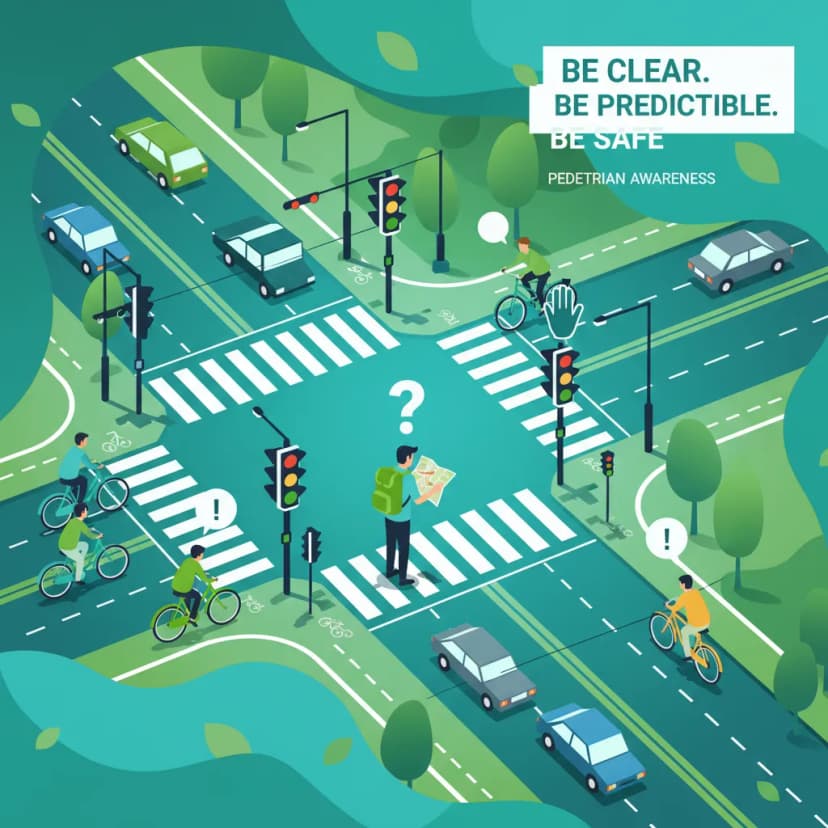
This lesson is dedicated to pedestrian safety, teaching riders to be constantly aware of people on foot, especially in busy urban environments. It reinforces the absolute duty to yield at marked crossings and encourages a cautious approach in areas like schools and shopping districts. The content stresses anticipating unpredictable actions, particularly from children or distracted pedestrians.
Explore how factors like weather, road surface, traffic density, and visibility influence the safe and legal speed for your moped. Understand the theory behind choosing a speed appropriate for the immediate driving environment in Sweden.

This lesson reinforces the core safety principle of adapting your driving to the prevailing weather conditions. You will learn why you must significantly reduce speed in heavy rain to avoid aquaplaning, how strong crosswinds can affect vehicle stability, and why reduced visibility in fog necessitates slower speeds and greater following distances. The goal is to instill a proactive approach to risk management whenever the weather is less than ideal.
This lesson teaches the crucial skill of adapting speed to prevailing conditions, emphasizing that the posted speed limit is a maximum, not a target. It covers various scenarios such as rain, fog, heavy traffic, and poor road surfaces, explaining why reducing speed is essential for maintaining vehicle control and safety. The goal is to cultivate a proactive mindset where the rider constantly assesses risk and adjusts their speed accordingly.

This lesson emphasizes that the posted speed limit is a maximum, not a target. You will learn the principles of situational speed adaptation, which involves adjusting your speed based on factors like visibility, road geometry (curves and hills), traffic density, and potential hazards. The lesson covers specific strategies for managing speed in urban environments with pedestrians, on rural roads with hidden entrances, and on motorways to match the flow of traffic.

This lesson teaches the crucial skill of adapting your speed to the dynamic and often congested conditions of urban riding. You will learn to modulate your speed smoothly in response to traffic flow, pedestrian activity, and complex intersections to maintain safety and control. Techniques covered include using engine braking effectively, anticipating the actions of other road users, and selecting a speed that maximizes your reaction time in a high-density environment.

This lesson focuses on the unique demands of managing speed in high-speed environments like motorways. You will learn techniques for maintaining a steady, appropriate speed that matches the flow of traffic, how to perform smooth overtakes, and the importance of increasing your following distance. It also covers physical factors such as managing wind blast and maintaining stability when riding near large trucks, ensuring a safe and controlled high-speed riding experience.
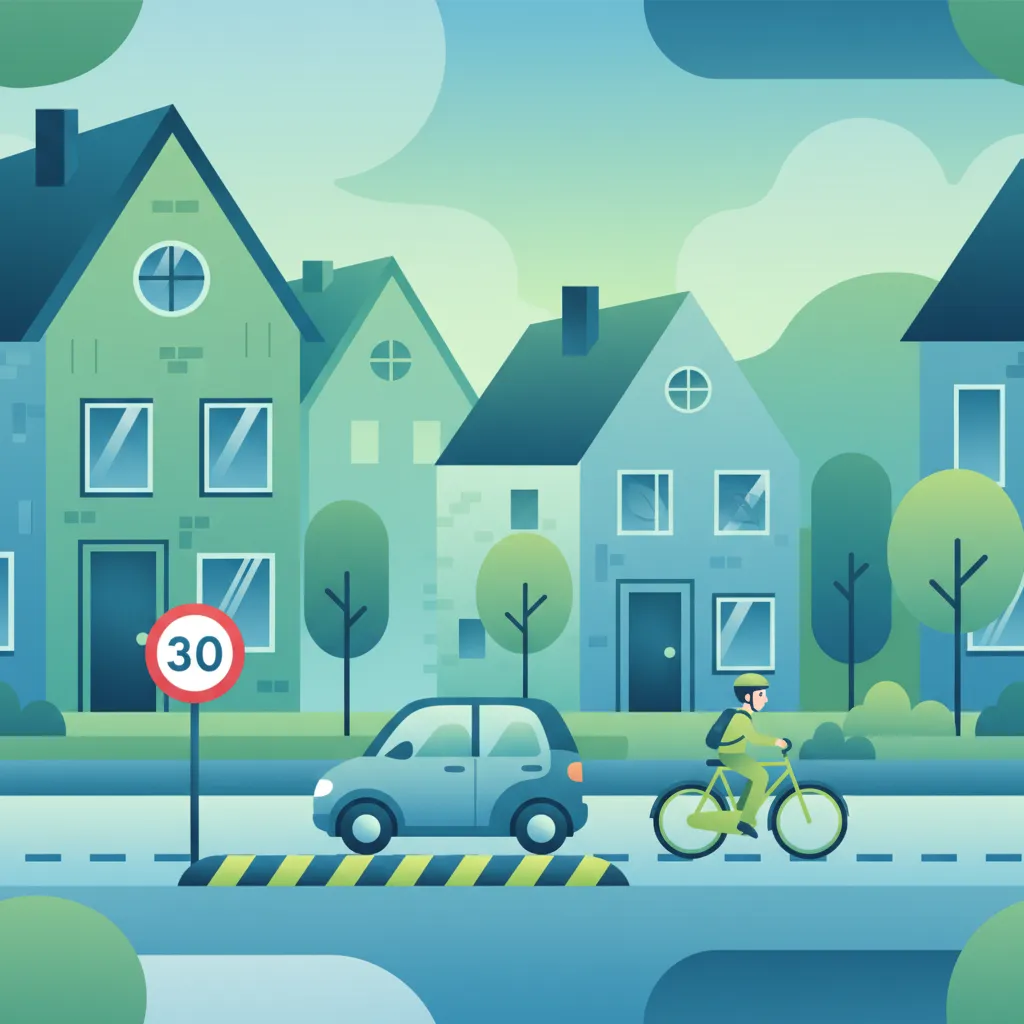
This lesson focuses on the high level of caution required when driving in residential areas. You will learn about the rules for special zones like 'gångfartsområde' (walking speed area) and the need to navigate around speed calming measures like speed bumps. The central theme is anticipating unpredictable behavior from residents, especially children, and managing the risks posed by parked cars that severely limit visibility.
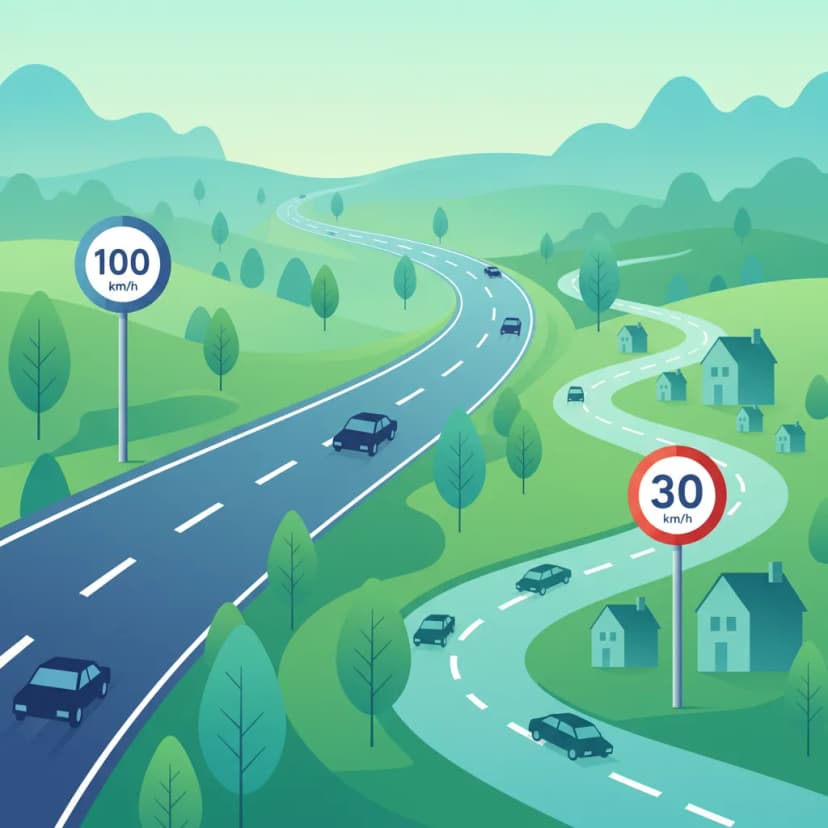
This lesson provides a comprehensive overview of the Swedish national speed limit system. You will learn the default speed limits applicable to different classes of roads, such as 50 km/h in built-up areas and 110 km/h on motorways. It also covers how to identify and comply with special zones, like residential areas (gångfartsområde), school zones, and temporary limits in construction areas, ensuring you always ride at a legal and appropriate speed.
This lesson explains the hierarchical structure of speed limits in Sweden as defined by the Trafikförordning. It covers the default 'base speeds', including 50 km/h in built-up areas and 70 km/h outside them, and how these are modified by specific road signs. You will learn to identify speed limit signs for different road types, such as motorways and residential zones, and understand the legal framework that governs maximum permissible speeds.

This lesson covers strategies for driving safely when visibility is compromised. You will learn the correct use of different lighting systems: when to use low beams, high beams (helljus), and how to avoid dazzling other drivers. The lesson also explains the specific regulations for using front and rear fog lights and provides techniques for navigating safely in dense fog or heavy precipitation by reducing speed and using the road edge as a guide.
This lesson explains the general speed limit system in Sweden, including the default limits that apply in the absence of specific signs. It covers the standard speeds for built-up areas, roads outside built-up areas, and motorways, clarifying which are relevant to moped riders. Understanding this structure enables riders to determine the correct legal speed even when signs are not immediately visible.
Find clear answers to common questions learners have about Duty of Care and Reasonable Speed. Learn how the lesson is structured, which driving theory objectives it supports, and how it fits into the overall learning path of units and curriculum progression in Sweden. These explanations help you understand key concepts, lesson flow, and exam focused study goals.
In Sweden, a 'duty of care' (vårdplikt) means you have a legal obligation to always behave in a way that does not endanger yourself or others. This requires you to be attentive, anticipate potential hazards, and take reasonable steps to prevent accidents, even if it means deviating from what others are doing.
You must always ride at a speed that is 'reasonable and prudent' (lämplig och med hänsyn till omständigheterna) for the conditions. This includes poor weather (rain, fog, snow), reduced visibility, heavy traffic, slippery roads, near pedestrian areas, or when approaching potential hazards like intersections or schools, even if the posted limit is higher.
The posted speed limit is the maximum allowed under ideal conditions. Your duty of care requires you to assess the actual conditions and reduce your speed if necessary to maintain safety. Riding at the maximum speed limit when conditions are poor is often considered negligent and can lead to penalties.
Generally, no, as long as you are not unnecessarily impeding traffic. However, if riding excessively slowly causes a hazard or significantly obstructs the flow of traffic without a good reason, it could be viewed as irresponsible conduct. The focus is always on a speed that is appropriate for the circumstances and safe for all road users.
The theory exam will present scenarios asking you to identify the safest speed or course of action. Questions often test your understanding that posted limits are not always safe, and that your duty of care and the prevailing conditions dictate the appropriate speed. Failing to select the 'reasonable and prudent' speed is a common reason for incorrect answers.