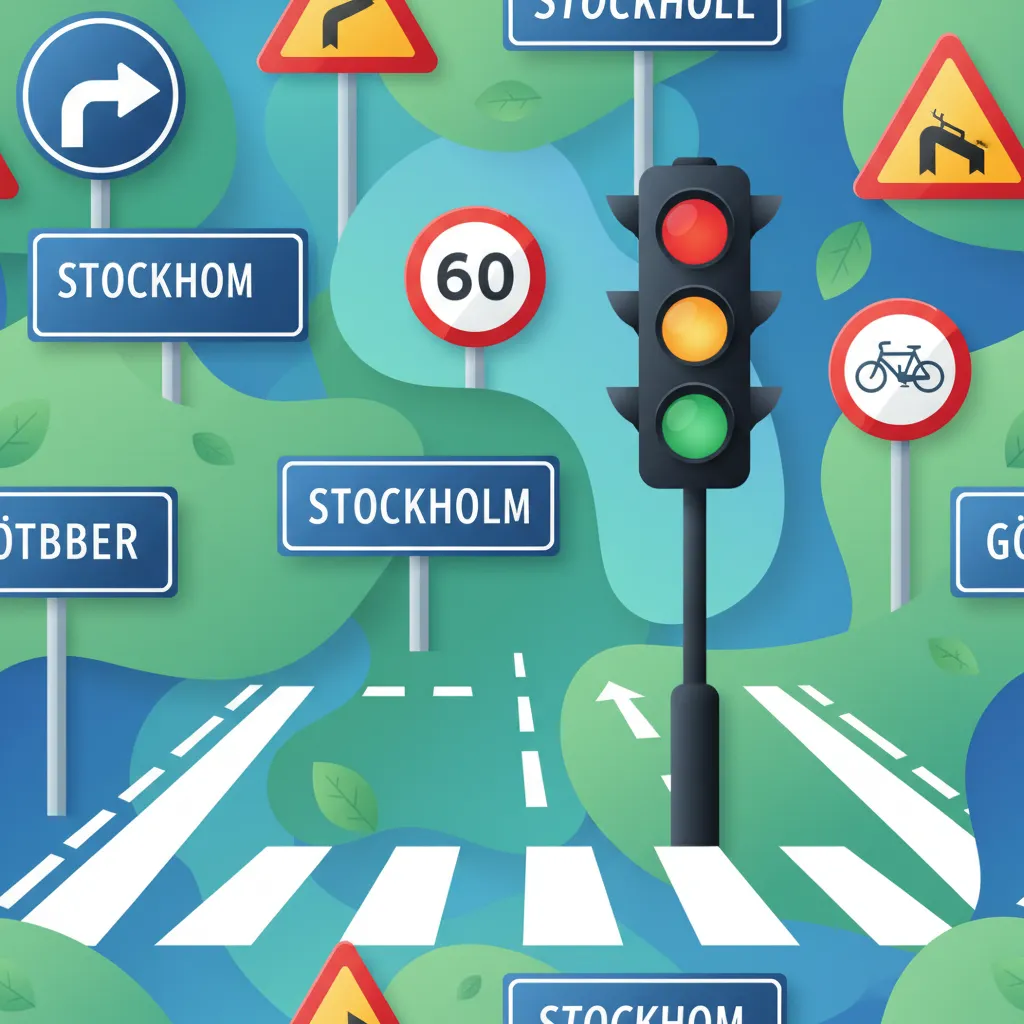
This unit provides a comprehensive guide to the visual language of Swedish roads. You'll learn to recognise and interpret every type of road sign, traffic signal, and road marking according to Trafikverket standards. Mastering these is crucial for passing your Category B theory test and ensuring safe driving on Swedish roads.
Browse all lessons that make up Road Signs and Signals. Each lesson focuses on specific topics, learning objectives, and core concepts, helping you build essential knowledge and follow a clear, structured progression toward your study goals in Sweden.
This lesson details the full range of Swedish regulatory signs, which establish legally enforceable rules for all road users. You will learn to interpret prohibitory signs (förbudsmärken) such as speed limits and no-entry signs, as well as mandatory signs (påbudsmärken) that dictate direction or lane usage. Understanding these signs is crucial as they directly regulate traffic flow, ensure safety at critical points, and carry legal consequences if ignored.
This lesson focuses on Swedish warning signs (varningsmärken), designed to alert drivers to potential dangers ahead. You will study the meaning of triangular signs indicating hazards such as sharp bends, pedestrian crossings, risk of animals on the road, or temporary road work. The objective is to develop proactive driving habits by understanding how to anticipate risks and adapt speed and positioning appropriately when a warning sign is present.
This lesson covers the extensive category of informational and directional signs that aid navigation throughout Sweden. You will learn to interpret signs for motorways, national roads, and local destinations, as well as symbols indicating services like gas stations, parking, and rest areas. Proper understanding of these signs allows for efficient route planning, reduces driver uncertainty, and contributes to smoother, safer traffic flow on all types of roads.
This lesson provides a detailed explanation of the Swedish traffic signal system. You will learn the precise legal meaning of solid red, yellow, and green lights, as well as green arrows which permit turning when oncoming traffic is stopped. It also covers procedures for flashing yellow signals and what to do when traffic lights are out of order, emphasizing that standard priority rules like the right-hand rule then apply.
This lesson explains the function and legal significance of various road markings (vägmarkeringar) in Sweden. You will learn the difference between broken lines that permit overtaking and solid lines that forbid it, as well as the meaning of stop lines, pedestrian crossings, and lane direction arrows. These markings work in conjunction with signs to organize traffic flow, separate lanes, and provide critical information directly on the road surface.
Explore high-intent keywords and long-tail search topics learners use when researching Road Signs and Signals. These terms reflect how people search for reliable study materials, structured explanations, and unit-level theory preparation support in Sweden.
Find clear answers to the most common questions learners ask about Road Signs and Signals. Understand how the unit is organized, what learning goals it supports, and how it contributes to your study progression with structured explanations and practical guidance tailored for learners in Sweden.
Warning signs (Varningstecken) alert you to potential hazards ahead, such as sharp bends or pedestrian crossings, requiring you to be cautious. Regulatory signs (Förbud & Påbud) impose direct obligations or prohibitions, like speed limits or no entry, which you must legally follow. Understanding this distinction is vital for correct responses in traffic and on the theory test.
Yes, temporary signs, often orange or yellow, indicate temporary situations like roadworks or diversions. They temporarily override permanent signs where indicated and require increased vigilance. You must always obey temporary signage for safety and compliance.
Road markings, such as lane lines, give-way lines, and stop lines, reinforce the instructions of traffic signs and traffic signals. For instance, a stop sign is usually accompanied by a stop line on the road. Understanding both together ensures you comply with the full set of traffic rules at any given point.
Common errors include confusing similar-looking signs, not understanding the implications of different colours and shapes, and failing to recognise temporary or less common signs. Misinterpreting signs is a frequent cause of incorrect answers on the theory test and can lead to dangerous driving.
While the exam uses Swedish terminology, the focus is on your understanding of the sign's meaning and its implication for driving. Knowing the official Swedish names (e.g., 'Varning för djur i trafik' for 'Warning for animals in traffic') can aid comprehension, but correctly applying the rule is paramount.
Traffic signals are extremely important. You must know the meaning of all lights (red, yellow, green, flashing lights) and how they apply to different vehicle types and situations, including pedestrian and cyclist signals. Understanding signal sequences and priority is a key part of the exam.
All included lessons
Lessons in Road Signs and Signals
See who benefits most from studying Road Signs and Signals. This overview explains how the unit supports different learning needs, what level of knowledge is helpful before starting, and how it fits into the overall study path in Sweden.
This unit is essential for all learner drivers preparing for the Swedish Category B driving theory test. It is particularly beneficial for beginners who need a foundational understanding of road signs and signals, as well as for anyone needing a refresher on Swedish road marking interpretations for exam success.

See how Swedish Driving Theory B is structured, with key topics, learning objectives, and a step-by-step path for theory preparation in Sweden.
Explore all units and lessons included in this driving theory course.