
Welcome to the 'Speed Management on Motorways and High-Speed Roads' lesson, part of your Swedish Motorcycle Theory Course. This lesson focuses on the specific challenges and rules for riding at higher speeds, building on your understanding of general speed limits and motorcycle dynamics. Mastering these techniques is crucial for passing your Category A theory exam and ensuring safety on Sweden's fastest roads.

Navigating Swedish motorways (Europavägar) and other high-speed roads such as motortrafikleder on a motorcycle demands exceptional speed management skills. These environments present unique challenges where the consequences of errors are significantly amplified due to higher speeds. This lesson delves into the essential techniques, physical principles, and legal requirements for safely managing your speed, maintaining control, and reacting effectively in high-speed scenarios. Mastery of these concepts is crucial for reducing crash risk and is a fundamental component of the Swedish Category A motorcycle theory exam.
Adhering to legal speed limits is the cornerstone of safe speed management. Swedish law, primarily the Road Traffic Act (Trafikförordningen), sets clear guidelines for maximum permissible speeds, which are designed to align with road design and ensure public safety. For motorcyclists, understanding and respecting these limits is not just a legal obligation but a critical safety measure.
Motorways in Sweden, identified by specific blue signs, generally have a default maximum speed limit. However, this limit can vary depending on the specific section of the road and local conditions.
Always assume the lowest posted speed limit when multiple signs are present or if there is any ambiguity. The most restrictive limit takes precedence.
Modern motorways in Sweden increasingly utilise Variable Speed Limits (VSL). These electronic signs dynamically adjust speed limits based on real-time conditions such as traffic density, weather, or incidents (e.g., accidents, roadworks).
Swedish traffic law (Trafikförordningen 3 kap. 1 §) explicitly states that no vehicle shall exceed the speed limit indicated by signs or statutory limits. Beyond the immediate legal penalties, exceeding speed limits, especially on high-speed roads, carries severe safety implications. It dramatically increases kinetic energy, reduces the time available for perception and reaction, and extends stopping distances, making collisions more likely and more severe.
Managing speed on motorways involves more than just observing signs; it requires a deep understanding of the physics that govern motorcycle dynamics at high velocity. The interplay of kinetic energy, reaction time, and aerodynamic forces dictates how a motorcycle behaves and how a rider must respond.
Kinetic energy (KE) is the energy an object possesses due to its motion. It is calculated by the formula KE = ½ mv², where 'm' is mass and 'v' is velocity (speed). This quadratic relationship means that even small increases in speed result in disproportionately large increases in kinetic energy.
Every driver has a perception-reaction time – the interval between identifying a hazard and initiating a response (e.g., applying brakes). For an experienced rider, this typically ranges from 1 to 1.5 seconds. At high speeds, a motorcycle covers a substantial distance during this short interval.
To estimate your total stopping distance on dry asphalt, a common rule of thumb is to take your speed in km/h, drop the zero, multiply the first digit by itself (reaction distance), and then multiply it by itself again (braking distance). For example, at 100 km/h: (103) + (105) = 30m + 50m = 80m. At 120 km/h, it would be even longer. However, use the precise calculation for exam questions.
At motorway speeds, air resistance and aerodynamic forces become significant factors, especially for motorcycles.
Effective speed management on motorways is an active process that involves continuous assessment and adaptation. It integrates legal limits with dynamic conditions, ensuring both safety and smooth traffic flow.
While legal speed limits define the maximum permissible speed, the safest speed often matches the prevailing flow of traffic. This doesn't mean exceeding the limit if traffic is fast, but rather choosing a speed that minimises unnecessary acceleration, deceleration, and lane changes.
The 2-second rule is a fundamental principle for maintaining a safe following distance in normal conditions. However, on high-speed roads, especially when following large vehicles, this gap needs to be extended.
Proper gear selection is crucial for smooth, efficient, and safe speed management on a motorcycle, particularly at high speeds. It affects throttle response, engine braking capability, and fuel efficiency.
Overtaking on a motorway requires careful planning and execution to ensure safety and maintain traffic flow.
Check Mirrors & Blind Spots: Verify the left lane is clear for your manoeuvre.
Signal Left: Activate your turn signal well in advance to alert others.
Select Gear & Accelerate: Choose a gear that allows smooth, controlled acceleration to pass the slower vehicle within the speed limit.
Enter Overtaking Lane: Move smoothly into the left lane.
Pass Safely: Maintain sufficient lateral distance from the vehicle you are passing.
Ensure Clearance: Wait until you can see the overtaken vehicle clearly in your right mirror.
Signal Right: Activate your right turn signal.
Return to Lane: Move smoothly back into the right lane.
Cancel Signal: Turn off your turn signal and adjust your speed and following distance.
Motorways are not always flat. Uphills and downhills significantly impact a motorcycle's energy state and require anticipatory speed management.
The aerodynamic effects of large vehicles, particularly heavy goods vehicles (HGVs) or trucks, pose specific challenges for motorcyclists on high-speed roads. These effects are amplified by speed and can lead to sudden instability if not managed correctly.
Safe speed management is not static; it constantly adapts to prevailing conditions. Weather, visibility, the specific road type, and even the state of your vehicle all demand adjustments to your speed and riding technique.
The state of your motorcycle and any load it carries directly impacts its handling and your required speed management.
Understanding common errors is as important as learning correct procedures. Here are some frequent violations and risky behaviours related to speed management on motorways, along with the correct approaches.
Exceeding the Speed Limit While Overtaking:
Insufficient Following Distance Behind a Truck:
Ignoring Variable Speed Limit (VSL) Signs:
Overtaking from the Right Lane:
Riding in a Truck's Turbulent Wake Zone:
Continuous Front Brake Use on Downhill Stretches:
Accelerating into a Visible Traffic Jam:
Neglecting to Signal Lane Changes:
Here's a summary of the most pertinent regulations from the Swedish Traffic Ordinance (Trafikförordningen) concerning speed management on motorways:
Effective speed management is a dynamic skill refined through practice and continuous learning. This lesson builds upon foundational knowledge and sets the stage for advanced techniques.
Lesson content overview
Explore all units and lessons included in this driving theory course.
Explore search topics learners often look for when studying Speed Management on Motorways and High-Speed Roads. These topics reflect common questions about road rules, driving situations, safety guidance, and lesson level theory preparation for learners in Sweden.
Browse additional driving theory lessons that cover connected traffic rules, road signs, and common driving situations related to this topic. Improve your understanding of how different rules interact across everyday traffic scenarios.
Understand the specific rules and safe techniques for overtaking other vehicles on Swedish motorways and high-speed roads. This lesson covers managing speed differentials, maintaining adequate following distance, and safely merging back into traffic after an overtake.
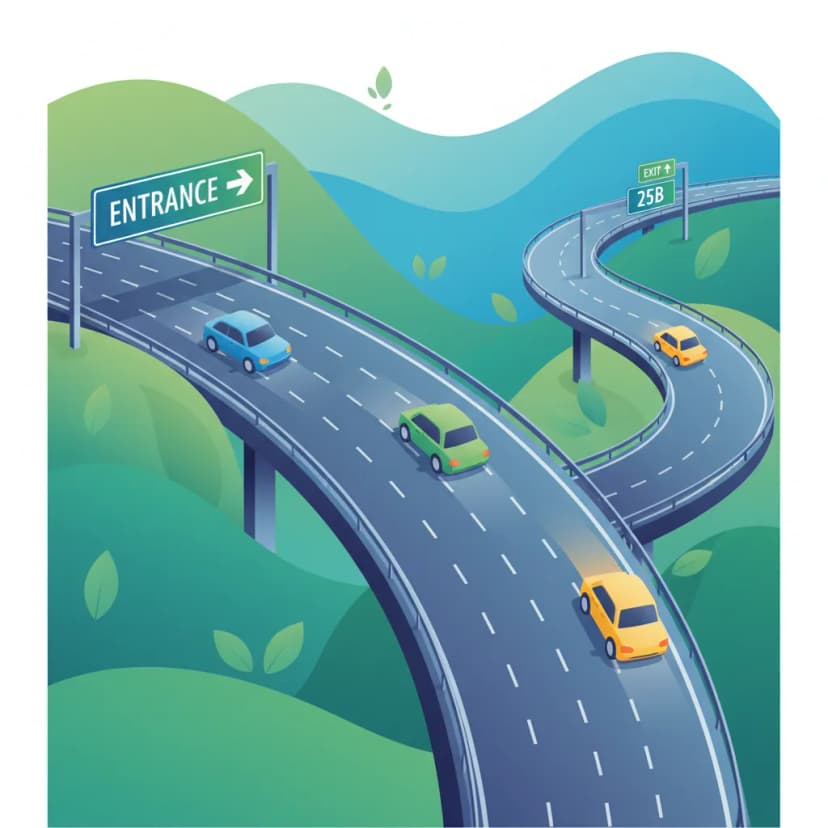
This lesson provides a step-by-step guide to motorway riding. You will learn the correct technique for accelerating on an on-ramp and merging smoothly into high-speed traffic. The content also covers maintaining proper lane discipline, executing safe overtakes, keeping a safe following distance at speed, and planning for your exit well in advance to ensure a smooth and stress-free experience on Sweden's fastest roads.
This lesson covers the critical maneuvers of overtaking and merging, which require precise judgment and communication. You will learn how to assess traffic speed and gaps, the importance of checking blind spots, and the correct use of signals to indicate your intentions. The content includes procedures for merging onto motorways from an on-ramp and how to perform safe overtaking maneuvers on various types of roads, minimizing risk to yourself and others.
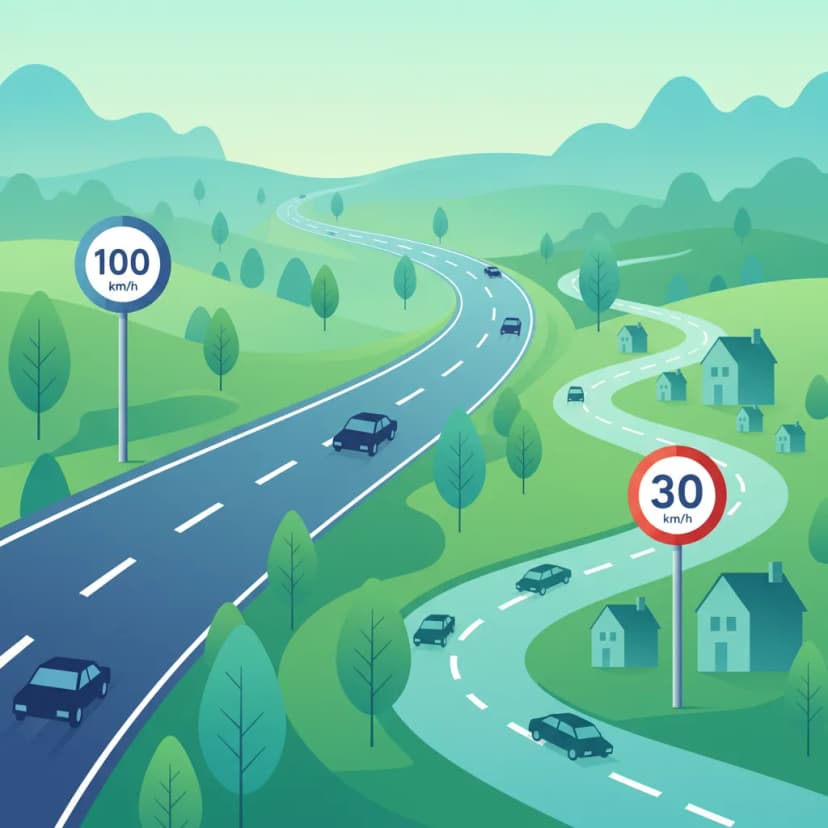
This lesson provides a comprehensive overview of the Swedish national speed limit system. You will learn the default speed limits applicable to different classes of roads, such as 50 km/h in built-up areas and 110 km/h on motorways. It also covers how to identify and comply with special zones, like residential areas (gångfartsområde), school zones, and temporary limits in construction areas, ensuring you always ride at a legal and appropriate speed.

This lesson provides a complete guide to motorway driving in Sweden. You will learn the correct procedures for merging from an on-ramp, maintaining proper lane discipline by keeping right unless overtaking, and exiting safely via off-ramps. The content emphasizes the importance of maintaining large safety margins at high speeds, checking blind spots thoroughly before any lane change, and knowing the correct safety procedures in case of a breakdown.

This lesson focuses on the variety of road markings used on Swedish roads and their meaning for motorcyclists. You will learn the difference between solid and broken lines regarding overtaking, how to position yourself correctly at intersections based on markings, and how to interpret symbols painted on the road surface. Adhering to these markings is essential for maintaining correct lane discipline and ensuring predictability for other road users.
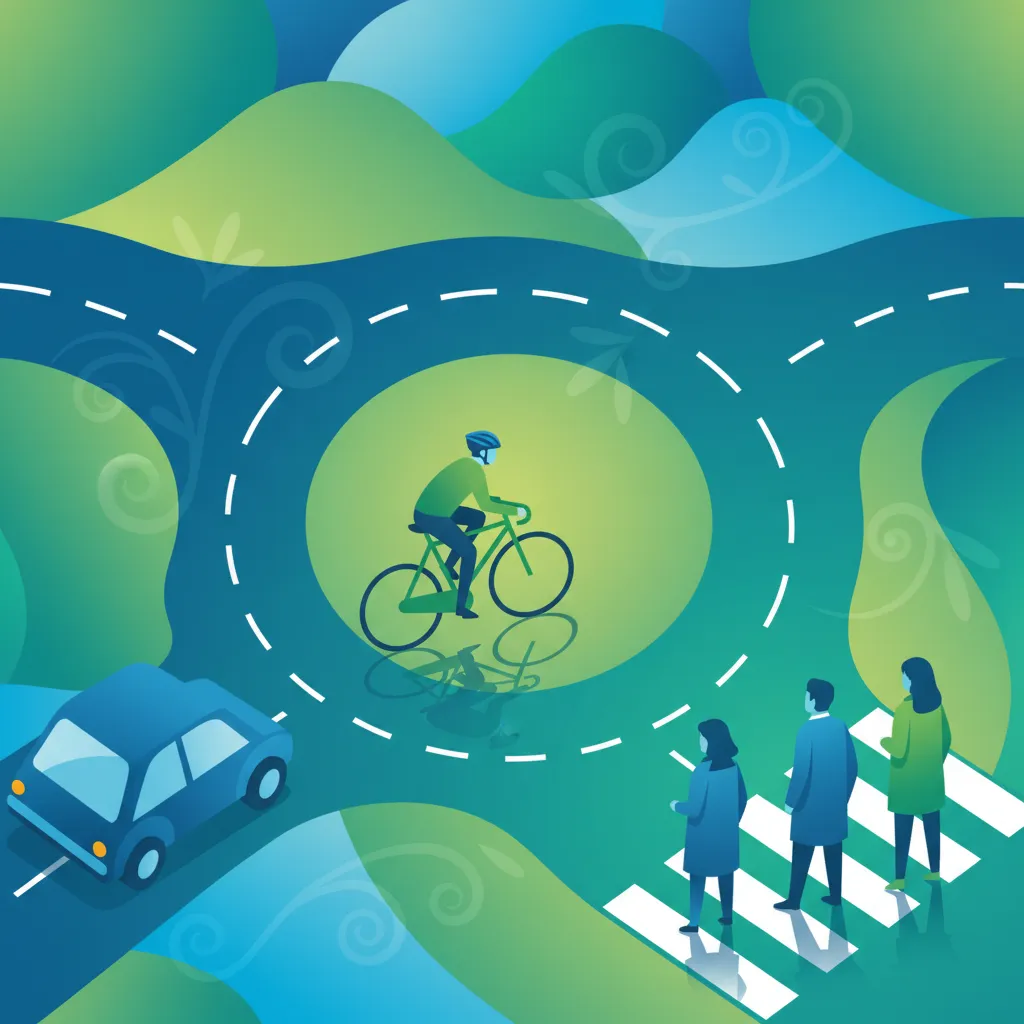
This lesson provides detailed guidance on navigating complex traffic points such as signalized intersections, multi-lane roundabouts, and pedestrian crossings. You will learn the correct procedures for entering and exiting roundabouts, the specific rules for yielding to pedestrians and cyclists at designated crossings, and how to interpret complex traffic light signals. These skills are vital for safe urban and suburban riding, where interaction with vulnerable road users is frequent.

This lesson delves into the physics of stopping a motorcycle, explaining the components of total stopping distance: perception time, reaction time, and braking distance. You will learn practical methods like the 'two-second rule' to maintain a safe following distance and how to adjust this buffer for adverse weather and high speeds. Understanding these concepts is fundamental to avoiding rear-end collisions and having enough space to react to any hazard.

This lesson explains the two core principles of priority in Swedish traffic law: the right-hand rule (Högerregeln) and the duty to yield (Väjningsplikt). You will learn how to apply the right-hand rule at uncontrolled intersections and when to yield to other traffic as indicated by signs or road markings. Understanding this fundamental hierarchy is crucial for making correct and safe decisions in a wide variety of common traffic situations you will face as a motorcyclist.

This lesson teaches the crucial skill of adapting your speed to the dynamic and often congested conditions of urban riding. You will learn to modulate your speed smoothly in response to traffic flow, pedestrian activity, and complex intersections to maintain safety and control. Techniques covered include using engine braking effectively, anticipating the actions of other road users, and selecting a speed that maximizes your reaction time in a high-density environment.

This lesson informs you about the various technologies and methods used for speed enforcement in Sweden, such as fixed and mobile speed cameras and police radar. You will understand the legal framework for speed monitoring and the corresponding penalties for violations, including fines (böter) and the potential for license suspension. This knowledge reinforces the importance of constant speed awareness and adherence to posted limits to ensure both safety and legal compliance.
Learn how to safely manage your speed and position within the dynamic flow of motorway traffic in Sweden. This lesson focuses on interacting with large vehicles like trucks, managing wind blast, and maintaining stability for a secure high-speed riding experience.
This lesson provides a step-by-step guide to motorway riding. You will learn the correct technique for accelerating on an on-ramp and merging smoothly into high-speed traffic. The content also covers maintaining proper lane discipline, executing safe overtakes, keeping a safe following distance at speed, and planning for your exit well in advance to ensure a smooth and stress-free experience on Sweden's fastest roads.

This lesson focuses on the specific techniques required for riding in busy city and town environments. You will learn how to maintain correct lane positioning amidst dense traffic, navigate complex intersections with multiple signals, and manage the motorcycle at low speeds in stop-and-go conditions. Emphasis is placed on heightened awareness of pedestrians, cyclists, and vehicles making sudden maneuvers, which are common hazards in urban settings.
This lesson focuses on the variety of road markings used on Swedish roads and their meaning for motorcyclists. You will learn the difference between solid and broken lines regarding overtaking, how to position yourself correctly at intersections based on markings, and how to interpret symbols painted on the road surface. Adhering to these markings is essential for maintaining correct lane discipline and ensuring predictability for other road users.
This lesson provides detailed guidance on navigating complex traffic points such as signalized intersections, multi-lane roundabouts, and pedestrian crossings. You will learn the correct procedures for entering and exiting roundabouts, the specific rules for yielding to pedestrians and cyclists at designated crossings, and how to interpret complex traffic light signals. These skills are vital for safe urban and suburban riding, where interaction with vulnerable road users is frequent.

This lesson provides in-depth analysis of how to safely interact with the full spectrum of road users. You will learn about the specific characteristics of each, such as the large blind spots of trucks, the potential for sudden movements from cyclists, and the unpredictability of pedestrians. The content teaches strategies for communication, anticipation, and defensive positioning to ensure safe and respectful coexistence on the road for everyone.
This lesson covers the critical maneuvers of overtaking and merging, which require precise judgment and communication. You will learn how to assess traffic speed and gaps, the importance of checking blind spots, and the correct use of signals to indicate your intentions. The content includes procedures for merging onto motorways from an on-ramp and how to perform safe overtaking maneuvers on various types of roads, minimizing risk to yourself and others.

This lesson tackles the challenge of navigating some of the most complex road features, such as large multi-lane roundabouts and grade-separated interchanges. You will learn the importance of advance planning, choosing the correct lane on approach, clear signaling, and comprehensive observation to safely move through these busy areas. Mastering these junctions is a key indicator of an advanced and competent rider who can handle any road layout.

This lesson provides clear guidance on selecting the appropriate lane on multi-lane roads to match your intended direction of travel. It covers the rules and best practices for moving into turning lanes, positioning for overtakes, and maintaining a steady course. The focus is on making early, predictable decisions to ensure smooth integration with surrounding traffic.

This lesson provides practical techniques for dealing with unavoidable road surface hazards. You will learn how to approach and cross obstacles like potholes, manhole covers, and patches of debris with minimal disruption to the motorcycle's stability. The content covers adjusting your speed, choosing the best line, and using your body to absorb impacts, helping you navigate the imperfections of real-world roads safely.

This lesson focuses on strategies to make yourself more visible to other road users, a critical factor in motorcycle safety. You will learn how to use lane positioning strategically to stay out of other drivers' blind spots and to maximize your own line of sight through corners and intersections. The content also covers the effectiveness of high-visibility and reflective clothing, as well as the correct use of lights to ensure you are seen in all conditions.
Find clear answers to common questions learners have about Speed Management on Motorways and High-Speed Roads. Learn how the lesson is structured, which driving theory objectives it supports, and how it fits into the overall learning path of units and curriculum progression in Sweden. These explanations help you understand key concepts, lesson flow, and exam focused study goals.
On motorways and high-speed roads in Sweden, a safe following distance is crucial. For motorcycles, we generally recommend at least a three-second rule, but it's often wise to extend this to four seconds when riding at high speeds or when following larger vehicles like trucks. This provides extra reaction time for unexpected braking or hazards.
When overtaking on a Swedish motorway, first check your mirrors and blind spots. Signal your intention to move into the passing lane. Accelerate smoothly and pass the vehicle clearly, ensuring you maintain a safe distance. Move back into your original lane once you have sufficient space ahead, checking your mirrors again before completing the manoeuvre. Always be aware of other traffic, especially faster vehicles approaching from behind.
Key risks include managing high speeds, which increases braking distances and impact severity. Wind blast from passing vehicles, particularly large trucks, can affect stability. Maintaining adequate following distances is vital due to the speed of traffic. Reduced visibility in adverse weather or at night also poses a significant danger.
Strong winds, especially crosswinds or turbulence from passing vehicles, can significantly affect a motorcycle's stability. You may need to make constant, subtle steering adjustments to stay on course. Be prepared for sudden gusts and maintain a firm but relaxed grip on the handlebars. Riding further into the lane or adjusting your position can help mitigate some wind effects.
In Sweden, the general speed limit on motorways is typically 110 km/h, and 120 km/h on certain sections. While there isn't a separate general limit for motorcycles, it's essential to ride at a speed appropriate for the conditions, traffic flow, and your own capabilities. Always adhere to posted signs, which may indicate lower limits or specific zones.