Lesson 5 of the Winter and Adverse Weather Driving unit
Swedish Driving Theory B: Weather-Related Speed Adjustment
Welcome to this lesson on Weather-Related Speed Adjustment, part of the Speed Limits and Distance Management unit for the Swedish Category B driving licence. Understanding how to adapt your speed to changing weather conditions is critical for safe driving in Sweden and a key topic on the theory test. This lesson will guide you through the specific risks and required actions when driving in rain, fog, or strong winds.
Adapting Driving Speed to Weather Conditions: A Guide for Swedish Drivers
Driving is a complex task that demands constant vigilance and adaptation. While posted speed limits provide a general guideline, they are established for ideal driving conditions. In reality, weather can dramatically alter the safety parameters of the road, necessitating a proactive adjustment of your driving speed. This lesson, part of your Swedish Driving License Theory Course for Category B Cars, will equip you with the essential knowledge and principles to drive safely and legally in rain, fog, snow, ice, and strong winds.
Failure to adjust speed to prevailing weather is a leading cause of traffic accidents in Sweden, particularly on motorways and rural roads where conditions can deteriorate rapidly and unexpectedly. Understanding the physics of vehicle control, the nuances of driver perception, and your legal obligations under the Trafikförordning (Swedish Traffic Regulations) is paramount to becoming a safe and responsible driver.
Core Principles of Weather-Related Speed Adjustment
At the heart of safe driving in adverse weather lies a set of fundamental principles that guide every decision behind the wheel. These principles are rooted in physics, human psychology, and Swedish law, ensuring you maintain control and can react appropriately to hazards.
The Speed Adaptation Principle
This principle mandates that a driver must continuously adjust their vehicle's speed to the actual road, weather, and visibility conditions, irrespective of any posted maximum speed limits. Its purpose is to ensure you can always stop within your visible range and maintain full control of your vehicle. This implies that reducing your speed below the legal maximum is often necessary when road surface grip or visibility is compromised.
The Stopping Distance Principle
The total distance required to bring a vehicle to a complete halt is the sum of your perception-reaction distance (the distance traveled from when you perceive a hazard to when you apply the brakes) and your braking distance (the distance traveled from when brakes are applied until the vehicle stops). Both of these distances increase significantly with reduced friction on the road surface and poorer visibility. This principle quantifies the safety margin you need under varying conditions, compelling drivers to increase following distance and/or lower speed when the coefficient of friction (grip) between tires and road decreases.
The Traction Loss Principle
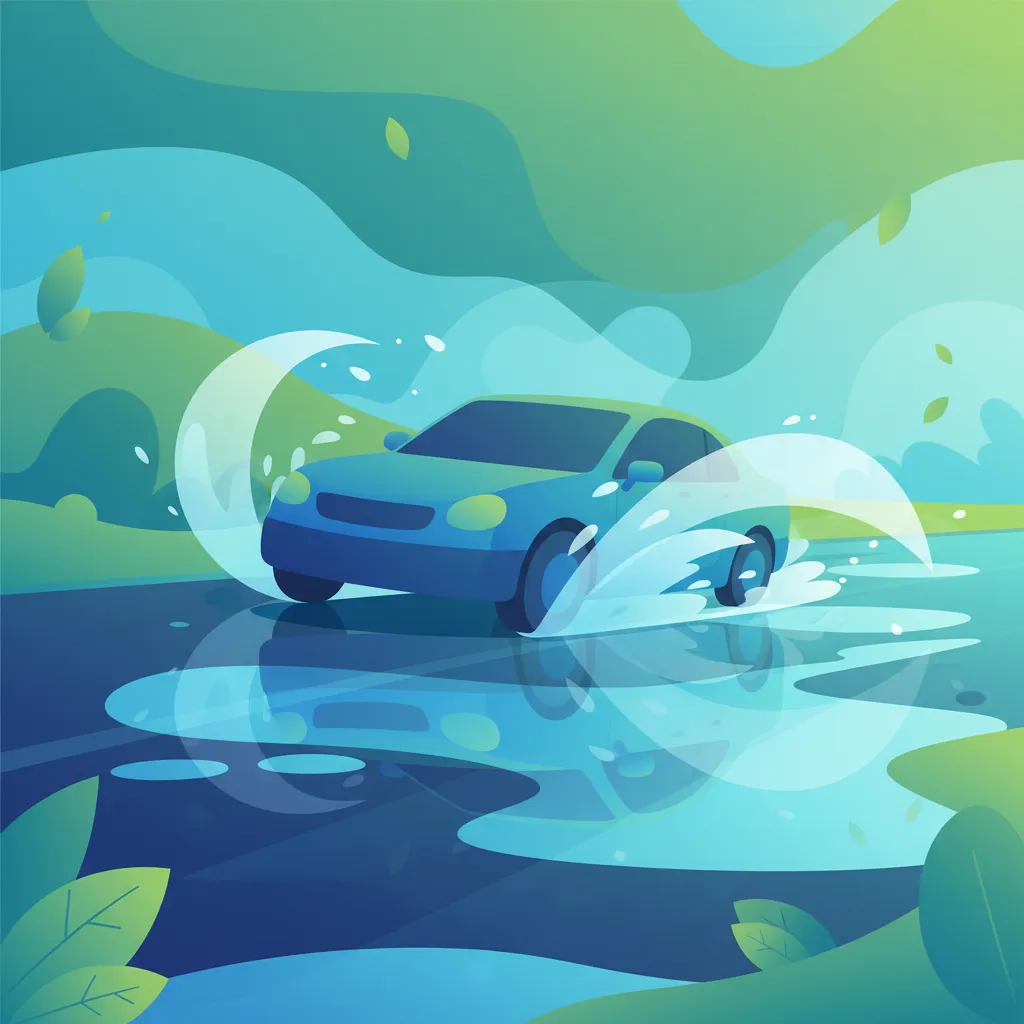
This principle highlights the physical limits of tire grip. When a layer of water, snow, or ice on the road surface exceeds the tire’s ability to displace it, the tire may lift and ride on a thin film, leading to a complete loss of grip. This phenomenon is commonly known as aquaplaning (on water) or skidding (on snow/ice). Understanding this limit is crucial because exceeding a critical speed can lead to an irreversible loss of control. Speed must be reduced to prevent the build-up of hydraulic pressure under the tires, allowing them to maintain contact with the road.
The Cross-Wind Stability Principle
Strong winds, especially those blowing perpendicular to your direction of travel (cross-winds), generate lateral aerodynamic forces on your vehicle. These forces can create a yaw moment, pushing your vehicle sideways and potentially causing it to drift out of its lane. This principle addresses vehicle dynamics in open, exposed sections of road, such as bridges, coastal routes, or open fields. Lowering your speed significantly reduces the impact of these lateral forces, with larger or high-profile vehicles requiring even greater speed reductions.
The Visibility-Based Speed Principle
Your driving speed must always allow you to stop safely within the distance you can see clearly ahead. This is critical for identifying potential road hazards such as stopped vehicles, sharp curves, or pedestrians. In conditions like dense fog or heavy rain, your visible distance might drop to less than 30 metres. The principle dictates that your speed must be reduced proportionally to ensure that your total stopping distance (including reaction time) never exceeds what you can actually see. This directly aligns your kinetic capability with your perceptual limits.
The Legal Compliance Principle
Swedish traffic regulations, particularly Trafikförordning §§ 4, 14, 19, and 23, explicitly oblige drivers to adapt their speed to road conditions and to use appropriate lighting. This principle codifies the driver’s fundamental duty of care. Non-compliance is not merely a safety risk but a punishable offence, carrying administrative penalties and demerit points on your license.
The Physics of Grip: Coefficient of Friction and Stopping Distance
Understanding how weather impacts the friction between your tires and the road surface is fundamental to safe speed adjustment.
Definition
Coefficient of Friction (μ)
The ratio of the frictional force resisting motion to the normal force pressing the tire onto the road surface. A higher coefficient means more grip.
On a dry asphalt road, the coefficient of friction (μ) typically ranges from 0.7 to 0.9. This allows for excellent grip and relatively short stopping distances. However, adverse weather conditions drastically reduce this crucial factor:
Wet Roads: Water acts as a lubricant, reducing μ to approximately 0.4 to 0.6. This can increase your braking distance by up to 70% compared to dry conditions.
Snow-Covered Roads: On packed snow, μ can drop further, often between 0.2 and 0.4, even with winter tires. Braking distances will be significantly longer.
Icy Roads (including Black Ice): This is the most dangerous condition, with μ plummeting to as low as 0.1 to 0.2. On black ice, your braking distance can be extended by a factor of 5 to 10.
The stopping distance is the critical metric. It's not just about how quickly your brakes can slow the car, but also about how quickly you can perceive a hazard and react.
Perception-reaction distance: This is the distance your vehicle travels during the time it takes you to see a hazard, process the information, decide to brake, and move your foot to the brake pedal. For an alert driver, this typically takes 1 to 1.5 seconds. At 100 km/h (approximately 27.8 m/s), you will travel about 28 to 42 metres before even beginning to brake.
Braking distance: This is the distance your vehicle travels from the moment you apply the brakes until it comes to a complete stop. As μ decreases, this distance extends dramatically.
Therefore, when the road is wet, snowy, or icy, both parts of the stopping distance equation lengthen, demanding a substantial reduction in speed to maintain a safe margin.
Navigating Specific Weather Challenges
Each type of adverse weather presents unique challenges and requires specific adjustments to your driving strategy.
Driving in Heavy Rain and Preventing Aquaplaning
Heavy rain significantly reduces road visibility and, more critically, the available traction. Standing water on the road surface poses the risk of aquaplaning, also known as hydroplaning.
Definition
Aquaplaning (Hydroplaning)
A dangerous condition where a film of water builds up between the vehicle's tires and the road surface, causing the tires to lose contact with the road and the vehicle to glide on the water.
Aquaplaning can occur even on seemingly shallow water at higher speeds. It's often categorized into:
Dynamic aquaplaning: Occurs at higher speeds on smooth, wet surfaces where the tire cannot displace water quickly enough.
Static aquaplaning: Can happen at lower speeds if there's significant standing water and/or your tire pressure is too low, or tread depth is insufficient.
When aquaplaning, your vehicle may feel "floating" or light, steering response will diminish, and braking becomes largely ineffective. Counterintuitively, driving faster does not prevent aquaplaning; it significantly increases the risk by making it harder for tires to push water aside.
To prevent aquaplaning:
Reduce speed: This is the most crucial step. A 25-35% speed reduction in heavy rain is often necessary.
Maintain good tire tread depth: Deeper treads are more effective at channelling water away from the tire's contact patch.
Ensure correct tire pressure: Properly inflated tires maintain their shape and efficiently disperse water.
Avoid sudden movements: Gentle steering and braking are essential.
Increase following distance: Give yourself more time to react.
The Trafikförordning § 4 explicitly states that drivers must adapt their speed to road conditions, making mandatory speed reduction in heavy rain a legal obligation.
Driving Safely in Fog and Low Visibility
Fog, caused by suspended water droplets, dramatically reduces visibility and contrast, making it difficult to identify objects and gauge distances.
Definition
Fog Visibility
The meteorological condition where suspended water droplets reduce contrast and limit the distance a driver can clearly identify objects, often to less than 30 metres.
In dense fog, your perception-reaction distance becomes the dominant factor. Your speed must be so low that you can safely stop within the distance you can see ahead. If you can only see 30 metres, your stopping distance (including reaction time) must be less than 30 metres. This often means reducing your speed to 20-40 km/h, even if the posted limit is higher.
Proper Headlight Usage in Fog:
Using the correct lighting is vital for both seeing and being seen:
Dipped Beam (Low Beam): Always use your dipped beam headlights when visibility is reduced (Trafikförordning § 23 (1)). These lights are designed to illuminate the road without causing glare that reflects off the fog droplets.
Front Fog Lights: If your vehicle is equipped with front fog lights, they may be used when visibility is less than 100 metres (Trafikförordning § 23 (2)). These are mounted low and provide a wide, flat beam that penetrates better under the fog without causing glare.
Rear Fog Light: This is a single, high-intensity red light at the rear of your vehicle. It should only be used when visibility is less than 50 metres and you are moving cautiously (Trafikförordning § 23 (3)). It is designed to make your vehicle visible to following traffic in extremely poor conditions. Do not use it in light fog or clear conditions, as it can be dazzling and confusing to other drivers.
Warning
Avoid using high-beam headlights in fog. They reflect off the water droplets, creating severe glare that significantly worsens your perception of the road ahead, making it harder to see.
Dealing with Strong Cross-Winds
Strong cross-winds, typically exceeding 30 km/h, exert lateral aerodynamic forces on your vehicle, pushing it sideways. This effect is particularly pronounced on high-profile vehicles such as vans, trucks, and cars with roof loads, and in exposed areas like bridges, coastal roads, and open highways.
Definition
Cross-Wind
Wind blowing perpendicular (at a right angle) to the vehicle's direction of travel, generating lateral aerodynamic forces that can affect vehicle stability.
Cross-winds can cause your vehicle to yaw (rotate around its vertical axis) and drift out of its lane. This requires constant, often subtle, steering corrections. Sudden gusts, or the "jet-stream effect" when exiting a sheltered area onto an open bridge, can be particularly dangerous.
While there isn't an explicit Swedish regulation specifically for cross-winds, the general duty under Trafikförordning § 4 to adapt speed to conditions applies.
To mitigate cross-wind effects:
Reduce speed: Lowering your speed significantly reduces the lateral force (which is proportional to the square of your speed). A 20% speed reduction can reduce the force by about 36%.
Maintain firm but relaxed grip on the steering wheel: Be prepared for sudden pushes.
Keep a wide lane position: Give yourself more room for lateral movement.
Avoid sudden steering inputs: Overcorrecting can worsen the situation.
Be especially cautious on bridges and elevated roads: These are notorious for strong winds.
Disable cruise control: You need direct, immediate control over your speed.
Mastering Snow, Ice, and Black Ice Conditions
Driving on snow and ice is arguably the most challenging of all weather conditions, primarily due to the dramatic reduction in the coefficient of friction.
Definition
Black Ice
A thin, nearly invisible layer of ice that forms on the road surface, often after thaw-freeze cycles or in shaded areas, making the road appear merely wet.
Black ice is particularly insidious because it is difficult to spot. It commonly forms on bridges, overpasses, and shaded sections of the road, as these areas cool down faster than the surrounding surfaces. The coefficient of friction on black ice can drop to an astonishing 0.1-0.2, making stopping distances extremely long and control precarious.
Driving safely on snow and ice:
Drastically reduce speed: This is non-negotiable. Even with winter tires, speeds of 30 km/h in urban areas or 50 km/h on motorways (unless lower limits are posted) might be necessary.
Increase following distance significantly: Aim for at least a six-second gap.
Use gentle controls: Accelerate, brake, and steer very smoothly to avoid breaking traction. Engine braking can be very effective here.
Proper tire equipment: In Sweden, winter tires (marked with "M+S" and the 3-peak mountain snowflake symbol) are mandatory from 1 December to 31 March if winter road conditions prevail (Trafikförordning § 23 (4)). Chains may be required on certain mountain roads, indicated by signage.
Be aware of ABS limitations: The Anti-Lock Braking System (ABS) prevents your wheels from locking, allowing you to steer during emergency braking. However, ABS does not shorten your stopping distance on icy surfaces; it only helps maintain steering control.
Scan far ahead: Look for signs of ice such as glittering surfaces, particularly on bridges and in shaded areas.
Following Distance: Your Crucial Safety Buffer
Definition
Following Distance (Time Gap)
The temporal gap between your vehicle and the vehicle ahead, expressed in seconds, which ensures sufficient time to react and brake safely.
Maintaining an adequate following distance is always critical, but its importance escalates exponentially in adverse weather. Trafikförordning § 14 stipulates that "The driver shall keep a distance that allows safe braking." While a "two-second rule" is a common recommendation for dry conditions, this must be dramatically increased in poor weather:
Dry conditions: 2-second gap.
Wet roads/Light rain: At least a 4-second gap.
Fog/Heavy rain/Snow/Ice: At least a 6-second gap, or even more depending on severity.
To measure your following distance, pick a fixed point on the road (e.g., a sign or lamppost). When the vehicle ahead passes that point, start counting "one-thousand-one, one-thousand-two,..." until your vehicle reaches the same point. The number of seconds counted is your following distance. Adjust your speed to increase this gap as needed.
Vehicle-Specific Considerations
The type of vehicle you are driving and its condition also play a significant role in how you should adjust your speed in bad weather.
Vehicle Load and Tire Pressure
Vehicle Load: Additional weight from passengers, cargo, or towing a trailer significantly increases a vehicle's inertia. This means it requires more force and a longer distance to slow down and stop, especially on slippery surfaces. A fully loaded vehicle will require a greater speed reduction in adverse weather compared to an empty one. Trafikförordning § 4 implies that you must ensure your vehicle is roadworthy for the conditions, which includes considering its load.
Tire Pressure: Incorrect tire pressure, particularly under-inflation, reduces the tire's contact patch with the road and can decrease its ability to displace water, increasing the risk of aquaplaning and reducing overall grip. Always check and maintain tire pressure according to the manufacturer's recommendations.
Use of Winter Tires and Chains
As previously mentioned, specific tire types are mandated for winter driving in Sweden.
Winter Tires: These tires, identified by the "M+S" marking and often a 3-peak mountain snowflake symbol, have specialized tread patterns and rubber compounds designed to provide superior grip on snow and ice. They are mandatory during specific periods when winter conditions prevail.
Tire Chains: In extremely severe conditions, particularly on mountain passes or very icy roads, tire chains may be necessary and sometimes legally required (indicated by road signs). Chains provide maximum traction on deep snow or ice, but they also severely limit speed (typically to 40-50 km/h) and should only be used where conditions absolutely demand them.
Swedish Traffic Regulations (Trafikförordning) for Adverse Weather Driving
The Trafikförordning (2019-2022) lays down the legal framework for adapting your driving to conditions. Compliance is not just about avoiding fines; it's about adhering to your duty of care as a driver.
Regulation
Rule Statement
Applicability
Legal Status
Rationale
Correct Example
Incorrect Example
Trafikförordning § 4
"A driver shall always drive with due regard for road conditions, weather, traffic and visibility."
All roads, all weather conditions.
Mandatory
Places comprehensive responsibility on the driver to adapt speed and driving style.
Reducing speed to 80 km/h on a motorway during heavy rainfall from 110 km/h.
Maintaining 110 km/h in the same heavy rain, regardless of visibility.
Trafikförordning § 19 (Speed limits)
"If the driver cannot stop within the distance that is visible ahead, speed must be reduced accordingly."
All situations where visibility or road surface grip is degraded.
Mandatory
Directly links driver's ability to stop with what they can see, emphasizing risk management.
Driving 30 km/h when dense fog limits visibility to 30 metres.
Driving 80 km/h with only 30 metres visibility, creating a significant hazard.
Trafikförordning § 14 (Following distance)
"The driver shall keep a distance that allows safe braking."
All vehicle classes, requiring increased distance under adverse conditions.
Mandatory
Prevents rear-end collisions by ensuring sufficient reaction and braking time for all road users.
Maintaining a 4-second gap from the vehicle ahead on a wet road.
Maintaining a 2-second gap on a wet road, which is insufficient for safe braking.
Trafikförordning § 23 (1-4) (Lighting & Tyres)
– (1) Use dipped beam headlights when visibility is reduced. – (2) Front fog lights may be used when visibility <100 m. – (3) Rear fog lights may be used when visibility <50 m. – (4) Winter tyres mandatory from 1 Dec–31 Mar when conditions require.
Low visibility, fog, heavy precipitation, winter season.
Mandatory (1, 4), Discretionary (2, 3)
Improves vehicle conspicuity, illuminates the road correctly, and ensures adequate traction in winter.
Using dipped beam and front fog lights in dense fog, reducing speed.
Using high beams in fog, which causes glare and reduces visibility further.
Trafikförordning § 29 (Temporary speed limits)
"When temporary signs indicate reduced speed due to weather, the driver must obey the indicated limit."
Roadworks, bridges, mountainous sections, or areas with localized hazards during adverse weather.
Mandatory
Addresses localized, specific hazards by enforcing an immediate speed reduction.
Complying with a temporary 50 km/h limit sign on an icy bridge.
Ignoring a temporary 50 km/h limit sign and continuing at 90 km/h on a hazardous stretch.
Common Mistakes and How to Avoid Them
Even experienced drivers can make mistakes in adverse weather. Recognizing these common pitfalls is key to avoiding them.
Violation
Why It Is Wrong
Correct Behaviour
Potential Consequence
Maintaining posted speed in heavy rain
Reduces tire grip (μ), significantly lengthens braking distance, and may exceed visible distance, risking aquaplaning.
Reduce speed until stopping distance is safely within visible distance (often 20-30% below posted limit).
Aquaplaning, loss of control, severe collision.
Using high-beam headlights in fog
High beams reflect off fog droplets, causing blinding glare that dramatically reduces your perception and visibility.
Switch to dipped beam headlights and activate front fog lights (if equipped) to illuminate the road without glare.
Inability to perceive obstacles, leading to rear-end collisions or lane departure crashes.
Neglecting to increase following distance on wet roads
A short gap leaves insufficient reaction and braking time when friction is reduced, especially if the vehicle ahead brakes suddenly.
Add at least 2 seconds (e.g., a 4-second gap) to your normal following distance, or more in heavy rain.
Rear-end collision due to extended braking distances.
Driving a loaded vehicle without adjusting speed on icy bridges
Additional mass increases inertia, making it harder to stop. Bridges are more exposed to wind and cold, increasing ice risk.
Reduce speed by at least 30% and maintain a wider lane position to counteract potential lateral movement.
Skidding, loss of control, potential roll-over for high-profile vehicles.
Relying solely on ABS to prevent skidding in snow/ice
ABS helps maintain steering control by preventing wheel lock-up, but it does not magically shorten stopping distances on extremely low-friction surfaces.
Apply gentle, progressive braking; consider engine braking; maintain a low, stable speed and ample following distance.
Extended stopping distance, leading to an unavoidable collision.
Failing to activate windshield wipers/defrosters promptly
Impaired forward and rearward visibility due to rain, snow, or fog accumulating on windows.
Use appropriate wiper speed for rainfall; activate front and rear window defrosters/demisters as soon as visibility begins to diminish.
Vision obstruction, leading to missed hazards or inability to see traffic.
Ignoring temporary speed limit signs on mountain passes during snowfall
These signs are placed specifically because localized conditions (steep gradients, sharp turns, reduced grip) demand much lower speeds.
Observe the sign and reduce your speed to the indicated limit immediately, or even lower if conditions warrant.
Loss of control on steep or winding roads, skidding off the road, potential collisions.
Driving with under-inflated tyres in wet conditions
Reduces the tire's optimal contact patch with the road, leading to lower grip and a higher risk of aquaplaning.
Regularly check and maintain tire pressure according to the vehicle manufacturer's recommendations.
Increased risk of aquaplaning, reduced braking efficiency, premature tire wear, or tire failure.
Over-reliance on cruise control in adverse weather
Cruise control maintains a set speed but cannot react to sudden changes in traction or visibility, potentially delaying driver intervention.
Disable cruise control during any adverse weather condition (rain, fog, snow, ice, strong winds) to ensure manual speed adjustment.
Sudden loss of traction, inability to brake or react promptly to changing road conditions.
Using rear fog lights on a clear road or in light fog
The high intensity of the rear fog light can be dazzling and confusing to following drivers, masking brake lights or turn signals.
Only activate the rear fog light when visibility is genuinely less than 50 metres, and deactivate it as soon as visibility improves.
Misinterpretation by following traffic, increasing the risk of a rear-end collision.
Conditional Logic and Contextual Variations
Safe speed adjustment is not a one-size-fits-all solution. Your approach must vary depending on several factors:
Weather Severity
Light Rain (≤2 mm/h): Reduce speed by 10-15% and increase your following distance by at least 1 second (aim for a 3-second gap).
Heavy Rain (>5 mm/h) with Standing Water: Reduce speed by 25-35% and use a 2-second extra gap (aim for a 4-second gap). Be highly alert for aquaplaning.
Fog (visibility <100 m): Your speed must be low enough to stop within the visible distance. This often means 20-40 km/h on secondary roads.
Snow/Ice: Drastically reduce speed to a minimum of 30 km/h (urban) or 50 km/h (motorway) unless temporary signs indicate lower limits. Increase following distance to ≥6 seconds.
Road Type
Motorways (motorväg): Higher baseline speeds mean a larger absolute speed reduction is needed. Maintain strict lane discipline and avoid sudden lane changes.
Urban Areas (stadstrafik): Reduced visibility in rain or fog can hide pedestrians and cyclists. Adopt a cautious speed, often below the posted 50 km/h, to maximize reaction time.
Rural/Two-lane Roads (landsväg): These roads are often more exposed to cross-winds. Further speed reduction is necessary on bridges, open stretches, and around bends with limited visibility.
Vehicle State
Loaded/Heavy Vehicle: Add an extra 5-10 km/h reduction for every 500 kg over the standard vehicle weight, as increased mass significantly extends braking distances.
Low Tyre Pressure: Reduce speed an additional 5-10% until tire pressure is corrected, as under-inflation compromises grip and increases aquaplaning risk.
Defective Wipers or Windshield Coatings: These can severely impair visibility. Mandate a greater speed reduction and consider pulling over if visibility becomes too dangerous.
Interaction with Vulnerable Road Users
Pedestrians in Rain/Snow: Sidewalks may be slippery, increasing crossing times. Treat pedestrians as potential obstacles at a very short distance, reducing speed proactively.
Cyclists: Cyclists also experience reduced tire grip and may swerve unexpectedly. Increase your following distance, reduce speed, and ensure a wide overtaking gap (more than 1.5 metres).
Time of Day & Light Conditions
Night + Rain/Fog: The combination of darkness with reduced visibility due to rain or fog significantly reduces contrast and perception. Drive at a much lower speed than during daytime rain/fog. Ensure proper use of dipped beams and fog lights.
Dawn/Dusk with Fog: These transition times combine reduced natural light with fog, making conditions particularly challenging. Use dipped beams and fog lights, and adjust speed strictly according to visible distance.
Legal Signage & Temporary Limits
Always obey temporary speed limit signs (e.g., 60 km/h on a snow-covered motorway). These signs take precedence over general speed limits and any weather-based reductions you might otherwise calculate, as they indicate specific, localized hazards.
Cause-and-Effect Relationships and Safety Insights
The principles and advice shared in this lesson are underpinned by clear cause-and-effect relationships:
Reduced Speed, Enhanced Safety: If a driver reduces speed appropriately in adverse weather, their braking distance will fall within or match their visible range. This maintains vehicle control and sharply drops the collision risk. Conversely, maintaining excessive speed means braking distance exceeds visible distance, leading to late reactions, potential loss of control (aquaplaning, skidding), and higher severity crashes.
Physics of Grip: A reduced coefficient of friction (μ) on wet or icy roads directly leads to increased slip ratios and longer stopping distances. This necessitates not just lower speed but also wider lane positioning to mitigate lateral drift.
Human Factors: Lower speeds provide the driver with more crucial time for perception and reaction. The average human perception-reaction time of 1-1.5 seconds translates to a significant distance travelled before braking even begins. Excessive speed in low visibility overwhelms cognitive processing, leading to misjudgment of distances and delayed reactions.
Statistical Evidence: Data from the Swedish Transport Agency (Trafikverket) consistently shows that a proactive reduction in speed significantly lowers the incidence and severity of weather-related collisions. Studies have indicated that even a 15% speed reduction under adverse conditions can lead to a substantial drop in crash severity.
Psychological Bias: Drivers often overestimate their vehicle's tire grip in rain or on cold surfaces, a common "wet road myth." Effective training emphasizes objective observation of road conditions (e.g., water spray, visible ice patches) rather than subjective feeling.
Vehicle Dynamics: The force exerted by a cross-wind is proportional to the square of the vehicle's speed. Reducing speed by 20% effectively lowers this lateral force by approximately 36%, dramatically improving vehicle stability and making it easier to maintain lane control.
Applied Driving Scenarios
Let's look at how these principles apply in real-world driving situations.
Scenario 1 – Heavy Rain on Motorway
Setting: E4 motorway, two hours after a thunderstorm. Standing water depth is approximately 3 mm. Visibility is reduced to 80 metres, and traffic density is moderate. The posted speed limit is 110 km/h.
Relevant Rules: Trafikförordning §§ 4 and 19 require speed adaptation. Trafikförordning § 14 mandates increased following distance. Proper use of dipped beam headlights and rear wipers is necessary.
Correct Behaviour: The driver reduces speed from 110 km/h to 80 km/h (a reduction of about 27%). They maintain at least a 4-second gap (approximately 90 metres) from the vehicle ahead. Windshield wipers are set to a high speed, and dipped beam headlights are active.
Incorrect Behaviour: Maintaining 110 km/h with only a 2-second gap. At this speed, the wet road braking distance (plus reaction time) far exceeds the 80-metre visibility, creating a high risk of aquaplaning and a rear-end collision.
Why Correct: At 80 km/h on a wet surface, the approximate braking distance is around 45 metres. Adding a 1.5-second reaction time (approx. 33 metres) results in a total stopping distance of about 78 metres, which is just within the visible range and allows for a safe margin.
Scenario 2 – Dense Fog on Rural Road
Setting: County road 210, dense fog reduces visibility to only 30 metres. It is night-time with no street lighting.
Relevant Rules: Trafikförordning § 23 (1-2) governs lighting. Trafikförordning § 19 dictates that speed must allow stopping within 30 metres.
Correct Behaviour: The driver reduces speed to 30 km/h (approximately 8 metres per second). They use dipped beam headlights and activate front fog lights. A 5-second gap (approximately 40 metres at this speed) is maintained to allow for detection of any unseen obstacles.
Incorrect Behaviour: Driving 70 km/h with high beams on. At 70 km/h, the typical braking distance is around 60 metres, plus reaction time. With only 30 metres visibility, a collision with an unseen obstacle is almost certain. High beams would also cause severe glare.
Why Correct: At 30 km/h, a 1.5-second reaction time covers about 12 metres, and braking distance is approximately 5-10 metres on a dry-equivalent surface (much longer if wet/icy, but fog itself doesn't always imply wet roads). This gives a total stopping distance of about 17-22 metres, safely within the 30-metre visible range.
Scenario 3 – Strong Cross-Wind on Bridge
Setting: Öresund Bridge, experiencing cross-wind gusts up to 45 km/h. There is light rain. The vehicle is a medium-sized van with a roof load, typically driven at 90 km/h in clear conditions.
Relevant Rules: Trafikförordning § 4 implies adjusting speed to conditions, including wind.
Correct Behaviour: The driver reduces speed from 90 km/h to 70 km/h. They maintain a firm, two-handed grip on the steering wheel, keeping the vehicle centered in the lane, and avoid any sudden steering inputs. Cruise control is deactivated.
Incorrect Behaviour: Maintaining 90 km/h and using cruise control. The van experiences significant lateral drift, forcing the driver into abrupt steering corrections, which can easily lead to loss of control, especially with a roof load.
Why Correct: Reducing speed by over 20% dramatically cuts the aerodynamic side force, making the vehicle much more stable and controllable, even with a high profile and roof load.
Scenario 4 – Snow-Covered Urban Street with Winter Tires
Setting: Stockholm city centre, fresh snow on the road. Visibility is good, and the posted speed limit is 50 km/h. The vehicle is equipped with mandatory winter tires.
Relevant Rules: Trafikförordning § 23 (4) mandates winter tires. Trafikförordning § 19 requires speed adjustment when stopping distance is compromised.
Correct Behaviour: The driver reduces speed to 35 km/h (a 30% reduction from the limit). They increase the following distance to a 6-second gap and ensure dipped beam headlights are active, even during the day, for better visibility.
Incorrect Behaviour: Driving at 50 km/h with only a 2-second gap. Despite winter tires, the braking distance on packed snow is still significantly longer than on dry asphalt. Braking hard at this speed could easily lock the brakes (even with ABS) and cause a skid.
Why Correct: Winter tires improve the coefficient of friction (to about 0.3-0.4 on snow), but stopping distances remain long. A significant speed reduction, combined with a much larger following distance, maintains a safe margin for reaction and braking.
Scenario 5 – Fog with Heavy Load Truck
Setting: A long-haul truck (total weight 25 tonnes) on a highway. Fog reduces visibility to 70 metres, and there is light rain.
Relevant Rules: Trafikförordning § 4 (adapt speed), § 14 (safe distance), and § 23 (1) (lighting) apply. The increased mass of the truck significantly increases stopping distance.
Correct Behaviour: The truck driver reduces speed to 60 km/h. They maintain a minimum 6-second gap (approximately 100 metres) from the vehicle ahead, activate front fog lights, and ensure tire pressures are correctly set for the heavy load.
Incorrect Behaviour: Maintaining 90 km/h with only a 3-second gap. A heavy truck at 90 km/h has a braking distance far exceeding 150 metres, which is more than double the visible range, making a collision highly probable.
Why Correct: A heavy vehicle's braking distance at 60 km/h on a wet surface, even with good brakes, can be around 90 metres. Combined with reaction time, this approaches the visibility limit. The significant speed reduction and extended following distance are critical for safety.
Final Concept Summary: Your Checklist for Safe Driving in Adverse Weather
As you prepare for your Swedish driving license theory test and ultimately, for safe driving on the roads, remember this checklist for weather-related speed adjustment:
Understand why speed must be adapted to weather conditions, considering the physics of friction, legal duties, and risk management principles.
Know how the coefficient of friction (μ) changes dramatically on wet, icy, or snowy surfaces and its direct impact on extending braking distances.
Be able to estimate or understand how your total stopping distance increases significantly in adverse weather and how to compare it to your visible distance.
Apply the relevant sections of the Trafikförordning (§§ 4, 14, 19, 23, 29) correctly to various weather-related driving situations.
Recognize aquaplaning conditions (e.g., heavy rain, standing water) and know the essential speed reductions and preventive measures.
Adjust your following distance by increasing your time gap (e.g., from a 2-second rule in dry conditions to a 4-second rule in rain/fog, or a 6-second rule in snow/ice).
Use appropriate lighting for reduced visibility (dipped beams, front fog lights) and specifically avoid high beams in fog. Know when and when not to use rear fog lights.
Understand the legal requirement for winter tires (M+S with snowflake symbol) in Sweden during specific periods and their importance on snow and ice.
Proactively reduce speed and use firm steering inputs when encountering strong cross-winds, especially on exposed bridges or when driving high-profile vehicles.
Adjust your speed and increase your following distance further when your vehicle load is heavy or your tire pressure is not optimal.
Always deactivate cruise control during any adverse weather conditions to maintain direct control over your vehicle's speed.
Pay close attention to and obey temporary speed limit signs that are put in place for specific weather-related hazards.
Be aware of common mistakes (e.g., maintaining speed, using high beams in fog, neglecting following distance) and their potential severe consequences.
Recognize how this lesson connects to other critical areas of the Swedish driving curriculum, such as speed limits, vehicle control, reduced visibility, and skid recovery techniques.
Master the essential vocabulary and definitions related to weather-related speed adjustment for clear understanding and communication.
Aquaplaning (Hydroplaning)
Loss of tyre‑road contact due to a water film, causing the vehicle to glide on water.
Coefficient of Friction (μ)
Ratio of lateral friction force to normal force between tyre and road surface; μ↓ ⇒ braking distance ↑.
Stopping Distance
Total distance needed to bring a moving vehicle to a halt; sum of perception‑reaction distance and braking distance.
Visibility (Road Visibility)
The distance ahead a driver can clearly see road hazards, measured in metres.
Cross-Wind
Wind blowing perpendicular to vehicle’s path, generating lateral aerodynamic force.
Dipped Beam (Low Beam)
Headlight setting designed to illuminate the road without dazzling oncoming traffic; mandatory in reduced visibility.
Fog Lights
Low‑mounted, wide‑angle lights intended for use when visibility <100 m; supplement dipped beam.
Rear Fog Light
High‑intensity red light used when visibility <50 m and the vehicle is moving.
Winter Tire (M+S with Snowflake)
Tyre designed with specific tread pattern and rubber compound for better grip on snow/ice; mandatory in Sweden when conditions require.
Following Distance (Time Gap)
Temporal gap between two vehicles, expressed in seconds; ensures safe braking time.
Black Ice
A thin, nearly invisible layer of ice on the road surface, often forms after thaw‑freeze cycles or in shaded sections.
Perception-Reaction Time
Time taken for a driver to perceive a hazard and initiate braking; typical 1–1.5 seconds.
Trafikförordning
The Swedish Traffic Ordinance, containing key regulations for road use and driver conduct.
Braking Distance
The distance a vehicle travels from the moment the brakes are applied until it comes to a complete stop.
Search topics related to Weather-Related Speed Adjustment
Explore search topics learners often look for when studying Weather-Related Speed Adjustment. These topics reflect common questions about road rules, driving situations, safety guidance, and lesson level theory preparation for learners in Sweden.
how to adjust speed in rain swedendriving in fog rules sweden theory testaquaplaning speed limit swedendriving in strong winds theory exam category BSwedish traffic rules adverse weathersafely reduce speed in bad weather driving theorywhat is the minimum speed in fog swedentheory test questions weather driving se
Related driving theory lessons for Weather-Related Speed Adjustment
Browse additional driving theory lessons that cover connected traffic rules, road signs, and common driving situations related to this topic. Improve your understanding of how different rules interact across everyday traffic scenarios.
Swedish Driving Theory Guide to Weather-Related Speed Adaptation
Understand how to safely adjust your speed and driving techniques in various Swedish weather conditions. This guide covers crucial theory for rain, fog, wind, and aquaplaning to ensure safe driving and prepare for your theory test.
weather drivingspeed adaptationrainfogwindaquaplaningSweden driving theory
Reduced Visibility and Headlight Use
This lesson covers strategies for driving safely when visibility is compromised. You will learn the correct use of different lighting systems: when to use low beams, high beams (helljus), and how to avoid dazzling other drivers. The lesson also explains the specific regulations for using front and rear fog lights and provides techniques for navigating safely in dense fog or heavy precipitation by reducing speed and using the road edge as a guide.
Swedish Driving Theory BWinter and Adverse Weather Driving
Riding in Rain: Hydroplaning and Surface Water Management
This lesson provides a complete guide to riding in wet conditions. You will learn how rain affects traction and braking distances, and the techniques needed to ride smoothly and safely, including gentle throttle and brake application. The content explains the phenomenon of hydroplaning, how to recognize conditions where it might occur, and what to do to avoid it, as well as tips on rain gear and maintaining clear vision.
Swedish Motorcycle Theory AAdverse Weather & Low-Grip Conditions
This lesson teaches you how to recognize and adapt to different types of slippery winter surfaces. You will learn about the characteristics of driving in loose snow, packed snow, and on ice, with a special focus on detecting 'black ice' (ishalka), which is transparent and extremely dangerous. The content identifies high-risk areas such as bridges and shaded sections of the road and emphasizes the need for extremely gentle steering, acceleration, and braking inputs.
Swedish Driving Theory BWinter and Adverse Weather Driving
This lesson details the specific hazards associated with riding on wet roads, including significantly increased stopping distances and the risk of aquaplaning. It explains how to recognize conditions where aquaplaning is likely and the importance of reducing speed. Riders will learn to use smoother throttle, braking, and steering inputs to maintain traction and control.
Swedish Moped Theory AMRiding in Adverse Weather and Light Conditions
This lesson teaches the crucial skill of adapting speed to prevailing conditions, emphasizing that the posted speed limit is a maximum, not a target. It covers various scenarios such as rain, fog, heavy traffic, and poor road surfaces, explaining why reducing speed is essential for maintaining vehicle control and safety. The goal is to cultivate a proactive mindset where the rider constantly assesses risk and adjusts their speed accordingly.
Swedish Moped Theory AMSpeed Limits and Safe Following Distances
Speed Adaptation in Different Zones (Stads-, landsväg, motorväg)
This lesson emphasizes that the posted speed limit is a maximum, not a target. You will learn the principles of situational speed adaptation, which involves adjusting your speed based on factors like visibility, road geometry (curves and hills), traffic density, and potential hazards. The lesson covers specific strategies for managing speed in urban environments with pedestrians, on rural roads with hidden entrances, and on motorways to match the flow of traffic.
Swedish Driving Theory BSpeed Limits and Distance Management
This lesson focuses on the high level of caution required when driving in residential areas. You will learn about the rules for special zones like 'gångfartsområde' (walking speed area) and the need to navigate around speed calming measures like speed bumps. The central theme is anticipating unpredictable behavior from residents, especially children, and managing the risks posed by parked cars that severely limit visibility.
Swedish Driving Theory BDriving in Different Environments
This lesson addresses the specific risks associated with driving on rural roads (landsvägar). You will learn how to manage higher speeds on narrow, winding roads with limited visibility due to curves and hills. The lesson covers procedures for safely overtaking slow-moving agricultural vehicles, managing encounters with oncoming traffic on narrow sections, and being constantly vigilant for wildlife, especially at dawn and dusk.
Swedish Driving Theory BDriving in Different Environments
This lesson provides critical knowledge on how to prevent and manage a skid. You will learn to differentiate between understeer (front-wheel skid) and oversteer (rear-wheel skid) and the correct steering and pedal inputs required to recover control in each case. The importance of looking and steering in the desired direction of travel is a key focus, along with understanding how modern safety systems like ABS and ESP assist the driver.
Swedish Driving Theory BWinter and Adverse Weather Driving
Cold Weather, Ice, and Snow: Low-Grip Surface Handling
This lesson provides essential information for any motorcyclist considering riding in cold Swedish weather. You will learn how cold temperatures affect tire performance and the extreme caution required on surfaces with potential ice or snow. The content focuses on recognizing hazardous spots like black ice, the need for exceptionally smooth and gentle control inputs, and why in many cases, the safest decision is not to ride at all in such conditions.
Swedish Motorcycle Theory AAdverse Weather & Low-Grip Conditions
Managing Driving Risks in Adverse Weather Conditions Sweden
Learn essential driving theory for managing risks associated with adverse weather. This lesson focuses on understanding how rain, fog, and wind impact vehicle control and stopping distances in Sweden, promoting a safer driving approach.
This lesson provides critical knowledge on how to prevent and manage a skid. You will learn to differentiate between understeer (front-wheel skid) and oversteer (rear-wheel skid) and the correct steering and pedal inputs required to recover control in each case. The importance of looking and steering in the desired direction of travel is a key focus, along with understanding how modern safety systems like ABS and ESP assist the driver.
Swedish Driving Theory BWinter and Adverse Weather Driving
This lesson teaches you how to recognize and adapt to different types of slippery winter surfaces. You will learn about the characteristics of driving in loose snow, packed snow, and on ice, with a special focus on detecting 'black ice' (ishalka), which is transparent and extremely dangerous. The content identifies high-risk areas such as bridges and shaded sections of the road and emphasizes the need for extremely gentle steering, acceleration, and braking inputs.
Swedish Driving Theory BWinter and Adverse Weather Driving
Riding in Rain: Hydroplaning and Surface Water Management
This lesson provides a complete guide to riding in wet conditions. You will learn how rain affects traction and braking distances, and the techniques needed to ride smoothly and safely, including gentle throttle and brake application. The content explains the phenomenon of hydroplaning, how to recognize conditions where it might occur, and what to do to avoid it, as well as tips on rain gear and maintaining clear vision.
Swedish Motorcycle Theory AAdverse Weather & Low-Grip Conditions
This lesson covers strategies for driving safely when visibility is compromised. You will learn the correct use of different lighting systems: when to use low beams, high beams (helljus), and how to avoid dazzling other drivers. The lesson also explains the specific regulations for using front and rear fog lights and provides techniques for navigating safely in dense fog or heavy precipitation by reducing speed and using the road edge as a guide.
Swedish Driving Theory BWinter and Adverse Weather Driving
This lesson details the specific hazards associated with riding on wet roads, including significantly increased stopping distances and the risk of aquaplaning. It explains how to recognize conditions where aquaplaning is likely and the importance of reducing speed. Riders will learn to use smoother throttle, braking, and steering inputs to maintain traction and control.
Swedish Moped Theory AMRiding in Adverse Weather and Light Conditions
This lesson focuses on the high level of caution required when driving in residential areas. You will learn about the rules for special zones like 'gångfartsområde' (walking speed area) and the need to navigate around speed calming measures like speed bumps. The central theme is anticipating unpredictable behavior from residents, especially children, and managing the risks posed by parked cars that severely limit visibility.
Swedish Driving Theory BDriving in Different Environments
Cold Weather, Ice, and Snow: Low-Grip Surface Handling
This lesson provides essential information for any motorcyclist considering riding in cold Swedish weather. You will learn how cold temperatures affect tire performance and the extreme caution required on surfaces with potential ice or snow. The content focuses on recognizing hazardous spots like black ice, the need for exceptionally smooth and gentle control inputs, and why in many cases, the safest decision is not to ride at all in such conditions.
Swedish Motorcycle Theory AAdverse Weather & Low-Grip Conditions
This lesson teaches the correct methodology for negotiating curves and turns of varying sharpness. You will learn the principle of 'slow in, fast out,' involving braking before the curve and gently accelerating through it to maintain stability and grip. The lesson also covers how to choose the correct line (placering) through a bend and how to use your vision effectively to look far ahead for a safe and controlled passage.
Swedish Driving Theory BVehicle Control and Maneuvering
Risk Assessment in Mixed Traffic (Cars, Bicycles, Pedestrians)
This lesson teaches you how to analyze and assess risk when sharing the road with a variety of users, from large trucks to cyclists and pedestrians. You will learn to recognize common patterns of behavior and potential conflict points, allowing you to anticipate the actions of others before they create a dangerous situation. Developing this predictive mindset is a cornerstone of defensive riding and is key to staying safe in busy, complex traffic environments.
Swedish Motorcycle Theory AHazard Perception & Risk Management
This lesson addresses the specific risks associated with driving on rural roads (landsvägar). You will learn how to manage higher speeds on narrow, winding roads with limited visibility due to curves and hills. The lesson covers procedures for safely overtaking slow-moving agricultural vehicles, managing encounters with oncoming traffic on narrow sections, and being constantly vigilant for wildlife, especially at dawn and dusk.
Swedish Driving Theory BDriving in Different Environments
Frequently asked questions about Weather-Related Speed Adjustment
Find clear answers to common questions learners have about Weather-Related Speed Adjustment. Learn how the lesson is structured, which driving theory objectives it supports, and how it fits into the overall learning path of units and curriculum progression in Sweden. These explanations help you understand key concepts, lesson flow, and exam focused study goals.
What is aquaplaning and how can I avoid it?
Aquaplaning occurs when a layer of water builds up between your tires and the road surface, causing a loss of traction. To avoid it, significantly reduce your speed before entering areas with standing water, ensure your tires have adequate tread depth, and avoid sudden braking or steering inputs in wet conditions.
What are the specific rules for driving in fog in Sweden?
In Sweden, when driving in fog, you must reduce your speed to a level that allows you to stop safely within the distance you can see. It is often recommended to use dipped headlights (dimljus) or fog lights if visibility is severely limited. Maintain a larger following distance than usual.
How does strong wind affect driving, and what speed adjustments are needed?
Strong winds, especially crosswinds, can push your vehicle off course. You need to be prepared for sudden gusts, particularly when overtaking or being overtaken, and when passing large vehicles or openings like bridges. Maintain a firm grip on the steering wheel and adjust your speed to maintain control and stability. Be extra cautious with lighter vehicles like motorcycles or bicycles.
Are there specific speed limits for driving in rain?
While there aren't always specific, lower speed limits designated solely for rain, the general rule of adapting speed to conditions means you must drive at a speed that ensures safety. This almost always requires a significant reduction from the posted limit, especially on motorways or roads where aquaplaning is a risk.
Should I always use fog lights in bad weather?
Rear fog lights (dimbakljus) should only be used when visibility is less than 50 meters. Front fog lights (dimljus) can be used in fog, heavy rain, or snowfall. Always switch them off when visibility improves to avoid dazzling other drivers.
Continue your Swedish driving theory learning journey