
Welcome to the lesson on calculating safe stopping distances for your Swedish Category AM moped license. Understanding how quickly you can stop is vital for road safety and passing your theory exam. This lesson breaks down total stopping distance into its key components and explains how to adjust your riding in different conditions.
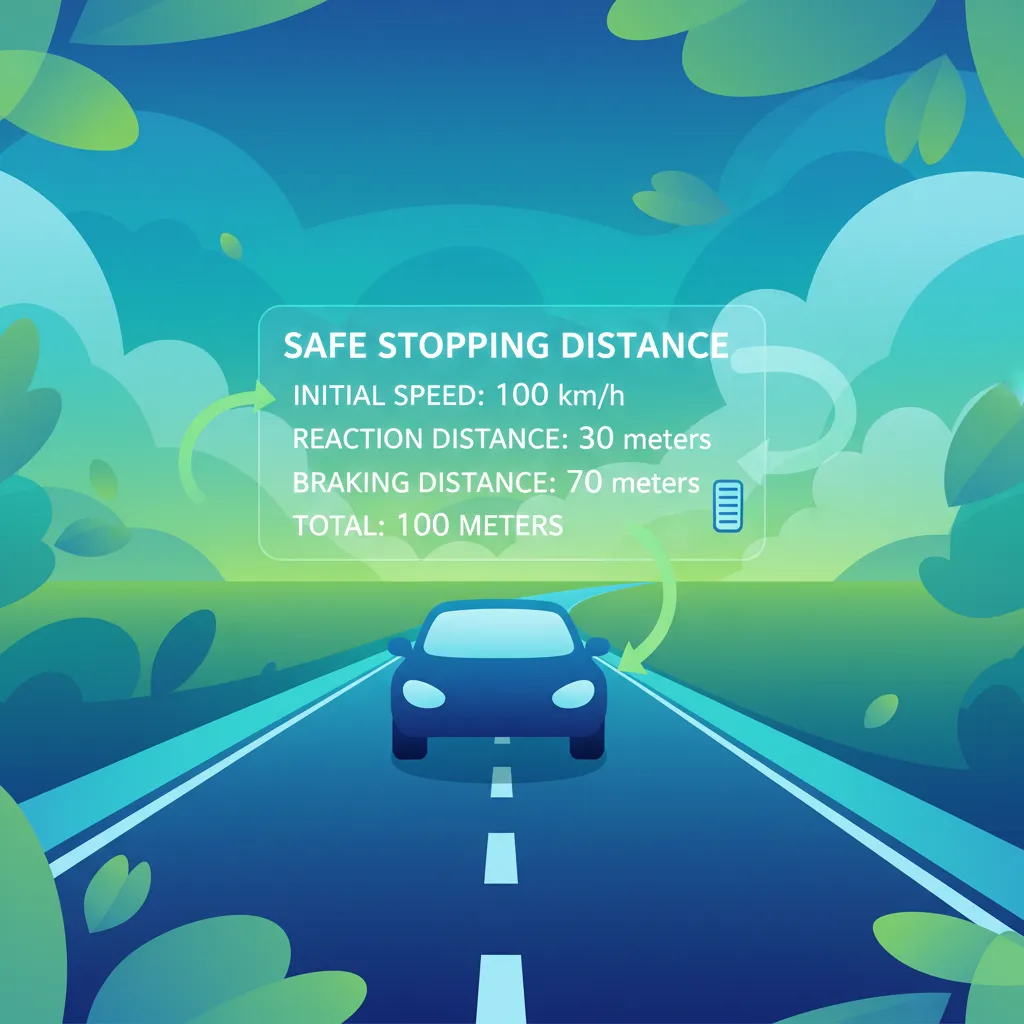
Understanding and accurately calculating safe stopping distances is a fundamental skill for every moped rider. This knowledge is not only crucial for personal safety and preventing collisions but also forms a cornerstone of Swedish traffic law. In the Swedish Driving License Theory Course for Category AM (Moped), mastering this topic ensures you can maintain appropriate distances under various conditions, fulfilling your legal obligation and contributing to safer roads.
Stopping a moped is a complex process influenced by a combination of rider actions, vehicle capabilities, and environmental factors. It’s more than just applying the brakes; it involves a sequence of events, each contributing to the total distance covered before coming to a complete halt. Grasping the physics behind these distances empowers you to make informed decisions and react effectively to hazards.
The total stopping distance (d₍t₎) is the entire length a moped travels from the moment a rider perceives a hazard until the moped comes to a full stop. This critical distance is divided into two distinct components: the reaction distance and the braking distance. Together, these two elements dictate how much space you need to avoid an accident.
For moped riders, maintaining an adequate stopping distance is paramount for several reasons. Firstly, it is the primary mechanism for collision avoidance, allowing sufficient space and time to react to sudden changes in traffic or unexpected hazards. Secondly, it is a direct fulfillment of a legal duty under the Swedish Traffic Ordinance (Trafikförordning), which mandates that every driver must keep a distance that allows them to stop safely without causing a collision. Lastly, this understanding underpins the practical calculation of safe following distances behind other vehicles, a critical aspect of defensive riding in Sweden. Without this knowledge, riders are at a significantly higher risk of rear-end collisions and other incidents.
To effectively calculate and manage your stopping distance, it's essential to understand its two main components and the factors that influence them. These are the reaction distance and the braking distance.
Perception-reaction time (tₚᵣ) is the duration from the moment a rider perceives a hazard until they react by beginning to apply the brakes. This time is a crucial human factor, inherently limiting how quickly a rider can respond. It's not instantaneous; the brain needs to process information, decide on an action, and then send signals to the muscles.
This time can be broken down into three phases:
For an alert, sober, and experienced rider on a level road with good visibility, the baseline perception-reaction time is approximately 0.9 seconds.
Several factors can significantly lengthen a rider's perception-reaction time, directly increasing the reaction distance and, consequently, the total stopping distance. These include:
The reaction distance (d₍r₎) is the distance your moped travels during your perception-reaction time, before you even begin to apply the brakes. During this interval, your moped continues at its original speed.
The formula for reaction distance is straightforward:
d₍r₎ = v ⋅ tₚᵣ
Where:
d₍r₎ is the reaction distance (in meters).v is your instantaneous speed (in meters per second, m/s).tₚᵣ is your perception-reaction time (in seconds).To convert speed from kilometers per hour (km/h) to meters per second (m/s), divide the speed in km/h by 3.6. For example, 45 km/h = 45 / 3.6 = 12.5 m/s.
Practical Meaning: At 45 km/h (12.5 m/s), a rider with a 0.9-second reaction time will travel approximately 11.25 meters before the brakes are even engaged. This distance is unavoidable and highlights the critical importance of being alert and maintaining a safe following distance.
The braking distance (d₍b₎) is the distance the moped travels from the moment the brakes are fully applied until it comes to a complete stop. This phase depends on the vehicle's braking capability and the friction between its tires and the road surface.
The braking distance is primarily influenced by:
The coefficient of friction (μ) is a critical factor in determining braking distance. It represents the "stickiness" of the road surface. A dry, clean asphalt road offers a high coefficient of friction, allowing for effective braking. Conversely, wet, icy, or gravel surfaces have significantly lower coefficients, meaning the tires have less grip, and braking distances dramatically increase.
Typical Values for Mopeds:
| Surface | Typical μ (dry) | Typical μ (wet) | Typical μ (snow/ice) |
|---|---|---|---|
| Asphalt/Concrete (new) | 0.75 – 0.80 | 0.45 – 0.55 | 0.15 – 0.20 |
| Gravel | 0.55 – 0.60 | 0.30 – 0.40 | 0.10 – 0.15 |
| Snow (packed) | 0.30 – 0.35 | 0.20 – 0.25 | 0.10 – 0.12 |
| Ice | 0.10 – 0.15 | 0.07 – 0.10 | 0.05 – 0.08 |
These values are general guidelines. Actual friction can vary based on tire type, road age, debris, and temperature.
Even a small change in the coefficient of friction can have a dramatic impact on braking distance. Always adjust your speed and following distance for prevailing road conditions.
Combining the reaction distance and the braking distance gives you the total stopping distance (d₍t₎), which is the absolute minimum distance required to bring your moped to a halt.
d₍t₎ = d₍r₎ + d₍b₎
For accurate calculations, it's best to use consistent units (meters and seconds).
Reaction Distance: d₍r₎ = v ⋅ tₚᵣ
v in m/stₚᵣ in secondsBraking Distance: d₍b₎ = v² / (2 ⋅ μ ⋅ g)
v in m/sμ is the coefficient of frictiong is the acceleration due to gravity (approximately 9.81 m/s²)For practical calculations, especially when speed is in km/h, a commonly used approximation for braking distance is: d₍b₎ ≈ (v_kmh)² / (254 ⋅ μ)
v_kmh is the speed in kilometers per hour.Let's look at some common scenarios for a Category AM moped (maximum speed 45 km/h) to understand how these calculations play out.
Scenario A: Dry Road, Alert Rider
Reaction Distance (d₍r₎): d₍r₎ = 8.33 m/s ⋅ 0.9 s ≈ 7.5 meters
Braking Distance (d₍b₎):
Using the approximation: d₍b₎ ≈ (30)² / (254 ⋅ 0.75) ≈ 10.8 / 190.5 ≈ 4.7 meters
(Using v in m/s: d₍b₎ = (8.33)² / (2 ⋅ 0.75 ⋅ 9.81) = 69.39 / 14.715 ≈ 4.7 meters)
Total Stopping Distance (d₍t₎): d₍t₎ = 7.5 m + 4.7 m ≈ 12.2 meters
Scenario B: Wet Road, Tired Rider
Reaction Distance (d₍r₎): d₍r₎ = 12.5 m/s ⋅ 1.5 s ≈ 18.75 meters
Braking Distance (d₍b₎):
Using the approximation: d₍b₎ ≈ (45)² / (254 ⋅ 0.45) = 2025 / 114.3 ≈ 17.7 meters
(Using v in m/s: d₍b₎ = (12.5)² / (2 ⋅ 0.45 ⋅ 9.81) = 156.25 / 8.829 ≈ 17.7 meters)
Total Stopping Distance (d₍t₎): d₍t₎ = 18.75 m + 17.7 m ≈ 36.45 meters
As these examples show, adverse conditions and rider state dramatically increase the total stopping distance.
Swedish traffic law places a clear responsibility on every driver, including moped riders, to manage their stopping distance effectively. These regulations are designed to prevent collisions and ensure road safety.
The core legal principle regarding stopping distance is outlined in the Trafikförordning (§ 40) (Swedish Traffic Ordinance, Section 40). It states:
"Every driver shall keep a distance that allows them to stop without causing a collision."
This seemingly simple statement is profound. It makes you legally accountable for any rear-end collision, implicitly requiring you to factor in your reaction time, braking capability, and prevailing road conditions. This rule applies to all road users, at all speeds, and on all road types.
To ensure a baseline level of safety, mopeds themselves must meet specific technical requirements. Transportstyrelsen TA-2010-200 (Swedish Transport Agency, Technical Approval Regulation 2010:200) mandates that Category AM mopeds must be able to stop from a speed of 45 km/h within a distance not exceeding 12 meters on a dry road. This regulation applies to manufacturers and is checked during vehicle type-approval and periodic inspections.
As a rider, it's your responsibility to ensure your moped's brakes are always in good working order, with sufficient pad wear and fluid levels, to meet at least these minimum performance standards.
Another relevant section of the Traffic Ordinance, Trafikförordning (§ 31), provides guidance on conditions of reduced visibility. It advises that:
"In reduced visibility conditions (fog, heavy rain, darkness) the driver must increase the following distance proportionally to the reduction in visibility."
This rule acknowledges that poor visibility directly impacts a rider's perception time. If you can only see 30 meters ahead in fog, you must ensure your total stopping distance is well within that range, meaning a significantly larger following distance is required.
While precise calculations are foundational, practical rules of thumb help you apply this knowledge instinctively in traffic.
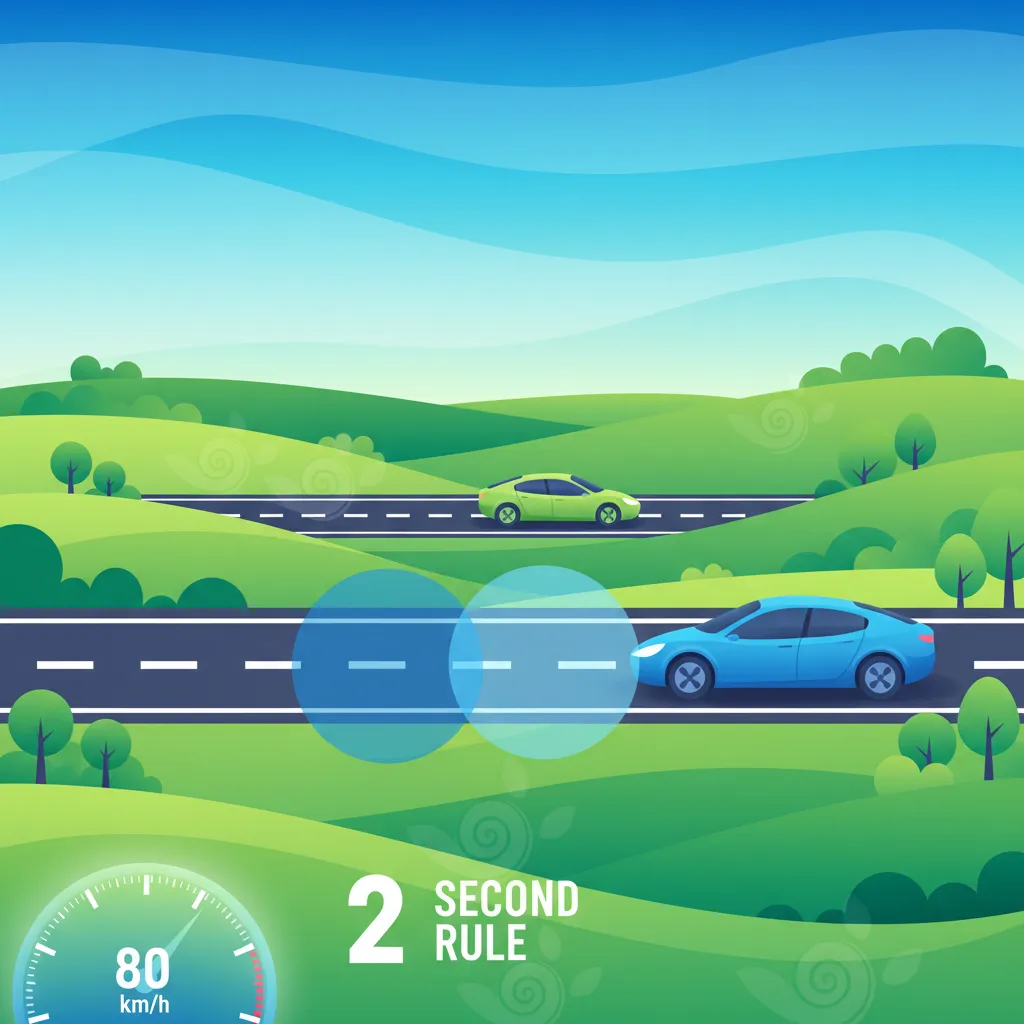
A widely taught and practical guideline for maintaining a safe following distance is the two-second rule.
Maintain a gap between your moped and the vehicle in front that takes at least two seconds to cover.
To use this rule:
Choose a fixed point on the road ahead, such as a road sign, tree, or bridge.
When the rear of the vehicle in front of you passes that point, start counting "one thousand one, one thousand two."
If the front of your moped reaches the same point before you finish counting "one thousand two," you are following too closely and need to increase your distance.
The two-second rule is effective because it scales with your speed: the faster you go, the greater the distance covered in two seconds. It inherently incorporates a baseline reaction interval. However, it is a minimum guideline and must be extended under adverse conditions.
The two-second rule is suitable for ideal conditions (dry road, good visibility, alert rider). For anything less than ideal, you must extend your following distance.
Many moped collisions, particularly rear-end incidents, stem from a failure to correctly assess and maintain safe stopping distances.
The most frequent violation related to stopping distance is simply following too closely. This happens when a rider maintains an insufficient gap, especially at higher speeds or in adverse conditions. For instance, following 5 meters behind a car at 40 km/h on a wet road is highly dangerous; the required total stopping distance could easily be 20-30 meters or more. This directly violates Trafikförordning § 40.
Distraction, such as looking at a phone or navigation device for more than a quick glance, significantly increases perception-reaction time. A moment's inattention at 45 km/h means traveling many meters blindly before even starting to brake. Similarly, riding under the influence of alcohol or drugs, even if only mildly impaired, lengthens reaction time and impairs judgment, making safe stops extremely difficult. Swedish law has a zero-tolerance approach to impaired driving.
Neglecting to adjust for adverse road conditions (wet, icy, gravel) by maintaining speed or insufficient following distance is a common cause of skidding and collisions. Additionally, riding with worn brake pads or low-tread tires reduces the moped's maximum deceleration capability, effectively decreasing the coefficient of friction and dramatically lengthening braking distance beyond what a rider might expect. This compromises safety and can lead to mechanical failure.
Always perform routine checks on your moped's brakes and tires. They are your primary safety features for managing stopping distances.
A thorough understanding of stopping distances is a cornerstone of responsible and safe moped riding in Sweden. It moves beyond abstract rules to provide concrete, physics-based reasons for your actions on the road. By consciously considering your perception-reaction time, the road surface, your speed, and your moped's condition, you gain the ability to anticipate hazards and adjust your riding to prevent accidents.
Always prioritize safety by:
This knowledge, combined with practical experience, will make you a more confident, safer, and legally compliant moped rider on Swedish roads.
Lesson content overview
Explore all units and lessons included in this driving theory course.
Explore search topics learners often look for when studying Calculating Safe Stopping Distances. These topics reflect common questions about road rules, driving situations, safety guidance, and lesson level theory preparation for learners in Sweden.
Browse additional driving theory lessons that cover connected traffic rules, road signs, and common driving situations related to this topic. Improve your understanding of how different rules interact across everyday traffic scenarios.
Explore how speed, road conditions, and driver alertness impact the total stopping distance for mopeds. Understand the critical elements that extend or reduce reaction and braking distances in Swedish traffic.
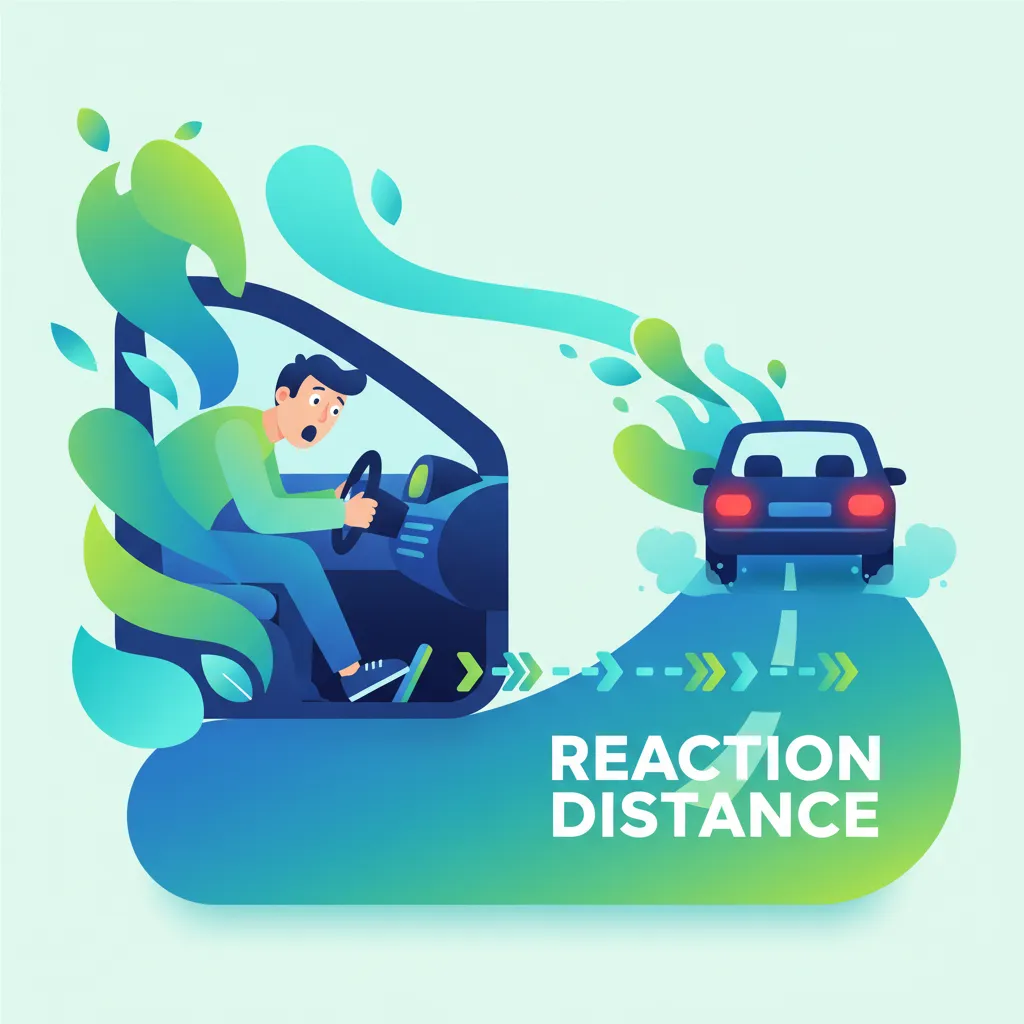
This lesson breaks down the components of the total stopping distance: reaction distance and braking distance. You will learn how your physical and mental state affects reaction time, and how speed, tire condition, and road surface (e.g., ice, rain) influence the distance required to brake to a complete stop. Understanding these physical principles is essential for making safe decisions about speed and following distance in all conditions.
This lesson delves into the physics of stopping a motorcycle, explaining the components of total stopping distance: perception time, reaction time, and braking distance. You will learn practical methods like the 'two-second rule' to maintain a safe following distance and how to adjust this buffer for adverse weather and high speeds. Understanding these concepts is fundamental to avoiding rear-end collisions and having enough space to react to any hazard.
This lesson teaches practical methods for maintaining a safe buffer to the vehicle ahead, with a primary focus on the universally recommended 'three-second rule'. You will learn how to apply this rule by picking a fixed point and counting the seconds until you pass it. The content also explains why this distance must be increased significantly in adverse conditions such as rain, snow, or when following large vehicles that obstruct your view.
This lesson clarifies the legal distinction between stopping temporarily and parking. It identifies areas where stopping is prohibited, such as near intersections or on pedestrian crossings, to maintain traffic flow and safety. The content also discusses designated waiting areas at traffic lights, often marked for cyclists and mopeds, which can offer a safer position.
This lesson teaches the crucial skill of adapting speed to prevailing conditions, emphasizing that the posted speed limit is a maximum, not a target. It covers various scenarios such as rain, fog, heavy traffic, and poor road surfaces, explaining why reducing speed is essential for maintaining vehicle control and safety. The goal is to cultivate a proactive mindset where the rider constantly assesses risk and adjusts their speed accordingly.
This lesson focuses on the high level of caution required when driving in residential areas. You will learn about the rules for special zones like 'gångfartsområde' (walking speed area) and the need to navigate around speed calming measures like speed bumps. The central theme is anticipating unpredictable behavior from residents, especially children, and managing the risks posed by parked cars that severely limit visibility.
This lesson reinforces the core safety principle of adapting your driving to the prevailing weather conditions. You will learn why you must significantly reduce speed in heavy rain to avoid aquaplaning, how strong crosswinds can affect vehicle stability, and why reduced visibility in fog necessitates slower speeds and greater following distances. The goal is to instill a proactive approach to risk management whenever the weather is less than ideal.
This lesson focuses on developing the fine control needed for low-speed maneuvering, a common challenge in urban environments. It covers techniques for making tight turns, such as U-turns, by using a combination of clutch, throttle, and rear brake control. The goal is to build the rider's skill and confidence in handling the moped in parking lots, heavy traffic, and other confined areas.
This lesson covers strategies for driving safely when visibility is compromised. You will learn the correct use of different lighting systems: when to use low beams, high beams (helljus), and how to avoid dazzling other drivers. The lesson also explains the specific regulations for using front and rear fog lights and provides techniques for navigating safely in dense fog or heavy precipitation by reducing speed and using the road edge as a guide.
This lesson focuses on the specific activity of stopping for the purpose of passenger embarkation/disembarkation or loading/unloading goods. You will learn that this is often permissible in areas marked with a 'no parking' sign, as long as the stop is brief and continuous. The lesson distinguishes this from a 'no stopping' zone, where any voluntary stop is prohibited, ensuring you understand the nuanced difference.
Learn how to maintain safe following distances and improve hazard perception to complement stopping distance calculations. This lesson covers defensive driving strategies essential for moped safety in Sweden.
This lesson delves into the physics of stopping a motorcycle, explaining the components of total stopping distance: perception time, reaction time, and braking distance. You will learn practical methods like the 'two-second rule' to maintain a safe following distance and how to adjust this buffer for adverse weather and high speeds. Understanding these concepts is fundamental to avoiding rear-end collisions and having enough space to react to any hazard.
This lesson focuses on developing the fine control needed for low-speed maneuvering, a common challenge in urban environments. It covers techniques for making tight turns, such as U-turns, by using a combination of clutch, throttle, and rear brake control. The goal is to build the rider's skill and confidence in handling the moped in parking lots, heavy traffic, and other confined areas.
This lesson delves into the dynamics of cornering on a two-wheeled vehicle, introducing the essential technique of counter-steering to initiate turns efficiently. It explains the importance of choosing a proper line, managing speed before the turn, and looking through the corner to the exit. The content also provides guidance on how to recognize and correct for a loss of traction or a skid.
This lesson details the specific hazards associated with riding on wet roads, including significantly increased stopping distances and the risk of aquaplaning. It explains how to recognize conditions where aquaplaning is likely and the importance of reducing speed. Riders will learn to use smoother throttle, braking, and steering inputs to maintain traction and control.
This lesson explores the critical relationship between the rider's body and the moped's stability. It explains how to maintain balance using correct posture and weight distribution for different maneuvers. The content covers basic steering inputs and how body positioning, such as leaning into turns, directly influences the vehicle's handling and responsiveness.
This lesson addresses the severe dangers of riding a moped in snow and icy conditions. It explains how to identify potential hazards like black ice and emphasizes that avoiding riding in such conditions is the safest strategy. For situations where it cannot be avoided, it provides advice on extremely gentle control inputs and vehicle preparation.
This lesson provides essential strategies for riding safely at night and during twilight hours. It covers the correct use of headlights to maximize visibility without dazzling other drivers and emphasizes the need to reduce speed to compensate for shorter sight distances. The content also highlights the importance of wearing reflective gear to be seen by others.
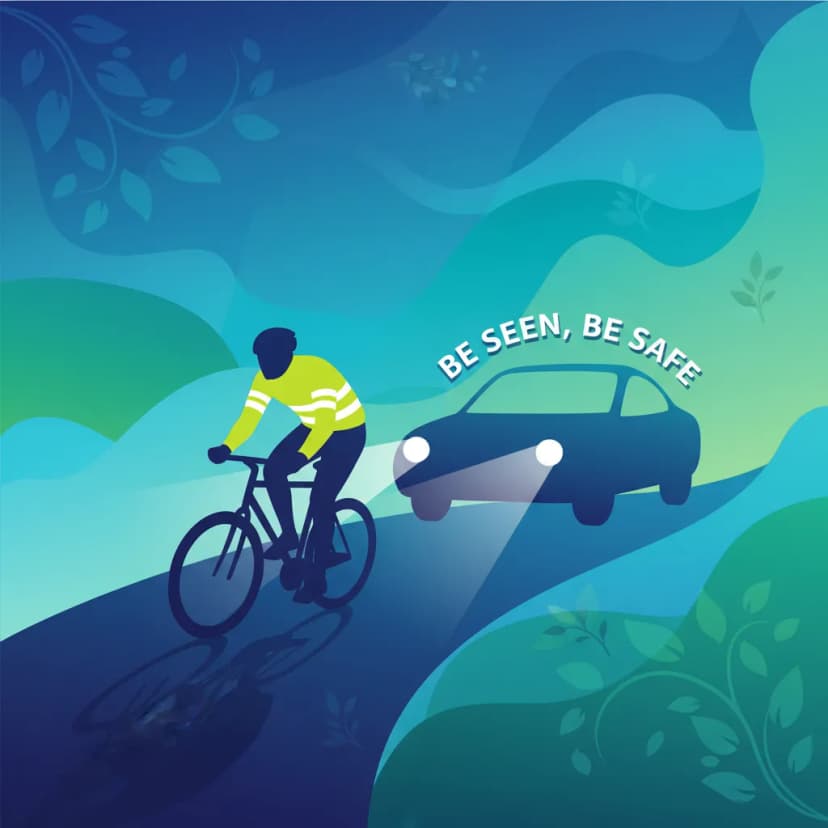
This lesson focuses on proactive strategies to increase a moped rider's visibility to other drivers. It strongly advocates for the use of high-visibility and reflective clothing, helmets, and accessories to stand out in traffic. Additionally, it revisits the concept of lane positioning as a tool to avoid being in other drivers' blind spots and to create a more prominent presence on the road.
This lesson provides a detailed guide to using a moped's braking system effectively and safely. It explains the different roles of the front and rear brakes and the concept of balanced braking to maximize stopping power without losing traction. Learners will understand techniques for both normal, controlled stops and emergency braking situations, including how to manage weight transfer.
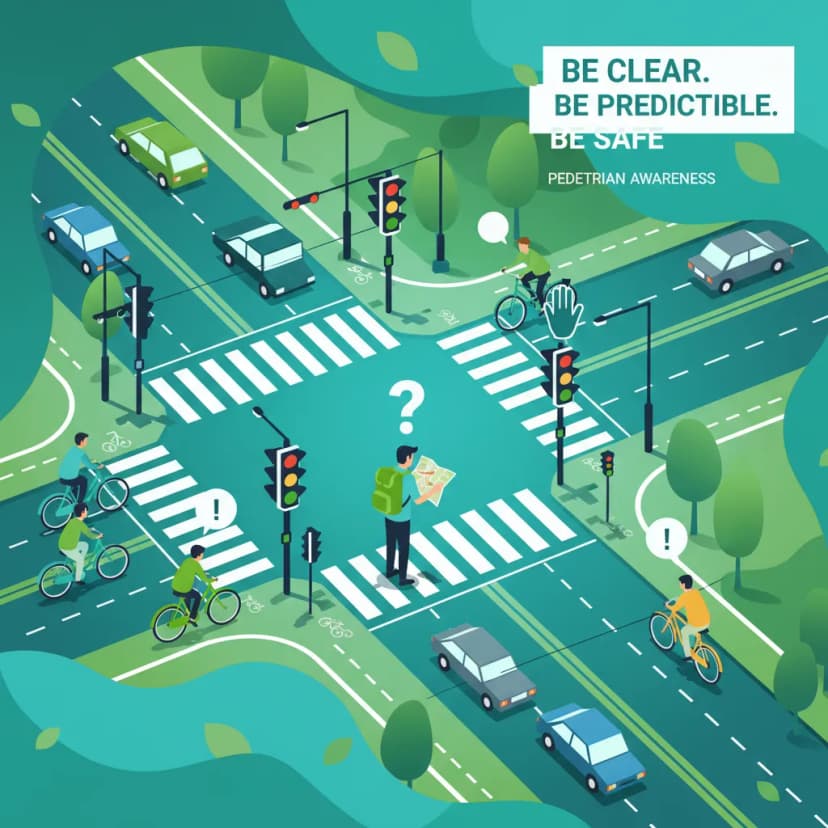
This lesson is dedicated to pedestrian safety, teaching riders to be constantly aware of people on foot, especially in busy urban environments. It reinforces the absolute duty to yield at marked crossings and encourages a cautious approach in areas like schools and shopping districts. The content stresses anticipating unpredictable actions, particularly from children or distracted pedestrians.
Find clear answers to common questions learners have about Calculating Safe Stopping Distances. Learn how the lesson is structured, which driving theory objectives it supports, and how it fits into the overall learning path of units and curriculum progression in Sweden. These explanations help you understand key concepts, lesson flow, and exam focused study goals.
Reaction distance is the distance your moped travels from the moment you perceive a hazard until you apply the brakes. Braking distance is the distance your moped covers from when you apply the brakes until it comes to a complete stop. Total stopping distance is the sum of these two.
Speed has a significant impact. Doubling your speed quadruples your braking distance, and also increases your reaction distance because you cover more ground per second. This means even small increases in speed can drastically increase the distance needed to stop safely.
Slippery conditions such as wet roads, ice, snow, or loose gravel significantly increase braking distance. Worn tyres or uneven road surfaces can also reduce grip and lengthen the distance needed to stop. Always adjust your speed and following distance accordingly.
Yes, the braking system's effectiveness (disc vs. drum brakes, condition of pads/shoes), tyre condition, and the moped's weight can all influence braking distance. Generally, well-maintained mopeds with good brakes and tyres will have shorter braking distances.
If you are tired, distracted, or under the influence of alcohol or drugs, your reaction time will increase. This directly increases your reaction distance, meaning you travel further before even starting to brake, thus extending your total stopping distance and increasing risk.
The theory test often asks about the principles and factors influencing stopping distance rather than requiring exact calculations. You need to understand the relationships between speed, reaction time, braking distance, and road conditions to answer correctly. For example, you'll learn that doubling speed quadruples braking distance.