
This lesson focuses on crucial motorcycle safety by explaining safe following distances and stopping sight distance. Understanding these concepts is vital for avoiding collisions and ensuring you have adequate space to react to hazards on Swedish roads, preparing you for the Category A theory exam.

Maintaining an appropriate distance from other vehicles is one of the most fundamental principles of safe motorcycling. This lesson explores the critical concepts of safe following distances and stopping sight distance (SSD) for motorcycles, delving into the physics, human factors, and legal obligations that dictate how much space you need to stop safely. Mastering these concepts is essential for preventing rear-end collisions, providing adequate time to react to hazards, and fulfilling the requirements of the Swedish Motorcycle Theory Course.
When you need to bring your motorcycle to a complete halt, the total distance traveled involves several stages. This Total Stopping Distance (TSD) is the sum of the distance covered during your perception and reaction, combined with the actual braking distance. Understanding each component is crucial for assessing how much space you truly need on the road.
The interval from when a potential hazard first appears in your field of vision until you consciously recognize it as a threat that requires action.
Perception time is the initial phase where your brain processes sensory information. This isn't instantaneous; it involves detecting the visual stimulus, understanding its nature, and recognizing it as a hazard. For a sober, alert rider in clear conditions, this can be around 1.0 to 1.5 seconds. However, factors like fatigue, distraction, poor visibility (e.g., heavy rain, fog, night riding with glare), or a complex traffic situation can significantly extend this time, potentially to 2.0 seconds or more.
For example, seeing the brake lights of a car ahead and realizing that it is braking hard, not just slowing down, takes valuable fractions of a second. Underestimating this delay is a common pitfall for many riders.
The period from the moment a rider consciously decides to act (e.g., apply brakes) until the physical action is initiated.
Once you've perceived a hazard and decided to react, your body still needs to execute the response. For a motorcyclist, this involves moving your hand to the brake lever, pressing the pedal, or initiating a swerve. This is your reaction time.
A simple reaction to a single stimulus (like a sudden red light) might be around 0.5 to 0.7 seconds for an alert rider. If the situation is more complex, requiring a choice between braking or swerving, or if you're experiencing factors like alcohol impairment or distraction, your reaction time can easily extend beyond 1.0 second. The Swedish Transport Agency (Transportstyrelsen) often recommends assuming 0.5 seconds for an alert rider and 1.0 second for a less alert or fatigued rider in its calculations.
The distance your motorcycle travels from the moment the brakes are effectively applied until it comes to a complete stop.
Braking distance is purely physical and depends on several critical factors:
A dimensionless value representing the ratio of the force of friction between the tire and the road surface to the normal force pressing them together. It directly influences braking distance.
For instance, a motorcycle traveling at 90 km/h on dry asphalt (µ ≈ 0.8) might stop in approximately 40 meters after the brakes are applied. If the road is wet (µ ≈ 0.45), that same motorcycle would require around 70 meters to stop, almost doubling the distance.
The combined distance covered during the perception, reaction, and braking phases until the motorcycle reaches a full stop.
The total stopping distance is the sum of the distances covered during each phase: TSD = Perception Distance + Reaction Distance + Braking Distance
Mathematically, this can be expressed as: TSD = (v × tₚ) + (v × tᵣ) + (v² / (2 × µ × g))
Where:
v = speed of the motorcycle (in meters per second, m/s)tₚ = perception time (in seconds, s)tᵣ = reaction time (in seconds, s)µ = friction coefficient between tires and roadg = acceleration due to gravity (approximately 9.81 m/s²)Example: At 80 km/h (which is 22.22 m/s), on a dry road (µ = 0.8), with a perception time of 1.5 s and a reaction time of 0.7 s:
This means that at 80 km/h, under these conditions, you need roughly 80 meters to stop your motorcycle. This significant distance highlights why maintaining a safe following distance is not just a recommendation, but a necessity.
While understanding TSD is crucial, calculating it precisely on the road is impractical. This is where Time-Headway (TH) provides a simpler, yet highly effective, practical tool for riders.
The time required for a following vehicle to travel the distance separating it from the vehicle directly ahead, expressed in seconds. It is calculated as the distance between vehicles divided by your speed.
A practical guideline stating that a rider should maintain a minimum time-headway of two seconds behind the vehicle directly in front under normal driving conditions.
The two-second rule is a widely endorsed safety guideline, including by the Swedish Transport Agency (Transportstyrelsen), for its simplicity and effectiveness. It provides a speed-independent measure of safety because the absolute distance it represents increases proportionally with your speed.
How to apply the two-second rule:
Example:
Notice how the time remains constant at 2 seconds, but the distance automatically increases with speed, providing a larger buffer when you need it most.
The two-second rule is a minimum for ideal conditions (dry road, good visibility, alert rider, light traffic). However, conditions are rarely ideal. You must consciously increase your time-headway to a 3-second, 4-second, or even greater rule under adverse circumstances.
Additional distance or time added to the calculated safe distance or time-headway to compensate for uncertainties, such as sudden obstacles, varying road conditions, or rider variability.
Here's when and why to increase your following distance (add a safety margin):
Wet or Slippery Roads (Rain, Snow, Ice): Reduce friction drastically increases braking distance. Increase headway to at least 3 seconds in moderate rain and 4 seconds or more on snow/ice.
Reduced Visibility (Fog, Heavy Rain, Dust, Night Riding with Glare): Perception time increases significantly. Add at least 0.5 to 1 second to your standard headway.
High Speeds (Motorways): While the two-second rule accounts for increased absolute distance, higher speeds mean faster closing rates and less time to react to sudden events. Many experienced Swedish riders opt for 3 seconds or more at motorway speeds (≥100 km/h), especially in dense traffic.
Heavy Load (Passenger, Luggage): Increased mass means longer braking distances. Add at least 0.5 second to your headway.
Following Large Vehicles (Trucks, Buses): Your forward visibility is often obstructed, making it harder to see traffic conditions ahead or brake lights early. Maintain at least 3 seconds to see around or through the vehicle.
Following Vulnerable Road Users (Cyclists, Pedestrians): These users can stop or change direction suddenly and without warning. Maintain a minimum 3-second headway and be prepared for unexpected movements.
Poor Road Surface (Gravel, Bumps, Uneven Pavement): Reduces tire grip and can unsettle the motorcycle during braking. Increase headway to account for unpredictable conditions.
Tired or Distracted Rider: Your perception and reaction times will be compromised. Compensate with significantly increased following distance, or better yet, take a break.
Steep Downhill Grades: Gravity adds to your momentum, increasing braking distance. Increase your headway by adding 10% to your braking distance calculation for every 1% of grade beyond 5%.
Think of the two-second rule as the absolute minimum. A professional, defensive rider often maintains a 3-second gap or more as a standard practice, adjusting further upwards when conditions demand it. This builds in a constant safety margin.
While riders are responsible for their individual safe following distance, road designers have a corresponding responsibility: to ensure that the road itself provides sufficient visibility for safe stopping. This is known as Stopping Sight Distance (SSD).
The minimum length of clear roadway required for a driver traveling at the design speed to perceive an obstruction, react, and bring the vehicle to a complete stop safely.
SSD is a critical parameter in road design. Engineers use specific formulas and standard values (often more conservative than typical rider values) for perception time, reaction time, and friction coefficients to ensure that curves, intersections, hills, and other road features always offer a clear line of sight long enough for a vehicle to stop. For example, the Swedish road design standards (Vägdirektivet) prescribe SSD values for various design speeds, typically assuming a longer perception-reaction time (e.g., 2.5 seconds) and a lower friction coefficient (e.g., µ = 0.35) to account for worst-case scenarios and different vehicle types.
Why SSD matters to riders:
In Sweden, the principle of maintaining a safe distance is not just a recommendation; it is a legal requirement rooted in the Swedish Road Traffic Regulations (Trafikförordningen – RVV 1990).
This article of the Swedish Road Traffic Regulations mandates that every driver must maintain a distance to the vehicle ahead that allows them to stop without causing a collision, taking into account speed, road surface, weather, vehicle condition, and load.
This fundamental rule places the responsibility squarely on the driver (and motorcyclist) to constantly assess conditions and adjust their following distance. It's a comprehensive requirement, meaning you cannot claim a collision was unavoidable if you failed to account for any of the factors listed. Failure to comply can lead to fines and legal consequences.
While RVV 1990 § 2 provides the legal framework, the Swedish Transport Agency (Transportstyrelsen) offers practical guidelines for motorcyclists to help fulfill this obligation. These recommendations, though non-binding as strict law, are considered best practice and form a key part of the Swedish Motorcycle Theory Course.
Guidance from the Swedish Transport Agency advising motorcyclists to observe a minimum 2-second headway under normal conditions and increase to 3 seconds or more in rain, snow, or when the road surface is compromised.
These recommendations align with the principles discussed earlier, urging riders to dynamically adjust their time-headway based on prevailing conditions.
This article stipulates that vehicles must be maintained so that their brakes, tires, and lighting systems function according to manufacturer's specifications.
This regulation is directly related to safe stopping distances. If your motorcycle's brakes are faulty, or your tires are worn, your actual braking distance will be longer than what is assumed for a well-maintained vehicle. This directly compromises your ability to stop safely and violates the law, potentially making you liable in a collision even if your following distance seemed adequate under normal assumptions.
This article requires drivers to reduce speed and increase following distance in conditions of reduced visibility (e.g., fog, heavy rain, snow) to ensure safe stopping.
This specific regulation reinforces the need to increase your safety margin when visibility is poor, directly addressing the impact of environmental factors on perception time and overall stopping capability.
Understanding the theory is one thing; applying it consistently in real-world scenarios is another. Here are common mistakes and edge cases that often lead to incidents:
Never treat the 2-second rule as a universal constant. It is the minimum for ideal conditions.
To consistently maintain a safe following distance and optimize your stopping capability, consider this checklist before and during every ride:
Pre-Ride Check: Ensure your tires are in good condition with adequate tread depth and correct pressure. Verify your brakes are functioning optimally.
Assess Conditions: Before and during your ride, constantly evaluate the current speed, road surface (dry, wet, icy, gravel), weather (clear, rain, fog), visibility, traffic density, and any road gradients.
Adjust Perception-Reaction Times: Mentally account for factors that might lengthen your perception and reaction times, such as fatigue, distraction, low light, or complex traffic.
Calculate (Mentally) Braking Distance Factors: Consider how the current friction coefficient (µ) impacts your braking distance. Remember that wet roads roughly double braking distance compared to dry roads.
Apply the Two-Second Rule (and Adjust): Use the two-second rule as your baseline. Immediately increase to 3 seconds, 4 seconds, or more when any adverse condition is present.
Add a Safety Margin: Always strive for a little extra buffer. Aim for 2.5 or 3 seconds as your standard even in good conditions, especially when feeling less alert or in uncertain traffic.
Look Ahead: Actively scan the road far ahead to identify potential hazards early. This provides more time for perception and reaction.
Be Aware of Load: If riding with a passenger or luggage, be consciously aware of the increased stopping distance and adjust your headway accordingly.
Maintain Legal Compliance: Remember that RVV 1990 § 2 mandates you to be able to stop safely under prevailing conditions. This is a legal obligation.
By internalizing these principles and applying them diligently on every ride, you significantly enhance your safety and reduce the risk of collisions, preparing you thoroughly for your Swedish Motorcycle Theory Course: A Licence Exam Preparation and for a lifetime of safe motorcycling.
Lesson content overview
Explore all units and lessons included in this driving theory course.
Explore search topics learners often look for when studying Safe Following Distances and Stopping Sight Distance. These topics reflect common questions about road rules, driving situations, safety guidance, and lesson level theory preparation for learners in Sweden.
Browse additional driving theory lessons that cover connected traffic rules, road signs, and common driving situations related to this topic. Improve your understanding of how different rules interact across everyday traffic scenarios.
Explore the critical factors that influence your total stopping distance on a motorcycle. Understand how speed, road conditions, and rider reaction time collectively determine the space needed for safe stops according to Swedish traffic theory.
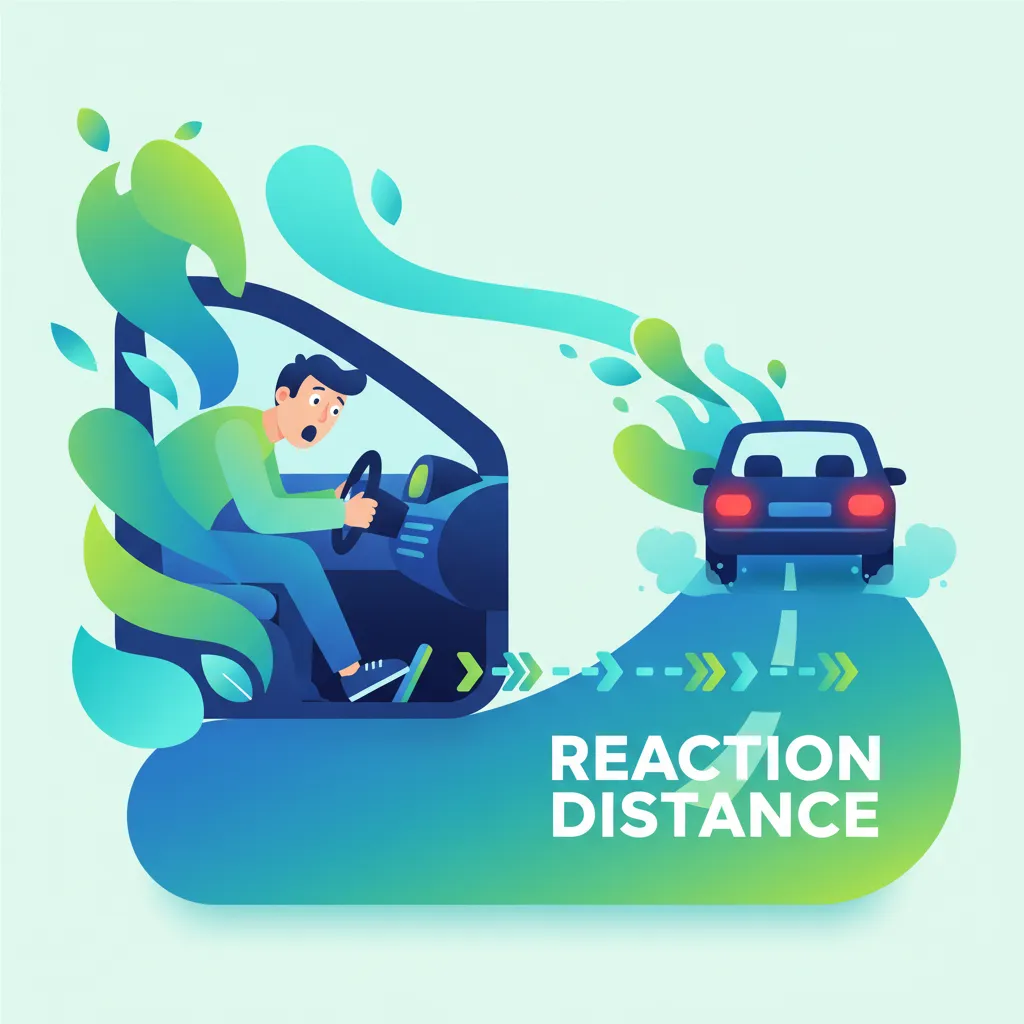
This lesson breaks down the components of the total stopping distance: reaction distance and braking distance. You will learn how your physical and mental state affects reaction time, and how speed, tire condition, and road surface (e.g., ice, rain) influence the distance required to brake to a complete stop. Understanding these physical principles is essential for making safe decisions about speed and following distance in all conditions.
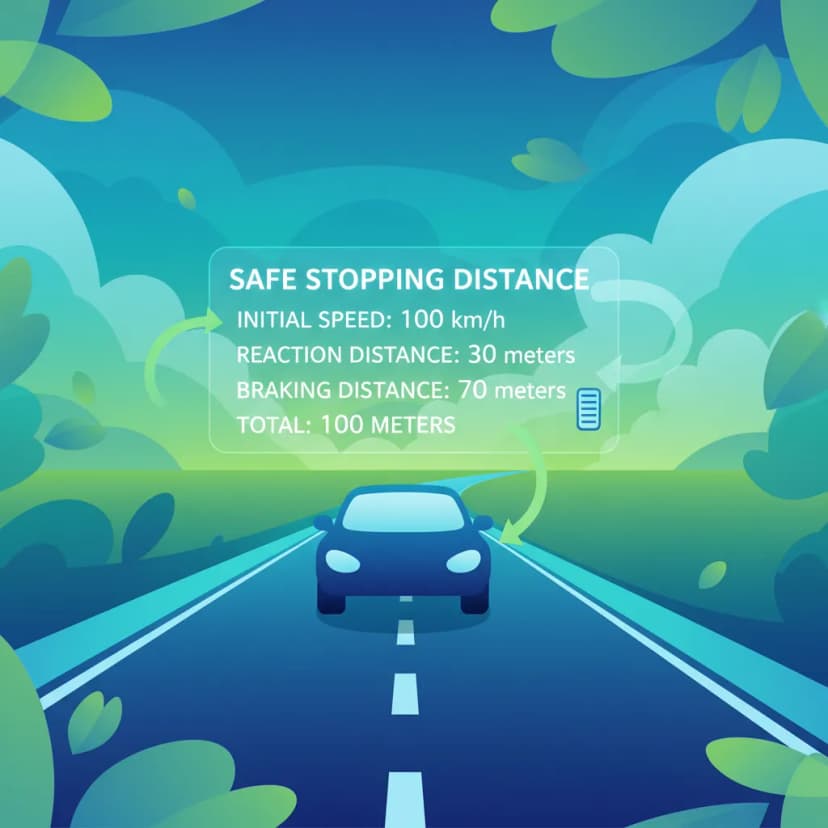
This lesson provides a practical understanding of the physics behind stopping a moped. It breaks down the total stopping distance into two key components: reaction distance (the distance traveled before applying the brakes) and braking distance (the distance covered while braking). Learners will explore how factors like speed, road conditions, and rider alertness dramatically affect these distances.
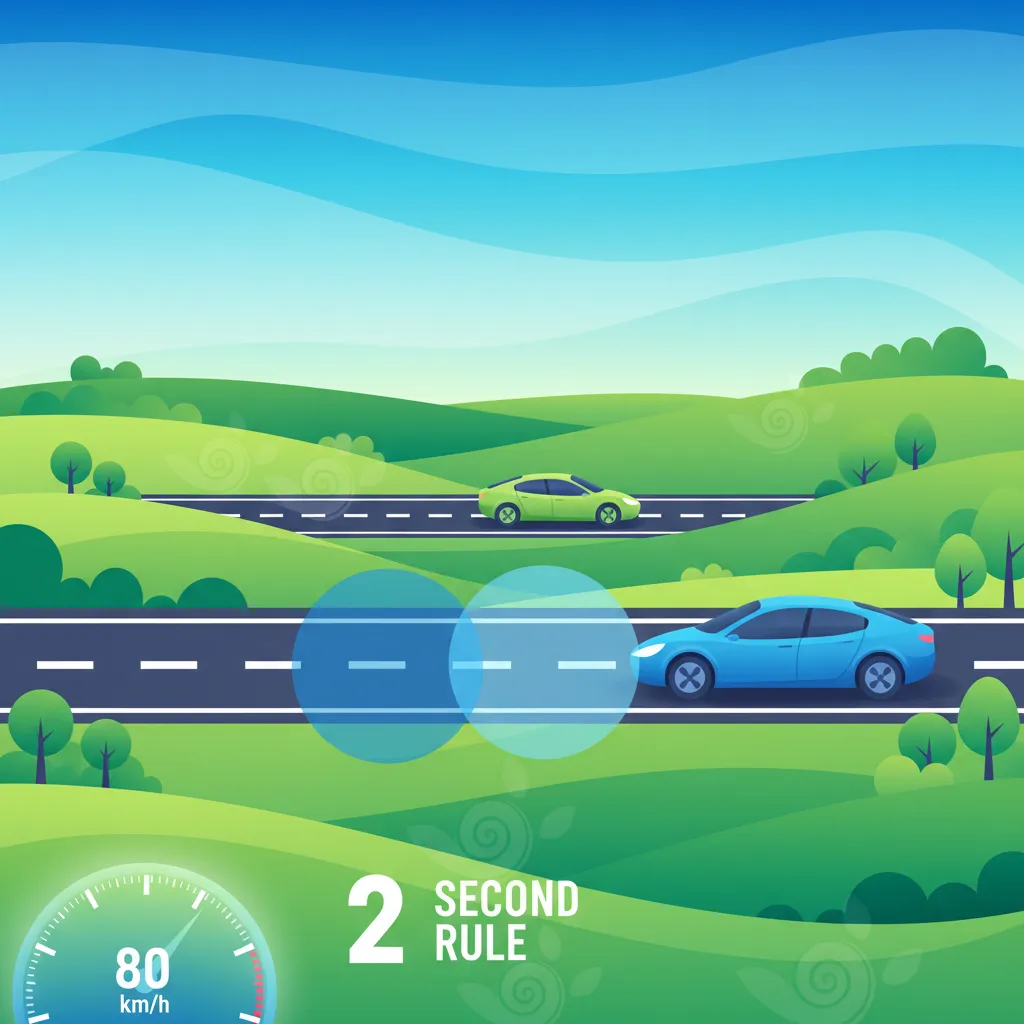
This lesson teaches practical methods for maintaining a safe buffer to the vehicle ahead, with a primary focus on the universally recommended 'three-second rule'. You will learn how to apply this rule by picking a fixed point and counting the seconds until you pass it. The content also explains why this distance must be increased significantly in adverse conditions such as rain, snow, or when following large vehicles that obstruct your view.

This lesson clarifies the legal distinction between stopping temporarily and parking. It identifies areas where stopping is prohibited, such as near intersections or on pedestrian crossings, to maintain traffic flow and safety. The content also discusses designated waiting areas at traffic lights, often marked for cyclists and mopeds, which can offer a safer position.
This lesson covers the final phase of an emergency maneuver: coming to a safe, controlled stop and moving off the road. You will learn the procedure for finding a safe spot, signaling your intentions, and securing the motorcycle. It also addresses the important steps to take after the immediate danger has passed, including checking yourself and your vehicle for damage and taking a moment to regain your composure before continuing your journey.

This lesson teaches the physical skill of applying maximum braking force while maintaining control of the motorcycle. You will learn the technique of progressive braking to avoid locking the wheels and how to react if a skid does occur. Understanding how to manage both front and rear wheel skids and how an ABS system assists in these situations gives you the best possible chance of stopping safely and quickly in an emergency.
This lesson provides a step-by-step guide to motorway riding. You will learn the correct technique for accelerating on an on-ramp and merging smoothly into high-speed traffic. The content also covers maintaining proper lane discipline, executing safe overtakes, keeping a safe following distance at speed, and planning for your exit well in advance to ensure a smooth and stress-free experience on Sweden's fastest roads.

This lesson focuses on the unique demands of managing speed in high-speed environments like motorways. You will learn techniques for maintaining a steady, appropriate speed that matches the flow of traffic, how to perform smooth overtakes, and the importance of increasing your following distance. It also covers physical factors such as managing wind blast and maintaining stability when riding near large trucks, ensuring a safe and controlled high-speed riding experience.

This lesson provides a detailed guide to using a moped's braking system effectively and safely. It explains the different roles of the front and rear brakes and the concept of balanced braking to maximize stopping power without losing traction. Learners will understand techniques for both normal, controlled stops and emergency braking situations, including how to manage weight transfer.
This lesson teaches the crucial skill of adapting your speed to the dynamic and often congested conditions of urban riding. You will learn to modulate your speed smoothly in response to traffic flow, pedestrian activity, and complex intersections to maintain safety and control. Techniques covered include using engine braking effectively, anticipating the actions of other road users, and selecting a speed that maximizes your reaction time in a high-density environment.
Learn to adjust your safe following distance based on speed, weather, and traffic intensity. This lesson covers practical techniques like the 'two-second rule' and its application in various Swedish driving environments to prevent collisions.
This lesson teaches practical methods for maintaining a safe buffer to the vehicle ahead, with a primary focus on the universally recommended 'three-second rule'. You will learn how to apply this rule by picking a fixed point and counting the seconds until you pass it. The content also explains why this distance must be increased significantly in adverse conditions such as rain, snow, or when following large vehicles that obstruct your view.
This lesson teaches the crucial skill of adapting your speed to the dynamic and often congested conditions of urban riding. You will learn to modulate your speed smoothly in response to traffic flow, pedestrian activity, and complex intersections to maintain safety and control. Techniques covered include using engine braking effectively, anticipating the actions of other road users, and selecting a speed that maximizes your reaction time in a high-density environment.
This lesson provides a practical understanding of the physics behind stopping a moped. It breaks down the total stopping distance into two key components: reaction distance (the distance traveled before applying the brakes) and braking distance (the distance covered while braking). Learners will explore how factors like speed, road conditions, and rider alertness dramatically affect these distances.

This lesson focuses on strategies to make yourself more visible to other road users, a critical factor in motorcycle safety. You will learn how to use lane positioning strategically to stay out of other drivers' blind spots and to maximize your own line of sight through corners and intersections. The content also covers the effectiveness of high-visibility and reflective clothing, as well as the correct use of lights to ensure you are seen in all conditions.
This lesson focuses on Swedish warning signs designed to alert drivers to potential dangers. You will study signs indicating sharp bends, slippery surfaces, animal crossings, and temporary hazards like road construction. Correctly interpreting these signs allows a motorcyclist to proactively adjust speed, lane position, and readiness to react, which is essential for maintaining control and safety, especially in adverse weather or on unfamiliar roads.
This lesson teaches you how to make an accident scene as safe as possible for yourself, any other involved parties, and approaching traffic. You will learn the correct use of hazard lights, the placement of warning triangles, and the importance of wearing a high-visibility vest. The content also covers how to identify and manage immediate post-crash hazards, such as spilled fuel or unstable vehicles, to prevent the situation from worsening.

This lesson prepares you for the specific challenges of riding on rural roads in Sweden. You will learn how to read the road ahead for changes in surface quality, approach blind corners safely, and adjust your speed for narrow lanes with no shoulder. The content also covers how to anticipate and safely interact with slow-moving agricultural vehicles and the potential for wild animals on the road, ensuring you are prepared for the unpredictable nature of country riding.

This lesson provides in-depth analysis of how to safely interact with the full spectrum of road users. You will learn about the specific characteristics of each, such as the large blind spots of trucks, the potential for sudden movements from cyclists, and the unpredictability of pedestrians. The content teaches strategies for communication, anticipation, and defensive positioning to ensure safe and respectful coexistence on the road for everyone.

This lesson focuses on the variety of road markings used on Swedish roads and their meaning for motorcyclists. You will learn the difference between solid and broken lines regarding overtaking, how to position yourself correctly at intersections based on markings, and how to interpret symbols painted on the road surface. Adhering to these markings is essential for maintaining correct lane discipline and ensuring predictability for other road users.
This lesson provides critical strategies for dealing with one of the biggest dangers in traffic: blind spots. You will learn the importance of the shoulder check and how to position yourself on the road to be more visible to other drivers. The lesson also trains you to scan the road surface ahead for hidden hazards like potholes, gravel, or oil spills that can pose a significant threat to a motorcycle's stability, teaching you to see and avoid them in time.
Find clear answers to common questions learners have about Safe Following Distances and Stopping Sight Distance. Learn how the lesson is structured, which driving theory objectives it supports, and how it fits into the overall learning path of units and curriculum progression in Sweden. These explanations help you understand key concepts, lesson flow, and exam focused study goals.
The two-second rule is a simple method for maintaining a safe following distance. Pick a fixed point the vehicle ahead passes (like a sign). Count 'one thousand one, one thousand two'. If you pass the same point after you've finished counting, your distance is adequate. For motorcycles, consider increasing this to three or even four seconds in adverse conditions.
As your speed increases, your total stopping distance dramatically increases. This means you need a significantly larger gap behind the vehicle in front to allow for perception, reaction, and braking. Always ensure your following distance increases proportionally with your speed to maintain adequate safety margins.
Stopping sight distance is the distance required to perceive a hazard, react, and bring your motorcycle to a complete stop before reaching it. On Swedish roads, especially at higher speeds or on winding rural routes, maintaining sufficient stopping sight distance ensures you can see potential dangers like stopped vehicles, pedestrians, or animals in time to react safely.
In wet, icy, or foggy conditions, your braking distance and reaction time can increase significantly. Swedish roads can become very slippery. It's crucial to increase your following distance considerably – often to three or four seconds or more. This gives you more time to react and more space to brake smoothly and avoid skidding.
While Sweden doesn't mandate a specific distance in metres, the principle of safe following distance, often approximated by the two-second rule (or more), is always applicable. On motorways, where speeds are higher, maintaining a larger gap is critical for managing the faster traffic flow and potential for sudden braking by other vehicles.