Welcome to the lesson on Merging and Lane Changes, a vital part of the 'Driving in Different Environments' unit in your Swedish Category B driving theory course. This lesson builds on your understanding of road signs and priority rules, preparing you for confident and safe driving on high-speed roads and complex junctions. Mastering these maneuvers is crucial for navigating Swedish traffic efficiently and safely, and for passing your theory exam.
Safe and efficient merging and lane-changing are fundamental skills for any driver, particularly on Sweden's diverse road network, which includes motorways, expressways, and multi-lane urban roads. This lesson provides a comprehensive guide to executing these maneuvers correctly, focusing on techniques that enhance safety, maintain smooth traffic flow, and comply with the Trafikförordning (Swedish Traffic Ordinance). Understanding these principles is crucial for preventing accidents and ensuring a confident driving experience.
Merging involves moving from one road or lane into another, often at varying speeds, such as entering a motorway from an acceleration lane. Lane changing, on the other hand, is the act of moving from one lane to an adjacent one on the same road. Both maneuvers require precision, foresight, and clear communication with other road users.
Improper merging and lane changes are significant contributors to traffic congestion and collisions, especially on high-speed roads. By mastering these techniques, you directly contribute to road safety and traffic efficiency. Correct execution minimizes the risk of sudden braking, sideswipes, and rear-end collisions, fostering a more predictable and harmonious driving environment for everyone. This is particularly vital in a country like Sweden, known for its emphasis on road safety.
Several core principles underpin safe merging and lane-changing, many of which are directly or indirectly mandated by the Trafikförordning. These principles ensure drivers make predictable and safe decisions when moving laterally or longitudinally within traffic.
A method of merging traffic where vehicles from two lanes alternate in entering a single lane, much like the teeth of a zipper interlocking. This principle is recommended to ensure fair and efficient traffic flow during lane reductions.
When two lanes of traffic converge into one, especially in situations like roadworks or lane closures, the dragkedjeprincipen (zipper principle) dictates that drivers should alternate, allowing one car from each lane to proceed. This method, often recommended by road signs and in the Trafikförordning (§ 5 (2) for lane-ending situations), is critical for reducing congestion, distributing delays fairly, and maintaining throughput. Early merging can sometimes be counterproductive, leading to longer queues in one lane while the other remains underutilized. Instead, drivers should use the entire length of the closing lane and merge at the point of convergence.
An acceleration lane, or slip-road, is a dedicated stretch of road designed to allow vehicles entering a higher-speed carriageway (like a motorway or expressway) to match the speed of the main traffic flow.
A designated lane that allows vehicles to accelerate and match the speed of traffic on a main carriageway before merging, keeping them separate from fast-moving traffic until a safe merging speed is achieved.
The primary goal when using an acceleration lane is to adjust your vehicle's speed to be compatible with the traffic already in the target lane. This reduces the relative speed difference, minimizing the need for sudden braking or acceleration from either party. Drivers must monitor their speed, the length of the acceleration lane, and the distance to the merge point, adjusting their throttle to reach the appropriate speed. Failing to match speed correctly is a common error that creates dangerous speed differentials and disrupts traffic flow.
On motorways and expressways, vehicles already in the main traffic lanes always have the right-of-way over vehicles entering from an acceleration lane, unless specifically indicated otherwise by signage (which is rare). This is a fundamental rule, stipulated by Trafikförordning § 4 (1)–(3), which states that a vehicle entering a road must not impede the normal flow of traffic already on that road.
This means that as a merging driver, you must adjust your speed and, if necessary, even stop at the end of the acceleration lane to wait for a safe gap. You must not force existing motorway traffic to brake or swerve. Incorrectly assuming priority can lead to dangerous situations and collisions.
Before initiating any lateral movement, a thorough and systematic check of your surroundings is non-negotiable. This involves two critical steps:
Areas around a vehicle that are not visible to the driver through the mirrors and require a physical head turn to check.
Failing to perform a proper blind-spot check is a common cause of side-impact collisions. This is legally required by Trafikförordning § 23, which implies ensuring the maneuver is safe.
Communicating your intentions clearly and in good time is vital for road safety. Whenever you plan to change lanes or merge, you must activate your vehicle’s turn indicator.
An electrical signaling device on a vehicle that flashes to communicate the driver's intention to turn or change lanes.
Trafikförordning § 11 (2) mandates that the indicator must be used "in a manner and for a period that allows other road users to anticipate the movement." This means a brief "quick flick" is insufficient. A good practice is to activate your indicator for at least 3 seconds before you begin your lateral movement. This provides other drivers with sufficient perception-reaction time (which averages 1.5-2 seconds) to understand your intentions and adjust their speed or position accordingly. Early and clear signaling reduces uncertainty and the risk of collisions.
Choosing the right moment to merge or change lanes, known as safe gap selection, is critical. A safe gap is a temporal and spatial opening in the target lane that allows you to complete the maneuver without forcing other drivers to brake abruptly or swerve.
A sufficient space in traffic, both in terms of distance and time, that permits a driver to merge or change lanes without causing other vehicles to decelerate or alter their path abruptly.
On motorways, a general guideline is to aim for a gap of at least 3 to 4 seconds. This means that after you merge, there should be at least a 3 to 4-second following distance between your vehicle and the vehicle behind you in your new lane. Estimating this requires judging the speed of vehicles in the target lane, your own acceleration capabilities, and the time needed to safely transition. Under-estimating the speed of fast-approaching vehicles is a common mistake.
Maintaining proper lane discipline and obeying road markings are fundamental for predictable traffic flow and safety. This involves:
Trafikförordning § 3 outlines the importance of complying with road markings. Ignoring these markings can lead to illegal maneuvers, sideswipes, and confusion among other drivers. For example, if a lane is ending and marked by a solid white line, you must have completed your merge before reaching that line.
Merging onto a motorway or expressway is a precise maneuver that requires careful planning and execution. Follow these steps for a safe and smooth merge:
Approach the Acceleration Lane: As you enter the acceleration lane (slip-road), observe the traffic ahead and behind you on the main carriageway. Look for road signs indicating the speed limit on the slip-road and any specific merge instructions.
Accelerate and Match Speed: Begin accelerating to match the speed of the traffic in the rightmost lane of the main carriageway. The goal is to reach a speed that is as close as possible to the flow of traffic by the time you reach the merge point, without exceeding the posted speed limit of the slip-road or the main road.
Signal Early and Check for Gaps: Activate your turn indicator (usually left) at least 3-4 seconds before your intended merge point. While accelerating, continuously check your rear-view and left side-view mirrors for potential gaps.
Perform Blind-Spot Check: Immediately after checking your mirrors, perform a quick head turn to check your blind spot in the direction you intend to merge. This confirms there are no vehicles hidden from your mirrors.
Select a Safe Gap: Identify a safe gap in the target lane. This gap should be large enough (typically 3-4 seconds) to allow you to merge without forcing other drivers to brake or adjust significantly. Remember, traffic on the main road has priority.
Execute the Merge Smoothly: Once a safe gap is identified and confirmed, steer smoothly and gradually into the target lane. Maintain your speed and adjust your position centrally within the new lane.
Post-Merge Actions: Cancel your turn indicator once you are fully established in the lane. Continue to monitor traffic around you and adjust your speed and following distance as necessary.
Changing lanes on multi-lane roads, whether urban or rural, follows many of the same principles as motorway merging, though speeds may be lower and traffic density can vary significantly.
When changing lanes, remember the following:
Road work zones or situations where a lane ends (e.g., due to a temporary obstruction) often require specific merging techniques. Pay close attention to temporary road signs and markings. Often, dashed lines with arrows will guide you to merge. This is where the zipper principle is most explicitly applied and encouraged. Drivers should utilize the full length of the ending lane to prevent early merging and subsequent queues in the open lane. Merge at the point where the lanes actually converge, alternating with traffic from the adjacent lane.
Several sections of the Trafikförordning (Swedish Traffic Ordinance) directly govern merging and lane-changing behavior, ensuring safety and order on Swedish roads.
Trafikförordning § 4 (1)–(3) states that: "A driver who intends to enter or leave a road, turn, change lane or otherwise make a significant lateral movement with the vehicle must ensure that it can be done without danger or unnecessary obstruction for other road users." This fundamental rule underpins the principle of priority for existing traffic, especially on motorways, and mandates that merging drivers must not force other vehicles to brake or swerve.
Trafikförordning § 11 (2) clarifies the obligation to signal: "The driver shall give a clear indication of the intended direction change, in a manner and for a period that allows other road users to anticipate the movement." This reinforces the need for early and sustained indicator use, not just a momentary flick.
Trafikförordning § 3 (2) requires drivers to comply with road markings, including solid and dashed lines, arrows, and lane-ending indicators. Crossing a solid white line is prohibited unless specifically allowed by another sign or instruction. This is crucial in lane reduction zones and during merging to ensure drivers follow the designed traffic flow and do not enter prohibited areas.
While not explicitly stating "blind spot," Trafikförordning § 23 (1)–(2) mandates that "the driver shall ensure that the intended maneuver can be carried out safely and without danger to other road users." This implicitly requires checking all areas around the vehicle, including blind spots, before any lateral movement. Relying solely on mirrors is insufficient.
Trafikförordning § 12 (1) states that "vehicle speed must not exceed the posted limit." This applies to acceleration lanes as well. While the goal is to match motorway speed, you must not exceed the slip-road's specific speed limit (if lower than the main road) or the overall speed limit for the section of road you are on. Balancing acceleration with legal speed limits is essential.
Being aware of common errors can help you prevent them:
Always remember that vehicles on the main road have priority when you are merging from an acceleration lane. You must yield.
Driving conditions are rarely ideal. Your merging and lane-changing techniques must adapt to various environmental and situational factors.
At night, judging distances and speeds can be more difficult.
When changing lanes, especially in urban environments, be extra vigilant for vulnerable road users.
Let's illustrate these principles with some practical examples.
Setting: You are driving a standard passenger car, approaching a motorway entry with a long acceleration lane. The motorway traffic is flowing smoothly at 100 km/h, and conditions are dry and clear.
Correct Behavior: You gradually accelerate on the slip-road, aiming to reach approximately 95-100 km/h. You activate your left indicator 4 seconds before the merge point. You scan your mirrors, perform a quick blind-spot check, and identify a 3.5-second gap in the rightmost lane of the motorway. You smoothly steer into the gap, maintaining speed, and then cancel your indicator.
Incorrect Behavior: You remain at 60 km/h on the acceleration lane, signal only 1 second before the merge, fail to check your blind spot, and abruptly pull into the lane, forcing a fast-moving vehicle behind you to brake sharply.
Setting: You are on a two-lane road (one lane in each direction) approaching a construction zone where your lane is temporarily closed. Road signs indicate a merge to the right, and dashed arrows guide traffic.
Correct Behavior: You continue in your lane, utilizing its full length as instructed by the markings. As you approach the actual merge point, you signal right, check mirrors and blind spot, and alternate merging with a vehicle from the adjacent lane, applying the dragkedjeprincipen. Traffic flows smoothly due to the orderly alternation.
Incorrect Behavior: You panic and merge too early, several hundred meters before the lane closure, causing a long queue in the open lane while the closing lane remains empty. This creates unnecessary congestion and driver frustration.
Setting: You are driving a car with a small trailer, entering a motorway from a slip-road on a wet day.
Correct Behavior: Recognizing the increased weight and reduced grip, you accelerate gradually and smoothly on the slip-road, staying within the speed limit. You activate your indicator much earlier (e.g., 5 seconds) and perform extra thorough mirror and blind-spot checks, accounting for the trailer's presence. You select a significantly larger gap (e.g., 5-6 seconds) to ensure you have ample space to merge and maintain control on the slippery surface.
Incorrect Behavior: You attempt to accelerate rapidly, causing the wheels to spin, and try to merge into a standard 3-second gap. This forces other drivers to brake and puts your vehicle at risk of jackknifing or losing control.
The rules and principles governing merging and lane changes are not arbitrary; they are rooted in fundamental aspects of driving safety, physics, and human behavior.
To further enhance your understanding and prepare for your Swedish Category B driving theory test, explore related topics and practice questions that delve deeper into road signs, priority rules, and safe driving in various environments.
Lesson content overview
Explore all units and lessons included in this driving theory course.
Explore search topics learners often look for when studying Merging and Lane Changes (Omkörning). These topics reflect common questions about road rules, driving situations, safety guidance, and lesson level theory preparation for learners in Sweden.
Browse additional driving theory lessons that cover connected traffic rules, road signs, and common driving situations related to this topic. Improve your understanding of how different rules interact across everyday traffic scenarios.
Understand the legal requirements and safe techniques for merging onto Swedish motorways and changing lanes. Covers acceleration lanes, blind spot checks, and the zipper principle for smooth traffic flow and accident prevention.
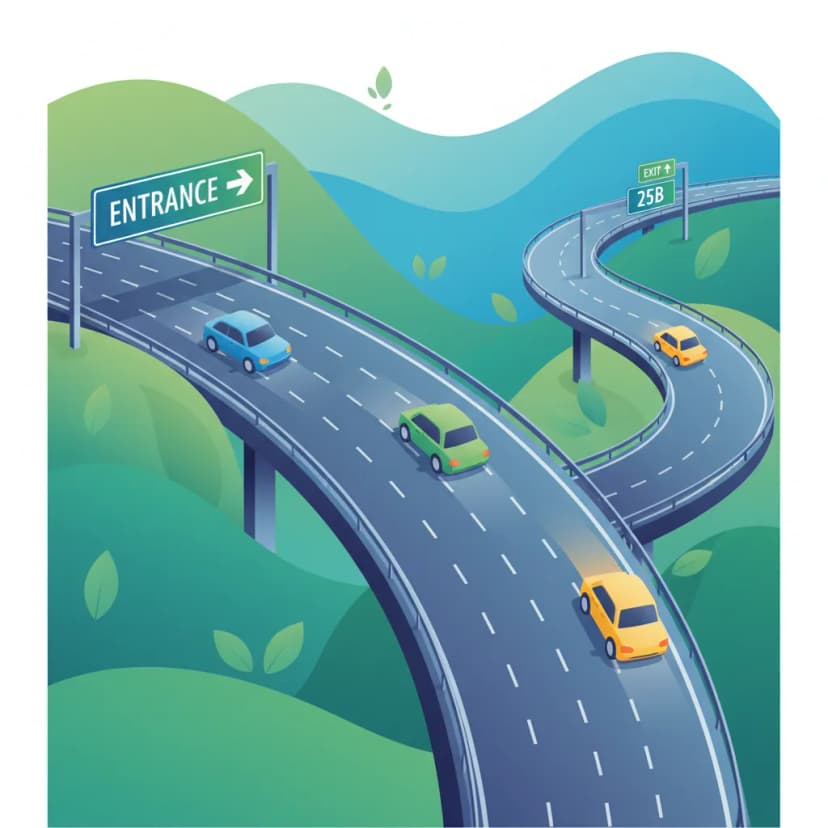
This lesson provides a step-by-step guide to motorway riding. You will learn the correct technique for accelerating on an on-ramp and merging smoothly into high-speed traffic. The content also covers maintaining proper lane discipline, executing safe overtakes, keeping a safe following distance at speed, and planning for your exit well in advance to ensure a smooth and stress-free experience on Sweden's fastest roads.
This lesson covers the critical maneuvers of overtaking and merging, which require precise judgment and communication. You will learn how to assess traffic speed and gaps, the importance of checking blind spots, and the correct use of signals to indicate your intentions. The content includes procedures for merging onto motorways from an on-ramp and how to perform safe overtaking maneuvers on various types of roads, minimizing risk to yourself and others.

This lesson provides a complete guide to motorway driving in Sweden. You will learn the correct procedures for merging from an on-ramp, maintaining proper lane discipline by keeping right unless overtaking, and exiting safely via off-ramps. The content emphasizes the importance of maintaining large safety margins at high speeds, checking blind spots thoroughly before any lane change, and knowing the correct safety procedures in case of a breakdown.
This lesson provides clear guidance on selecting the appropriate lane on multi-lane roads to match your intended direction of travel. It covers the rules and best practices for moving into turning lanes, positioning for overtakes, and maintaining a steady course. The focus is on making early, predictable decisions to ensure smooth integration with surrounding traffic.

This lesson tackles the challenge of navigating some of the most complex road features, such as large multi-lane roundabouts and grade-separated interchanges. You will learn the importance of advance planning, choosing the correct lane on approach, clear signaling, and comprehensive observation to safely move through these busy areas. Mastering these junctions is a key indicator of an advanced and competent rider who can handle any road layout.
This lesson provides detailed guidance on navigating complex traffic points such as signalized intersections, multi-lane roundabouts, and pedestrian crossings. You will learn the correct procedures for entering and exiting roundabouts, the specific rules for yielding to pedestrians and cyclists at designated crossings, and how to interpret complex traffic light signals. These skills are vital for safe urban and suburban riding, where interaction with vulnerable road users is frequent.

This lesson focuses on creating a complete awareness of the traffic situation around your vehicle. You will learn the correct procedure for using your interior and side mirrors in a continuous scanning pattern. Crucially, the lesson explains what the blind spot (döda vinkeln) is, where it is located, and why a physical head check over the shoulder is a non-negotiable safety step before any lateral movement like changing lanes or turning.

This lesson focuses on the variety of road markings used on Swedish roads and their meaning for motorcyclists. You will learn the difference between solid and broken lines regarding overtaking, how to position yourself correctly at intersections based on markings, and how to interpret symbols painted on the road surface. Adhering to these markings is essential for maintaining correct lane discipline and ensuring predictability for other road users.

This lesson focuses on the unique demands of managing speed in high-speed environments like motorways. You will learn techniques for maintaining a steady, appropriate speed that matches the flow of traffic, how to perform smooth overtakes, and the importance of increasing your following distance. It also covers physical factors such as managing wind blast and maintaining stability when riding near large trucks, ensuring a safe and controlled high-speed riding experience.
This lesson teaches the correct methodology for negotiating curves and turns of varying sharpness. You will learn the principle of 'slow in, fast out,' involving braking before the curve and gently accelerating through it to maintain stability and grip. The lesson also covers how to choose the correct line (placering) through a bend and how to use your vision effectively to look far ahead for a safe and controlled passage.
Learn about essential driving theory concepts like the zipper principle (dragkedjeprincipen) and how cooperation between road users ensures safe and efficient traffic flow. This covers interactions during lane changes and merging.

This lesson provides in-depth analysis of how to safely interact with the full spectrum of road users. You will learn about the specific characteristics of each, such as the large blind spots of trucks, the potential for sudden movements from cyclists, and the unpredictability of pedestrians. The content teaches strategies for communication, anticipation, and defensive positioning to ensure safe and respectful coexistence on the road for everyone.

This lesson focuses on the unique challenges of driving in urban environments. You will learn techniques for anticipating the actions of vulnerable road users like pedestrians and cyclists, especially near crossings and bus stops. The content covers how to navigate narrow streets, one-way systems, and areas with heavy traffic, emphasizing the need for lower speeds, heightened awareness, and a defensive mindset.
This lesson focuses on the specific techniques required for riding in busy city and town environments. You will learn how to maintain correct lane positioning amidst dense traffic, navigate complex intersections with multiple signals, and manage the motorcycle at low speeds in stop-and-go conditions. Emphasis is placed on heightened awareness of pedestrians, cyclists, and vehicles making sudden maneuvers, which are common hazards in urban settings.
This lesson provides detailed guidance on navigating complex traffic points such as signalized intersections, multi-lane roundabouts, and pedestrian crossings. You will learn the correct procedures for entering and exiting roundabouts, the specific rules for yielding to pedestrians and cyclists at designated crossings, and how to interpret complex traffic light signals. These skills are vital for safe urban and suburban riding, where interaction with vulnerable road users is frequent.
This lesson teaches the correct methodology for negotiating curves and turns of varying sharpness. You will learn the principle of 'slow in, fast out,' involving braking before the curve and gently accelerating through it to maintain stability and grip. The lesson also covers how to choose the correct line (placering) through a bend and how to use your vision effectively to look far ahead for a safe and controlled passage.
This lesson focuses on the high level of caution required when driving in residential areas. You will learn about the rules for special zones like 'gångfartsområde' (walking speed area) and the need to navigate around speed calming measures like speed bumps. The central theme is anticipating unpredictable behavior from residents, especially children, and managing the risks posed by parked cars that severely limit visibility.

This lesson teaches the crucial skill of adapting your speed to the dynamic and often congested conditions of urban riding. You will learn to modulate your speed smoothly in response to traffic flow, pedestrian activity, and complex intersections to maintain safety and control. Techniques covered include using engine braking effectively, anticipating the actions of other road users, and selecting a speed that maximizes your reaction time in a high-density environment.

This lesson teaches you how to analyze and assess risk when sharing the road with a variety of users, from large trucks to cyclists and pedestrians. You will learn to recognize common patterns of behavior and potential conflict points, allowing you to anticipate the actions of others before they create a dangerous situation. Developing this predictive mindset is a cornerstone of defensive riding and is key to staying safe in busy, complex traffic environments.
This lesson focuses on safe interaction with cyclists. You will learn to differentiate between a 'bicycle crossing' (cykelöverfart), where you have a duty to yield, and a 'bicycle passage' (cykelpassage), where specific priority rules apply. The content stresses the importance of leaving adequate space when overtaking cyclists and the critical danger of the 'right-hook' accident, emphasizing the need to check mirrors and blind spots carefully before turning right.
This lesson tackles the challenge of navigating some of the most complex road features, such as large multi-lane roundabouts and grade-separated interchanges. You will learn the importance of advance planning, choosing the correct lane on approach, clear signaling, and comprehensive observation to safely move through these busy areas. Mastering these junctions is a key indicator of an advanced and competent rider who can handle any road layout.
Find clear answers to common questions learners have about Merging and Lane Changes (Omkörning). Learn how the lesson is structured, which driving theory objectives it supports, and how it fits into the overall learning path of units and curriculum progression in Sweden. These explanations help you understand key concepts, lesson flow, and exam focused study goals.
The zipper principle, or dragkedjeprincipen, is a method used when two lanes merge into one. Drivers from both lanes should take turns merging, much like teeth on a zipper. This ensures a smoother and more efficient flow of traffic. You should not try to force your way in; instead, allow drivers from the other lane to merge when it's their turn, and vice versa.
You must check your blind spot immediately before you change lanes or merge. This check should be done after you have checked your mirrors and signalled your intention. The blind spot is an area not covered by your mirrors, and a quick head turn is necessary to ensure no vehicle or cyclist is present in that critical zone.
An acceleration lane allows you to increase your speed to match that of the traffic already on the motorway. Start by checking traffic in your mirrors and blind spot. Accelerate steadily along the lane, observing the flow of traffic on the main road. Find a safe gap, signal your intention to merge, and steer smoothly into the gap when it's safe to do so. Never merge if it forces other drivers to brake sharply.
While this lesson focuses on moving traffic, it's important to distinguish. Stopping typically means halting temporarily for traffic conditions (like a red light or merging). Parking means leaving the vehicle unoccupied. For merging and lane changes, the goal is to integrate smoothly into moving traffic, not to stop. Stopping inappropriately on an acceleration lane or motorway is dangerous and illegal.
Yes, you should be aware of signs indicating lane endings, lane merges, and general traffic flow changes. Signs related to 'Omkörning' (overtaking) or 'Väjningsplikt' (yielding) may also be relevant if a lane is ending and you must yield to traffic in the open lane. Understanding traffic signal information is also key.