
This lesson focuses on safely interacting with cyclists, a crucial skill for navigating Swedish roads. Understanding specific rules for bicycle crossings (cykelöverfart) and passages (cykelpassage) is key to preventing accidents and ensuring smooth traffic flow. It builds on general priority rules and prepares you for complex urban and suburban driving scenarios relevant to the Category B theory exam.

Driving on Swedish roads requires a thorough understanding of how to interact safely with all road users, especially those who are more vulnerable. Cyclists, due to their lack of protective enclosure and lower mass, fall into this category. This lesson provides essential knowledge for drivers of Category B cars on navigating around cyclists, focusing on specific Swedish road features like bicycle crossings (cykelöverfart) and bicycle passages (cykelpassage), as well as general safety principles such as safe overtaking and preventing the dangerous "right-hook" collision. Mastering these rules is vital not only for passing your Swedish driving theory test but, more importantly, for ensuring the safety of everyone on the road.
In the Swedish traffic system, cyclists are categorized as vulnerable road users. This designation reflects their increased risk of severe injury or fatality in the event of a collision with a motor vehicle. Unlike car occupants, cyclists have no crumple zones, airbags, or steel cage protection. This inherent vulnerability necessitates specific rules and a heightened sense of awareness from motor vehicle drivers. The design of traffic laws and infrastructure aims to create predictable and safer environments for cyclists, placing a significant responsibility on drivers to anticipate their presence and yield when required.
Collisions involving cyclists often result in disproportionately severe outcomes for the cyclist. Even at low speeds, the forces involved can cause serious injuries. As a driver, recognizing the vulnerability of cyclists is the first step towards safe interaction. This awareness should translate into a proactive driving style that prioritizes observation, adequate spacing, and strict adherence to priority rules. A driver's ability to safely interact with cyclists is a cornerstone of responsible driving and is crucial for promoting a harmonious and safe traffic environment for all users.
Swedish road infrastructure includes specially designed and marked facilities to manage the flow of cyclists and ensure their safety at potential conflict points. Two primary facilities that drivers must clearly understand are the cykelöverfart (bicycle crossing) and cykelpassage (bicycle passage). These are distinct from each other and carry different priority rules.
A cykelöverfart, translated as a bicycle crossing, is a designated section of a road where cyclists have a legal right-of-way to cross the carriageway. These crossings are typically found at intersections or mid-block locations where a bicycle path meets a road. They are clearly identified by specific visual cues:
When you approach a cykelöverfart, your primary duty as a driver is to slow down, be prepared to stop, and yield to any cyclist who is already on the crossing or clearly about to enter it. This rule applies even if the cyclist is approaching from the opposite side of the road and intending to cross your path. It's also important to remember that overtaking is strictly prohibited on the crossing itself; it is considered a "no-overtake" zone to ensure the safety of crossing cyclists.
The rule to yield at a cykelöverfart is absolute and does not depend on the presence of traffic lights or other priority signs that might apply to general vehicle traffic. A common misunderstanding among drivers is to assume that a green traffic light for vehicles automatically overrides a cyclist's priority at a crossing. This is incorrect. If a cyclist is on the cykelöverfart, you must yield, regardless of the traffic signal. This ensures that cyclists can cross without needing to stop or check for vehicle traffic, making their journey more predictable and safer.
In contrast to a cykelöverfart, a cykelpassage (bicycle passage) is a designated lane or portion of the road where cyclists travel in the same direction as motor vehicles. These passages are typically found alongside vehicle lanes, often to the right, and serve to provide a continuous path for cyclists through intersections or along road segments.
A cykelpassage is identified by:
cykelpassage.The practical meaning for drivers is that vehicles may not cut into or abruptly cross a cykelpassage to overtake a cyclist unless a safe gap exists and the maneuver can be completed with ample clearance. The most critical rule associated with a cykelpassage concerns turning vehicles, particularly when making a right turn.
When a vehicle intends to turn right across a cykelpassage, the driver has a mandatory duty to yield to any cyclist who is continuing straight ahead in that passage. This is a crucial rule designed to prevent "right-hook" collisions, which are among the most common and dangerous types of accidents involving cyclists. Drivers must actively check for cyclists in the passage and wait until their path is clear before initiating the turn. This priority for cyclists applies even if your vehicle has a green light or seems to have the right-of-way based on other rules; the cyclist's continuous straight path in their designated passage takes precedence.
Beyond understanding the specific facilities, several overarching safety principles are fundamental to safe interaction with cyclists. These principles revolve around maintaining adequate space, comprehensive observation, and clear communication.
One of the most direct ways to ensure cyclist safety is by maintaining a sufficient lateral (side-to-side) distance when overtaking. The law in Sweden specifies a minimum safe lateral clearance:
This rule applies universally on all road types, day and night. Achieving this clearance often requires drivers to adjust their speed, move to an adjacent lane if safe and available, or even wait behind the cyclist until a suitable opportunity for a safe overtake presents itself. It's not just about avoiding contact; it's about providing enough space for the cyclist to react to road hazards, gusts of wind, or unexpected movements without being endangered by a passing vehicle.
The "right-hook" collision is a particularly insidious type of accident that occurs when a driver turns right across the path of a cyclist who is traveling straight alongside them. This often happens because the driver fails to adequately check their mirrors and blind spots. Cyclists can easily disappear from view in a vehicle's blind spot, especially immediately before a turn.
To prevent a right-hook collision, drivers must perform a thorough three-point check before initiating any right turn:
Signal your right turn well in advance.
Adjust your speed and position your vehicle appropriately for the turn.
Perform a systematic mirror check: rear-view mirror, then right-hand side mirror.
Crucially, execute a quick, deliberate right-shoulder check to cover your blind spot.
If a cyclist is detected in the bicycle passage or approaching from behind, yield to them until they have cleared your intended turning path.
Only initiate the turn when the path is completely clear and safe.
This comprehensive observation is mandatory before any right turn, lane change, or overtaking maneuver that could affect a cyclist. Relying solely on mirrors is insufficient, as modern vehicles have significant blind spots.
The ability to quickly and accurately identify the visual cues that delineate a cykelöverfart or cykelpassage is fundamental for safe driving. These markings and signs are not merely decorative; they are legally binding instructions for all road users.
Drivers must scan the road ahead for these cues from a reasonable distance (e.g., at least 30 meters) to allow sufficient time to slow down, adjust lane position, and prepare to yield or overtake safely. Failure to recognize and react to these markings can lead to violations and, more importantly, dangerous situations. Even if markings appear faded, they remain legally effective until officially removed or replaced.
The rules governing interactions between drivers and cyclists are enshrined in Swedish traffic law, primarily the Trafikförordning (Traffic Ordinance) and Vägtrafiklag (Road Traffic Act). Adherence to these regulations is not just about avoiding fines; it's about fulfilling your responsibility as a driver to ensure safety.
Cykelöverfart: As per Trafikförordning (1998:1276) § 7, drivers must yield to cyclists on a marked cykelöverfart. This means slowing down and stopping if necessary to allow cyclists to cross without impediment.Cykelpassage: Trafikförordning § 8 mandates that when turning right, drivers must yield to cyclists travelling straight ahead in a cykelpassage. This rule is crucial for preventing right-hook collisions.The Vägtrafiklag (1971:291) 3 kap. § 3 establishes the minimum lateral clearance required when overtaking cyclists: at least 1.5 meters if practicable, and never less than 1 meter. This legal requirement aims to provide a safety buffer and reduce the severity of injuries if an incident were to occur. It demands careful judgment from drivers about road width, traffic conditions, and cyclist behavior.
Trafikförordning § 5 implies a general duty to ensure safety before any maneuver, including lane changes or turns that could affect a cyclist. This explicitly necessitates a thorough shoulder check to detect cyclists in blind spots.Trafikförordning § 12 (2 b) states that drivers must use additional lighting (such as flashing lights or additional low-beam) when overtaking a cyclist at night on roads without adequate illumination. This significantly enhances mutual visibility and reduces collision risk in darkness.Drivers, even experienced ones, can make mistakes when interacting with cyclists. Awareness of these common errors is the first step toward correction and safer driving.
| Violation | Why It’s Wrong | Correct Behavior | Potential Consequence |
|---|---|---|---|
| Turning right without checking the bicycle passage | Ignores the cyclist’s right-of-way and blind spots, leading to right-hook collisions. | Perform mirror + shoulder check; wait for cyclist to clear passage before turning. | Injury/death of cyclist; driver may receive a fine and penalty points. |
| Overtaking a cyclist with < 1 meter clearance | Violates minimum safe distance, increasing injury severity in case of contact. | Slow down, wait for a wider gap, or overtake with ≥ 1.5 m when possible. | Legal penalty; higher risk of severe cyclist injury. |
| Assuming a cyclist will move out of the way at a crossing | Places the burden on the vulnerable cyclist; the law gives the driver the responsibility to stop. | Stop before the crossing; allow the cyclist to cross fully. | Near-miss or collision; possible reckless driving charge. |
| Driving in a bicycle lane to bypass traffic | Occupies space reserved for cyclists, creating unpredictable and dangerous situations. | Remain in the proper vehicle lane; only enter a bicycle lane when explicitly permitted (e.g., for turning at a designated merge point). | Fine; increased crash risk. |
| Relying solely on automatic emergency braking (AEB) to avoid cyclists | AEB systems may not react quickly enough or detect all vulnerable users. | Maintain manual vigilance; use mirrors and shoulder checks as the primary method. | Overreliance can lead to missed detection and collisions. |
| Turning right on a green light while a cyclist is in the adjacent passage | Right-turn priority at a light does not override the cyclist's right-of-way in their passage. | Treat the cyclist as having priority; delay the turn until the lane is clear. | Right-hook collision. |
Many common errors stem from misunderstandings about priority or overconfidence in one's own visibility. For instance, assuming a cyclist will always yield or that they are always visible in your mirrors are dangerous assumptions. Cyclists may be less experienced, distracted, or simply not expect a vehicle to turn into their path. Always drive defensively and according to the rules, anticipating potential hazards.
Safe interaction with cyclists isn't a one-size-fits-all approach. Drivers must constantly adapt their behavior based on prevailing conditions, which can significantly affect visibility, reaction times, and overall safety.
cykelöverfart and cykelpassage markings. Drivers will frequently need to perform right-hook checks and be prepared to yield. Lower speeds are common, but the density of traffic and potential conflicts are higher.The rules and regulations for interacting with cyclists are not arbitrary; they are based on fundamental principles of physics, human physiology, and psychology, all aimed at minimizing risk and maximizing safety.
½mv²) dictates the severity of an impact. A collision between a lightweight cyclist and a heavy motor vehicle transfers immense kinetic energy to the cyclist. Increasing lateral distance and reducing speed both work to minimize the potential for impact and reduce the forces if a collision were to occur.Psychological factors, such as "attentional tunneling" (focusing intensely on one element and missing others) or confirmation bias (only seeing what you expect to see), can contribute to collisions with cyclists. Structured observation routines, such as the three-point check, are designed to counteract these human tendencies and ensure comprehensive awareness. Data from the Swedish Transport Administration consistently shows that a significant percentage of cyclist-involved collisions occur during right-turn maneuvers, underscoring the critical importance of right-hook avoidance strategies.
Applying these rules in real-world driving situations is key to safe driving. Consider these scenarios:
cykelöverfart, allows the cyclist to clear the crossing completely, then proceeds safely.Understanding how to interact safely with cyclists is a critical part of becoming a responsible driver. These principles extend to all vulnerable road users and contribute to a safer, more predictable traffic environment for everyone.
Lesson content overview
Explore all units and lessons included in this driving theory course.
Explore search topics learners often look for when studying Cyclists and Bicycle Lanes. These topics reflect common questions about road rules, driving situations, safety guidance, and lesson level theory preparation for learners in Sweden.
Browse additional driving theory lessons that cover connected traffic rules, road signs, and common driving situations related to this topic. Improve your understanding of how different rules interact across everyday traffic scenarios.
Explore detailed Swedish traffic laws regarding cyclists. Understand the distinction between 'cykelöverfart' and 'cykelpassage', learn precise safe overtaking distances, and master yielding rules at crossings to prevent accidents and ensure road safety.
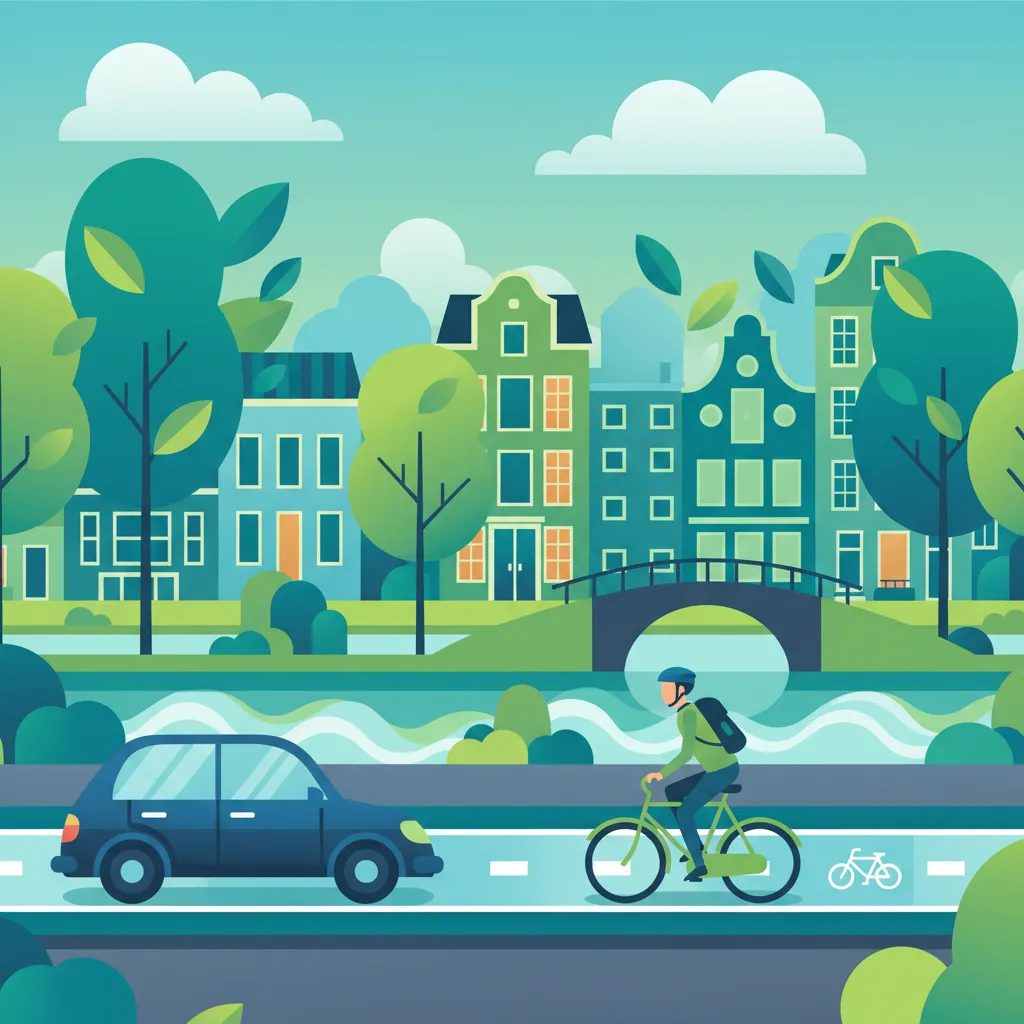
This lesson details the best practices for sharing the road with cyclists, who are even more vulnerable than moped riders. It explains the legal requirements and safe etiquette for overtaking cyclists, emphasizing the need to provide ample space. The content also reviews the rules of interaction on designated cycle paths (Cykelbana) where both may be present.

This lesson provides detailed guidance on navigating complex traffic points such as signalized intersections, multi-lane roundabouts, and pedestrian crossings. You will learn the correct procedures for entering and exiting roundabouts, the specific rules for yielding to pedestrians and cyclists at designated crossings, and how to interpret complex traffic light signals. These skills are vital for safe urban and suburban riding, where interaction with vulnerable road users is frequent.
This lesson covers the critical maneuvers of overtaking and merging, which require precise judgment and communication. You will learn how to assess traffic speed and gaps, the importance of checking blind spots, and the correct use of signals to indicate your intentions. The content includes procedures for merging onto motorways from an on-ramp and how to perform safe overtaking maneuvers on various types of roads, minimizing risk to yourself and others.

This lesson introduces the core principles of right-of-way in Sweden, including the general duty to give way (Väjningsplikt) and the stricter stop duty (Stopplikt). It explains the concept of a priority road and how to apply the right-hand rule at uncontrolled intersections. By understanding this legal framework, riders can determine who has priority in any given situation and act predictably and safely.

This lesson examines a variety of special situations where standard priority rules are modified. You will learn about the 'exit rule' (utfartsregeln) when entering a road from property, your duty to yield to buses indicating a departure from a stop, and the specific rules for pedestrian-only streets (gågata). The content also covers interactions with trams, emergency vehicles, and procedures at railway crossings, highlighting situations that demand maximum vigilance.

This lesson addresses the specific challenges and priority rules associated with riding in tunnels and on bridges. You will learn about lane restrictions, speed adaptation in low-light conditions, and the increased importance of maintaining a safe following distance in enclosed spaces. Furthermore, it covers how to manage the effects of strong crosswinds on bridges, a significant hazard for motorcyclists, ensuring you can maintain stability and control.

This lesson teaches practical methods for maintaining a safe buffer to the vehicle ahead, with a primary focus on the universally recommended 'three-second rule'. You will learn how to apply this rule by picking a fixed point and counting the seconds until you pass it. The content also explains why this distance must be increased significantly in adverse conditions such as rain, snow, or when following large vehicles that obstruct your view.

This lesson explains the two core principles of priority in Swedish traffic law: the right-hand rule (Högerregeln) and the duty to yield (Väjningsplikt). You will learn how to apply the right-hand rule at uncontrolled intersections and when to yield to other traffic as indicated by signs or road markings. Understanding this fundamental hierarchy is crucial for making correct and safe decisions in a wide variety of common traffic situations you will face as a motorcyclist.

This lesson explains a motorcyclist's legal duty when encountering emergency vehicles with active sirens and lights. You will learn the correct procedure for yielding the right-of-way by safely pulling over and stopping. Additionally, the lesson covers the rules and best practices for sharing the road with public transport like buses and trams, including navigating around bus stops and respecting dedicated lanes, to ensure safety for all road users.

This lesson details a driver's responsibility towards pedestrians. You will learn the strict rule of yielding to pedestrians who are on or about to enter a marked, uncontrolled crosswalk. The content also covers the specific, highly restrictive rules for driving in designated pedestrian zones (gågata) and 'walking speed' areas (gångfartsområde), where pedestrians have complete priority and vehicle traffic is severely limited.
Learn to identify and prevent dangerous 'right-hook' collisions with cyclists. This lesson focuses on critical mirror checks and blind spot awareness before turning right, ensuring safe interaction with cyclists and other vulnerable road users in urban environments.

This lesson provides critical strategies for dealing with one of the biggest dangers in traffic: blind spots. You will learn the importance of the shoulder check and how to position yourself on the road to be more visible to other drivers. The lesson also trains you to scan the road surface ahead for hidden hazards like potholes, gravel, or oil spills that can pose a significant threat to a motorcycle's stability, teaching you to see and avoid them in time.
Find clear answers to common questions learners have about Cyclists and Bicycle Lanes. Learn how the lesson is structured, which driving theory objectives it supports, and how it fits into the overall learning path of units and curriculum progression in Sweden. These explanations help you understand key concepts, lesson flow, and exam focused study goals.
A cykelöverfart (bicycle crossing) is a marked area on the road specifically for cyclists to cross. As a driver, you have a duty to yield to cyclists on a cykelöverfart. A cykelpassage is an area where a cycle path crosses the road, often integrated with a pedestrian crossing or at an intersection. Here, specific priority rules apply, usually meaning cyclists on the passage have priority, but drivers must still exercise caution and check for cyclists.
You must always yield to cyclists at a designated bicycle crossing (cykelöverfart). For bicycle passages (cykelpassage), priority rules are more complex and depend on the intersection design, but generally, cyclists have priority when crossing the road. You must also yield if a cyclist is entering the roadway from a private driveway or path. Always be alert and ready to yield if a cyclist's path is in danger.
A 'right-hook' accident occurs when a driver turning right fails to see a cyclist travelling straight ahead and collides with them. To avoid this, always check your right mirror and blind spot thoroughly before making a right turn, especially when cyclists are present or approaching. Anticipate that cyclists may be in your blind spot and be prepared to wait for them to pass safely.
Swedish regulations require you to leave at least 1.5 meters of space when overtaking cyclists on roads with a speed limit of 50 km/h or less. On roads with higher speed limits, or where overtaking is difficult, you should maintain an even greater distance, ideally 2 meters or more. Always reduce your speed when overtaking and ensure you have completed the manoeuvre safely before merging back into your lane.
Yes, designated bicycle lanes (cykelfält) are for cyclists only. Drivers must not drive or park in them. Cyclists using a bicycle lane generally have priority within that lane. When preparing to turn or change lanes, be aware of cyclists using these lanes, as they may not always be visible immediately. Always check your mirrors and surroundings.