
This lesson focuses on the essential skills for safely navigating turns, corners, and curves, a crucial aspect of the Swedish Category B driving theory. Building on basic vehicle control, we'll explore techniques for maintaining stability and making correct decisions in varied road conditions to ensure you're well-prepared for the official exam.

Navigating turns, corners, and curves is a fundamental aspect of driving that demands precise control, careful planning, and a deep understanding of vehicle dynamics. This lesson, part of the Swedish Driving License Theory Course for Category B Cars, will equip you with the essential knowledge and techniques to safely and efficiently negotiate bends of varying sharpness. Mastering curve negotiation is crucial, as a significant portion of single-vehicle collisions occur on curves due to improper speed or control. By applying the principles discussed here, you will reduce the risk of skidding, maintain lane integrity, and enhance your overall safety on Swedish roads.
To safely navigate a curve, it is essential to grasp the physical forces at play that influence your vehicle's stability and grip.
When a vehicle travels around a curve, it experiences a perceived outward push known as centrifugal force. This force is not a true physical force but rather the inertia of the vehicle trying to continue in a straight line. To counteract this, a real inward force, called centripetal force, is required, which is primarily provided by the friction between your tyres and the road surface.
The magnitude of this required centripetal force is directly proportional to the square of your speed ((v²)) and inversely proportional to the radius ((r)) of the curve. This means that even a small increase in speed can significantly increase the demand for tyre grip.
Your tyres can only provide a finite amount of grip, which is determined by the friction coefficient ((\mu)) between the tyre rubber and the road surface. This coefficient varies dramatically with road conditions: it is high on dry asphalt but significantly lower on wet, icy, or snowy surfaces. If the required centripetal force at a given speed exceeds the available tyre-road friction, the tyres will lose grip, leading to a skid or loss of control.
As you accelerate, brake, or steer, the weight of your vehicle shifts. This phenomenon is known as load transfer.
Understanding load transfer is critical because it directly influences which tyres have the most grip at any given moment. Effective curve negotiation involves managing these shifts to maintain optimal tyre contact and stability throughout the turn.
The "slow-in, fast-out" principle is a fundamental technique for safe and efficient curve negotiation. It dictates that you should reduce your speed before entering a curve, maintain a steady and appropriate speed through the curve, and gently accelerate upon exit.
This principle is designed to:
The line (placering) you choose – the specific path your vehicle takes through a curve – significantly impacts the safety and smoothness of your drive. The goal is to maximize the effective radius of the curve, which reduces the required steering angle and lateral forces, thereby increasing stability.
For most curves, the optimal line follows an outside-inside-outside trajectory within your lane:
While a general "outside-inside-outside" line is standard, the timing of hitting the apex can vary:
Under Swedish traffic law, specifically Trafikförordning § 71-1, vehicles must remain within lane markings unless overtaking or avoiding an obstacle. "Cutting the corner" by crossing into the opposite lane is not only illegal but also extremely dangerous, as it risks head-on collisions. Always maintain your chosen line strictly within your designated lane.
Your vision is your most critical tool when negotiating curves. Employing the vision-lead or look-ahead technique means continuously directing your gaze towards your intended path, specifically focusing on a point far ahead, rather than just the immediate road in front of your vehicle.
Precise control of the brake and accelerator pedals is paramount for maintaining stability and grip in curves.
Progressive braking involves applying brake pressure smoothly and gradually increasing it to achieve the desired deceleration. This smooth application prevents sudden weight transfer and allows the tyres to maintain optimal grip.
For maximum deceleration without locking the wheels, you can use threshold braking. This involves applying brake pressure to the point just before the wheels lock up (or before the Anti-lock Braking System (ABS) activates). This technique ensures that the tyres are generating maximum friction for braking, while still allowing for steering control.
Once you have passed the apex of the curve and are beginning to unwind the steering, gently and progressively apply the accelerator. This serves several purposes:
Consider using engine braking (downshifting to use the engine's resistance to slow the vehicle) when approaching curves, especially on downhill sections. This helps reduce reliance on the friction brakes and can improve stability.
Not all curves are created equal. Their geometry – defined by factors like radius, central angle, and length – dictates the safe speed and optimal line.
The Trafikförordning § 17-2 clearly states that drivers must adapt their speed to road, traffic, weather, and road surface conditions. This is particularly relevant for curves. Never assume you can take a curve at the posted speed limit, especially if the curve looks sharper than average or if conditions are less than ideal.
These warning signs indicate a curve that may require a significant speed reduction. Look for supplementary signs indicating a recommended speed or a reduced speed limit.
Beyond the physics and techniques, Swedish traffic law imposes clear obligations on drivers when turning and negotiating curves.
The principles of "slow-in, fast-out" and optimal line selection remain constant, but their application requires significant adjustments based on environmental conditions.
Many accidents in curves result from predictable errors. By being aware of these pitfalls, you can consciously choose safer actions.
Late Braking: Applying brakes hard within the curve or too close to its entry.
Cutting the Apex (Inside Line): Driving on the inner lane or crossing the centre line to shorten the curve.
Accelerating Too Early (Before Apex): Applying significant throttle before the steering is straightened.
Failure to Signal: Not using turn indicators at least 150 metres before the curve, particularly if it's an intersection or involves a lane change.
Speeding on a Reduced-Limit Curve: Ignoring a specific, lower speed limit posted for a curve.
"Tunnel Vision": Focusing only on the road directly in front of the vehicle.
Mastering curve negotiation requires consistent practice and a solid theoretical foundation. Reviewing related topics will deepen your understanding and improve your driving skills.
To reinforce your knowledge and prepare for your theory test, practice applying these principles to various scenarios.
Lesson content overview
Explore all units and lessons included in this driving theory course.
Explore search topics learners often look for when studying Turning, Cornering and Curve Negotiation. These topics reflect common questions about road rules, driving situations, safety guidance, and lesson level theory preparation for learners in Sweden.
Browse additional driving theory lessons that cover connected traffic rules, road signs, and common driving situations related to this topic. Improve your understanding of how different rules interact across everyday traffic scenarios.
Understand the principles of correct road positioning and vehicle placement for safely navigating turns and curves in Swedish driving theory. Learn techniques for maintaining control and stability through bends.
This lesson provides a detailed guide to navigating Swedish roundabouts (cirkulationsplatser). Key principles include always yielding to traffic already in the roundabout and choosing the correct lane based on your intended exit. You will learn the specific rules for signalling your intention to exit, how to safely interact with cyclists, and the techniques for maneuvering through multi-lane roundabouts to maintain traffic flow and prevent accidents.
This lesson provides step-by-step instructions for performing common low-speed maneuvers, including reversing in a straight line, backing around a corner, and various types of parking. You will learn how to use reference points on your vehicle and the surroundings to position the car accurately. The paramount importance of slow speed, continuous 360-degree observation, and being prepared to stop for pedestrians or other vehicles is emphasized throughout.

This lesson focuses on creating a complete awareness of the traffic situation around your vehicle. You will learn the correct procedure for using your interior and side mirrors in a continuous scanning pattern. Crucially, the lesson explains what the blind spot (döda vinkeln) is, where it is located, and why a physical head check over the shoulder is a non-negotiable safety step before any lateral movement like changing lanes or turning.

This lesson focuses on the correct use of warning devices to protect an accident or breakdown scene. You will learn to immediately activate your hazard lights (varningsblinkers). The main focus is on the proper placement of the warning triangle, explaining how the distance from the vehicle must be adapted based on the road's speed limit and visibility to give oncoming drivers adequate time to react.

This lesson provides a complete guide to motorway driving in Sweden. You will learn the correct procedures for merging from an on-ramp, maintaining proper lane discipline by keeping right unless overtaking, and exiting safely via off-ramps. The content emphasizes the importance of maintaining large safety margins at high speeds, checking blind spots thoroughly before any lane change, and knowing the correct safety procedures in case of a breakdown.

This lesson focuses on the three fundamental inputs for controlling a car: steering, acceleration, and braking. You will learn the correct hand positioning on the steering wheel for maximum control and techniques for smooth, progressive application of the gas and brake pedals. The content explains how these inputs affect the vehicle's balance and stability, forming the basis for all advanced driving and maneuvering techniques.
This lesson focuses on the high level of caution required when driving in residential areas. You will learn about the rules for special zones like 'gångfartsområde' (walking speed area) and the need to navigate around speed calming measures like speed bumps. The central theme is anticipating unpredictable behavior from residents, especially children, and managing the risks posed by parked cars that severely limit visibility.
This lesson addresses the specific risks associated with driving on rural roads (landsvägar). You will learn how to manage higher speeds on narrow, winding roads with limited visibility due to curves and hills. The lesson covers procedures for safely overtaking slow-moving agricultural vehicles, managing encounters with oncoming traffic on narrow sections, and being constantly vigilant for wildlife, especially at dawn and dusk.
This lesson covers the critical maneuvers of merging and changing lanes. You will learn the correct technique for using an acceleration lane to match the speed of motorway traffic before merging smoothly and safely. The lesson emphasizes the importance of checking mirrors and the blind spot, signaling in good time, and applying the 'zipper principle' (dragkedjeprincipen) where lanes merge to ensure efficient and courteous traffic flow.
This lesson provides detailed guidance on navigating complex traffic points such as signalized intersections, multi-lane roundabouts, and pedestrian crossings. You will learn the correct procedures for entering and exiting roundabouts, the specific rules for yielding to pedestrians and cyclists at designated crossings, and how to interpret complex traffic light signals. These skills are vital for safe urban and suburban riding, where interaction with vulnerable road users is frequent.
Learn the crucial relationship between speed control and negotiating curves safely according to Swedish driving theory. Master the 'slow in, fast out' technique and its application in different road conditions.

This lesson emphasizes that the posted speed limit is a maximum, not a target. You will learn the principles of situational speed adaptation, which involves adjusting your speed based on factors like visibility, road geometry (curves and hills), traffic density, and potential hazards. The lesson covers specific strategies for managing speed in urban environments with pedestrians, on rural roads with hidden entrances, and on motorways to match the flow of traffic.

This lesson reinforces the core safety principle of adapting your driving to the prevailing weather conditions. You will learn why you must significantly reduce speed in heavy rain to avoid aquaplaning, how strong crosswinds can affect vehicle stability, and why reduced visibility in fog necessitates slower speeds and greater following distances. The goal is to instill a proactive approach to risk management whenever the weather is less than ideal.

This lesson teaches the crucial skill of adapting your speed to the dynamic and often congested conditions of urban riding. You will learn to modulate your speed smoothly in response to traffic flow, pedestrian activity, and complex intersections to maintain safety and control. Techniques covered include using engine braking effectively, anticipating the actions of other road users, and selecting a speed that maximizes your reaction time in a high-density environment.
This lesson focuses on the high level of caution required when driving in residential areas. You will learn about the rules for special zones like 'gångfartsområde' (walking speed area) and the need to navigate around speed calming measures like speed bumps. The central theme is anticipating unpredictable behavior from residents, especially children, and managing the risks posed by parked cars that severely limit visibility.

This lesson focuses on the unique demands of managing speed in high-speed environments like motorways. You will learn techniques for maintaining a steady, appropriate speed that matches the flow of traffic, how to perform smooth overtakes, and the importance of increasing your following distance. It also covers physical factors such as managing wind blast and maintaining stability when riding near large trucks, ensuring a safe and controlled high-speed riding experience.
This lesson addresses the specific risks associated with driving on rural roads (landsvägar). You will learn how to manage higher speeds on narrow, winding roads with limited visibility due to curves and hills. The lesson covers procedures for safely overtaking slow-moving agricultural vehicles, managing encounters with oncoming traffic on narrow sections, and being constantly vigilant for wildlife, especially at dawn and dusk.
This lesson provides a complete guide to motorway driving in Sweden. You will learn the correct procedures for merging from an on-ramp, maintaining proper lane discipline by keeping right unless overtaking, and exiting safely via off-ramps. The content emphasizes the importance of maintaining large safety margins at high speeds, checking blind spots thoroughly before any lane change, and knowing the correct safety procedures in case of a breakdown.
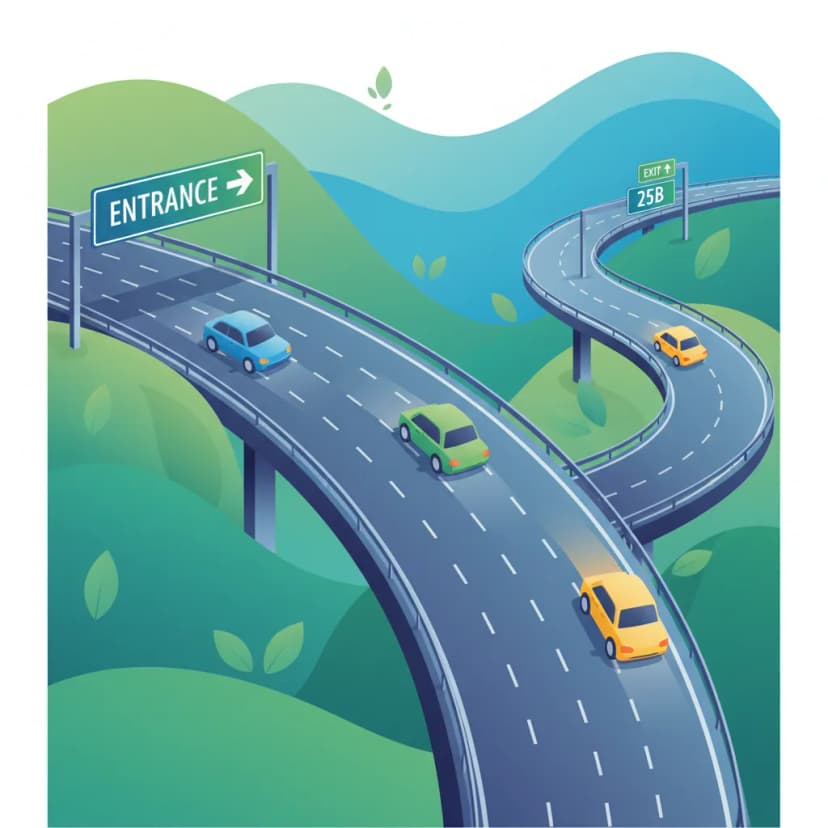
This lesson provides a step-by-step guide to motorway riding. You will learn the correct technique for accelerating on an on-ramp and merging smoothly into high-speed traffic. The content also covers maintaining proper lane discipline, executing safe overtakes, keeping a safe following distance at speed, and planning for your exit well in advance to ensure a smooth and stress-free experience on Sweden's fastest roads.
This lesson teaches the crucial skill of adapting speed to prevailing conditions, emphasizing that the posted speed limit is a maximum, not a target. It covers various scenarios such as rain, fog, heavy traffic, and poor road surfaces, explaining why reducing speed is essential for maintaining vehicle control and safety. The goal is to cultivate a proactive mindset where the rider constantly assesses risk and adjusts their speed accordingly.

This lesson focuses on developing the fine control needed for low-speed maneuvering, a common challenge in urban environments. It covers techniques for making tight turns, such as U-turns, by using a combination of clutch, throttle, and rear brake control. The goal is to build the rider's skill and confidence in handling the moped in parking lots, heavy traffic, and other confined areas.
Find clear answers to common questions learners have about Turning, Cornering and Curve Negotiation. Learn how the lesson is structured, which driving theory objectives it supports, and how it fits into the overall learning path of units and curriculum progression in Sweden. These explanations help you understand key concepts, lesson flow, and exam focused study goals.
The 'slow in, fast out' principle means you should reduce your speed before entering a curve (slow in) by braking, and then gently accelerate as you pass through and exit the curve (fast out). This helps maintain grip and stability, preventing the vehicle from losing traction or skidding. It's a fundamental technique for safe cornering in Sweden.
Choosing the correct road line (placering) through a curve is vital for both safety and efficiency. A typical line involves starting on the outside of the curve, moving towards the inside as you apex the bend, and then moving back to the outside as you exit. This maximizes your visibility, allows for smoother acceleration, and ensures you stay within your lane, avoiding potential collisions.
Effective vision is key to safe turning. You should always look as far ahead as possible through the curve, scanning for potential hazards, changes in road surface, or other vehicles. Looking where you want to go helps guide your steering and anticipate necessary adjustments, making your driving smoother and safer.
You should always aim to brake *before* entering the curve, not within it. Braking while turning can destabilise the vehicle and increase the risk of skidding, especially on slippery surfaces. The 'slow in, fast out' method emphasizes braking well in advance to achieve a safe entry speed.
While the core principles of 'slow in, fast out' and proper 'placering' apply to all curves, the degree to which you apply them will vary. Sharper curves require more significant speed reduction before entry and more precise steering input. Gentle curves allow for higher speeds and more relaxed steering. You must always adapt your speed and technique to the specific radius and visibility of the curve.