This lesson focuses on safely navigating diverse road users, a critical skill for motorcyclists in Sweden. Building on general traffic rules, you'll learn to anticipate and react to the specific behaviours and potential hazards presented by cars, trucks, cyclists, and pedestrians. Mastering this is key for your Category A motorcycle theory exam and essential for safe urban and rural riding.
Learning to ride a motorcycle safely involves mastering not only the dynamics of your own vehicle but also the complex art of interacting with all other road users. This comprehensive lesson, part of the Swedish Motorcycle Theory Course (Category A licence exam preparation), provides an in-depth analysis of how motorcyclists must coexist safely and respectfully with passenger cars, heavy trucks, cyclists, and pedestrians. Understanding the unique characteristics, vulnerabilities, and legal rights of each group is crucial for reducing collision risk, improving traffic flow, and fulfilling legal obligations under Swedish traffic law, including the Trafikförordningen (Traffic Regulations) and Vägtrafiklag 1998 (Road Traffic Act).
This guide builds upon foundational knowledge from earlier lessons, particularly concerning right-of-way rules, speed management, distance keeping, and hazard perception. By applying these principles, you will develop the essential strategies for communication, anticipation, and defensive positioning required for safe motorcycling.
Effective interaction on the road is a dynamic interplay of legal mandates, physical realities, and human psychology. As a motorcyclist, your continuous assessment of other road users' intentions, capabilities, and vulnerabilities must inform your speed, positioning, and signaling.
Swedish traffic law establishes a clear hierarchy of protection, prioritizing those with the least physical safeguarding in the event of a crash. Pedestrians are afforded the highest priority, followed by cyclists, then motorcyclists, and finally car and truck drivers. This legal ordering is designed to reduce severe injuries for the most vulnerable. For motorcyclists, this means yielding earlier, allowing substantially larger safety margins around pedestrians and cyclists, and always being prepared for their unpredictable movements.
A legal and ethical principle in traffic law that prioritizes the protection of road users based on their level of exposure and potential for severe injury in a collision, giving highest priority to pedestrians, then cyclists, then motorcyclists.
Blind spots are areas around any vehicle that the driver cannot see directly, either through mirrors or by turning their head. For cars, these are typically the rear-side zones. For heavy trucks and buses, blind spots are significantly larger, encompassing vast lateral areas alongside the cab and trailer, as well as substantial zones directly behind the vehicle. A motorcycle riding within any of these zones is effectively invisible to the driver, drastically increasing the risk of a collision, especially during lane changes or turns.
Continuously estimating your speed relative to other road users is fundamental to safe riding. This involves calculating whether a space in traffic is large enough to safely execute maneuvers like overtaking, merging, or crossing intersections. Motorcycles, with their higher acceleration and deceleration capabilities but smaller mass, are more susceptible to wind turbulence from large vehicles and require more precise gap judgement, particularly when considering their shorter braking distances compared to cars.
The speed difference between two moving objects, which significantly influences the risk of collision and the time available for reaction and maneuvering.
Clear and early communication of your intentions to other road users is paramount. This goes beyond merely activating your indicator lights. It involves using precise positioning, consistent speed, and even body language (like a head-tilt or eye-direction) to convey your next move before it becomes a surprise to others. Early, unambiguous signals improve shared situational awareness, allowing other drivers to anticipate your actions and react accordingly, thereby reducing the likelihood of unexpected maneuvers and conflicts.
Choosing an optimal road position is a proactive safety measure that minimizes your exposure to potential hazards. This often means riding slightly to the left of the lane center to maximize visibility to drivers behind you and in opposing traffic, especially when approaching intersections or riding near larger vehicles. Defensive positioning involves actively staying out of other vehicles' blind spots and maintaining escape routes, which is particularly crucial for motorcycles that are often less visible than cars.
Adjusting your speed to the type and density of surrounding road users is a critical safety practice. When vulnerable users like pedestrians and cyclists are present, or when navigating areas with a high mix of different vehicle types, reducing your speed provides more time for perception and reaction. This compensates for the inherent vulnerabilities of motorcycles, such as shorter reaction times needed for emergency braking or avoiding sudden obstacles.
Passenger cars are the most common vehicles on the road, and interactions with them form a significant portion of a motorcyclist's daily ride. Cars generally have smaller blind spots than trucks, but these can still conceal a motorcycle, especially in multi-lane traffic or during lane changes.
While smaller than a truck's, a car's blind spots are still dangerous. These typically extend from the rear wheel arch to about the middle of the back door on either side. Many drivers rely solely on their side mirrors, which do not provide a complete view. As a motorcyclist, always assume you are unseen if you are riding in these zones.
Practical Strategies:
Car drivers are accustomed to visual cues from other cars. Your motorcycle's smaller profile means your signals need to be even clearer and earlier.
Tips for Effective Communication:
When overtaking a car, assess the situation carefully. A larger gap is always safer.
Heavy trucks, buses, and other large vehicles present unique challenges for motorcyclists due to their sheer size, limited maneuverability, and substantial blind spots. Collisions involving motorcycles and large vehicles are often severe.
Trucks have enormous blind spots, often referred to as "no-zones," which extend far beyond what a car driver experiences.
Safety Implications:
Large vehicles displace a significant amount of air, creating powerful aerodynamic forces that can destabilize a motorcycle.
Mitigation Strategies:
Overtaking a truck requires careful planning and execution.
Assess visibility: Ensure you can see the truck's mirrors and, ideally, the driver's face. If you can't see them, they can't see you.
Scan ahead: Confirm that the road ahead is clear, with sufficient distance to complete the overtake without impeding oncoming traffic.
Signal early: Activate your left indicator well in advance.
Accelerate decisively: Swiftly move into the left lane, maintaining a safe lateral distance from the truck. Accelerate past the truck to minimize time spent alongside it.
Return safely: Once you can see the entire front of the truck in your rearview mirror, signal right and return to your lane, ensuring ample space.
Pedestrians and cyclists are the most vulnerable road users. As a motorcyclist, you share some of their vulnerability compared to cars and trucks, but legally, you still have greater responsibility to protect them.
Pedestrians have specific rights-of-way that motorcyclists must strictly adhere to.
Failing to yield to a pedestrian at a marked or unmarked crossing can lead to severe injury, legal liability, and significant penalties under Swedish law.
Cyclists are often less predictable than motor vehicles and can change direction or speed abruptly. They are also highly vulnerable.
Effective signaling is about more than just activating a light; it’s about conveying your intentions to everyone around you in a clear, unambiguous, and timely manner.
Your presence and how you position your motorcycle communicate volumes to other road users.
Think of your motorcycle as an extension of yourself. Your movements, even subtle ones, contribute to the overall communication with other road users.
Judging gaps in traffic is a skill honed over time, and for motorcyclists, it requires an even higher degree of precision due to the motorcycle's unique dynamics and vulnerability.
The critical process of evaluating whether a space in traffic is sufficiently large and safe to complete a desired maneuver, such as overtaking, merging, or turning, considering all relevant factors like speed, distance, and vehicle dynamics.
Intersections and roundabouts are high-risk areas due to the convergence of multiple traffic flows and diverse road users. Proper positioning and adherence to right-of-way rules are paramount.
Multi-lane roundabouts require specific lane discipline and clear signaling.
As discussed, the air turbulence created by large vehicles can significantly impact motorcycle stability. This is not just a nuisance but a genuine hazard that demands specific riding adjustments.
The physical characteristics of the road surface and its layout heavily influence safe interaction, particularly for motorcycles.
Tram tracks and metal grates are significant hazards for motorcycles due to their potential to trap a wheel or cause a loss of traction.
Swedish traffic law, primarily the Trafikförordningen (1998:1276), clearly outlines the duties and responsibilities of all road users, with particular emphasis on protecting the vulnerable.
| Rule | Statement | Applicability | Legal Status | Rationale |
|---|---|---|---|---|
| Pedestrian Right-of-Way at Crossings | Motorcyclists must stop at marked pedestrian crossings when a pedestrian is on or about to step onto the crosswalk. | All road types | Mandatory (Trafikförordningen § 4-1) | Protects the most vulnerable users by granting them priority. |
| Yield to Cyclists in Dedicated Lanes | Motorcyclists must not cross a cyclist lane unless a sufficient gap is available and the cyclist can clearly see the motorcyclist. | Urban streets with painted or physically separated cyclist lanes. | Mandatory (Trafikförordningen § 4-2) | Prevents side collisions and ensures mutual awareness for cyclist safety. |
| Blind-Spot Overtaking Rule | An overtaking maneuver is illegal if the overtaken vehicle cannot see the overtaking motorcycle in its mirrors or directly. | Overtaking cars, trucks, buses on any road. | Mandatory (Trafikförordningen §§ 3-1, 3-2) | Avoids accidents caused by hidden vehicles during overtaking. |
| Signal Requirement before Lane Change | Before changing lanes or turning, a motorcyclist must signal with the appropriate indicator (or hand signal if indicators are unavailable) at least 3 seconds prior to the maneuver. | All lane-change and turning situations. | Mandatory (Trafikförordningen § 4-4) | Provides clear intent to surrounding traffic, reducing uncertainty. |
| Speed Adaptation Near Vulnerable Users | Motorcyclists must reduce speed when approaching areas where pedestrians or cyclists are likely to be present, especially near crossings, schools, or in residential zones. | Residential and urban zones, especially near schools, parks. | Mandatory (Trafikförordningen § 3-1) | Allows for shorter stopping distances and increases reaction time to protect vulnerable road users. |
| Cyclist Overtaking on Right | Overtaking a cyclist on the right is prohibited unless the cyclist is traveling in a lane that explicitly permits it and sufficient clearance (minimum 1.5 m) is given. | Urban streets with mixed traffic. | Mandatory (Trafikförordningen § 4-5) | Prevents "right-hook" collisions where drivers fail to see cyclists on their right. |
| Tram Track Avoidance | Motorcyclists must avoid riding on tram tracks; if unavoidable, they must ride straight through with minimal steering input at low speed. | Streets with tram tracks. | Mandatory (Trafikförordningen § 4-9) | Prevents wheel lock, skidding, and loss of control. |
Awareness of common mistakes can significantly improve your safety. Many collisions stem from predictable errors in judgment or observation.
Why it's wrong: Riding too close to a truck, especially on its right side or directly behind it, places you in a "no-zone" where the driver cannot see you. A sudden lane change or turn by the truck can lead to a catastrophic collision. Correct behavior: Always assume you are invisible in a truck's blind spot. Maintain ample distance, position yourself where you can see the truck driver's mirrors, and pass swiftly and decisively when clear.
Why it's wrong: Ignoring a pedestrian at a crossing (marked or unmarked) violates fundamental traffic law and puts the pedestrian at extreme risk. Pedestrians often assume drivers will yield, especially at marked crossings. Correct behavior: Slow down well in advance of any potential crossing. Be prepared to stop. Make eye contact with pedestrians to confirm their intent, and always yield to those on or about to step onto the carriageway.
Why it's wrong: Signaling only just before or during a lane change or turn deprives other road users of critical time to react. This can lead to sudden braking, swerving, or collisions. Correct behavior: Activate your indicators at least 3 seconds before you intend to execute a maneuver. Earlier signaling, coupled with appropriate road positioning, gives others maximum warning.
Why it's wrong: While it might feel safer to hug the curb, it places you out of the primary line of sight for many drivers. It also exposes you to road debris, potholes, and can reduce your escape options. Correct behavior: In most circumstances, position your motorcycle slightly to the left of the lane center. This increases your visibility to vehicles ahead and behind, and provides a buffer zone from roadside hazards.
Why it's wrong: Cyclists often have a limited field of vision, and overtaking them on the right (unless in a dedicated right-hand lane) or without sufficient lateral clearance (less than 1.5 meters) is dangerous and often illegal. It can lead to side-swipes or cause the cyclist to lose balance. Correct behavior: Overtake cyclists on the left, providing at least 1.5 meters of lateral clearance. Ensure you have a clear view ahead and that the cyclist is aware of your presence.
Safe motorcycle interaction is highly context-dependent. Your riding strategy must adapt to changing conditions.
| Condition | Recommended Variation for Motorcyclists | Reasoning |
|---|---|---|
| Adverse Weather (Rain, Snow, Fog) | Increase following distance by 1-2 seconds (e.g., 4-5 seconds behind trucks); reduce speed; avoid overtaking large vehicles; use dipped beams and wear high-visibility gear. | Wet surfaces drastically lengthen braking distances; reduced visibility increases the perception and reaction time needed for all road users. |
| Nighttime / Low Light | Use dipped beams (and high beams when appropriate and legal), wear reflective clothing; avoid riding in other vehicles’ blind spots; increase gap behind trucks to at least 3 seconds. | Human night vision and headlight range are limited; darker conditions make smaller, less illuminated VRUs harder to see. |
| Urban vs. Rural Roads | Urban: Stay closer to lane center for visibility, respect lower speed limits, anticipate frequent pedestrian crossings and varied traffic. Rural: Anticipate higher speeds, longer sight distances, larger farm vehicles, and potential wildlife. | Different traffic densities, road design, and potential hazards alter risk profiles and required vigilance. |
| Heavy Load or Passenger | Further increase following distances (add 1 second to typical gaps); adjust braking points earlier; be aware of altered handling characteristics. | Added mass increases inertia, reducing deceleration capability and affecting motorcycle stability. |
| Presence of Vulnerable Users (VRUs) | Lower speed by 10-20 km/h when pedestrians or cyclists are within 30 meters; give at least 1.5 meters lateral clearance when passing. | VRUs have minimal protection; reduced speed allows more reaction time and minimizes impact force in a collision. |
| Poor Road Surface (Gravel, Sand, Tram Tracks) | Reduce speed significantly, avoid high-lean maneuvers; cross tram tracks straight and slowly (≤30 km/h) with minimal steering input. | Low-traction surfaces dramatically increase slip risk; tram tracks can trap wheels, leading to loss of control. |
| High Traffic Density | Adopt a "riding in the lane" technique to maintain your space; maintain consistent speed; limit unnecessary lane changes; communicate intent early and clearly. | Frequent lane changes in dense traffic increase conflict probability and reduce safety margins. |
| Wind Gusts (especially near large vehicles or open areas) | Maintain a lateral distance of ≥2 meters from large vehicles; reduce speed when strong crosswinds are detected, especially on exposed bridges or open roads. | Aerodynamic turbulence can destabilize a motorcycle, pushing it laterally and potentially causing a loss of control. |
Beyond rules and techniques, understanding the scientific and psychological principles behind safe interaction enhances your riding prowess.
Mastering safe interaction with all road users is fundamental to your success in the Swedish Motorcycle Theory Course and, more importantly, to your safety on the road. Remember these critical points:
By consistently applying these principles, rules, and strategies, you will significantly enhance your safety and contribute to a more harmonious traffic environment for everyone.
Lesson content overview
Explore all units and lessons included in this driving theory course.
Explore search topics learners often look for when studying Interaction with Cars, Trucks, Cyclists, and Pedestrians. These topics reflect common questions about road rules, driving situations, safety guidance, and lesson level theory preparation for learners in Sweden.
Browse additional driving theory lessons that cover connected traffic rules, road signs, and common driving situations related to this topic. Improve your understanding of how different rules interact across everyday traffic scenarios.
Explore advanced theory on communicating intentions and anticipating the actions of cars, trucks, cyclists, and pedestrians. This lesson enhances your ability to predict and react, ensuring safer coexistence in complex Swedish traffic environments.
This lesson teaches you how to analyze and assess risk when sharing the road with a variety of users, from large trucks to cyclists and pedestrians. You will learn to recognize common patterns of behavior and potential conflict points, allowing you to anticipate the actions of others before they create a dangerous situation. Developing this predictive mindset is a cornerstone of defensive riding and is key to staying safe in busy, complex traffic environments.
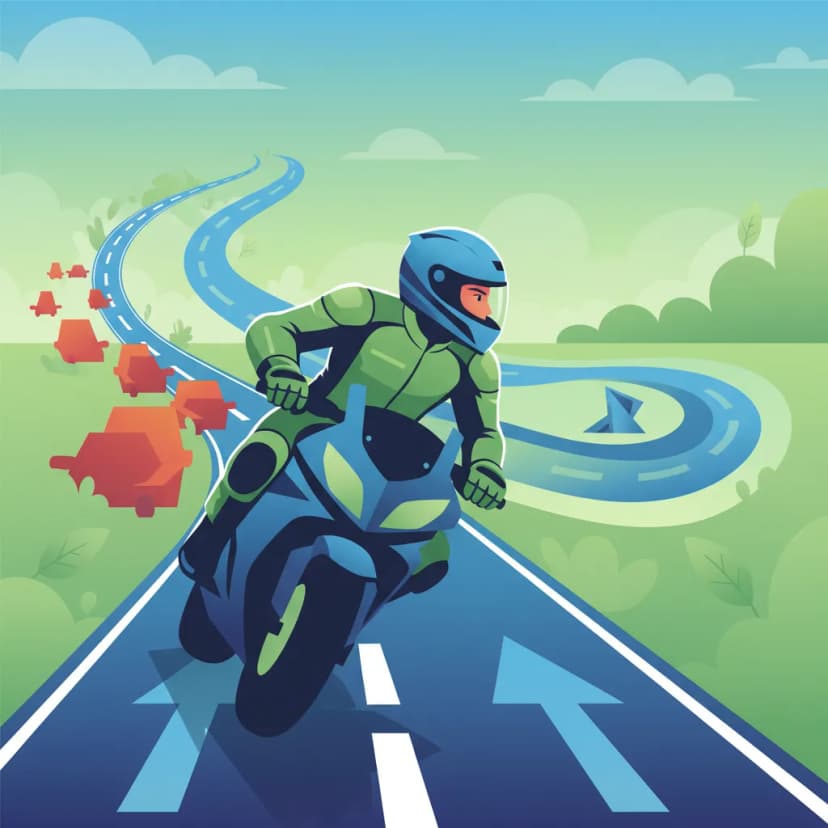
This lesson introduces the core concepts of defensive riding, which involves anticipating potential dangers and actively managing the space around your motorcycle. You will learn the technique of continuously identifying and maintaining an 'escape path'—an open space to move into if a threat suddenly appears. This proactive, forward-thinking approach dramatically reduces the chances of being trapped in a dangerous situation and is a key skill of advanced, safe riders.
This lesson provides detailed guidance on navigating complex traffic points such as signalized intersections, multi-lane roundabouts, and pedestrian crossings. You will learn the correct procedures for entering and exiting roundabouts, the specific rules for yielding to pedestrians and cyclists at designated crossings, and how to interpret complex traffic light signals. These skills are vital for safe urban and suburban riding, where interaction with vulnerable road users is frequent.
This lesson covers the correct interpretation and response to all forms of light and audible signals a motorcyclist will encounter. You will study the sequences of traffic lights, the rules for using turn indicators and hazard lights, and the legally permitted uses of the horn. Proper use of these signals is a fundamental aspect of safe riding, as it communicates your intentions clearly to other road users and helps prevent misunderstandings and collisions.

This lesson focuses on strategies to make yourself more visible to other road users, a critical factor in motorcycle safety. You will learn how to use lane positioning strategically to stay out of other drivers' blind spots and to maximize your own line of sight through corners and intersections. The content also covers the effectiveness of high-visibility and reflective clothing, as well as the correct use of lights to ensure you are seen in all conditions.
This lesson teaches the crucial skill of adapting your speed to the dynamic and often congested conditions of urban riding. You will learn to modulate your speed smoothly in response to traffic flow, pedestrian activity, and complex intersections to maintain safety and control. Techniques covered include using engine braking effectively, anticipating the actions of other road users, and selecting a speed that maximizes your reaction time in a high-density environment.
This lesson focuses on the specific techniques required for riding in busy city and town environments. You will learn how to maintain correct lane positioning amidst dense traffic, navigate complex intersections with multiple signals, and manage the motorcycle at low speeds in stop-and-go conditions. Emphasis is placed on heightened awareness of pedestrians, cyclists, and vehicles making sudden maneuvers, which are common hazards in urban settings.

This lesson goes beyond mechanical signals to cover the subtle art of non-verbal communication in traffic. It highlights the importance of making eye contact with drivers to ensure you have been seen before making a move. The content also reviews standard hand signals as a backup to electronic signals and discusses how clear, confident body language can make a rider's intentions more predictable.
This lesson focuses on Swedish warning signs designed to alert drivers to potential dangers. You will study signs indicating sharp bends, slippery surfaces, animal crossings, and temporary hazards like road construction. Correctly interpreting these signs allows a motorcyclist to proactively adjust speed, lane position, and readiness to react, which is essential for maintaining control and safety, especially in adverse weather or on unfamiliar roads.
This lesson provides practical techniques for dealing with unavoidable road surface hazards. You will learn how to approach and cross obstacles like potholes, manhole covers, and patches of debris with minimal disruption to the motorcycle's stability. The content covers adjusting your speed, choosing the best line, and using your body to absorb impacts, helping you navigate the imperfections of real-world roads safely.
Learn essential Swedish driving theory on safely navigating around large vehicles like trucks, cars, cyclists, and pedestrians. This lesson focuses on anticipating behaviours, managing blind spots, and defensive positioning for a safer ride.
This lesson teaches you how to analyze and assess risk when sharing the road with a variety of users, from large trucks to cyclists and pedestrians. You will learn to recognize common patterns of behavior and potential conflict points, allowing you to anticipate the actions of others before they create a dangerous situation. Developing this predictive mindset is a cornerstone of defensive riding and is key to staying safe in busy, complex traffic environments.
This lesson focuses on the specific challenges mopeds face when interacting with cars and heavy vehicles. It highlights the significant blind spots (or 'no-zones') around trucks and buses and teaches riders how to position themselves to remain visible. The content also covers the dangers of wind turbulence when near large vehicles and the importance of maintaining a generous space cushion.
This lesson provides detailed guidance on navigating complex traffic points such as signalized intersections, multi-lane roundabouts, and pedestrian crossings. You will learn the correct procedures for entering and exiting roundabouts, the specific rules for yielding to pedestrians and cyclists at designated crossings, and how to interpret complex traffic light signals. These skills are vital for safe urban and suburban riding, where interaction with vulnerable road users is frequent.
This lesson addresses the unique hazards associated with public transportation. It explains how to safely navigate around buses that are stopping to pick up or drop off passengers and the importance of watching for pedestrians. It also covers the physical danger of slippery tram tracks, especially when wet, and reiterates that trams typically have absolute priority.
This lesson focuses on strategies to make yourself more visible to other road users, a critical factor in motorcycle safety. You will learn how to use lane positioning strategically to stay out of other drivers' blind spots and to maximize your own line of sight through corners and intersections. The content also covers the effectiveness of high-visibility and reflective clothing, as well as the correct use of lights to ensure you are seen in all conditions.
This lesson details the best practices for sharing the road with cyclists, who are even more vulnerable than moped riders. It explains the legal requirements and safe etiquette for overtaking cyclists, emphasizing the need to provide ample space. The content also reviews the rules of interaction on designated cycle paths (Cykelbana) where both may be present.
This lesson focuses on safe interaction with cyclists. You will learn to differentiate between a 'bicycle crossing' (cykelöverfart), where you have a duty to yield, and a 'bicycle passage' (cykelpassage), where specific priority rules apply. The content stresses the importance of leaving adequate space when overtaking cyclists and the critical danger of the 'right-hook' accident, emphasizing the need to check mirrors and blind spots carefully before turning right.
This lesson focuses on the specific techniques required for riding in busy city and town environments. You will learn how to maintain correct lane positioning amidst dense traffic, navigate complex intersections with multiple signals, and manage the motorcycle at low speeds in stop-and-go conditions. Emphasis is placed on heightened awareness of pedestrians, cyclists, and vehicles making sudden maneuvers, which are common hazards in urban settings.
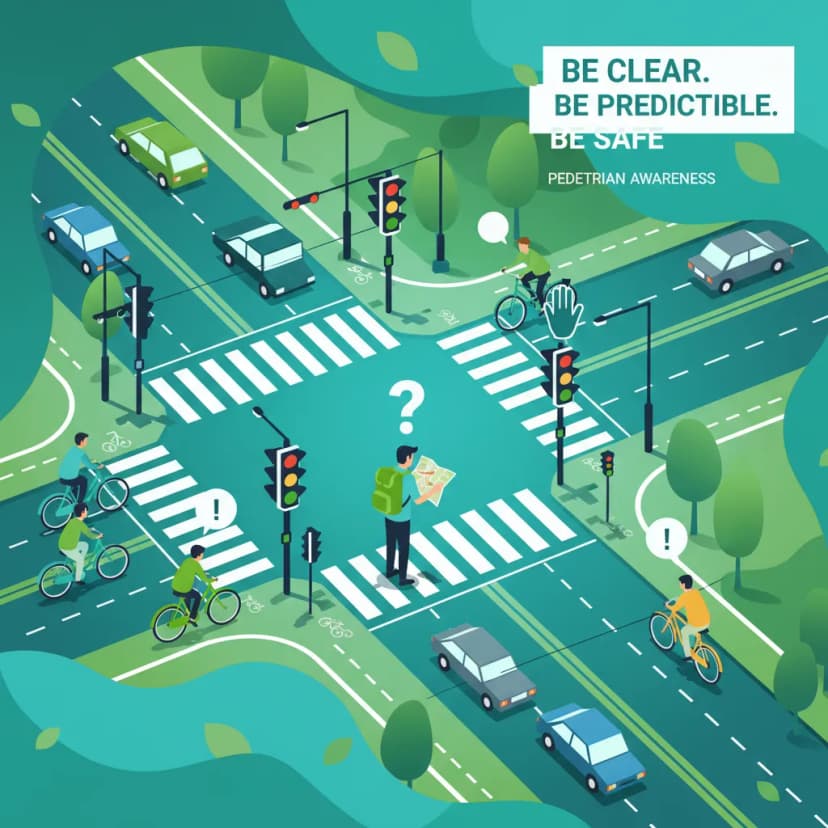
This lesson is dedicated to pedestrian safety, teaching riders to be constantly aware of people on foot, especially in busy urban environments. It reinforces the absolute duty to yield at marked crossings and encourages a cautious approach in areas like schools and shopping districts. The content stresses anticipating unpredictable actions, particularly from children or distracted pedestrians.
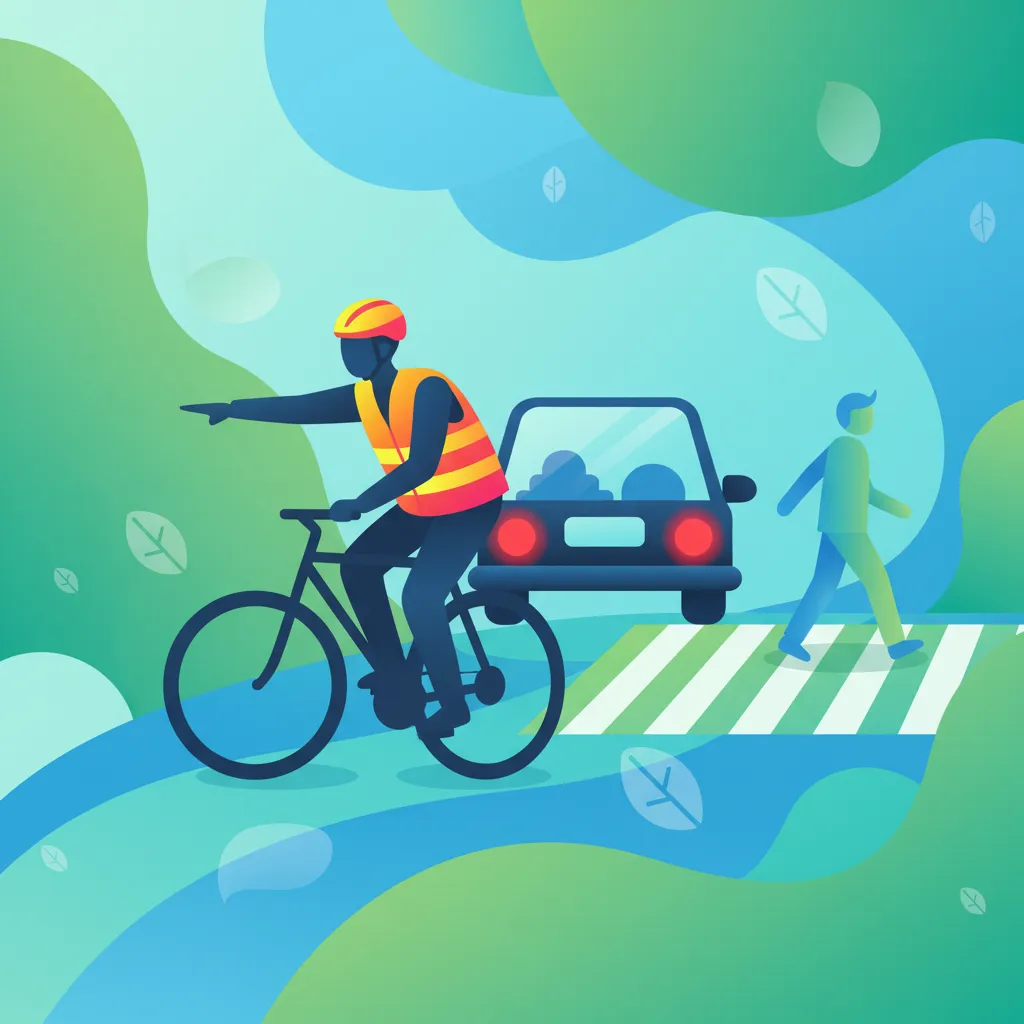
This lesson teaches you how to make an accident scene as safe as possible for yourself, any other involved parties, and approaching traffic. You will learn the correct use of hazard lights, the placement of warning triangles, and the importance of wearing a high-visibility vest. The content also covers how to identify and manage immediate post-crash hazards, such as spilled fuel or unstable vehicles, to prevent the situation from worsening.
Find clear answers to common questions learners have about Interaction with Cars, Trucks, Cyclists, and Pedestrians. Learn how the lesson is structured, which driving theory objectives it supports, and how it fits into the overall learning path of units and curriculum progression in Sweden. These explanations help you understand key concepts, lesson flow, and exam focused study goals.
Trucks have very large blind spots, known as 'no-zones', on all sides, especially directly in front, behind, and to the sides. As a motorcyclist, you must avoid these areas. Never assume the truck driver can see you; always maintain a safe distance and visible position, and be prepared for them to move unexpectedly without signalling.
When approaching a cyclist, especially on a narrow road, assess if there is sufficient space to overtake safely. If you cannot pass with at least 1.5 meters of clearance (as recommended in Sweden for vulnerable road users), you must slow down or wait behind them until it is safe. Always anticipate that cyclists may swerve to avoid obstacles like potholes.
Clear communication is vital. Use your indicators early and decisively. Position your motorcycle visibly within your lane, making eye contact with other drivers when possible. Avoid sudden movements, and be aware of how your visibility might be affected by other vehicles' blind spots.
Yes, pedestrians can be a significant risk, especially in urban areas, at crossings, and in low-visibility conditions. They may step into the road unexpectedly or misjudge your speed. Always be prepared to brake or swerve, maintain a safe speed, and be extra vigilant in areas where pedestrians are present.
Motorcycles are less visible than cars, smaller, and less stable, making them more vulnerable. Car drivers may not see you or may underestimate your speed. This means you must be more proactive in ensuring you are seen, anticipating potential actions by car drivers, and maintaining a greater safety margin.