This lesson focuses on safely navigating critical traffic points: signalized intersections, multi-lane roundabouts, and pedestrian crossings. Understanding these complex scenarios is crucial for urban and suburban motorcycle riding, building upon general priority rules from Unit 2. Mastering these skills will prepare you for specific scenarios in your Swedish Category A theory test and enhance your real-world riding safety.
Navigating the complex network of Swedish roads as a motorcyclist requires precise understanding and application of traffic rules, especially at intersections, roundabouts, and pedestrian crossings. These points are where different traffic streams converge, making them critical areas for collision prevention and smooth traffic flow. This lesson provides comprehensive guidance on safely and confidently handling these situations, vital for your Swedish Category A motorcycle theory course and for safe riding practices.
Correct interaction at these traffic points is paramount for motorcyclists. Due to a motorcycle's smaller visual profile and inherent instability compared to larger vehicles, predicting potential conflicts, maintaining adequate observation distances, and executing maneuvers with precision are crucial. A significant percentage of motorcycle collisions occur at these locations, often involving vulnerable road users such as pedestrians and cyclists.
Before delving into specific intersection types, it is essential to revisit the core Swedish priority rules that govern all road user interactions. These foundational principles ensure predictability and safety where traffic streams meet.
Väjningsplikt is a fundamental concept in Swedish traffic law, mandating that you yield to other road users who have priority. This duty applies broadly, including situations where you face a yield sign, are entering a main road from a minor one, or are entering a roundabout. As a motorcyclist, correctly identifying when you have Väjningsplikt is critical to prevent collisions and maintain legal compliance. It means you must not proceed if doing so would force another road user to change their speed or direction.
The Högerregeln is a simple, yet frequently misunderstood, rule for uncontrolled intersections. If there are no traffic lights, stop signs, or yield signs (Väjningspliktsskylt), and no other priority signs (like a main road sign), then you must yield to any vehicle approaching from your right. This rule applies to motor vehicles, bicycles, and even equestrians, ensuring a clear default priority where explicit instructions are absent. Always be prepared to apply this rule, particularly in residential areas or rural roads.
Traffic lights provide a clear and coordinated system for managing traffic flow at busy intersections. These signals dictate when traffic may proceed, stop, or yield, significantly reducing the risk of simultaneous conflicting movements. As a motorcyclist, you must interpret each lamp configuration accurately, including dedicated arrows and flashing phases. Adherence to these signals is mandatory and crucial for preventing collisions.
Swedish traffic law places a strong emphasis on protecting vulnerable road users, including pedestrians and cyclists. At designated crossings and in various intersection scenarios, these users often have priority, and motorcyclists must be extra vigilant. Recognising their reduced protection in a collision, you must reduce speed, anticipate their movements, and be prepared to stop or yield whenever they have the right of way. This commitment to safety helps prevent severe injuries and fatalities.
Signalised intersections are controlled by traffic lights, which coordinate movements to allow different traffic streams to proceed without conflict. Understanding the various phases and signals is essential for motorcyclists.
Traffic lights typically follow a standard three-colour cycle: red, amber (yellow), and green. Each colour dictates a specific action for traffic. A red light means you must stop before the stop line and remain stationary until a green light appears. A green light permits you to proceed, provided the way is clear and it is safe to do so. An amber light, appearing after green, indicates that the signal is about to change to red, and you must stop unless you are so close to the stop line that an abrupt stop would be dangerous.
Many intersections also feature arrow phases, indicating specific movements such as left turns, right turns, or straight ahead. A green arrow allows you to proceed in the indicated direction, even if the main light is red for other movements. It is critical to follow these arrows, as they often dictate a protected turn, meaning opposing traffic will have a red light. Conversely, a red arrow means you must not proceed in that direction.
A flashing amber signal is a caution signal, not an "all-clear" signal. When you encounter a flashing amber, you are permitted to proceed, but only after ensuring the way is clear and you have yielded to any crossing traffic or pedestrians. This means you must reduce your speed significantly, be prepared to stop, and actively look for other road users. Often, flashing amber appears at intersections during off-peak hours or when the main signals are out of order, reverting the junction to an uncontrolled status where rules like Högerregeln or specific pedestrian priorities may apply.
At signalised intersections, a white solid line, known as the stop line (stopp linje), indicates where you must stop when faced with a red light or a stop sign. You must always stop before this line. Crossing the stop line prematurely is a violation and can lead to conflicts with crossing traffic or pedestrians. As a motorcyclist, position yourself clearly within your lane, ensuring you are visible to other drivers and that your brake light can be seen. Avoid positioning directly in blind spots of larger vehicles.
When stopping at a signalised intersection, try to position your motorcycle slightly to the side (left or right) of the center of your lane. This makes you more visible to vehicles behind you and provides an escape route if you need to react to a rear-end collision risk.
Roundabouts, or rondeller in Swedish, are circular intersections designed to improve traffic flow and reduce the severity of collisions compared to traditional cross-intersections. Traffic within a roundabout typically moves counter-clockwise, and a key rule is to yield to traffic already circulating.
In a single-lane roundabout, the entry and exit are straightforward. You must approach at a reduced speed, check for traffic already inside the roundabout from your left, and yield if necessary. Once a safe gap appears, you enter, maintain your position, and signal left only when you are about to exit the roundabout, usually after passing the exit before yours. There is no need to signal right on entry unless you intend to take the very first immediate exit.
Multi-lane roundabouts are more complex and require careful lane selection before entry. Road markings and signs will indicate which lane to use for your intended exit.
Approach and Lane Selection: As you approach, observe road signs and markings to choose the correct lane for your desired exit. Generally, the rightmost lane is for the first or second exit, while the leftmost lane is for later exits (e.g., third exit or beyond) or for going straight if it's a large roundabout.
Yielding at Entry: Before entering, yield to all traffic already circulating in the roundabout from your left. Only enter when there is a safe gap, ensuring you do not force circulating traffic to brake or swerve.
Signalling within the Roundabout:
Exiting the Roundabout: As you approach your exit, ensure you are in the correct lane, signal left, and exit smoothly. Be aware of cyclists or pedestrians who may be crossing the exit point.
Mini-roundabouts, typically with a diameter of less than 15 meters, function similarly to larger roundabouts but often require even slower speeds and greater precision. The general rules of yielding to circulating traffic and signalling apply. Always treat the central island as impassable, even if it is paint-marked, and avoid cutting across it. Some roundabouts may also have traffic lights embedded within them, adding another layer of complexity requiring adherence to signalised priority rules.
This is the golden rule for roundabouts in Sweden (RVV 1990 §41). It ensures continuous flow and prevents abrupt stops or conflicts inside the circulating stream. Always check to your left for oncoming traffic within the roundabout before entering. Never force your way in; wait for a clear and safe opportunity. Failure to yield is a common cause of collisions in roundabouts and carries significant penalties.
Do not overtake other vehicles within a roundabout unless specific lane markings explicitly permit it. Overtaking inside the circulatory flow creates dangerous situations and is generally prohibited in Swedish law.
Pedestrian crossings are designated areas where pedestrians have the legal right of way to cross the road. Motorcyclists have a significant responsibility to protect these vulnerable road users.
Zebra crossings are easily identifiable by their white parallel stripes. At a zebrastreck, pedestrians have absolute priority. This means you must reduce your speed, be prepared to stop, and yield to any pedestrian who is on the crossing or has clearly indicated their intention to step onto it. This rule applies even if there are no traffic lights and even if a vehicle's traffic light elsewhere at the junction is green. Never proceed until the crossing is completely clear. (RVV 1990 §33)
Pelican crossings are controlled by traffic lights activated by pedestrians using a push-button. When a pedestrian presses the button, the vehicle traffic light will eventually turn red, and a "green man" signal will appear for pedestrians, allowing them to cross. As a motorcyclist, you must stop at the red vehicle light. Do not proceed until the green vehicle light appears and the crossing is clear of pedestrians. Even if the green man is no longer active, if pedestrians are still in the process of clearing the crossing, you must wait.
Tourelle crossings provide an additional layer of warning for drivers. They often include a flashing amber light that activates when a pedestrian indicates an intention to cross, signaling "proceed with caution and give way" to vehicles. When the pedestrian has a green light, you must stop. These systems are designed to enhance safety, especially in areas with high pedestrian traffic, by providing earlier warnings to drivers. As with all crossings, absolute vigilance is required.
Areas around schools are often designated as safety zones (säkerhetszon), frequently featuring reduced speed limits and additional visual cues to warn drivers of the potential presence of children. These zones may include special pedestrian crossings or enhanced signage. Motorcyclists must be particularly cautious, reduce speed, and be ready to stop at any moment, as children can be unpredictable. Always assume a child might step into the road without warning in these areas.
Unsignalised intersections lack traffic lights or specific priority signs on all approaches, meaning drivers must rely on default priority rules.
While less common in Sweden than in some other countries, some intersections may feature stop signs on all approaches. In such cases, the general rule is that the vehicle that arrives and stops first at the intersection is the first to proceed. If two vehicles arrive simultaneously, the vehicle on the right has priority. Always come to a complete stop at the stop line, observe all directions, and proceed only when it is safe and your turn.
At these junctions, a yield sign (Väjningspliktsskylt) is present on one or more minor roads, indicating that traffic on those roads must yield to traffic on the main road.
If you are on the minor road and face a yield sign, you must reduce speed, prepare to stop, and give way to all traffic on the main road before entering or crossing it. Only proceed when the main road is clear. If you are on the main road, you still need to be aware that other drivers might not obey the yield sign, so maintain caution.
In truly unmarked intersections – those without any traffic lights, stop signs, yield signs, or main road signs – the Högerregeln (right-hand rule) applies. This means vehicles approaching from your right have priority. It is crucial to remember this rule, as these intersections can be particularly hazardous due to the lack of explicit guidance. Slow down considerably, scan diligently to your right, and be prepared to stop if another vehicle is approaching from that direction. Never assume you have priority at an unmarked junction unless you are certain there is no traffic from the right or they are yielding to you.
Motorcycles have unique characteristics that demand specific attention at intersections and crossings to ensure safety.
Proper lane positioning (placering) is crucial for motorcyclists to enhance visibility and communicate intentions. Before an intersection or roundabout, position yourself clearly in the correct lane for your intended direction, as indicated by road markings or signs. Avoid riding in blind spots of larger vehicles. In multi-lane situations, maintain a central position within your chosen lane to prevent other vehicles from attempting to share your lane or overtake you dangerously.
Early and correct use of your turn indicators (blinkers) is vital. You must activate your indicator at least 50 meters before a turn, lane change, or exit from a roundabout. This gives other road users ample warning of your intentions, allowing them to anticipate your movement and react safely. Late signalling can cause confusion, unexpected braking from following vehicles, and increase the risk of collisions. Remember to switch off your indicator after completing the maneuver.
Cyclists are vulnerable road users, and motorcyclists must interact with them safely, especially at crossings and intersections. Treat cyclists as equal road users for priority purposes unless specific signage dictates otherwise. Always observe cyclist positions, anticipate their trajectories, and avoid cutting across their path.
When overtaking a cyclist on a shared road or passing them at a crossing, maintain a minimum lateral clearance of at least 1.5 meters (Transportstyrelsen guidance). This distance provides a safety buffer against unexpected swerving, gusts of wind, or uneven road surfaces. Never squeeze past a cyclist; patience is key.
As a motorcyclist, your observation distance and decision time must be proportionate to your speed and prevailing conditions. Motorcycles have a shorter braking distance than cars but require a similar perception-reaction time (around 1.5 seconds). This means you need to look further ahead and process information earlier, especially when approaching potential conflict points like intersections. Reducing speed significantly at these points increases your observation window, reduces the need for harsh braking, and lowers the kinetic energy in case of an impact, thereby reducing collision severity.
Awareness of common mistakes can help motorcyclists avoid dangerous situations and legal penalties.
Many motorcycle collisions at intersections are preventable. These incidents often stem from a lapse in observation, incorrect interpretation of priority rules, or poor judgment. The consequences for motorcyclists are often more severe due to their lack of protective enclosure.
Here are common violations and associated risks:
Effective motorcycle riding involves constantly adapting your behavior based on prevailing conditions. Intersections, roundabouts, and crossings become even more challenging in adverse circumstances.
Mastery of intersections, roundabouts, and pedestrian crossings is fundamental to safe motorcycle riding in Sweden. This lesson highlights the following crucial principles:
By diligently applying these principles, you will be well-equipped to navigate the most challenging traffic points safely and confidently, preparing you thoroughly for your Swedish motorcycle theory exam and ensuring safe riding for years to come.
Lesson content overview
Explore all units and lessons included in this driving theory course.
Explore search topics learners often look for when studying Intersections, Roundabouts, and Pedestrian Crossings. These topics reflect common questions about road rules, driving situations, safety guidance, and lesson level theory preparation for learners in Sweden.
Browse additional driving theory lessons that cover connected traffic rules, road signs, and common driving situations related to this topic. Improve your understanding of how different rules interact across everyday traffic scenarios.
Deepen your understanding of advanced priority rules for multi-lane roundabouts, complex signalized intersections, and pedestrian crossings in Sweden. Learn critical theory for safe motorcycle navigation in challenging traffic environments.
This lesson explains the two core principles of priority in Swedish traffic law: the right-hand rule (Högerregeln) and the duty to yield (Väjningsplikt). You will learn how to apply the right-hand rule at uncontrolled intersections and when to yield to other traffic as indicated by signs or road markings. Understanding this fundamental hierarchy is crucial for making correct and safe decisions in a wide variety of common traffic situations you will face as a motorcyclist.
This lesson provides practical instructions for safely navigating different types of intersections and roundabouts. It covers procedures for approaching, entering, and exiting roundabouts, emphasizing the rule to yield to traffic already circulating. The content also addresses how to handle signal-controlled and uncontrolled intersections, ensuring riders select the correct lane and manage their speed appropriately.
This lesson introduces the core principles of right-of-way in Sweden, including the general duty to give way (Väjningsplikt) and the stricter stop duty (Stopplikt). It explains the concept of a priority road and how to apply the right-hand rule at uncontrolled intersections. By understanding this legal framework, riders can determine who has priority in any given situation and act predictably and safely.
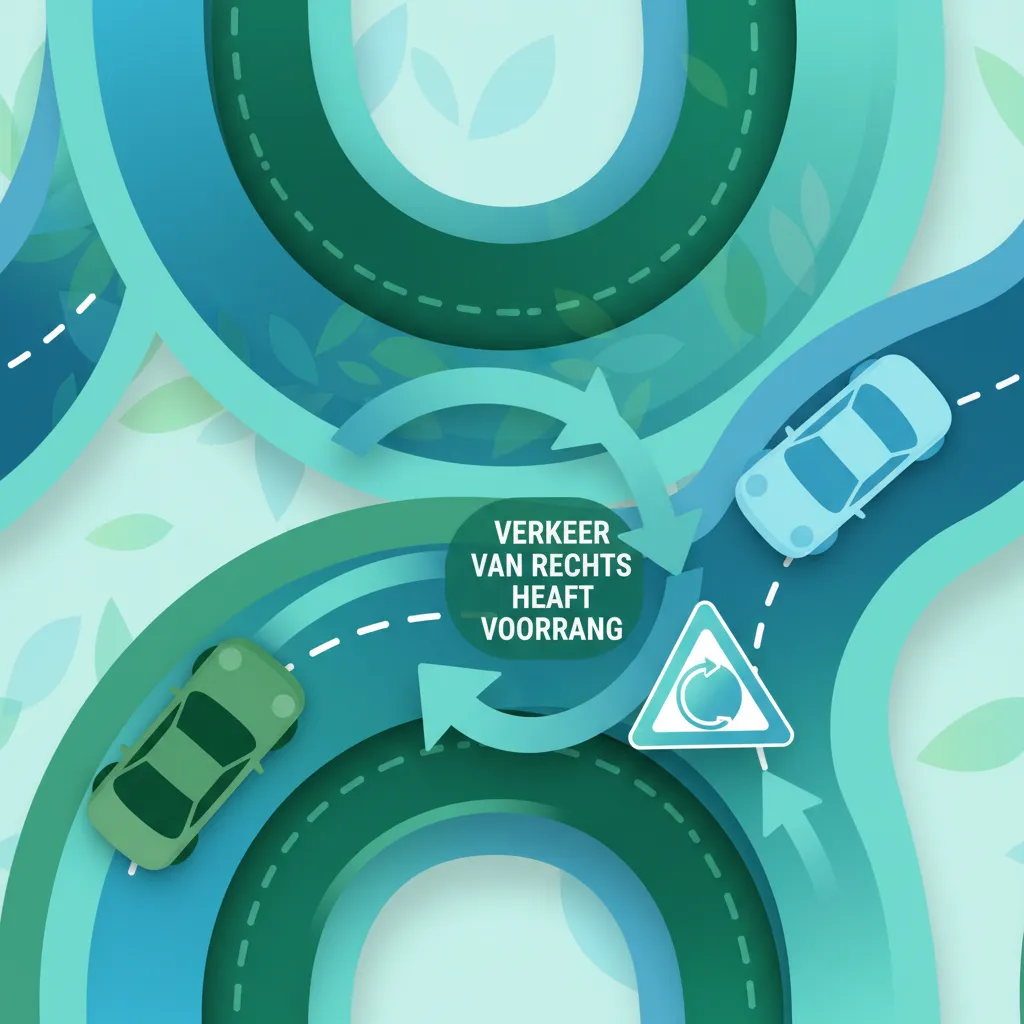
This lesson covers the critical maneuvers of overtaking and merging, which require precise judgment and communication. You will learn how to assess traffic speed and gaps, the importance of checking blind spots, and the correct use of signals to indicate your intentions. The content includes procedures for merging onto motorways from an on-ramp and how to perform safe overtaking maneuvers on various types of roads, minimizing risk to yourself and others.
This lesson addresses the specific challenges and priority rules associated with riding in tunnels and on bridges. You will learn about lane restrictions, speed adaptation in low-light conditions, and the increased importance of maintaining a safe following distance in enclosed spaces. Furthermore, it covers how to manage the effects of strong crosswinds on bridges, a significant hazard for motorcyclists, ensuring you can maintain stability and control.
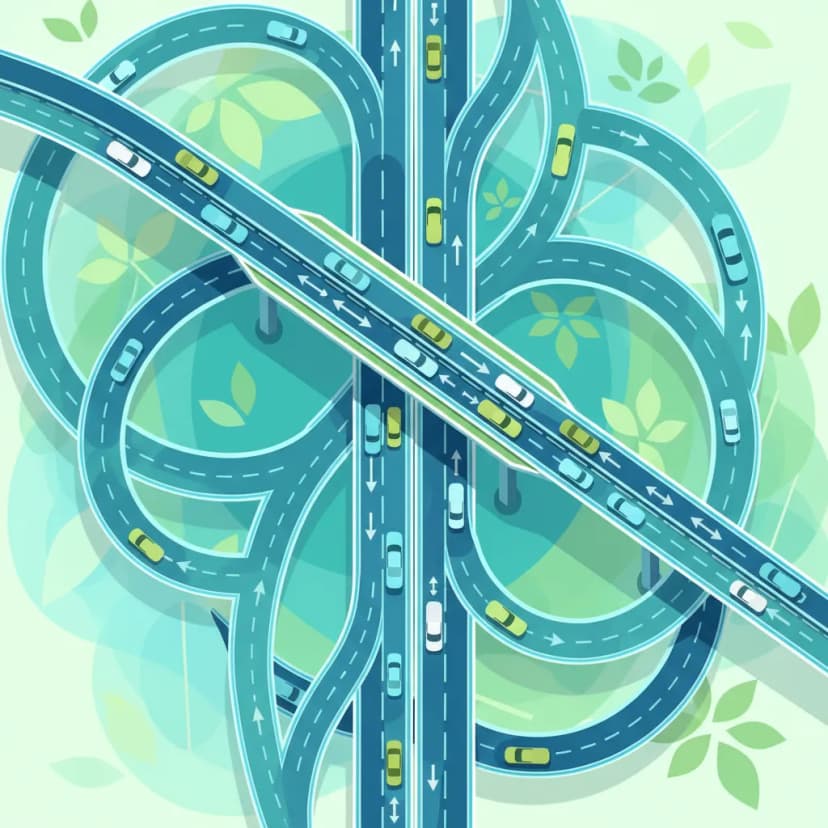
This lesson tackles the challenge of navigating some of the most complex road features, such as large multi-lane roundabouts and grade-separated interchanges. You will learn the importance of advance planning, choosing the correct lane on approach, clear signaling, and comprehensive observation to safely move through these busy areas. Mastering these junctions is a key indicator of an advanced and competent rider who can handle any road layout.

This lesson details the specific priority rules at pedestrian and tram crossings (Spårvagnskorsning). It reinforces the legal obligation for moped riders to stop for pedestrians at marked zebra crossings and explains that trams almost always have priority. Learners will understand the importance of approaching these crossings with caution, scanning for hazards, and being prepared to stop.
This lesson explains a motorcyclist's legal duty when encountering emergency vehicles with active sirens and lights. You will learn the correct procedure for yielding the right-of-way by safely pulling over and stopping. Additionally, the lesson covers the rules and best practices for sharing the road with public transport like buses and trams, including navigating around bus stops and respecting dedicated lanes, to ensure safety for all road users.
This lesson provides in-depth analysis of how to safely interact with the full spectrum of road users. You will learn about the specific characteristics of each, such as the large blind spots of trucks, the potential for sudden movements from cyclists, and the unpredictability of pedestrians. The content teaches strategies for communication, anticipation, and defensive positioning to ensure safe and respectful coexistence on the road for everyone.
This lesson focuses on the specific techniques required for riding in busy city and town environments. You will learn how to maintain correct lane positioning amidst dense traffic, navigate complex intersections with multiple signals, and manage the motorcycle at low speeds in stop-and-go conditions. Emphasis is placed on heightened awareness of pedestrians, cyclists, and vehicles making sudden maneuvers, which are common hazards in urban settings.
Explore the specific meanings of traffic light signals and the essential rules for interacting safely with pedestrians and cyclists at crossings. This lesson focuses on defensive riding and predicting actions in urban Swedish traffic.
This lesson focuses on the unique challenges of driving in urban environments. You will learn techniques for anticipating the actions of vulnerable road users like pedestrians and cyclists, especially near crossings and bus stops. The content covers how to navigate narrow streets, one-way systems, and areas with heavy traffic, emphasizing the need for lower speeds, heightened awareness, and a defensive mindset.
This lesson details a driver's responsibility towards pedestrians. You will learn the strict rule of yielding to pedestrians who are on or about to enter a marked, uncontrolled crosswalk. The content also covers the specific, highly restrictive rules for driving in designated pedestrian zones (gågata) and 'walking speed' areas (gångfartsområde), where pedestrians have complete priority and vehicle traffic is severely limited.

This lesson covers the essential topic of communication in traffic using the vehicle's built-in signaling devices. You will learn the rules for using your turn indicators (körriktningsvisare) in good time before turning or changing lanes. The content also explains the proper use of hazard lights (varningsblinkers) in emergency situations and the very limited, specific circumstances in which using the horn (ljudsignal) is permitted to avert immediate danger.
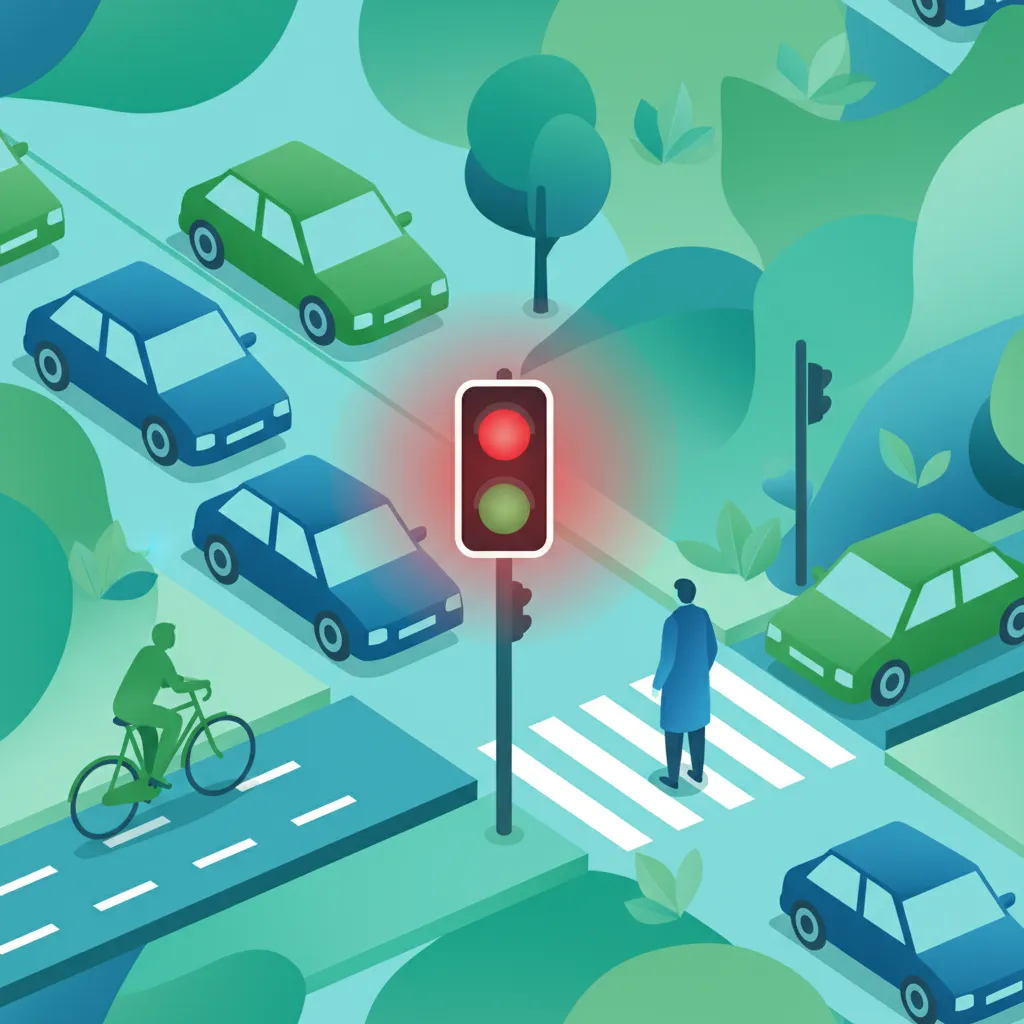
This lesson provides a detailed explanation of the Swedish traffic signal system. You will learn the precise legal meaning of solid red, yellow, and green lights, as well as green arrows which permit turning when oncoming traffic is stopped. It also covers procedures for flashing yellow signals and what to do when traffic lights are out of order, emphasizing that standard priority rules like the right-hand rule then apply.
This lesson provides in-depth analysis of how to safely interact with the full spectrum of road users. You will learn about the specific characteristics of each, such as the large blind spots of trucks, the potential for sudden movements from cyclists, and the unpredictability of pedestrians. The content teaches strategies for communication, anticipation, and defensive positioning to ensure safe and respectful coexistence on the road for everyone.
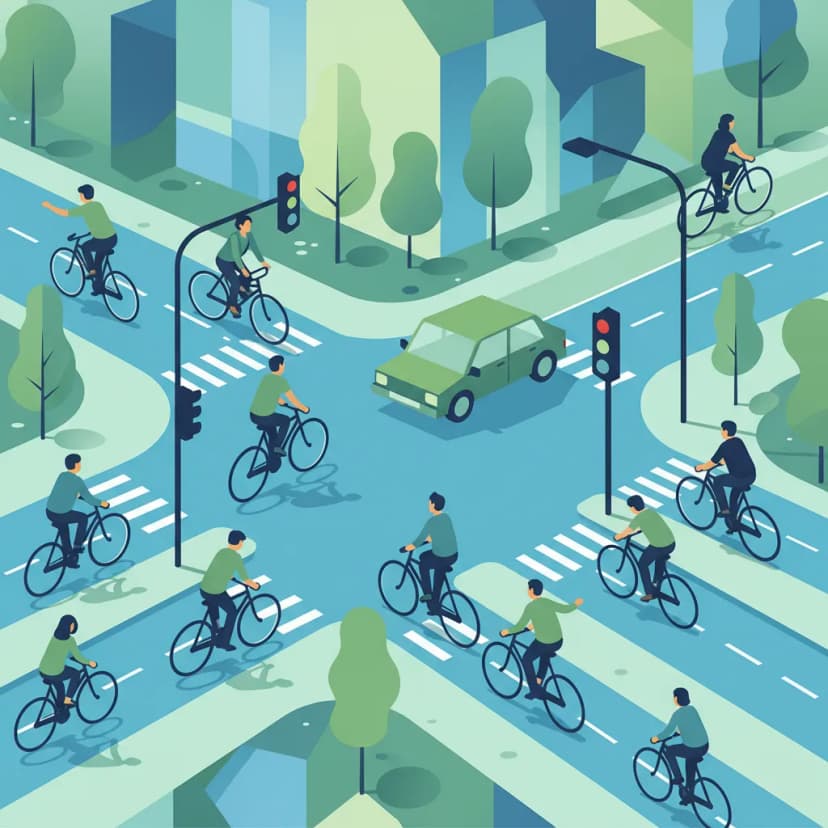
This lesson focuses on safe interaction with cyclists. You will learn to differentiate between a 'bicycle crossing' (cykelöverfart), where you have a duty to yield, and a 'bicycle passage' (cykelpassage), where specific priority rules apply. The content stresses the importance of leaving adequate space when overtaking cyclists and the critical danger of the 'right-hook' accident, emphasizing the need to check mirrors and blind spots carefully before turning right.
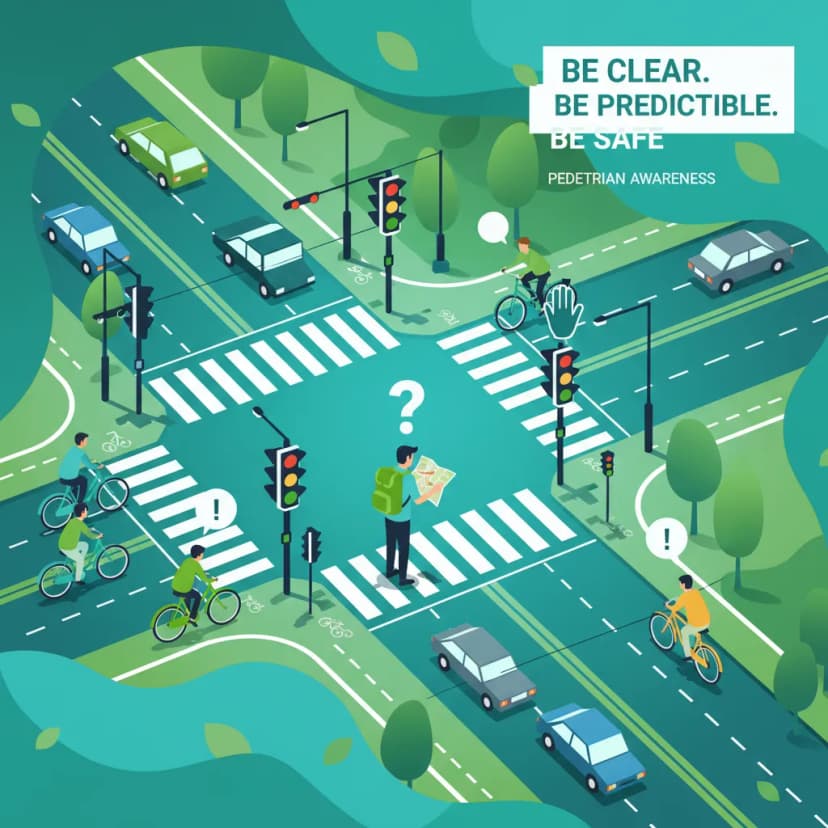
This lesson is dedicated to pedestrian safety, teaching riders to be constantly aware of people on foot, especially in busy urban environments. It reinforces the absolute duty to yield at marked crossings and encourages a cautious approach in areas like schools and shopping districts. The content stresses anticipating unpredictable actions, particularly from children or distracted pedestrians.
This lesson focuses on the high level of caution required when driving in residential areas. You will learn about the rules for special zones like 'gångfartsområde' (walking speed area) and the need to navigate around speed calming measures like speed bumps. The central theme is anticipating unpredictable behavior from residents, especially children, and managing the risks posed by parked cars that severely limit visibility.
This lesson explains the function and legal significance of various road markings (vägmarkeringar) in Sweden. You will learn the difference between broken lines that permit overtaking and solid lines that forbid it, as well as the meaning of stop lines, pedestrian crossings, and lane direction arrows. These markings work in conjunction with signs to organize traffic flow, separate lanes, and provide critical information directly on the road surface.
This lesson covers the correct interpretation and response to all forms of light and audible signals a motorcyclist will encounter. You will study the sequences of traffic lights, the rules for using turn indicators and hazard lights, and the legally permitted uses of the horn. Proper use of these signals is a fundamental aspect of safe riding, as it communicates your intentions clearly to other road users and helps prevent misunderstandings and collisions.
Find clear answers to common questions learners have about Intersections, Roundabouts, and Pedestrian Crossings. Learn how the lesson is structured, which driving theory objectives it supports, and how it fits into the overall learning path of units and curriculum progression in Sweden. These explanations help you understand key concepts, lesson flow, and exam focused study goals.
In Sweden, the general priority rule (Högerregeln) usually applies to traffic entering a roundabout from the right, unless signs indicate otherwise. Always look for signs (like Väjningsplikt) and be aware of vehicles already in the roundabout. You must always yield to traffic already within the roundabout.
You must always yield to pedestrians who are on or are about to enter a pedestrian crossing. This applies whether the crossing is marked or unmarked, and even if there are no traffic lights or signs. Motorcyclists must be particularly vigilant as their vehicles are less visible.
Yes, multi-lane roundabouts require careful lane discipline. You should choose your lane well in advance based on your intended exit. Generally, lanes further to the right are used for exiting sooner, while inner lanes are for continuing around or taking later exits. Always check road markings and signs.
A yellow traffic light signifies that the light is about to turn red. You should stop before the intersection if you can do so safely. If you are too close to stop safely, proceed through the intersection cautiously.
Trams often have priority. You must be especially careful when crossing tram lines or train tracks, looking out for the tram's approach and giving way as required by specific signals or signs. The general right-hand rule may not apply in these situations.