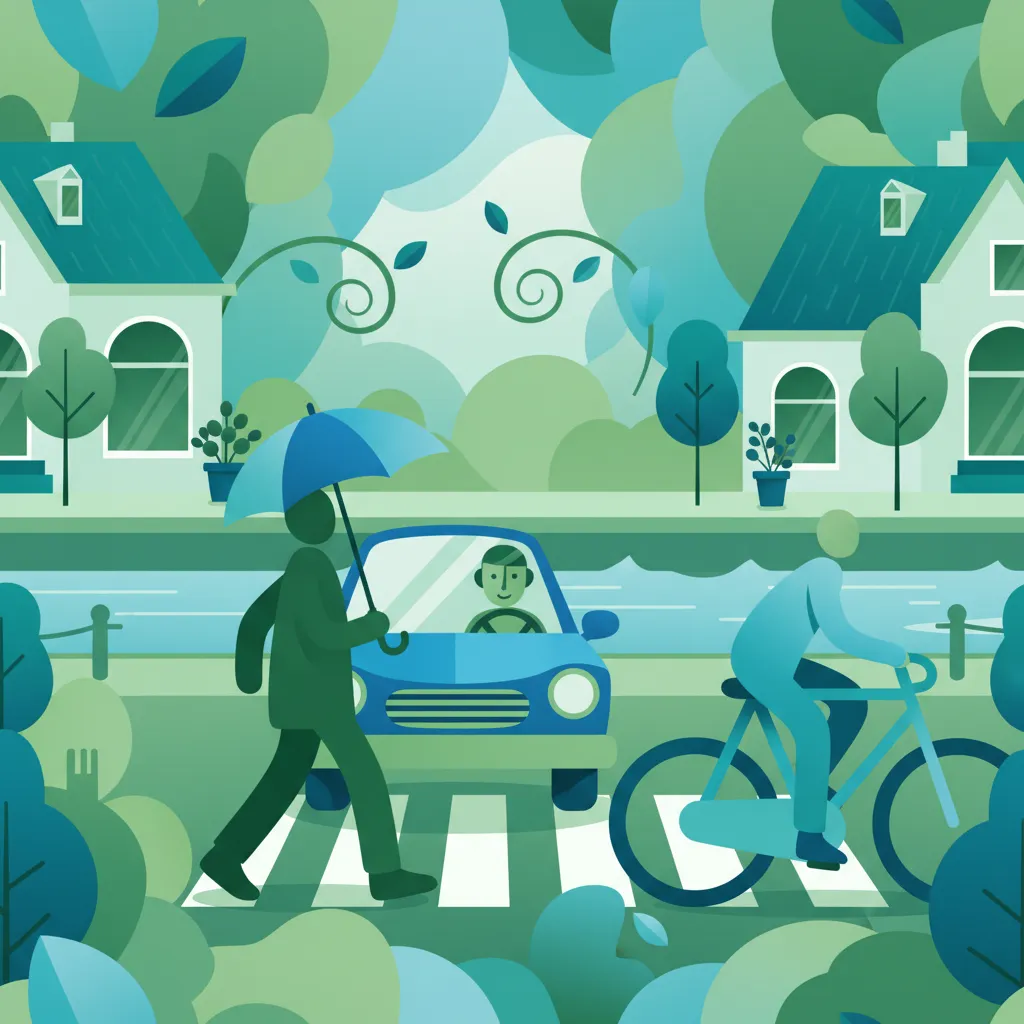
This unit focuses on safe interactions with pedestrians, cyclists, moped riders, and motorcyclists – Sweden's most vulnerable road users. Understanding their needs and anticipating their movements is crucial for preventing accidents and passing your theory test. You'll learn specific rules and develop the essential awareness needed for safe driving in all conditions.
Browse all lessons that make up Interaction with Vulnerable Road Users. Each lesson focuses on specific topics, learning objectives, and core concepts, helping you build essential knowledge and follow a clear, structured progression toward your study goals in Sweden.
This lesson details a driver's responsibility towards pedestrians. You will learn the strict rule of yielding to pedestrians who are on or about to enter a marked, uncontrolled crosswalk. The content also covers the specific, highly restrictive rules for driving in designated pedestrian zones (gågata) and 'walking speed' areas (gångfartsområde), where pedestrians have complete priority and vehicle traffic is severely limited.
This lesson focuses on safe interaction with cyclists. You will learn to differentiate between a 'bicycle crossing' (cykelöverfart), where you have a duty to yield, and a 'bicycle passage' (cykelpassage), where specific priority rules apply. The content stresses the importance of leaving adequate space when overtaking cyclists and the critical danger of the 'right-hook' accident, emphasizing the need to check mirrors and blind spots carefully before turning right.
This lesson explains how to identify and interact with various types of mopeds and other low-speed vehicles common on Swedish roads. You will learn the difference between Class I and Class II mopeds and their place on the road, as well as how to recognize A-tractors by their LGF (långsamtgående fordon) sign. The key focus is on managing the large speed differential and making safe judgments when deciding to overtake.
This lesson highlights the extreme caution needed in areas where children are present. You will learn to recognize school zone signs and the specific sign for a school bus, and understand your duty to slow down and be prepared to stop when a school bus has stopped for passengers. The lesson emphasizes that children can be impulsive and have poor risk judgment, requiring drivers to be exceptionally vigilant and maintain very low speeds.
This lesson provides clear instructions on the correct response to an approaching emergency vehicle with its sirens and lights active. You will learn your absolute duty to give way and the best methods for doing so, which typically involve pulling over to the right and stopping. The lesson stresses the importance of acting calmly and predictably, avoiding sudden braking or swerving that could endanger the emergency vehicle or other traffic.
Explore high-intent keywords and long-tail search topics learners use when researching Interaction with Vulnerable Road Users. These terms reflect how people search for reliable study materials, structured explanations, and unit-level theory preparation support in Sweden.
Find clear answers to the most common questions learners ask about Interaction with Vulnerable Road Users. Understand how the unit is organized, what learning goals it supports, and how it contributes to your study progression with structured explanations and practical guidance tailored for learners in Sweden.
Vulnerable road users are those who lack the physical protection of a vehicle. Pedestrians, cyclists, moped riders, and motorcyclists are particularly vulnerable because they have less protection in a collision and are more susceptible to serious injury. Swedish traffic law emphasizes driver responsibility to ensure their safety.
When passing cyclists, you must maintain a safe distance of at least 1.5 meters. Always check for bike lanes and be aware that cyclists may need to maneuver unexpectedly. You should also be mindful of speed when approaching them, especially in areas where they might be present.
You must always yield to pedestrians who are on or about to step onto a pedestrian crossing. Even if they are not on a designated crossing, you should be prepared to stop if they show any intention of crossing. Increased awareness and reduced speed are key.
Yes, you must be extremely cautious when driving near school buses, especially when they are stopped to pick up or drop off children. You must slow down significantly and be prepared to stop completely if children are crossing the road. Always assume children may act unpredictably.
A common mistake is failing to anticipate the movements of vulnerable road users or underestimating their presence, especially at junctions or in busy urban areas. Drivers often forget to maintain adequate passing distances or to reduce speed sufficiently when near them.
While the principle of protecting vulnerable road users applies everywhere, the specific risks and rules are most critical in urban areas, residential zones, and near schools or crossings. On motorways, direct interaction is less common, but awareness of mopeds or emergency vehicles is still important.
All included lessons
Lessons in Interaction with Vulnerable Road Users
See who benefits most from studying Interaction with Vulnerable Road Users. This overview explains how the unit supports different learning needs, what level of knowledge is helpful before starting, and how it fits into the overall study path in Sweden.
This unit is essential for all learner drivers preparing for the Swedish Category B theory test. It is particularly beneficial for those who want to build a strong foundation in urban driving scenarios and for anyone looking to refine their understanding of safety beyond basic traffic rules.

See how Swedish Driving Theory B is structured, with key topics, learning objectives, and a step-by-step path for theory preparation in Sweden.
Explore all units and lessons included in this driving theory course.