
This lesson is crucial for safe driving, covering how to effectively use your interior and side mirrors to maintain full situational awareness. We’ll detail what the blind spot is, where it’s located, and the absolute necessity of a physical head check before any lane change or turn. This knowledge is vital for preventing accidents and acing the Swedish Category B driving theory exam.

Developing acute visual perception and comprehensive situational awareness is paramount for safe driving, especially on Swedish roads. This lesson, part of your Swedish Driving License Theory Course for Category B Cars, will guide you through the essential techniques for effectively using your vehicle's mirrors and managing critical blind spots (often referred to as döda vinkeln in Swedish). By the end, you will understand how to integrate mirror observations with direct head checks to create a continuous, 360-degree mental model of the traffic environment around you, significantly reducing the risk of collisions.
Driving demands constant attention to your surroundings. While your forward vision is crucial, it represents only a fraction of the necessary information. To safely navigate, you must maintain a complete understanding of what is happening behind and to the sides of your vehicle. This holistic awareness is achieved through a combination of correctly adjusted mirrors, a disciplined scanning pattern, and essential physical head checks to cover areas not visible in mirrors.
The human eye's natural field of view is limited, focusing primarily on what is directly ahead. Mirrors serve as extensions of your peripheral vision, allowing you to monitor traffic dynamics that would otherwise be unseen. However, even with perfectly adjusted mirrors, certain areas around your vehicle remain hidden. These are the blind spots, and they pose a significant risk if not actively managed. Mastering mirror use and blind spot management is not just a best practice; it is a fundamental requirement rooted in Swedish traffic law, designed to prevent common side-impact and lane-change accidents.
Your vehicle is equipped with several mirrors, each designed to provide specific views of the traffic around you. Learning to use them effectively and systematically is key to safe driving.
The interior rear-view mirror is mounted on your windshield and provides a direct view of the traffic immediately behind your vehicle. It is your primary source for understanding what is approaching from the rear and for monitoring the distance to following vehicles. This mirror is essential for assessing traffic density, identifying faster-approaching vehicles, and preparing for situations that require you to slow down or stop.
Some interior mirrors feature an electro-chromatic dimming function or a manual 'night-position' to reduce glare from headlights behind you during night driving. While helpful for comfort, ensure the dimming doesn't excessively impair your ability to see clearly.
A common misunderstanding is believing that the interior mirror alone is sufficient for all rearward observations, especially for lateral movements like lane changes. However, its field of view is limited, primarily covering the area directly behind your vehicle and offering very little lateral coverage. It must always be used in conjunction with your side mirrors.
The left-hand side mirror is an exterior mirror positioned on the driver's side of the vehicle. Its primary function is to provide visibility of traffic in your left rear-quarter, covering a significant portion of what would otherwise be a blind spot on your left side. This mirror is critical for safely changing lanes to the left, merging onto highways, and monitoring overtaking traffic.
Side mirrors come in various types:
It is crucial not to assume that a convex mirror eliminates the need for a head-check. While they offer a wider view, the distortion of distance can be misleading, and a small blind spot will always remain.
The right-hand side mirror is located on the passenger side of the vehicle and covers the right rear-quarter. This mirror is equally vital for monitoring traffic on your right, especially when changing lanes to the right, exiting roundabouts, or when driving on multi-lane roads where vehicles might overtake on your right.
Similar to the left-hand side mirror, the right-hand mirror can be flat, convex, or dual-segment. The distance distortion of convex mirrors is particularly important to remember when using the right-hand mirror, as misjudging distances on this side can lead to unsafe maneuvers, especially when maneuvering in tight spaces or overtaking from the left. Correct adjustment is essential to provide a clear view of the adjacent lane and minimize blind zones.
Proper mirror adjustment is the foundational step for effective mirror use. According to Swedish traffic regulations, specifically Trafikförordning §20, you must adjust your interior and side mirrors before setting off. The goal is to maximize your field of view around the vehicle without requiring excessive head movement.
Interior (Rear-View) Mirror: Adjust so you can see the entire rear window and the road directly behind your vehicle. You should be able to see the rear bumper or a small portion of the rear of your car at the very bottom of the mirror, with the horizon line roughly in the middle.
Left-Hand Side Mirror: Lean your head slightly towards the driver's side window until your head almost touches it. Then, adjust the mirror outwards until you can just barely see the rear quarter panel of your own vehicle. This maximizes the view of the lane beside you and the lanes further left, minimizing the blind spot.
Right-Hand Side Mirror: Lean your head slightly towards the center of the vehicle (towards the interior mirror). Then, adjust the mirror outwards until you can just barely see the rear quarter panel of your own vehicle. This similarly maximizes the view of the lane beside you and further right.
These specific angular settings aim to create an overlapping field of view between your interior mirror and your side mirrors, while also pushing the blind spots as far back as possible. Remember to re-adjust your mirrors anytime there is a significant change to your vehicle, such as loading heavy cargo in the rear, adding passengers, or attaching a trailer, as these can alter your vehicle's stance and your sightlines.
Despite correctly adjusted mirrors, there will always be areas around your vehicle that remain entirely hidden. This crucial area is known as the blind spot, or döda vinkeln in Swedish. Failing to check these zones is a leading cause of preventable accidents.
The blind spot (döda vinkeln) is defined as the area adjacent to your vehicle that is not visible in any of your mirrors and can only be observed by physically turning your head. These zones exist on both sides of your vehicle, typically extending from just behind your side mirrors to your rear bumper. The size and location of these blind spots vary depending on the vehicle's design, mirror configuration, and your seating position.
Blind spots can be categorized into:
Any vehicle, cyclist, or pedestrian hidden in a blind spot can be struck if you initiate a lateral maneuver without first verifying the area is clear. This is why active blind spot management is a non-negotiable safety step.
A head-check, also commonly called a shoulder check, is a brief, rapid turn of the head to glance over the relevant shoulder, providing a direct line-of-sight into the blind spot on that side of the vehicle. This quick glance confirms that the blind spot is clear and complements the information gathered from your mirrors.
Do not rely solely on blind-spot detection systems, if your vehicle has them. These systems are electronic aids and do not replace your legal obligation to perform a physical head-check.
In Sweden, the head-check is not just a recommendation; it is a mandatory safety procedure stipulated by the Trafikförordning. You must perform a shoulder check before any lateral movement, including:
How to perform a head-check:
The head-check should be quick but thorough enough to confirm the blind spot is clear. Avoid over-rotating your head, which could cause you to lose sight of the road ahead for too long. It is the final, crucial step in ensuring the safety of your lateral maneuvers.
Effective visual perception isn't about isolated glances; it's about a systematic, continuous process of monitoring your entire surroundings. This is achieved through a disciplined scanning pattern.
A scanning pattern is a repeatable, rhythmic sequence of glances that ensures regular monitoring of all mirror views and the forward vision. This prevents "tunnel vision," where a driver fixates solely on the road ahead, missing critical information from the sides and rear.
A widely recommended scanning pattern for steady traffic typically follows this sequence:
Interior (Rear-View) Mirror: Check traffic directly behind you.
Left-Hand Side Mirror: Check traffic in your left rear-quarter and adjacent lane.
Right-Hand Side Mirror: Check traffic in your right rear-quarter and adjacent lane.
Forward View (Road Ahead): Return your focus to the road ahead to scan for immediate hazards.
This sequence should be repeated every 5-8 seconds in steady traffic. In dense traffic, at higher speeds, or in complex environments (e.g., intersections), increase the frequency of your scanning to every 3-4 seconds. The key is rhythm and consistency, ensuring no area is ignored for longer than your reaction time.
By adhering to a continuous scanning pattern, you prevent your vision from becoming fixated, a phenomenon known as tunnel vision. This practice significantly enhances your ability to anticipate potential hazards, detect rapidly approaching vehicles or vulnerable road users, and make smoother, more informed driving decisions. It allows you to maintain a dynamic mental map of traffic, recognizing developing situations before they become emergencies.
In Sweden, the use of mirrors and the performance of head-checks are not merely suggestions for good driving practice; they are legally binding requirements under the Trafikförordning (Traffic Ordinance). Non-compliance can lead to traffic offenses and increased liability in the event of an accident.
The Swedish Traffic Ordinance (Trafikförordning 1998:1276) explicitly outlines these obligations:
Failure to comply with these regulations is considered a traffic offense and can result in fines, demerit points on your driving license, and significantly increased liability if you are involved in an accident due to inadequate observation.
Effective mirror use and blind spot management are not static skills; they must be adapted to various driving conditions and situations.
When towing a trailer or carrying a heavy load, your vehicle's dynamics and sightlines change significantly:
Action: You must re-adjust your side mirrors further outward to compensate for the increased vehicle length and ensure maximum visibility along the side of the trailer. Increase the frequency of your mirror scanning and perform more thorough and frequent head-checks, being particularly aware of the trailer's blind spots.
Poor visibility demands increased vigilance:
The context of the road also dictates your scanning intensity:
Pedestrians, cyclists, and motorcyclists are particularly susceptible to being hidden in blind spots.
Even experienced drivers can fall into bad habits. Being aware of common violations and edge cases can help you maintain safe practices.
| Violation / Edge Case | Why It’s Wrong | Correct Behaviour | Potential Consequence |
|---|---|---|---|
| Neglecting the shoulder check on a lane change | Blind spot may still contain fast-approaching vehicles or cyclists, especially motorcycles. | Perform a quick over-the-shoulder glance after mirror checks, even if mirrors appear clear. | Side-impact collision; fines; demerit points on license. |
| Relying solely on a convex side mirror to judge distance | Convex mirrors distort distances, leading to under-estimation of closing speed and overestimation of safe gaps. | Use a flat or dual-segment mirror for accurate distance, or supplement with frequent shoulder checks. | Misjudged overtaking distance → collision or unsafe maneuver. |
| Leaving mirrors unadjusted after loading a heavy load | Load shifts vehicle height and changes mirror angles, creating new blind spots. | Re-adjust all mirrors after any change in vehicle load or trailer attachment, before starting to drive. | Sudden loss of visibility, leading to accidents during lane changes. |
| Scanning pattern omitted in dense urban traffic | Peripheral traffic (e.g., cyclists from the side) may be missed due to tunnel vision. | Increase scanning frequency (every 4–5 seconds) and ensure peripheral glances towards mirrors are integrated. | Near-misses or collisions with side-approaching traffic, particularly vulnerable road users. |
| Using interior mirror while driving in rain without wiping | Critical rear-view information is missing, increasing risk of rear-end collision. | Clean mirrors before travel and regularly during precipitation; use water-repellent treatment if available. | Rear-end collision; breach of duty of care; reduced ability to react to hazards behind. |
| Performing only a quick glance over shoulder while turning at high speed | Insufficient time to perceive fast-moving road users; may miss a cyclist. | Reduce speed before the turn, perform a thorough shoulder check, and ensure the blind spot is clear. | Collisions with vulnerable road users; severe injury or fatality. |
| Blind spot occlusion by large vehicle ahead (e.g., truck) while changing lane | The truck blocks the view of other vehicles or cyclists in the driver’s blind spot. | Perform a shoulder check and, if needed, slightly adjust position to gain a direct line of sight. | Collision with hidden cyclist or vehicle, especially if you pull alongside the truck too quickly. |
| Night driving with interior mirror dimmed to night setting, neglecting to adjust | Night setting reduces visibility of rear traffic, especially in low-light conditions behind you. | Use “day” mirror setting at night or ensure the interior mirror is fully clear; perform extra head-checks. | Missed rear traffic, delayed reaction to fast-approaching vehicles, potential rear-end collision. |
Let's illustrate these principles with some common driving scenarios.
You are cruising on a four-lane motorway on a clear day with moderate traffic. You wish to move from the middle lane to the left lane to overtake a slower vehicle.
Correct behavior:
Incorrect behavior: You skip the shoulder check, assuming the left side mirror is sufficient. As you begin to change lanes, you collide with a motorcycle that was hidden in your blind spot, resulting in a serious side-impact accident.
You are at a city intersection in light rain, with a green light. You intend to turn right onto a side street, but there are parked cars along the right side of the street you are entering, potentially obscuring your view of cyclists.
Correct behavior:
Incorrect behavior: You turn without performing a right-shoulder check. A cyclist, previously hidden by a parked van, emerges and is struck as you make your turn, leading to serious injury for the cyclist.
You are on a narrow two-lane rural road in daylight, following a large truck with a trailer. You decide to overtake.
Correct behavior:
Incorrect behavior: You return to your lane after overtaking without the second shoulder check. You misjudge the safe distance, or another vehicle was tucked into the truck's blind spot, leading to a collision with the truck's trailer or the hidden vehicle.
You are merging onto a busy motorway from an on-ramp at night. Your interior mirror is currently in its dimmed "night-position" to reduce glare.
Correct behavior:
Incorrect behavior: You leave the interior mirror in night-position, significantly reducing your ability to accurately perceive the distance and speed of fast-approaching cars from behind. You misjudge a gap, causing you to brake abruptly or abort the merge unsafely, potentially causing a rear-end collision or blocking traffic.
You are driving a heavily loaded van with a trailer attached on a foggy rural road. You need to change to the left lane to avoid an unexpected obstacle.
Correct behavior:
Incorrect behavior: You rely solely on your mirrors, which are obscured by the fog and not fully adjusted for the trailer. A cyclist, hidden in the trailer’s enlarged blind spot, is struck as you attempt the lane change.
Mastering the use of mirrors and effective blind spot management is fundamental to safe driving on Swedish roads. It moves beyond simply glancing at reflections; it involves developing a systematic approach to visual perception that integrates mirror observations with direct head checks. This holistic approach ensures you maintain a continuous, 360-degree awareness of your surroundings, anticipate potential hazards, and make confident, safe decisions behind the wheel. Remember, the proactive management of your visual field is not just good practice—it's a legal obligation and your first line of defense against collisions.
Lesson content overview
Explore all units and lessons included in this driving theory course.
Explore search topics learners often look for when studying Use of Mirrors and Blind Spot Management. These topics reflect common questions about road rules, driving situations, safety guidance, and lesson level theory preparation for learners in Sweden.
Browse additional driving theory lessons that cover connected traffic rules, road signs, and common driving situations related to this topic. Improve your understanding of how different rules interact across everyday traffic scenarios.
Understand the essential rules for using mirrors and performing blind spot checks in Swedish traffic. This lesson covers crucial procedures for lane changes, turns, and overall situational awareness as required by Swedish driving theory.
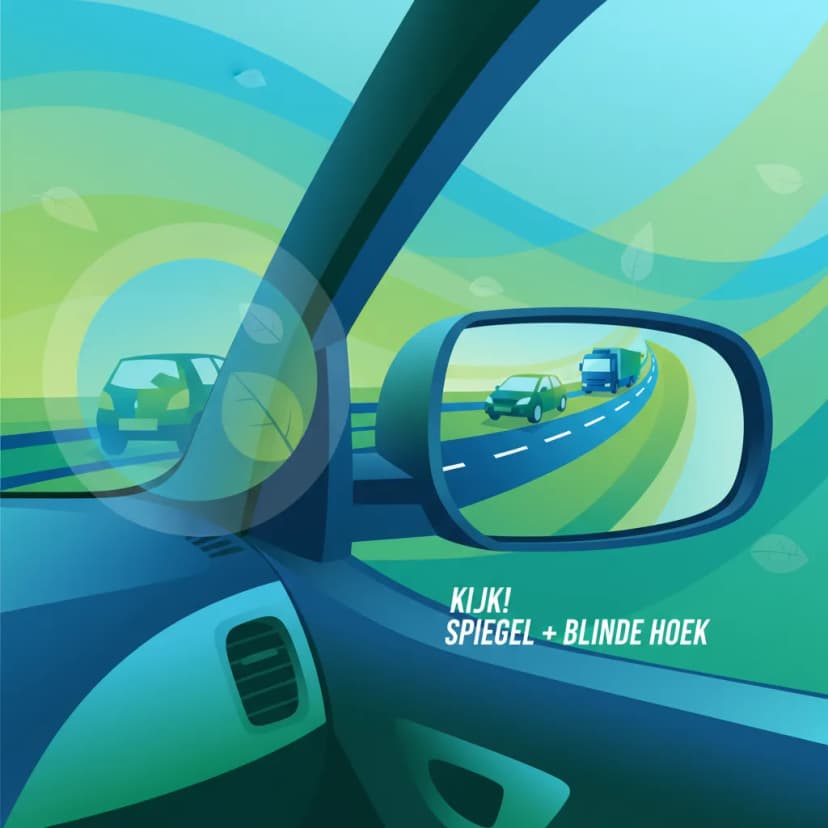
This lesson emphasizes the importance of a comprehensive visual scanning routine that includes regular mirror checks and mandatory head checks (shoulder checks) to cover blind spots. It explains that mirrors alone are not sufficient and that a physical turn of the head is required before any lateral movement. This habit is fundamental to preventing collisions during lane changes, merging, or turning.

This lesson covers strategies for driving safely when visibility is compromised. You will learn the correct use of different lighting systems: when to use low beams, high beams (helljus), and how to avoid dazzling other drivers. The lesson also explains the specific regulations for using front and rear fog lights and provides techniques for navigating safely in dense fog or heavy precipitation by reducing speed and using the road edge as a guide.

This lesson covers the critical maneuvers of merging and changing lanes. You will learn the correct technique for using an acceleration lane to match the speed of motorway traffic before merging smoothly and safely. The lesson emphasizes the importance of checking mirrors and the blind spot, signaling in good time, and applying the 'zipper principle' (dragkedjeprincipen) where lanes merge to ensure efficient and courteous traffic flow.

This lesson provides step-by-step instructions for performing common low-speed maneuvers, including reversing in a straight line, backing around a corner, and various types of parking. You will learn how to use reference points on your vehicle and the surroundings to position the car accurately. The paramount importance of slow speed, continuous 360-degree observation, and being prepared to stop for pedestrians or other vehicles is emphasized throughout.
This lesson provides critical strategies for dealing with one of the biggest dangers in traffic: blind spots. You will learn the importance of the shoulder check and how to position yourself on the road to be more visible to other drivers. The lesson also trains you to scan the road surface ahead for hidden hazards like potholes, gravel, or oil spills that can pose a significant threat to a motorcycle's stability, teaching you to see and avoid them in time.

This lesson teaches the correct methodology for negotiating curves and turns of varying sharpness. You will learn the principle of 'slow in, fast out,' involving braking before the curve and gently accelerating through it to maintain stability and grip. The lesson also covers how to choose the correct line (placering) through a bend and how to use your vision effectively to look far ahead for a safe and controlled passage.
This lesson focuses on the high level of caution required when driving in residential areas. You will learn about the rules for special zones like 'gångfartsområde' (walking speed area) and the need to navigate around speed calming measures like speed bumps. The central theme is anticipating unpredictable behavior from residents, especially children, and managing the risks posed by parked cars that severely limit visibility.

This lesson focuses on strategies to make yourself more visible to other road users, a critical factor in motorcycle safety. You will learn how to use lane positioning strategically to stay out of other drivers' blind spots and to maximize your own line of sight through corners and intersections. The content also covers the effectiveness of high-visibility and reflective clothing, as well as the correct use of lights to ensure you are seen in all conditions.

This lesson provides a complete guide to motorway driving in Sweden. You will learn the correct procedures for merging from an on-ramp, maintaining proper lane discipline by keeping right unless overtaking, and exiting safely via off-ramps. The content emphasizes the importance of maintaining large safety margins at high speeds, checking blind spots thoroughly before any lane change, and knowing the correct safety procedures in case of a breakdown.
This lesson covers the critical maneuvers of overtaking and merging, which require precise judgment and communication. You will learn how to assess traffic speed and gaps, the importance of checking blind spots, and the correct use of signals to indicate your intentions. The content includes procedures for merging onto motorways from an on-ramp and how to perform safe overtaking maneuvers on various types of roads, minimizing risk to yourself and others.
Learn to build a comprehensive understanding of your surroundings beyond basic mirror checks. This lesson explores advanced techniques for scanning traffic and anticipating potential hazards, essential for safe driving in diverse Swedish road conditions.

This lesson focuses on the unique challenges of driving in urban environments. You will learn techniques for anticipating the actions of vulnerable road users like pedestrians and cyclists, especially near crossings and bus stops. The content covers how to navigate narrow streets, one-way systems, and areas with heavy traffic, emphasizing the need for lower speeds, heightened awareness, and a defensive mindset.

This lesson tackles the challenge of navigating some of the most complex road features, such as large multi-lane roundabouts and grade-separated interchanges. You will learn the importance of advance planning, choosing the correct lane on approach, clear signaling, and comprehensive observation to safely move through these busy areas. Mastering these junctions is a key indicator of an advanced and competent rider who can handle any road layout.

This lesson teaches you how to analyze and assess risk when sharing the road with a variety of users, from large trucks to cyclists and pedestrians. You will learn to recognize common patterns of behavior and potential conflict points, allowing you to anticipate the actions of others before they create a dangerous situation. Developing this predictive mindset is a cornerstone of defensive riding and is key to staying safe in busy, complex traffic environments.
This lesson focuses on the high level of caution required when driving in residential areas. You will learn about the rules for special zones like 'gångfartsområde' (walking speed area) and the need to navigate around speed calming measures like speed bumps. The central theme is anticipating unpredictable behavior from residents, especially children, and managing the risks posed by parked cars that severely limit visibility.
This lesson teaches the correct methodology for negotiating curves and turns of varying sharpness. You will learn the principle of 'slow in, fast out,' involving braking before the curve and gently accelerating through it to maintain stability and grip. The lesson also covers how to choose the correct line (placering) through a bend and how to use your vision effectively to look far ahead for a safe and controlled passage.

This lesson introduces the core concepts of defensive riding, which involves anticipating potential dangers and actively managing the space around your motorcycle. You will learn the technique of continuously identifying and maintaining an 'escape path'—an open space to move into if a threat suddenly appears. This proactive, forward-thinking approach dramatically reduces the chances of being trapped in a dangerous situation and is a key skill of advanced, safe riders.

This lesson teaches the crucial skill of adapting your speed to the dynamic and often congested conditions of urban riding. You will learn to modulate your speed smoothly in response to traffic flow, pedestrian activity, and complex intersections to maintain safety and control. Techniques covered include using engine braking effectively, anticipating the actions of other road users, and selecting a speed that maximizes your reaction time in a high-density environment.
This lesson provides detailed guidance on navigating complex traffic points such as signalized intersections, multi-lane roundabouts, and pedestrian crossings. You will learn the correct procedures for entering and exiting roundabouts, the specific rules for yielding to pedestrians and cyclists at designated crossings, and how to interpret complex traffic light signals. These skills are vital for safe urban and suburban riding, where interaction with vulnerable road users is frequent.
This lesson focuses on the specific techniques required for riding in busy city and town environments. You will learn how to maintain correct lane positioning amidst dense traffic, navigate complex intersections with multiple signals, and manage the motorcycle at low speeds in stop-and-go conditions. Emphasis is placed on heightened awareness of pedestrians, cyclists, and vehicles making sudden maneuvers, which are common hazards in urban settings.

This lesson examines a variety of special situations where standard priority rules are modified. You will learn about the 'exit rule' (utfartsregeln) when entering a road from property, your duty to yield to buses indicating a departure from a stop, and the specific rules for pedestrian-only streets (gågata). The content also covers interactions with trams, emergency vehicles, and procedures at railway crossings, highlighting situations that demand maximum vigilance.
Find clear answers to common questions learners have about Use of Mirrors and Blind Spot Management. Learn how the lesson is structured, which driving theory objectives it supports, and how it fits into the overall learning path of units and curriculum progression in Sweden. These explanations help you understand key concepts, lesson flow, and exam focused study goals.
The blind spot, or 'döda vinkeln' in Swedish, refers to the areas around your vehicle that cannot be seen directly using your mirrors alone. These are typically to the sides and slightly behind your vehicle. Because mirrors cannot cover these areas, a physical head check is required.
A head check, a quick turn of your head to look over your shoulder, is a mandatory safety step before any manoeuvre that involves a lateral change in your vehicle's position. This includes changing lanes, turning at junctions, pulling away from the side of the road, and moving off after parking.
You should develop a routine of checking your mirrors frequently and systematically. A good practice is to scan your mirrors every 5-8 seconds, in addition to checking them before signalling, braking, or changing speed, and crucially, before performing a head check for blind spots.
Yes, even properly adjusted side mirrors have blind spots. While modern mirrors can be adjusted to minimise these areas, they cannot eliminate them entirely. This is precisely why the physical head check over the shoulder is a crucial, non-negotiable safety step before moving sideways.
The Swedish theory test will feature questions assessing your understanding of mirror usage and blind spot management. Scenarios will often involve changing lanes, overtaking, or turning, requiring you to select the correct action that includes mirror checks and head turns. Correctly answering these questions demonstrates your readiness for safe driving.