
This lesson delves into navigating complex road features, including large multi-lane roundabouts and grade-separated interchanges, crucial for the Swedish Category A motorcycle theory test. Building on previous units, you'll learn the advanced observation, planning, and lane discipline needed to confidently handle these challenging scenarios.

Navigating the most demanding road configurations requires exceptional skill and attention. This lesson, part of the Swedish Motorcycle Theory Course: A Licence Exam Preparation, focuses on mastering complex junctions, multi-lane roundabouts, and grade-separated interchanges. These environments, common in modern road networks, challenge a rider's situational awareness, lane discipline, and risk assessment abilities. Success here is a hallmark of an advanced and competent rider.
Errors in these high-traffic, often high-speed zones are a significant cause of motorcycle collisions due to reduced visibility, high traffic density, and rapid decision-making windows. By understanding the principles and regulations governing these areas, you will be better equipped to ride safely and confidently, preparing you for the Category A theory exam and real-world riding.
Complex junctions are designed to manage high volumes of traffic, often by separating conflicting traffic streams either radially (roundabouts) or vertically (grade separation). Swedish road design, spearheaded by Trafikverket, prioritizes safety, aiming to reduce the likelihood of high-speed, crossing trajectories.
For motorcyclists, the physics involved in maintaining stability while changing lanes or negotiating a leaned turn in a roundabout requires careful management of centrifugal force and tire traction. Legally, the Swedish Road Traffic Ordinance (RVV 1990) and Transportstyrelsen regulations mandate precise actions concerning right-of-way, signaling, and lane usage to minimize conflict with other road users. This lesson builds upon your existing knowledge of Swedish traffic signs and signals (Lesson 1), right-of-way rules (Lesson 2), speed management (Lesson 3), and fundamental motorcycle dynamics (Lesson 4).
Safe navigation through complex junctions hinges on a set of core principles that, when applied systematically, reduce cognitive load and enhance safety. These principles apply universally across all types of complex road layouts.
Advance Planning (AP) is the systematic mental rehearsal of your route, intended lane choice, and required maneuvers long before you reach the junction itself. This proactive approach reduces the need for last-minute decisions, allowing for smoother, more deliberate actions. As a rider, you must actively read advance road signs, anticipate lane assignments, and position yourself in the correct lane early.
Always look far ahead for directional signs and lane allocation markings. Knowing your route in advance helps you set up for the junction without rushed decisions.
Lane Discipline (LD) involves selecting and consistently maintaining the lane that corresponds to your intended exit or continuation. This includes respecting all solid and broken lane markings. Proper lane discipline is crucial for preventing sudden, dangerous lane changes that significantly increase conflict with other road users. Incorrect lane usage can force weaving maneuvers, raising the risk of collisions.
Layered Observation (LO) is a structured scanning routine designed to ensure all potential hazards are perceived early enough for corrective action. It involves a progressive scan:
Failure to scan systematically can lead to "tunnel vision," causing you to miss critical hazards.
Clear Signalling (CS) refers to the precise and timely use of turn signals. This must be done well before the maneuver and, as a motorcyclist, can be complemented by body posture cues (such as leaning into a turn or a shoulder check). The primary purpose is to communicate your intentions unambiguously to other road users, significantly reducing the element of surprise and preventing collisions in busy areas.
Speed Adaptation (SA) is the critical skill of adjusting your speed not just to the posted limit, but also to the geometric speed limit of the junction itself, which is often lower than the preceding road speed. You must also adapt to the observed traffic flow and prevailing road conditions. Correct speed allows for sufficient reaction time and stable motorcycle handling while turning or changing lanes. Excessive speed compromises stability, increases stopping distances, and constitutes a legal violation.
Priority Management (PM) involves thoroughly understanding and correctly applying the hierarchy of right-of-way rules. This includes interpreting road markings, obeying traffic lights and their phasing, and yielding requirements at roundabouts and interchanges. Correctly managing priority prevents illegal entry into junctions and avoids conflicts at decision points. Misinterpreting priority rules can lead to forced stops or even collisions.
Vertical Separation Awareness (VSA) is the ability to recognize the presence and function of grade-separated structures like flyovers and underpasses. It highlights the necessity to maintain your lane and a steady speed while on these elevated or depressed roadways. This principle reduces the temptation to brake or change lanes abruptly on a grade-separated segment, which can be highly dangerous. Failure to maintain speed on a flyover can lead to rear-end collisions.
Multi-lane roundabouts are circular intersections featuring two or more concentric circulating lanes, each typically assigned to different exit directions. Navigating them effectively requires careful attention to signage and lane markings.
For motorcyclists, the critical aspect is to select the correct lane before entering the roundabout, based on road markings and advance signs. Once inside, you must maintain your lane discipline and only activate your turn signal after passing the exit immediately preceding your intended exit. Signalling too early can confuse other drivers, particularly those waiting to enter.
Swedish regulations (RVV 1990 § 27) give priority to traffic already circulating within the roundabout. You must yield to vehicles already inside.
A frequent error is entering the inner lane for a left turn, then attempting to switch to the outer lane while still inside the roundabout to exit. This is an illegal lane change and extremely dangerous. Another common mistake is signalling before the entry point, which can cause drivers waiting to enter to mistakenly assume you are exiting earlier.
Never attempt to change lanes within a multi-lane roundabout if the lane markings are solid. Always aim to be in the correct lane before entry.
Complex signalised intersections, sometimes informally called "Spaghetti Junctions," are characterized by multiple legs, overlapping turning lanes, and intricate traffic light phases. These can include protected left-turns (where a dedicated green arrow allows turning traffic to proceed without conflict), U-turn phases, and sometimes dedicated lanes for specific vehicle types.
Riders must carefully read the sequence of traffic signals and obey specific arrow indicators for their intended direction. Anticipating late-phase changes is crucial, as these can affect the lane you occupy or the priority of opposing traffic. For example, a main green light may be followed by a protected arrow for oncoming traffic turning left, requiring you to yield if you are turning left without a protected arrow.
While less common, some complex intersections may feature dedicated motorcycle lane markings. When present, these markings (often a "motorcykel" symbol) indicate a lane exclusively for motorcycles, and their use may be mandatory. The Swedish Road Traffic Ordinance (RVV 1990 § 42) mandates strict obedience to all traffic signals.
A critical error is entering an intersection on a green light without verifying that a protected turn arrow for opposing traffic is not about to begin. Similarly, ignoring lane markings that clearly separate through-traffic from turning traffic can lead to being in the wrong lane and attempting dangerous last-minute maneuvers.
Grade-separated interchanges are road structures where traffic streams cross at different vertical levels, eliminating direct crossing conflicts. These include various designs such as cloverleafs, stacks, turbines, and directional interchanges.
On these structures, motorcyclists must maintain a steady speed, avoiding abrupt braking unless forced by traffic ahead. Braking suddenly on steep grades or curves can destabilize a motorcycle. It is vital to stay within the correct ramp lane, guided by arrow signs. The Swedish Road Traffic Ordinance (RVV 1990 § 53) mandates maintaining a safe speed on motorways and interchanges.
Maintaining a consistent speed is crucial. Sudden speed changes, particularly on curved or graded ramps, can lead to loss of stability, especially for motorcycles. Always follow the posted speed limits for ramps, which are often lower than the main carriageway. Always check your mirrors and blind spots before any lane adjustments on these high-speed sections.
Visual cues on the road surface are indispensable for navigating complex junctions. These markings guide lane use, turning movements, and indicate where lane changes are permitted or prohibited.
Riders must strictly obey these markings, particularly in multi-lane roundabouts where inner/outer lane arrows dictate exit options. Misinterpreting or ignoring markings, especially on high-speed ramps where broken lines might exist, can lead to dangerous situations. Always assume broken lines on ramps allow changes only if it's safe and necessary, never for convenience.
Adhering to specific Swedish traffic regulations is not only a legal requirement but also fundamental to safe riding.
Rule: Vehicles already circulating on the roundabout path have priority over entering traffic. Applicability: All roundabouts, irrespective of the number of lanes. Rationale: This rule prevents collisions by establishing a clear right-of-way, ensuring smooth traffic flow. Correct Example: A rider approaching a roundabout yields to a car already circulating inside and enters only when a safe gap appears.
Rule: Drivers must obey all displayed traffic signals, including specific protected turn arrows. Applicability: All signalised intersections, including complex multi-leg junctions. Rationale: Ensures coordinated traffic flow and reduces conflicting movements, preventing accidents. Correct Example: A rider stops at a red light at a multi-phase junction and proceeds only when the light turns green or a protected arrow for their intended direction appears.
Rule: Speed must not exceed the posted limit; a margin of up to 10 km/h may be tolerated if sign-posted in specific contexts (though generally, the limit is absolute). Applicability: Motorway sections, flyovers, and ramp sections of interchanges. Rationale: High speeds on curved ramps increase centrifugal forces, significantly reducing a motorcycle's stability and tire grip. Correct Example: A rider approaching a 90 km/h motorway exit ramp reduces speed smoothly to match the ramp's curve and posted limit, adjusting for any traffic ahead.
Rule: Vehicles must stay within the lane markings that correspond to their intended direction; lane changes are only allowed where markings are broken and it is safe. Applicability: All roadways, especially multi-lane roundabouts and interchanges. Rationale: Prevents abrupt and dangerous lane changes that could cause side-swipe collisions. Correct Example: A rider entering a three-lane roundabout intending to take the third exit positions themselves in the outermost lane well before entry and maintains that lane until exiting.
Rule (§ 4.2): Motorcyclists must use turn signals at least 150 m before a planned turn when visibility permits; hand signals are permitted only when indicators are not functional and typically when the vehicle is stationary or moving at very low speed. Rule (§ 5.1): When approaching a multi-lane roundabout, the rider must select the lane appropriate for the intended exit before the entry point, as indicated by road markings. Applicability: All junctions where a turn is intended, and all multi-lane roundabouts. Rationale: Provides sufficient warning to other road users, preventing confusion and promoting safe flow. Selecting the correct lane early prevents dangerous weaving inside the roundabout. Correct Example: A rider entering a roundabout intending to exit at the third exit activates their right indicator only after passing the second exit, giving adequate warning to following traffic.
Riding through complex junctions requires dynamic adaptation based on prevailing conditions.
In conditions like night, fog, heavy rain, or snow, Layered Observation distances must be increased. Double your typical "distant overview" range. Speed Adaptation is critical; significantly reduce your speed margin to allow for increased braking distances and reduced traction. Clear Signalling should be done even earlier than usual, as other road users may not perceive signals quickly.
Ignoring the principles and regulations governing complex junctions can lead to dangerous situations and legal penalties.
These scenarios illustrate the application of core principles in real-world driving situations.
Correct Behavior: The rider initiates Advance Planning by observing advance signs approximately 500 m before the roundabout, identifying their exit and the corresponding lane. They position their motorcycle in the outermost lane (Lane Discipline). As they approach, they apply Speed Adaptation, smoothly reducing speed to about 60 km/h to match the circulating traffic. They apply Priority Management by yielding to traffic already in the roundabout before entering on a green entry. Once inside, they maintain their lane. After safely passing the second exit, the rider activates their right indicator (Clear Signalling) and prepares to exit. Before fully exiting, a quick Rear-Check confirms no traffic is unexpectedly alongside.
Correct Behavior: The rider stops at the red light in the dedicated left-turn lane, maintaining safe following distance (Lane Discipline). Due to the rain, they apply Speed Adaptation by anticipating a lower speed through the turn, perhaps 10 km/h below the usual limit, to maintain traction. They actively apply Layered Observation, watching the signal sequence for the protected left-turn arrow. When the green arrow appears, they signal left (Clear Signalling), proceed smoothly, and continuously scan for pedestrians at the adjacent crosswalk (Priority Management) who might be difficult to see in the rain.
Correct Behavior: The rider initiates Advance Planning by noting the approaching interchange signs. Recognizing the light snow and nighttime conditions, they apply significant Speed Adaptation, reducing their speed to approximately 80 km/h well before entering the ramp. They remain strictly in the designated right-hand ramp lane (Lane Discipline), following the spiraling lane markings of the turbine interchange. They avoid any abrupt braking, using smooth throttle modulation to navigate the curves while maintaining a safe distance to any vehicle ahead. Their Vertical Separation Awareness is heightened, and they keep their head-up, looking through the curve to monitor ramp exit signs and potential changes in road surface.
Transportstyrelsen 2022 crash statistics indicate that roundabout-related crashes account for 12% of all motorcycle accidents in Sweden. Of these, 70% involved loss of control due to excessive speed or improper lane use. Additionally, interchange-related rear-end collisions represent 8% of motorcycle accidents, primarily caused by abrupt braking on ramps. These figures underscore the importance of strict adherence to the principles outlined in this lesson.
Lesson content overview
Explore all units and lessons included in this driving theory course.
Explore search topics learners often look for when studying Complex Junctions, Multi-Lane Roundabouts, and Grade Separation. These topics reflect common questions about road rules, driving situations, safety guidance, and lesson level theory preparation for learners in Sweden.
Browse additional driving theory lessons that cover connected traffic rules, road signs, and common driving situations related to this topic. Improve your understanding of how different rules interact across everyday traffic scenarios.
Learn theory for safely navigating complex junctions, multi-lane roundabouts, and grade-separated interchanges in Sweden. Focuses on correct lane selection, signaling, and observation for advanced motorcycle riders.
This lesson provides detailed guidance on navigating complex traffic points such as signalized intersections, multi-lane roundabouts, and pedestrian crossings. You will learn the correct procedures for entering and exiting roundabouts, the specific rules for yielding to pedestrians and cyclists at designated crossings, and how to interpret complex traffic light signals. These skills are vital for safe urban and suburban riding, where interaction with vulnerable road users is frequent.
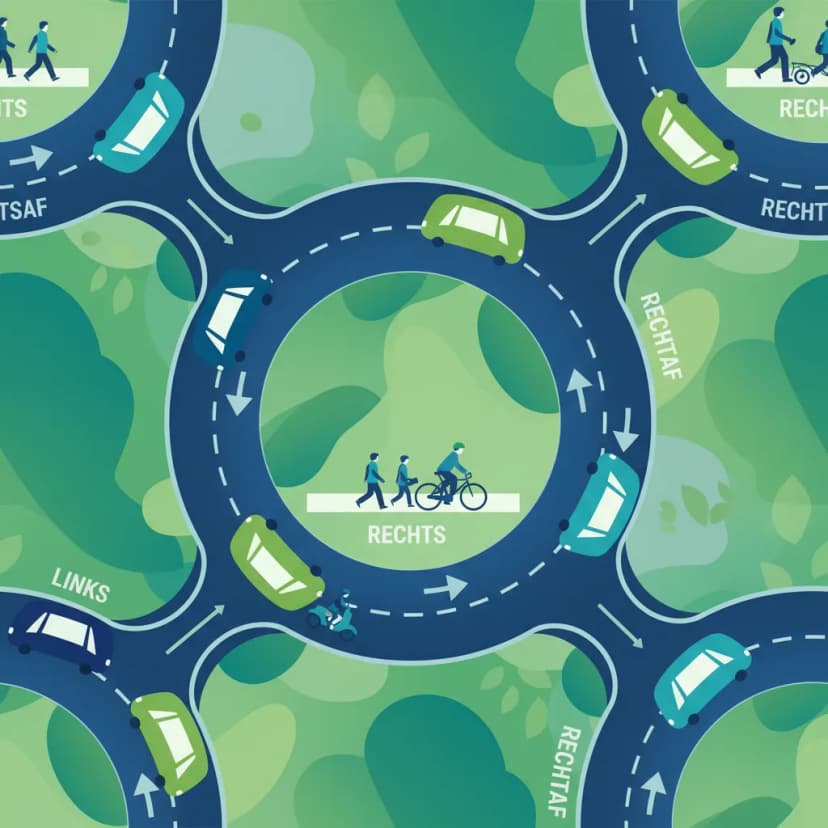
This lesson provides a detailed guide to navigating Swedish roundabouts (cirkulationsplatser). Key principles include always yielding to traffic already in the roundabout and choosing the correct lane based on your intended exit. You will learn the specific rules for signalling your intention to exit, how to safely interact with cyclists, and the techniques for maneuvering through multi-lane roundabouts to maintain traffic flow and prevent accidents.

This lesson covers the critical maneuvers of merging and changing lanes. You will learn the correct technique for using an acceleration lane to match the speed of motorway traffic before merging smoothly and safely. The lesson emphasizes the importance of checking mirrors and the blind spot, signaling in good time, and applying the 'zipper principle' (dragkedjeprincipen) where lanes merge to ensure efficient and courteous traffic flow.

This lesson focuses on the unique challenges of driving in urban environments. You will learn techniques for anticipating the actions of vulnerable road users like pedestrians and cyclists, especially near crossings and bus stops. The content covers how to navigate narrow streets, one-way systems, and areas with heavy traffic, emphasizing the need for lower speeds, heightened awareness, and a defensive mindset.

This lesson focuses on regulated intersections where priority is determined by signs indicating a main road (huvudled), a duty to yield (väjningsplikt), or a duty to stop (stopplikt). You will learn how to identify which road has priority and your legal obligation to give way to all traffic on that road before proceeding. The lesson covers proper procedures for approaching these junctions, assessing traffic, and entering the main road safely.

This lesson focuses on the high level of caution required when driving in residential areas. You will learn about the rules for special zones like 'gångfartsområde' (walking speed area) and the need to navigate around speed calming measures like speed bumps. The central theme is anticipating unpredictable behavior from residents, especially children, and managing the risks posed by parked cars that severely limit visibility.

This lesson provides practical instructions for safely navigating different types of intersections and roundabouts. It covers procedures for approaching, entering, and exiting roundabouts, emphasizing the rule to yield to traffic already circulating. The content also addresses how to handle signal-controlled and uncontrolled intersections, ensuring riders select the correct lane and manage their speed appropriately.

This lesson provides a complete guide to motorway driving in Sweden. You will learn the correct procedures for merging from an on-ramp, maintaining proper lane discipline by keeping right unless overtaking, and exiting safely via off-ramps. The content emphasizes the importance of maintaining large safety margins at high speeds, checking blind spots thoroughly before any lane change, and knowing the correct safety procedures in case of a breakdown.

This lesson explains the function and legal significance of various road markings (vägmarkeringar) in Sweden. You will learn the difference between broken lines that permit overtaking and solid lines that forbid it, as well as the meaning of stop lines, pedestrian crossings, and lane direction arrows. These markings work in conjunction with signs to organize traffic flow, separate lanes, and provide critical information directly on the road surface.

This lesson focuses on creating a complete awareness of the traffic situation around your vehicle. You will learn the correct procedure for using your interior and side mirrors in a continuous scanning pattern. Crucially, the lesson explains what the blind spot (döda vinkeln) is, where it is located, and why a physical head check over the shoulder is a non-negotiable safety step before any lateral movement like changing lanes or turning.
Explore advanced priority rules for complex Swedish traffic situations, including large roundabouts and challenging intersections. Understand how to interpret right-of-way in detailed scenarios relevant to the Category A motorcycle licence theory.

This lesson examines a variety of special situations where standard priority rules are modified. You will learn about the 'exit rule' (utfartsregeln) when entering a road from property, your duty to yield to buses indicating a departure from a stop, and the specific rules for pedestrian-only streets (gågata). The content also covers interactions with trams, emergency vehicles, and procedures at railway crossings, highlighting situations that demand maximum vigilance.
This lesson focuses on regulated intersections where priority is determined by signs indicating a main road (huvudled), a duty to yield (väjningsplikt), or a duty to stop (stopplikt). You will learn how to identify which road has priority and your legal obligation to give way to all traffic on that road before proceeding. The lesson covers proper procedures for approaching these junctions, assessing traffic, and entering the main road safely.
This lesson provides detailed guidance on navigating complex traffic points such as signalized intersections, multi-lane roundabouts, and pedestrian crossings. You will learn the correct procedures for entering and exiting roundabouts, the specific rules for yielding to pedestrians and cyclists at designated crossings, and how to interpret complex traffic light signals. These skills are vital for safe urban and suburban riding, where interaction with vulnerable road users is frequent.

This lesson introduces the core principles of right-of-way in Sweden, including the general duty to give way (Väjningsplikt) and the stricter stop duty (Stopplikt). It explains the concept of a priority road and how to apply the right-hand rule at uncontrolled intersections. By understanding this legal framework, riders can determine who has priority in any given situation and act predictably and safely.

This lesson explains the two core principles of priority in Swedish traffic law: the right-hand rule (Högerregeln) and the duty to yield (Väjningsplikt). You will learn how to apply the right-hand rule at uncontrolled intersections and when to yield to other traffic as indicated by signs or road markings. Understanding this fundamental hierarchy is crucial for making correct and safe decisions in a wide variety of common traffic situations you will face as a motorcyclist.
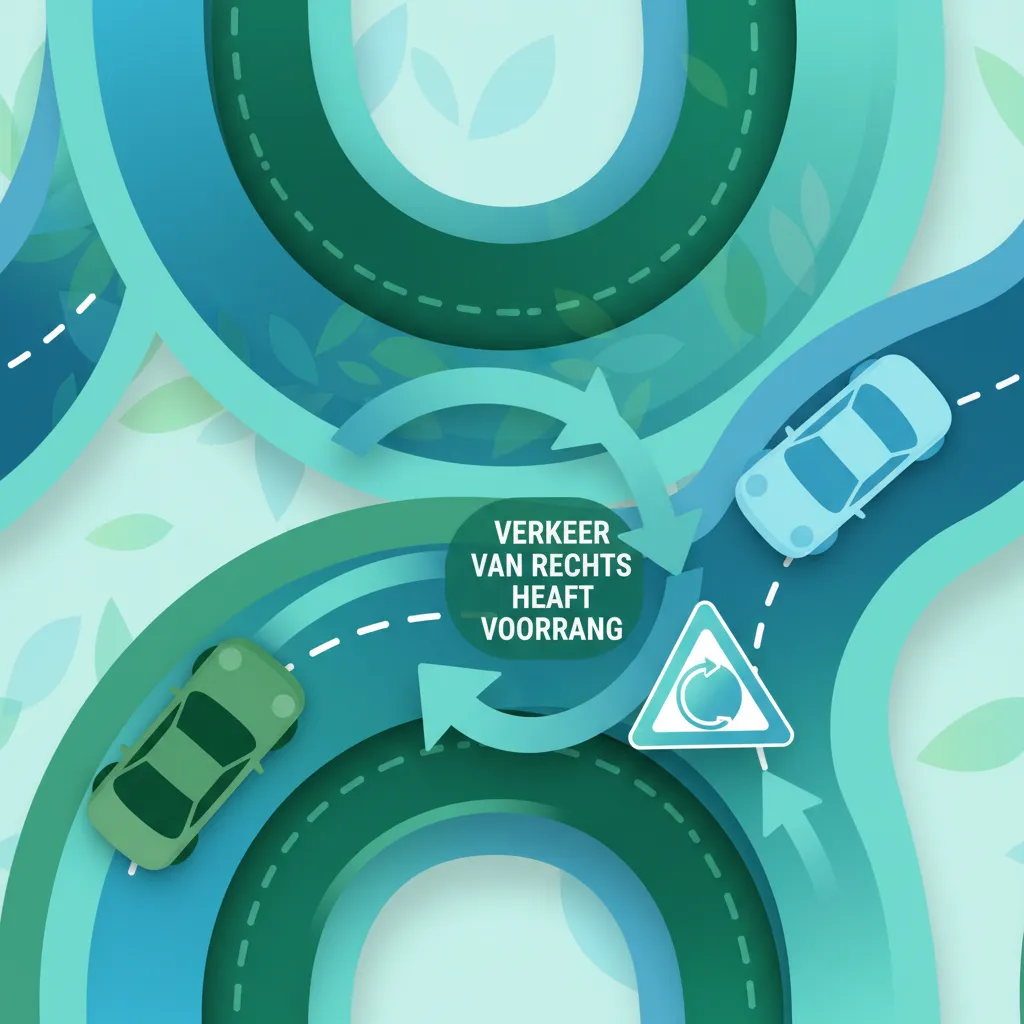
This lesson covers the critical maneuvers of overtaking and merging, which require precise judgment and communication. You will learn how to assess traffic speed and gaps, the importance of checking blind spots, and the correct use of signals to indicate your intentions. The content includes procedures for merging onto motorways from an on-ramp and how to perform safe overtaking maneuvers on various types of roads, minimizing risk to yourself and others.
This lesson provides a detailed guide to navigating Swedish roundabouts (cirkulationsplatser). Key principles include always yielding to traffic already in the roundabout and choosing the correct lane based on your intended exit. You will learn the specific rules for signalling your intention to exit, how to safely interact with cyclists, and the techniques for maneuvering through multi-lane roundabouts to maintain traffic flow and prevent accidents.
This lesson provides practical instructions for safely navigating different types of intersections and roundabouts. It covers procedures for approaching, entering, and exiting roundabouts, emphasizing the rule to yield to traffic already circulating. The content also addresses how to handle signal-controlled and uncontrolled intersections, ensuring riders select the correct lane and manage their speed appropriately.

This lesson addresses the specific challenges and priority rules associated with riding in tunnels and on bridges. You will learn about lane restrictions, speed adaptation in low-light conditions, and the increased importance of maintaining a safe following distance in enclosed spaces. Furthermore, it covers how to manage the effects of strong crosswinds on bridges, a significant hazard for motorcyclists, ensuring you can maintain stability and control.

This lesson details the specific priority rules at pedestrian and tram crossings (Spårvagnskorsning). It reinforces the legal obligation for moped riders to stop for pedestrians at marked zebra crossings and explains that trams almost always have priority. Learners will understand the importance of approaching these crossings with caution, scanning for hazards, and being prepared to stop.
Find clear answers to common questions learners have about Complex Junctions, Multi-Lane Roundabouts, and Grade Separation. Learn how the lesson is structured, which driving theory objectives it supports, and how it fits into the overall learning path of units and curriculum progression in Sweden. These explanations help you understand key concepts, lesson flow, and exam focused study goals.
A common mistake is not selecting the correct lane early enough for their intended exit. Motorcyclists might also fail to check blind spots adequately when changing lanes within the roundabout, or struggle to anticipate the movements of larger vehicles. This lesson emphasizes advanced observation and correct lane positioning to avoid these errors.
Approach grade-separated interchanges with a clear plan, observing signs well in advance to choose the correct lane. Maintain a safe speed for the merging or exiting ramp, continuously scanning for other traffic. This lesson covers the specific observation and speed adjustment techniques required for these complex structures.
Yes, while general rules apply, motorcycles must be particularly vigilant about their lane choice based on their exit. The principles of positioning and signaling are critical. This lesson focuses on applying these principles specifically to multi-lane roundabouts to ensure safe and legal navigation.
Motorcycles are more vulnerable and require more precise lane positioning and observation due to their smaller size and potential blind spots for other drivers. They also need to consider dynamic factors like wind and stability more carefully. This lesson highlights these differences and provides specific strategies for motorcyclists.
If you miss your exit on a multi-lane roundabout, do not stop or make sudden lane changes. Proceed around the roundabout again, taking the correct lane for your desired exit on the subsequent pass. This lesson covers how to handle such situations calmly and safely.