
Welcome to the first lesson of your Category AM moped theory course! This module clarifies the exact legal definitions and vehicle specifications for mopeds in Sweden. Understanding these basics is crucial for knowing where you can legally ride and how your moped is classified, setting the foundation for all other topics.

Obtaining a Swedish Category AM (moped) driving licence allows you to operate specific types of motorised two-, three-, or four-wheel vehicles on public roads. This lesson clarifies the precise technical parameters and legal definitions that classify a vehicle as suitable for an AM licence, as well as outlining where these vehicles can legally be driven. Understanding these regulations is fundamental for safe and lawful moped operation in Sweden.
The Category AM licence is specifically designed for lighter, lower-powered motorised vehicles, often referred to as mopeds. This licence category ensures that riders operate vehicles that match their initial level of experience and the safety expectations of the road environment. Swedish law, primarily governed by the Trafikförordning (Traffic Ordinance) and directives from Transportstyrelsen (the Swedish Transport Agency), sets strict limits on the technical specifications of these vehicles.
A Category AM vehicle in Sweden is defined by several key technical parameters. It refers to a motorised two-, three-, or even some light four-wheel vehicles that meet specific criteria for engine displacement or electric power, and maximum design speed. This classification ensures that only vehicles with a certain performance level are operated by AM licence holders, preventing the use of more powerful machines that require higher licence categories (A1, A2, A for motorcycles).
The regulations governing Category AM vehicles are not arbitrary; they are built upon a foundation of safety, infrastructure compatibility, and legal certainty. Limiting engine power and top speed directly reduces the kinetic energy of the vehicle, which translates to shorter braking distances and less severe impacts in the event of a collision. This is particularly important for newer riders who may have less experience in anticipating hazards and reacting quickly. Furthermore, mopeds are primarily intended for urban and suburban environments. Allowing them on high-speed motorways or expressways would create dangerous speed differentials with other traffic, significantly increasing accident risk. Clear specifications for vehicles and road access also provide law enforcement with measurable criteria to ensure compliance, thereby enhancing overall road safety.
The technical limitations are the cornerstone of the AM licence. They define what constitutes a legal moped and, consequently, what vehicle an AM licence holder is permitted to ride.
For mopeds equipped with an internal combustion engine, the maximum engine displacement is 50 cubic centimetres (cm³). This limit is critical for classification. The engine displacement refers to the total volume swept by the pistons within the engine cylinders. A vehicle with an engine displacement even slightly above 50 cm³, such as a 55 cm³ engine, would not be classified as a Category AM moped, even if its top speed is restricted.
It is a common misunderstanding to assume that only the speed limit matters. Both the engine displacement and the design speed must comply with the Category AM requirements.
Alongside the engine displacement, the maximum design speed of a Category AM moped must not exceed 45 km/h. This is the highest speed the vehicle is engineered to achieve under optimal conditions, as certified by the manufacturer and approved during type-approval. It is not about the speed a rider actually reaches, but the vehicle's inherent capability. Modifications that increase this design speed are illegal and will reclassify the vehicle, making it unlawful to ride with an AM licence.
With the rise of electric vehicles, equivalent standards have been established. For electric mopeds, the equivalent of the 50 cm³ displacement limit is a maximum continuous rated power output of 4 kilowatts (kW). Like combustion engine mopeds, electric mopeds must also adhere to the maximum design speed of 45 km/h. This ensures that electric mopeds provide similar performance and safety characteristics to their petrol-powered counterparts under the AM category.
Many mopeds are equipped with speed limiting devices to ensure they comply with the 45 km/h design speed. These limiters must be tamper-proof and conform to approved standards. Any unauthorised modification that increases the vehicle's design speed beyond 45 km/h, even if it's just a digital 'chip' or mechanical alteration, renders the vehicle illegal for Category AM use. Such modifications can lead to severe penalties, including fines, vehicle confiscation, and even criminal charges, as the vehicle would effectively become an unregistered and uninsured motorcycle requiring a different licence category.
The technical specifications of your moped directly influence where you are legally permitted to ride. Understanding these road access rules is critical for avoiding dangerous situations and legal infractions.
Category AM mopeds are primarily intended for roads with lower speed limits, integrating safely with slower-moving traffic. You may legally operate an AM moped on:
For safety reasons, AM mopeds are strictly prohibited from certain types of high-speed roads. It is illegal to ride a Category AM moped on:
Entering these prohibited roads, even accidentally, can lead to fines and dangerous situations due to the significant speed differential between your moped and other vehicles. Always pay close attention to road signs, especially when approaching major intersections or on-ramps.
Designated moped lanes offer a safe corridor for AM mopeds, often running parallel to busier roads. These lanes are typically marked with a blue sign featuring a white 'M' symbol.
When a moped lane is available, AM-licensed mopeds must use it. This rule applies even if the general road has a speed limit higher than 45 km/h, as the moped lane is specifically designed to accommodate mopeds safely. Ignoring a marked moped lane and riding in the main carriageway would be a violation of traffic regulations.
Road signs are your primary guide to understanding where you can and cannot ride. Pay close attention to signs that:
Always interpret road signs in conjunction with the general rules for AM mopeds. For example, a sign indicating a 60 km/h speed limit on a road automatically prohibits AM mopeds, unless a designated moped lane is present.
Operating a Category AM moped in Sweden requires not only a compliant vehicle and adherence to road rules but also proper identification and documentation. These requirements enable law enforcement to verify the vehicle's legal status and the rider's authority to operate it.
Every Category AM moped must display clear and permanent identification markings:
For most Category AM mopeds, specifically those with a continuous power output exceeding 0.5 kW (which includes nearly all mopeds capable of 45 km/h), a registration plate (registreringsskylt) is mandatory. The plate must be:
When operating a Category AM moped on public roads, you must always carry specific documents:
Failure to present any of these documents upon request by law enforcement can result in fines or, in some cases, the temporary seizure of your vehicle until proper documentation is produced.
Keep your documents organised and protected from the elements, perhaps in a waterproof pouch on your person or securely within your moped's storage compartment.
In Sweden, liability insurance (trafikförsäkring) is mandatory for all registered motor vehicles, including most Category AM mopeds. This insurance covers damages caused to third parties (other vehicles, property, or individuals) in an accident. Riding an uninsured moped is illegal and carries significant penalties, including daily fines and personal financial liability for any damages caused. Always ensure your insurance policy is active and covers your specific moped.
Understanding the legal scope of your AM licence is paramount to preventing dangerous situations and avoiding penalties. Violations often stem from either a misunderstanding of the rules or intentional disregard.
Modifying your moped to exceed its legal technical limits is a serious offence:
Consequences: These violations can lead to substantial fines, vehicle confiscation, invalidation of your insurance (meaning you are personally liable for damages), and even criminal charges for driving an unregistered or uninsured vehicle. You may also face a driving licence suspension or points on your licence.
Riding your moped on prohibited roads:
Consequences: Fines, warnings, and potential licence points. More importantly, it puts you at significant risk due to speed differentials with faster traffic.
Errors related to vehicle identification and documentation can also lead to legal issues:
Consequences: Fines, potential vehicle detention, and administrative penalties.
While the core rules for AM mopeds remain constant, various external factors require riders to adapt their behaviour to maintain safety and compliance.
The 45 km/h design speed limit provides a safety margin, but adverse conditions demand extra caution:
Always prioritize safety. If conditions are particularly challenging (e.g., heavy snow or ice), consider if riding your moped is truly safe or if an alternative mode of transport would be better.
As a moped rider, you are a vulnerable road user. Your interactions with others are crucial:
Every restriction placed on Category AM mopeds and their riders is rooted in a fundamental safety principle, designed to protect the rider and other road users.
The limits on engine displacement (50 cm³ or 4 kW) and maximum design speed (45 km/h) directly control the vehicle's kinetic energy. Kinetic energy is calculated as E = ½mv², where 'm' is mass and 'v' is velocity (speed). By limiting both the potential for high mass (lighter vehicles) and, crucially, speed, the amount of energy that needs to be dissipated in a collision is significantly reduced. This means:
Prohibiting mopeds from motorways and high-speed roads (over 45 km/h) is vital for managing speed differentials. When vehicles travel at very different speeds on the same road, it creates dangerous situations:
Lower speeds also benefit the moped rider directly, especially considering that AM licence holders are often younger and less experienced:
These safety rationales underpin the entire framework of Category AM licensing in Sweden, ensuring that moped riding is as safe as possible for all road users.
To deepen your understanding of moped regulations and prepare for your exam, explore related topics and practice scenarios.
Lesson content overview
Explore all units and lessons included in this driving theory course.
Explore search topics learners often look for when studying Scope of the AM Licence and Vehicle Classification. These topics reflect common questions about road rules, driving situations, safety guidance, and lesson level theory preparation for learners in Sweden.
Browse additional driving theory lessons that cover connected traffic rules, road signs, and common driving situations related to this topic. Improve your understanding of how different rules interact across everyday traffic scenarios.
Understand the precise technical requirements for AM mopeds in Sweden, including engine size and speed limits. Learn which roads are legally accessible for mopeds based on these classifications, crucial for the driving theory course.
This lesson analyzes the legal definitions that determine where mopeds can operate within the Swedish road network. It covers the rules for using urban streets, rural roads, and designated cycle paths (Cykelbana), while clearly identifying prohibited zones like motorways. The content explains how to interpret signs indicating moped permissions or restrictions, enabling riders to plan legally compliant routes and navigate shared spaces correctly.
This lesson focuses on the specific speed regulations applicable to Category AM mopeds in Sweden. It emphasizes the absolute maximum legal speed of 45 km/h and explains that riders must always adapt their speed to be lower when conditions require. The content also covers any special, lower speed limits that may apply when riding on designated cycle paths or in shared spaces.
This lesson consolidates the key regulations that apply specifically to moped operation in Sweden. It covers mandatory rules such as speed limits, helmet use, and requirements for vehicle lighting and reflectors. Furthermore, the lesson explains the legal consequences of violations, including the system of fines and potential demerit points, ensuring riders understand their full range of legal responsibilities on the road.

This lesson details the personal eligibility criteria required to obtain a Category AM license in Sweden, starting with the minimum age of 15. It explains the mandatory health assessment, including vision and physical fitness standards, which must be certified by a medical professional. The content also addresses the competency and maturity expectations for young riders, including the role of parental consent in the application process.
This lesson outlines the essential administrative responsibilities of a moped owner and rider. It covers the legal requirement to have valid third-party liability insurance and to ensure the vehicle is properly registered. The content also reminds riders of the documents they must carry with them at all times, such as their driving license and registration certificate.

This lesson provides a comprehensive guide to the Swedish Category AM theory examination process managed by Transportstyrelsen. It outlines the necessary steps for registration, the specific documentation required such as valid ID and medical certificates, and how to schedule a test at an authorized center. Learners will understand the exam format, scoring system, and the procedures for receiving their license upon successful completion.

This lesson serves as a summary of the legal requirements for safety equipment in Sweden. It reiterates the mandatory helmet law for both the rider and any passenger. It also touches on the rider's responsibility to ensure the moped itself is legally equipped with functioning lights, brakes, and other essential safety features, linking personal gear with vehicle roadworthiness.

This lesson clarifies the regulations for operating a moped on cycle paths (Cykelbana) and other shared spaces in Sweden. It explains which types of mopeds are permitted on these paths and the specific rules that apply, such as lower speed limits and the duty to yield to cyclists. The content focuses on safe interaction and communication to ensure peaceful coexistence with other users in these environments.
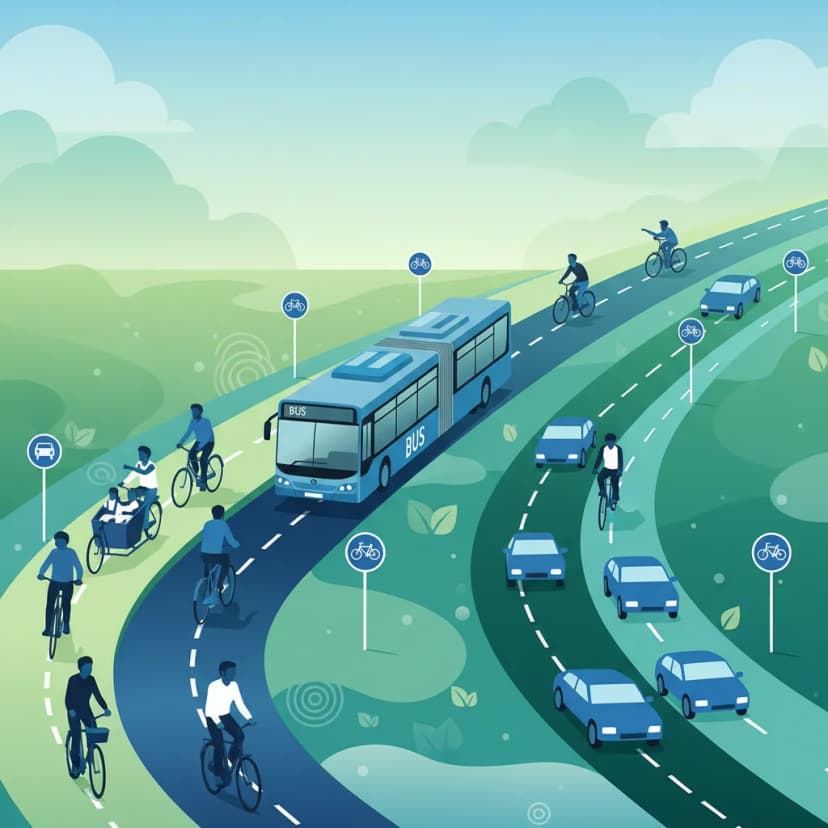
This lesson explains the specific regulations for lanes designated for particular users, such as buses or cyclists. It clarifies under what circumstances a moped is permitted to enter these lanes and the rules that must be followed while in them. Understanding these regulations is key to navigating complex urban environments legally and safely.
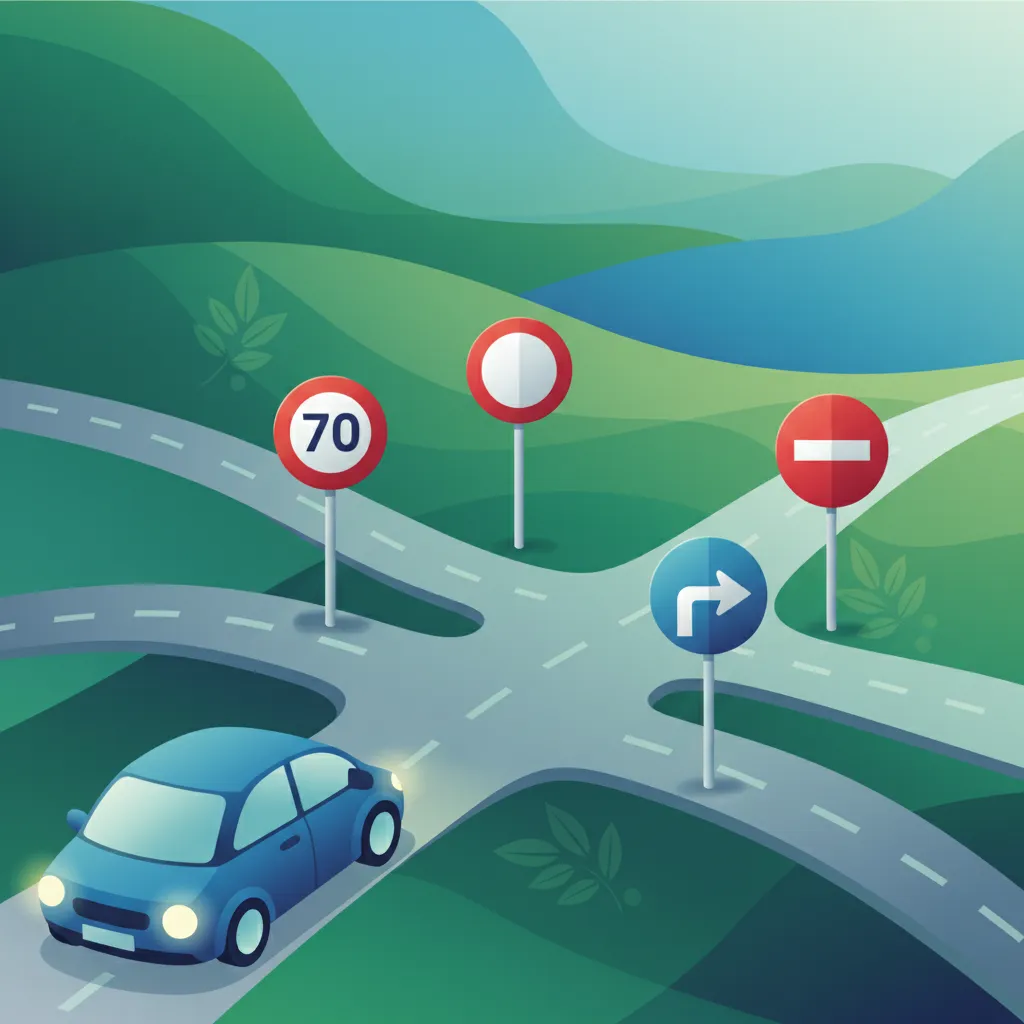
This lesson focuses on regulatory signs (Regulationsskyltar), which issue mandatory instructions and prohibitions that all road users must follow. It details common signs such as speed limits, stop and give way signs, and mandatory direction arrows. Special attention is given to signs directly affecting mopeds, like 'no moped' signs and those indicating designated moped lanes, ensuring riders can navigate legally and safely.
Explore the specific speed limits and engine capacity rules for AM mopeds in Sweden as detailed in the driving theory curriculum. This lesson covers how these technical limits dictate where mopeds can legally operate, ensuring compliance with Swedish traffic laws.
This lesson consolidates the key regulations that apply specifically to moped operation in Sweden. It covers mandatory rules such as speed limits, helmet use, and requirements for vehicle lighting and reflectors. Furthermore, the lesson explains the legal consequences of violations, including the system of fines and potential demerit points, ensuring riders understand their full range of legal responsibilities on the road.
This lesson focuses on the specific speed regulations applicable to Category AM mopeds in Sweden. It emphasizes the absolute maximum legal speed of 45 km/h and explains that riders must always adapt their speed to be lower when conditions require. The content also covers any special, lower speed limits that may apply when riding on designated cycle paths or in shared spaces.
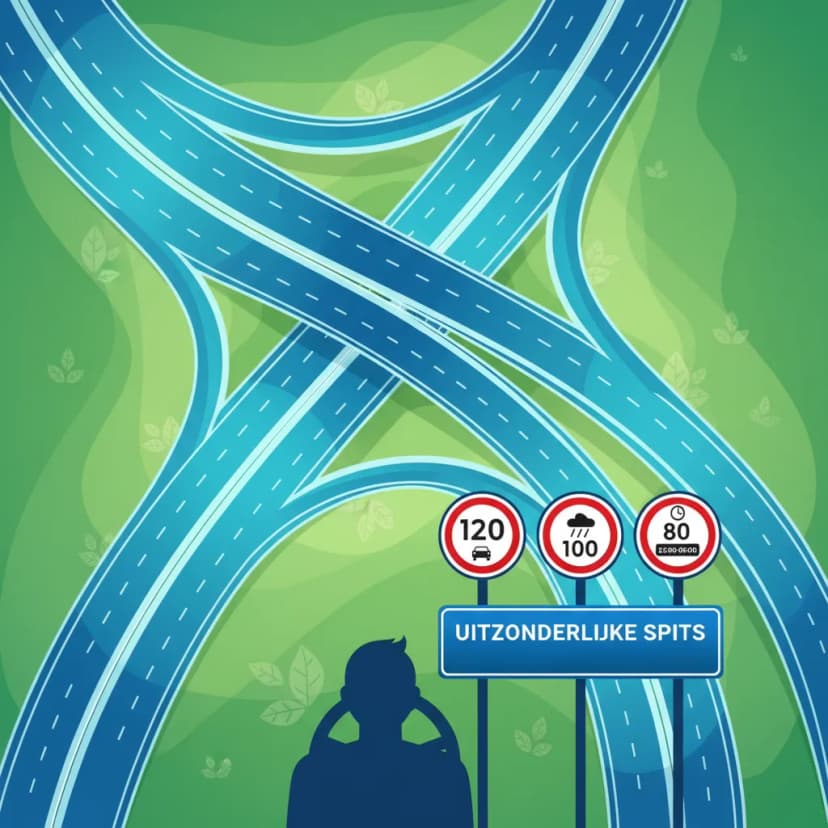
This lesson explains the general speed limit system in Sweden, including the default limits that apply in the absence of specific signs. It covers the standard speeds for built-up areas, roads outside built-up areas, and motorways, clarifying which are relevant to moped riders. Understanding this structure enables riders to determine the correct legal speed even when signs are not immediately visible.
This lesson teaches the crucial skill of adapting speed to prevailing conditions, emphasizing that the posted speed limit is a maximum, not a target. It covers various scenarios such as rain, fog, heavy traffic, and poor road surfaces, explaining why reducing speed is essential for maintaining vehicle control and safety. The goal is to cultivate a proactive mindset where the rider constantly assesses risk and adjusts their speed accordingly.
This lesson explains how to identify and interact with various types of mopeds and other low-speed vehicles common on Swedish roads. You will learn the difference between Class I and Class II mopeds and their place on the road, as well as how to recognize A-tractors by their LGF (långsamtgående fordon) sign. The key focus is on managing the large speed differential and making safe judgments when deciding to overtake.

This lesson introduces the foundational legal concept of 'duty of care,' which requires all road users to act in a way that does not endanger others. It explains that this duty often requires driving at a 'reasonable speed' that may be lower than the posted limit, depending on conditions. This principle encourages a proactive and considerate approach to sharing the road.
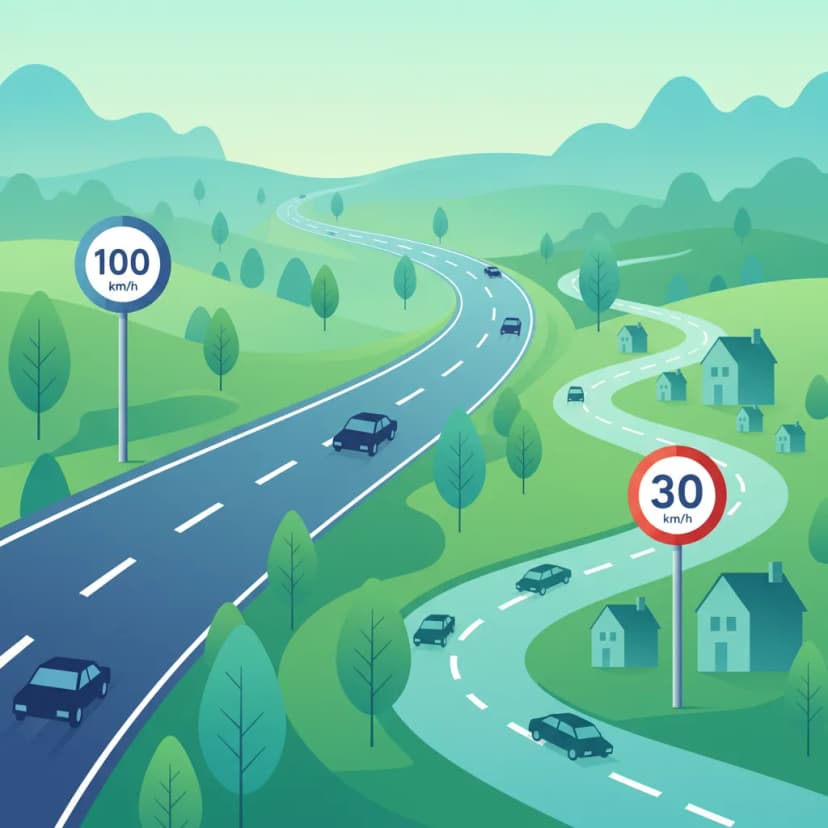
This lesson provides a comprehensive overview of the Swedish national speed limit system. You will learn the default speed limits applicable to different classes of roads, such as 50 km/h in built-up areas and 110 km/h on motorways. It also covers how to identify and comply with special zones, like residential areas (gångfartsområde), school zones, and temporary limits in construction areas, ensuring you always ride at a legal and appropriate speed.
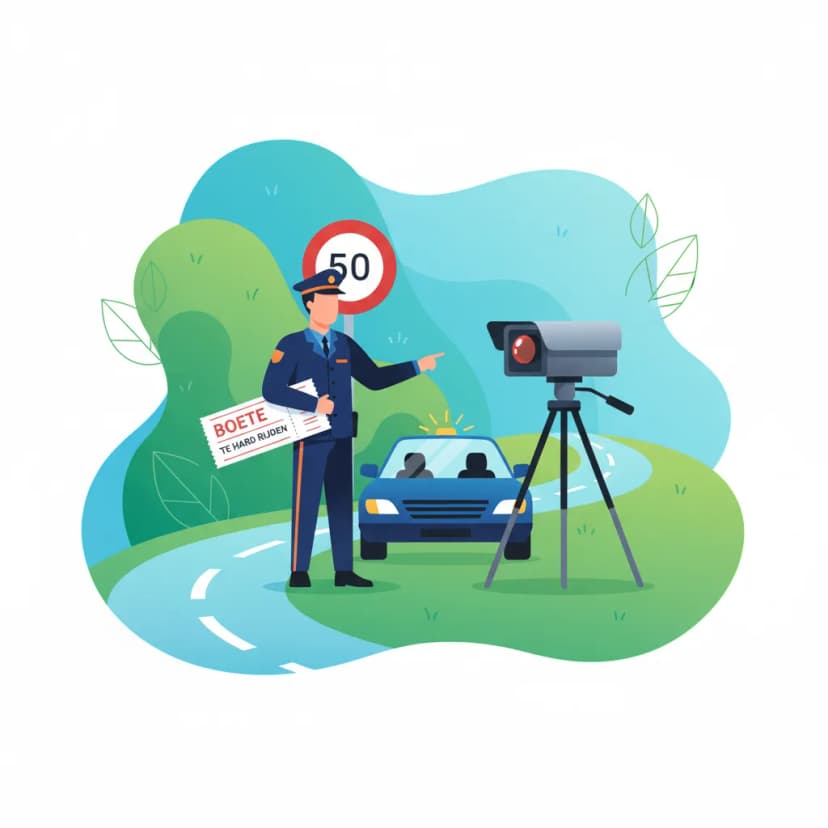
This lesson outlines the enforcement measures and penalties for speeding violations in Sweden. It explains the system of fines, how they escalate based on the severity of the offense, and the potential for receiving demerit points on a license. The content serves as a serious reminder of the legal and financial consequences of speeding, reinforcing the importance of adhering to all speed regulations.
This lesson clarifies the regulations for operating a moped on cycle paths (Cykelbana) and other shared spaces in Sweden. It explains which types of mopeds are permitted on these paths and the specific rules that apply, such as lower speed limits and the duty to yield to cyclists. The content focuses on safe interaction and communication to ensure peaceful coexistence with other users in these environments.
This lesson focuses on regulatory signs (Regulationsskyltar), which issue mandatory instructions and prohibitions that all road users must follow. It details common signs such as speed limits, stop and give way signs, and mandatory direction arrows. Special attention is given to signs directly affecting mopeds, like 'no moped' signs and those indicating designated moped lanes, ensuring riders can navigate legally and safely.
Find clear answers to common questions learners have about Scope of the AM Licence and Vehicle Classification. Learn how the lesson is structured, which driving theory objectives it supports, and how it fits into the overall learning path of units and curriculum progression in Sweden. These explanations help you understand key concepts, lesson flow, and exam focused study goals.
In Sweden, a Category AM moped is legally defined by its engine capacity and maximum speed. The engine must not exceed 50 cubic centimeters (cc) for internal combustion engines, and the maximum design speed must not exceed 45 km/h. Exceeding these limits would classify the vehicle differently.
No, AM mopeds are generally prohibited from using motorways (motorväg) and express roads (motortrafikled) in Sweden. These roads are designated for faster, higher-powered vehicles. Mopeds must use alternative routes such as general roads and streets.
Vehicle classification refers to how a vehicle is legally categorized based on its technical specifications, such as engine size, maximum speed, and weight. For a Category AM moped in Sweden, this classification determines specific rules regarding licensing, road access, and required safety equipment.
Having correct vehicle documentation, such as registration documents (registreringsbevis) and proof of insurance, is crucial for legal compliance. It proves the moped meets the AM category's legal requirements and allows authorities to identify the vehicle. Operating a moped without proper documentation can lead to fines and other penalties.
While all fall under the AM category, there can be distinctions. Light mopeds (Lätt moped) are typically limited to 45 km/h, while 'epa-traktors' or 'a-traktors' (which are converted cars and have different regulations) are distinct. This lesson focuses on the standard definition of a light moped intended for the AM license.