Logo
Swedish Driving Theory Courses

Lesson 1 of the Swedish Road Sign System for Mopeds unit

Swedish Moped Theory AM: Regulatory Signs (Regulationsskyltar)

Welcome to our lesson on Swedish regulatory signs (Regulationsskyltar) for Category AM moped riders. Understanding these mandatory signs is crucial for safe and legal moped operation. This lesson, part of Unit 2 on the Swedish Road Sign System, will equip you with the knowledge to interpret and obey signs that dictate speed limits, directions, and prohibitions, ensuring you are well-prepared for both the theory exam and real-world riding.
regulatory signsRegulationsskyltarSwedish road signsmoped AMtheory exam
Swedish Moped Theory AM: Regulatory Signs (Regulationsskyltar)
Swedish Moped Theory AM

Understanding Regulatory Signs (Regulationsskyltar) for Swedish Moped Riders

Navigating the roads safely and legally as a moped rider in Sweden requires a thorough understanding of traffic signs. Among these, regulatory signs, known in Swedish as Regulationsskyltar, are perhaps the most crucial. These signs issue mandatory instructions and prohibitions that all road users, including Category AM (moped) riders, must follow without exception. This lesson will detail the various types of regulatory signs, their specific implications for moped riders, and the underlying principles that make them indispensable for road safety and traffic flow.

What are Regulatory Signs (Regulationsskyltar)?

Regulatory signs are the backbone of Sweden's traffic regulation system. They are binding directives established under the Trafikförordningen (Swedish Traffic Regulations) and the Vägtrafiklagen (Road Traffic Act). Unlike warning signs that alert you to potential hazards, or information signs that provide guidance, regulatory signs demand immediate and specific actions or prohibitions. Failure to comply with these signs can lead to legal penalties, including fines and penalty points, and significantly increases the risk of accidents.

The primary purpose of Regulationsskyltar is multifaceted:

  • Safety: By limiting speeds, prohibiting dangerous maneuvers, and directing traffic flow, these signs actively reduce the likelihood and severity of collisions.
  • Predictability: Mandatory instructions create a shared understanding among all road users, which is essential for smooth and safe navigation, especially at intersections and in areas with mixed traffic.
  • Legal Intent: They serve as instantly recognizable visual cues that translate complex legal requirements into simple, actionable directives, ensuring quick decision-making on the road.

This lesson forms a fundamental part of your Swedish Driving License Theory Course – Category AM (Moped), building upon basic knowledge of the Swedish road sign classification system and general traffic rules. It also lays the groundwork for understanding priority rules, speed limits, and how road markings reinforce sign instructions.

Core Principles of Regulatory Sign Compliance

Several core principles govern how regulatory signs function and how moped riders must interpret them. Understanding these principles is key to consistent and safe road behavior.

Every regulatory sign represents a mandatory rule; non-compliance is considered a legal offense. This principle ensures that traffic rules are enforceable and that all road users adhere to a common standard of behavior. For moped riders, this means ignoring a speed limit, a stop sign, or a "no mopeds" sign will result in immediate fines or penalty points, regardless of whether you intended to break the rule.

Visibility and Legibility for Moped Riders

Regulatory signs must be positioned, designed, and maintained so that all road users, including moped riders, can perceive and read them with adequate reaction time. Mopeds, due to their lower seating position, can have a narrower field of view compared to cars. Signs are typically designed to be visible from at least 150 meters under normal conditions, allowing sufficient time for a rider to process the information and adjust their speed or direction safely before the rule applies.

Understanding the Zone of Influence

Each regulatory sign has a specific effective area, or "zone of influence," where its instruction applies. This zone typically begins at the sign's placement and continues until superseded by another sign or a clear end-of-restriction marker. Moped riders must understand precisely when a rule begins and ends to adjust their speed, lane selection, or other behaviors at the correct point. Ambiguity about a sign's application can lead to confusion and hazardous situations.

Hierarchy of Signs for Resolving Conflicts

Occasionally, different signs might appear to conflict. In such cases, the principle of hierarchy clarifies which rule prevails. Generally, a sign with higher specificity takes precedence over a more general one. For instance, a "No mopeds" sign explicitly prohibiting mopeds would override a more general "No motor vehicles" sign if a specific exemption for mopeds existed on the latter. This ensures that the most relevant and precise instruction is always followed.

Interpreting Conditional Modifiers and Supplementary Plates

Many regulatory signs are accompanied by additional plates, known as supplementary plates (tilläggstavlor), which modify their primary meaning. These plates might specify conditions like time (e.g., "Only between 06:00-22:00"), vehicle types (e.g., "Except for mopeds"), or specific distances. A "Speed limit 30 km/h" sign with a supplementary plate "Except for mopeds" means that mopeds are allowed to travel up to their maximum legal speed of 45 km/h, while other vehicles must adhere to 30 km/h. Correctly interpreting these modifiers is vital for legal and safe riding.

Mastering Speed Limits for Mopeds in Sweden

Speed-limit signs are among the most frequently encountered regulatory signs. They dictate the maximum speed allowed for all vehicles, unless modified for specific vehicle types.

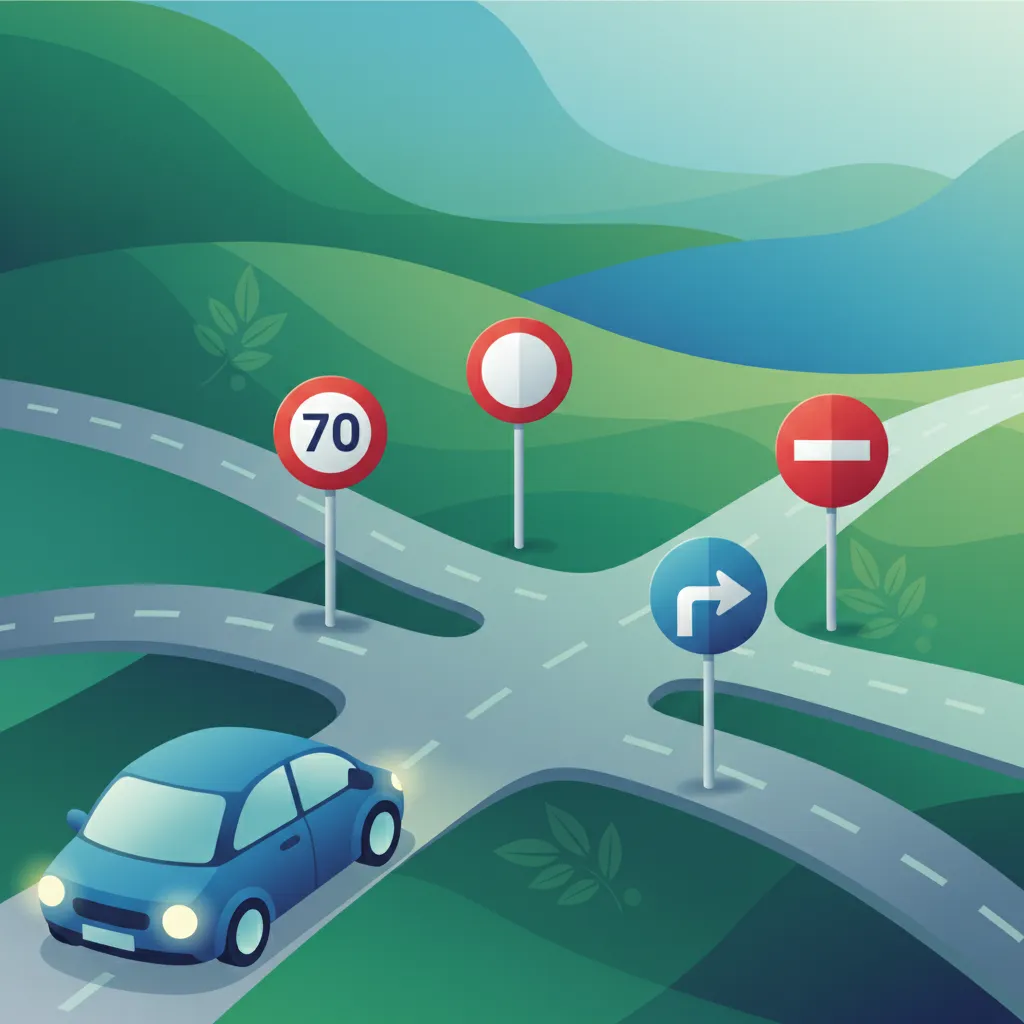
  • Definition: These are circular white signs with a red border displaying a numeric value (e.g., 30, 50, 70, 90) that indicates the maximum permitted speed in kilometers per hour (km/h).
  • Practical Meaning for Mopeds: As a Category AM moped rider, your vehicle's maximum legal speed is 45 km/h. Therefore, even if a sign indicates a higher speed limit (e.g., 50 km/h or 70 km/h), you must never exceed 45 km/h. You must, however, comply with any posted limit below 45 km/h. For example, in a 30 km/h zone, your maximum speed is 30 km/h.
  • Types of Speed Limits:
    • General Speed Limit: The most common type, applying to all vehicles.
    • Temporary Speed Limit: Often indicated by an orange background on the sign or a supplementary plate with "Tillfälligt" (Temporary). These are frequently used during roadworks or special events and supersede general limits.
    • Conditional Speed Limit: Accompanied by supplementary plates that modify the limit for certain vehicles or under specific conditions. For example, a "30 km/h" sign with a plate "Except for mopeds" means mopeds are exempt from the 30 km/h limit and can travel up to 45 km/h.

Tip

Always be aware of your moped's legal top speed. Even if the road allows for higher speeds, your vehicle does not. However, if the posted limit is lower than 45 km/h, that lower limit applies to you.

Common Misunderstandings about Speed Limits:

  • Zone of Application: A speed limit applies from the point where the sign is erected and continues until you encounter another speed-limit sign, an "end of speed limit" sign, or a general end-of-restriction sign. Do not assume a speed limit applies to an entire long road segment.
  • Ignoring Conditional Plates: Failing to read supplementary plates can lead to riding too fast or unnecessarily slowly. Always check if a plate modifies the limit for mopeds.

Intersections are critical areas where priority rules are paramount. Stop and Yield signs are regulatory signs designed to manage right-of-way and prevent collisions.

Stop Sign (Stopplåt)

  • Definition: An octagonal red sign with the word "STOP" in white. It is one of the most demanding regulatory signs.
  • Practical Meaning: When you encounter a Stop sign, you must bring your moped to a complete and full halt before the stop line marked on the road, or before the crosswalk if present. If there is no line or crosswalk, you must stop at a point where you have a clear view of the intersecting traffic without entering the flow of traffic. After stopping, you must check all directions and proceed only when it is safe to do so and when you have been granted the right-of-way by other traffic.
  • Associated Rules:
    • A full stop is mandatory, regardless of whether there is visible cross-traffic. A "rolling stop" (slowing down without a complete halt) is illegal and can result in a fine.
    • The rule applies to all vehicle types, including mopeds.

Warning

A rolling stop at a STOP sign is a common violation with serious consequences. Always come to a complete halt.

Yield (Give Way) Sign (Väjningsplåt)

  • Definition: An inverted triangular sign with a red border and a white interior. In some variants, it may contain the word "VÄJ" (Swedish for yield).
  • Practical Meaning: This sign instructs you to reduce your speed and be prepared to stop, giving precedence to traffic on the intersecting road. You are not obligated to stop if the intersecting traffic is absent or sufficiently distant that you can proceed safely without impeding them.
  • Associated Rules:
    • You must be ready to stop if necessary, but stopping is only required if there is traffic to which you must yield.
    • Always yield to vehicles approaching from your left and right on the main road.
  • Common Misunderstandings: Confusing a Yield sign with a Stop sign is a common error. While you must be prepared to stop, it is not always mandatory. However, prioritize safety; if in doubt, slow down or stop.

Prohibited Entry and Vehicle Restrictions for Mopeds

Certain regulatory signs prohibit entry for specific vehicle types or all traffic, often to protect vulnerable road users or manage traffic flow in sensitive areas.

No Entry for Specific Vehicles

These are circular signs with a red border and a white background, displaying a black pictogram of the prohibited vehicle type. A red diagonal line across the pictogram further emphasizes the prohibition.

  • No Motor Vehicles (R3 - Förbud mot trafik med motordrivet fordon): This sign (often a car silhouette) generally prohibits entry for all motor vehicles, including mopeds.
  • No Mopeds (R4 - Förbud mot trafik med moped):
  • Definition: This crucial sign explicitly prohibits mopeds from entering a designated area or road segment.
  • Practical Meaning: If you see this sign, you must not enter the road or area beyond it with your moped. These signs are common in pedestrian zones, certain bicycle paths, or environmentally sensitive areas where mopeds are deemed unsuitable.
  • No Entry for All Traffic (R5 - Förbud mot infart): A red circular sign with a white horizontal bar, signifying no entry for any type of traffic from the direction you are approaching. This means you absolutely cannot proceed beyond the sign.

Common Misunderstandings:

  • "No Motor Vehicles" vs. "No Mopeds": While "No Motor Vehicles" generally includes mopeds, always look for the more specific "No Mopeds" sign. If a "No motor vehicles" sign allows exceptions (via supplementary plate) that exclude mopeds, the specific plate governs.
  • Sign Placement: Remember that a prohibition applies from where the sign is visible to you. A "No Entry" sign facing traffic from the opposite direction does not apply to your current direction of travel.

Mandatory Directions and Lane Usage for Moped Riders

These signs dictate the compulsory direction of travel or designate specific lanes for certain vehicle types, ensuring orderly traffic flow and safety.

Mandatory Direction Arrows (R6 - Påbjuden körriktning)

  • Definition: Blue circular signs with a white arrow indicating a compulsory direction of travel (straight, left, right, or a combination like straight-or-right).
  • Practical Meaning: You must follow the indicated direction while in the lane or road segment controlled by the sign. These are often found at intersections or to manage traffic flow on one-way streets.
  • Associated Rules:
    • Mandatory direction arrows are typically reinforced by road markings in multi-lane situations.
    • If no lane markings are present, the arrow's instruction usually applies to the entire width of the road for your direction of travel.
  • Common Misunderstandings: Assuming an arrow applies only to the immediate lane you are in. It can govern the entire road section if not clearly demarcated for specific lanes.

Lane-Use Signs for Mopeds (R7 - Körfält för moped/cykel)

  • Definition: Blue circular signs featuring a white moped silhouette (or a bicycle silhouette sometimes with a moped overlay), designating specific lanes for mopeds or shared use with bicycles.
  • Types:
    • Exclusive Moped Lane: A sign showing only a moped silhouette, sometimes with a solid line beneath it, indicates a lane designated solely for mopeds.
    • Shared Bicycle-Moped Lane: A sign showing both a bicycle and a moped side-by-side indicates a lane where mopeds and bicycles can travel together.
  • Practical Meaning: If an exclusive moped lane or a shared bicycle-moped lane is present, you must use it. Riding on the general roadway or in exclusive bicycle lanes (without a shared-use sign) when a designated moped lane exists is a violation.
  • Associated Rules:
    • Mopeds are generally prohibited from using lanes marked only for bicycles unless a shared-lane sign is explicitly displayed.
    • Violation of lane-use regulations for mopeds can result in a fine, as mopeds are considered motorized vehicles with specific rules.
  • Common Misunderstandings: A common mistake is assuming all bicycle lanes are permissible for mopeds. Always look for the moped silhouette on the sign to confirm shared or exclusive moped access.

Overtaking Restrictions and Prohibitions (Förbjuden omkörning)

Overtaking, or passing another vehicle, is a maneuver that carries inherent risks. Regulatory signs help manage these risks by prohibiting overtaking in specific hazardous areas.

  • Definition: These are red circular signs with a white car silhouette (or sometimes a moped silhouette) with a red diagonal line across it, indicating that overtaking is prohibited.
  • Types Relevant to Mopeds:
    • No Overtaking for All Vehicles (C25): The standard sign, typically showing a car silhouette, prohibits all vehicles, including mopeds, from overtaking other motor vehicles.
    • No Overtaking for Mopeds (Specific Sign/Plate): Less common, but a specific sign or supplementary plate might prohibit mopeds from overtaking, perhaps on a narrow road or where their acceleration is insufficient for a safe pass.
  • Practical Meaning: When this sign is in effect, you must remain in your current lane and not pass any vehicle from behind. This rule applies until you see an "end of no overtaking" sign or another road feature indicates the restriction has ended.
  • Associated Rules: These signs are typically placed on stretches of road where visibility is limited (e.g., sharp curves, hillcrests), where the road is too narrow, or where oncoming traffic poses a high risk.
  • Common Misunderstandings: Assuming the sign applies only to faster vehicles. If a general "No Overtaking" sign is present, it applies to all vehicles, including mopeds.

Parking and Stopping Rules for Mopeds (Förbud att parkera/stoppa)

Understanding where you can and cannot park or stop your moped is crucial for urban navigation and avoiding fines. These regulatory signs clearly define permitted actions.

No Parking and No Stopping Signs

  • Definition: These are red circular signs with a white background.
    • No Parking (C33): Features a black "P" (for parking) crossed out by a red diagonal line.
    • No Stopping (C34): Features a red circle with a single red diagonal line across it.
  • Practical Meaning:
    • No Parking: Prohibits leaving your vehicle stationary for any period beyond what is strictly necessary for loading/unloading passengers or goods, or to avoid interfering with traffic. You can stop briefly if traffic requires it, but you cannot leave the vehicle unattended.
    • No Stopping: This is a stricter prohibition. It forbids even a brief halt, for any reason (e.g., picking up/dropping off passengers, loading/unloading, or checking a map). You must keep moving in a "no stopping" zone.
  • Specific for Mopeds: Sometimes, a supplementary plate will specify "No parking for mopeds" or "No stopping for mopeds," indicated by a moped silhouette.
  • Associated Rules: These signs are vital for maintaining traffic flow, ensuring visibility, and preventing obstruction of emergency access.
  • Common Misunderstandings: A frequent mistake is confusing "No Parking" with "No Stopping." Remember that "No Stopping" is the more restrictive rule. If you see a "No Stopping" sign, you cannot even pause momentarily.

Tip

Always look for designated moped parking areas or find a legal spot that does not obstruct traffic or violate any parking/stopping prohibitions.

Interpreting Supplementary Plates (Tilläggstavlor)

Supplementary plates are small rectangular signs placed below primary regulatory signs. They are essential for understanding the full scope and specific conditions of a regulation. Ignoring them can lead to misinterpretation and violations.

  • Definition: Rectangular plates, typically white with black text or symbols, that provide additional information, exceptions, or conditions to the main sign above them.
  • Purpose: They allow traffic authorities to implement nuanced regulations tailored to specific situations, vehicle types, or times.
  • Examples:
    • "Except for mopeds" (Utom moped): Modifies a prohibition, allowing mopeds to be exempt.
    • "Only between 08:00-17:00": Specifies the hours during which the regulation applies.
    • "For residents only": Restricts access or parking to local residents.
    • "For 50 meters": Indicates the distance over which the regulation is in effect.
  • Implications for Moped Riders: These plates are critical. A general "No Entry" sign might have a supplementary plate "Except for mopeds," meaning you are allowed to enter. Conversely, a speed limit might have a plate "For mopeds – 30 km/h" specifically setting a lower limit for you. Always read these plates carefully.

Common Regulatory Sign Violations and Consequences

Understanding common violations is as important as knowing the rules themselves. Many fines and accidents stem from simple misinterpretations or intentional disregard of regulatory signs.

  • Riding a moped into a pedestrian zone marked "No Mopeds": This directly ignores a vehicle-type restriction designed to protect pedestrians.
    • Why It’s Wrong: Endangers pedestrians, violates traffic regulations.
    • Correct Behaviour: Divert before the sign and use an alternative legal route.
    • Consequence: Fine (e.g., around 1,500 SEK) and possible penalty points.
  • Performing a rolling stop at a STOP sign: The law requires a complete halt.
    • Why It’s Wrong: Fails to guarantee full observation of cross-traffic, increasing collision risk.
    • Correct Behaviour: Bring the moped to a full stop before the stop line, look in all directions, and proceed only when safe.
    • Consequence: Significant fine (e.g., around 2,000 SEK) and possible penalty points.
  • Riding in an exclusive bicycle lane when only a moped lane is allowed: Mopeds are motorized vehicles and have distinct lane requirements.
    • Why It’s Wrong: Violates lane-use regulations, endangers cyclists, and creates conflict.
    • Correct Behaviour: Stay within designated moped lanes or the general road lane when no specific moped lane is provided.
    • Consequence: Fine and possible penalty points.
  • Ignoring a "No overtaking for mopeds" sign on a steep hill:
    • Why It’s Wrong: Overtaking on hills or curves compromises visibility, traction, and control, significantly increasing crash risk.
    • Correct Behaviour: Remain behind the vehicle until the restriction ends and it is safe and legal to pass.
    • Consequence: Fine and increased risk of accident.
  • Misinterpreting a conditional speed-limit plate: For example, seeing "30 km/h - Except for mopeds" and riding at 30 km/h instead of the allowed 45 km/h, or conversely, ignoring a lower limit for mopeds.
    • Why It’s Wrong: Either leads to unnecessary slowing or, more dangerously, exceeding the allowed speed for mopeds.
    • Correct Behaviour: Always apply the specific rule for your vehicle category as stated on the supplementary plate. If exempt, ride up to your maximum legal speed (45 km/h for mopeds); if a specific lower limit is given, adhere to that.
    • Consequence: Fine if speed exceeds the allowed limit.

Conditional Factors Affecting Regulatory Sign Interpretation

The effectiveness and interpretation of regulatory signs can be influenced by various external and internal factors. Moped riders must consider these conditions to ensure compliance and safety.

Weather and Visibility Conditions

  • Reduced Visibility: In fog, heavy rain, or snow, the distance at which you can perceive and read signs is drastically reduced. This demands that riders anticipate signs earlier, reduce speed, and increase following distances.
  • Temporary Signs: Temporary speed-limit signs, often with an orange background, are frequently used during adverse weather conditions or roadworks. These supersede the regular limits and must be strictly obeyed.

Road Type and Environment

  • Urban Streets: City centers and residential areas often feature numerous "No Mopeds" zones, pedestrian-only areas, and mandatory direction arrows to manage dense traffic and protect vulnerable road users. Speed limits are generally lower.
  • Rural Roads: While rural roads may have higher general speed limits, "No Overtaking for Mopeds" signs can appear on curves, hills, or narrow sections where passing is hazardous.
  • Motorways (Motorväg): Mopeds are generally prohibited from motorways. The "No Motor Vehicles" sign (R3) or specific "No Mopeds" signs (R4) will prevent entry. Entering a motorway on a moped is illegal.

Vehicle State and Road User Interactions

  • Vehicle Malfunctions: If your moped has a malfunctioning headlight, you must not enter a "Mandatory Headlight" zone during periods when headlights are required (e.g., night, tunnels).
  • Overloaded Mopeds: An overloaded moped might be restricted from certain lanes or areas due to increased width or reduced maneuverability.
  • Interactions with Vulnerable Users: When a "Give Way" sign is near a pedestrian crossing, you must yield to pedestrians even if no vehicle is present. In shared bicycle-moped lanes, maintaining a safe lateral distance (approximately 1 meter) from cyclists is paramount.

Time-Based Modifiers

Some regulatory signs have specific time-based restrictions indicated by supplementary plates (e.g., "No mopeds 22:00–06:00"). This means the prohibition only applies during those hours; outside these times, mopeds may be permitted. Always check for such time-based conditions.

Why Regulatory Signs Matter: Safety and Predictability

The strict enforcement and clear design of regulatory signs are not arbitrary; they are rooted in principles of physics, human psychology, and traffic management, all aimed at enhancing safety and predictability on the roads.

  • Kinetic Energy and Crash Severity: The kinetic energy of a moving vehicle increases exponentially with speed (kinetic energy is proportional to speed squared). Even a small reduction in speed, for example, from 45 km/h to 30 km/h, significantly reduces the kinetic energy and thus the severity of potential collisions. This is why speed-limit signs are strictly enforced and critical for moped riders, who are more vulnerable in crashes.
  • Visibility and Reaction Time: Regulatory signs are strategically placed to ensure that riders have adequate perception-reaction time. For a moped traveling at its maximum 45 km/h (approximately 12.5 meters per second), a typical reaction time of 3 seconds means a minimum perception-reaction distance of about 38 meters. Signs are positioned well in advance to allow for safe braking and maneuvering.
  • Human Factors – Reducing Cognitive Load: Clear, unambiguous regulatory signs (e.g., "STOP," "No Entry") simplify decision-making for riders, reducing cognitive load. This lowers mental fatigue and the likelihood of errors, especially in complex traffic situations.
  • Statistical Evidence: Studies by the Swedish Transport Agency and similar bodies consistently show that robust regulatory signage, combined with enforcement, leads to tangible safety improvements. For example, the implementation of dedicated moped lanes (as mandated by R7 signs) has been linked to a significant reduction in moped-related collisions in urban areas.
  • Psychology of Compliance: Consistent and visible enforcement of regulatory signs helps to cultivate habit formation among road users. Over time, behaviors like stopping completely at a Stop sign or avoiding "No Mopeds" zones become automatic, contributing to a safer and more orderly traffic environment for everyone.

By understanding these underlying principles and diligently adhering to regulatory signs, moped riders not only comply with the law but also actively contribute to their own safety and the safety of others on Swedish roads.

Regulatory Sign (Regulationsskylt)
A sign that imposes a binding traffic rule, such as a mandatory action, prohibition, or restriction, under Swedish law.
Speed Limit
The maximum permissible speed indicated by a circular sign with a numerical value in kilometers per hour (km/h).
Stop Sign (Stopplåt)
An octagonal red sign with the word 'STOP' that requires a complete halt before proceeding.
Yield Sign (Väjningsplåt)
An inverted triangular sign with a red border, indicating that drivers must give precedence to traffic on the intersecting road.
No-Entry Sign
A sign prohibiting one or more vehicle types from entering a specific road segment or area.
Mandatory Direction Arrow
A blue circular sign with a white arrow dictating a compulsory direction of travel for vehicles.
Moped Lane
A designated lane for mopeds, sometimes shared with bicycles, indicated by a blue circular sign with a moped silhouette.
No Overtaking Sign
A red circular sign with a crossed-out vehicle silhouette, prohibiting passing other vehicles.
Parking Prohibition
A red circular sign with a crossed-out 'P' indicating that parking is forbidden.
Stopping Prohibition
A red circular sign with a single diagonal line, indicating that even a brief halt is forbidden.
Supplementary Plate (Tilläggstavla)
A small rectangular plate attached below a primary sign, providing additional conditions, exceptions, or specific limits.
Zone of Influence
The specific area or segment of road where a regulatory sign's rule applies, typically from the sign's location until superseded.
Trafikförordningen
The Swedish Traffic Regulations, the primary legal source governing road use and sign compliance in Sweden.
Penalty Points
Points added to a driver's license record for traffic violations, which can lead to license suspension if accumulated.

Learn more with these articles

Check out these practice sets


Search topics related to Regulatory Signs (Regulationsskyltar)

Explore search topics learners often look for when studying Regulatory Signs (Regulationsskyltar). These topics reflect common questions about road rules, driving situations, safety guidance, and lesson level theory preparation for learners in Sweden.

swedish moped regulatory signs amRegulationsskyltar meaning sweden mopedam moped theory test sweden stop signwhat does speed limit sign mean sweden mopedno moped sign swedenunderstanding mandatory road signs sweden amtrafikverket regulationsskyltar moped category

Related driving theory lessons for Regulatory Signs (Regulationsskyltar)

Browse additional driving theory lessons that cover connected traffic rules, road signs, and common driving situations related to this topic. Improve your understanding of how different rules interact across everyday traffic scenarios.

Swedish Regulatory Signs and Their Meanings for Mopeds

Understand the mandatory instructions and prohibitions of Swedish regulatory signs (Regulationsskyltar). This lesson covers essential signs like speed limits, stop, and give way, focusing on those relevant to the AM moped category.
regulatory signsRegulationsskyltarSwedish road signsmoped AMtheory
Information Signs (Informationsskyltar) lesson image

Information Signs (Informationsskyltar)

This lesson explains the function of informational signs (Informationsskyltar), which provide guidance for navigation and access to services. It covers signs indicating distances to destinations, route numbers, and locations of fuel stations or parking areas. For moped riders, this includes identifying signs for designated moped or cycle lanes, helping them to plan and follow routes efficiently and legally.
Swedish Moped Theory AMSwedish Road Sign System for Mopeds
View lesson
Warning Signs (Varningsskyltar) lesson image

Warning Signs (Varningsskyltar)

This lesson teaches riders to interpret warning signs (Varningsskyltar), which alert them to potential dangers on the road ahead. It covers a wide range of signs, including those for sharp curves, slippery surfaces, wildlife crossings, and upcoming roadworks. Understanding these triangular signs allows riders to anticipate hazards, adjust their speed and position proactively, and enhance their overall safety.
Swedish Moped Theory AMSwedish Road Sign System for Mopeds
View lesson
Road Markings Relevant to Mopeds lesson image

Road Markings Relevant to Mopeds

This lesson focuses on the importance of road markings (Vägmarkering) for guiding traffic flow and ensuring safety. It explains the meaning of different line types, such as solid and broken lines, and the function of stop lines and pedestrian crosswalks. The content highlights markings specific to cycle and moped lanes, teaching riders how to correctly position themselves on the road based on these visual cues.
Swedish Moped Theory AMSwedish Road Sign System for Mopeds
View lesson
Regulatory Signs and Their Meaning lesson image

Regulatory Signs and Their Meaning

This lesson details the full range of Swedish regulatory signs, which dictate mandatory actions and prohibitions for all road users. You will learn to identify signs that establish speed limits, restrict access, prohibit overtaking, and define parking rules. Understanding these signs is critical for legal compliance and safe interaction with other traffic, as they form the basis of enforceable road law under the Trafikförordning regulations.
Swedish Motorcycle Theory ASwedish Road Signs & Signals for Motorcyclists
View lesson
Overview of Moped-Specific Regulations lesson image

Overview of Moped-Specific Regulations

This lesson consolidates the key regulations that apply specifically to moped operation in Sweden. It covers mandatory rules such as speed limits, helmet use, and requirements for vehicle lighting and reflectors. Furthermore, the lesson explains the legal consequences of violations, including the system of fines and potential demerit points, ensuring riders understand their full range of legal responsibilities on the road.
Swedish Moped Theory AMIntroduction to Category AM and Licensing
View lesson
Parking Regulations for Mopeds (Parkeringsförbud) lesson image

Parking Regulations for Mopeds (Parkeringsförbud)

This lesson focuses on the often-confusing topic of moped parking. It covers how to interpret parking signs, including those indicating prohibitions (Parkeringsförbud), and where to find designated parking spots for two-wheelers. The content provides practical advice on where it is legal to park and how to do so without causing an obstruction, thereby avoiding fines.
Swedish Moped Theory AMRoad Markings and Shared Spaces
View lesson
Temporary Roadwork and Detour Signage lesson image

Temporary Roadwork and Detour Signage

This lesson prepares riders for encountering roadworks, which can introduce temporary and often confusing changes to the road layout. It explains how to interpret the specific orange-colored signs used in these zones, including new speed limits, lane diversions, and warnings about surface hazards. The key takeaway is to reduce speed and increase vigilance when navigating through construction areas.

Swedish Moped Theory AMRoad Markings and Shared Spaces
View lesson
Documentation, Insurance, and Registration lesson image

Documentation, Insurance, and Registration

This lesson outlines the essential administrative responsibilities of a moped owner and rider. It covers the legal requirement to have valid third-party liability insurance and to ensure the vehicle is properly registered. The content also reminds riders of the documents they must carry with them at all times, such as their driving license and registration certificate.

Swedish Moped Theory AMLegal Responsibilities, Conduct, and Penalties
View lesson
Stopping and Waiting at Designated Areas lesson image

Stopping and Waiting at Designated Areas

This lesson clarifies the legal distinction between stopping temporarily and parking. It identifies areas where stopping is prohibited, such as near intersections or on pedestrian crossings, to maintain traffic flow and safety. The content also discusses designated waiting areas at traffic lights, often marked for cyclists and mopeds, which can offer a safer position.
Swedish Moped Theory AMRoad Markings and Shared Spaces
View lesson
Cycle Lanes, Bus Lanes, and Mixed Use Zones lesson image

Cycle Lanes, Bus Lanes, and Mixed Use Zones

This lesson explains the specific regulations for lanes designated for particular users, such as buses or cyclists. It clarifies under what circumstances a moped is permitted to enter these lanes and the rules that must be followed while in them. Understanding these regulations is key to navigating complex urban environments legally and safely.

Swedish Moped Theory AMRoad Markings and Shared Spaces
View lesson

Swedish Road Signs for Mopeds Overview

Gain a comprehensive understanding of the Swedish road sign system for mopeds, moving beyond regulatory signs to cover warning and information signs. Learn how different sign types work together to ensure safe traffic flow.

road signsmoped AMSwedish traffic ruleswarning signsinformation signs
Information Signs (Informationsskyltar) lesson image

Information Signs (Informationsskyltar)

This lesson explains the function of informational signs (Informationsskyltar), which provide guidance for navigation and access to services. It covers signs indicating distances to destinations, route numbers, and locations of fuel stations or parking areas. For moped riders, this includes identifying signs for designated moped or cycle lanes, helping them to plan and follow routes efficiently and legally.

Swedish Moped Theory AMSwedish Road Sign System for Mopeds
View lesson
Warning Signs (Varningsskyltar) lesson image

Warning Signs (Varningsskyltar)

This lesson teaches riders to interpret warning signs (Varningsskyltar), which alert them to potential dangers on the road ahead. It covers a wide range of signs, including those for sharp curves, slippery surfaces, wildlife crossings, and upcoming roadworks. Understanding these triangular signs allows riders to anticipate hazards, adjust their speed and position proactively, and enhance their overall safety.

Swedish Moped Theory AMSwedish Road Sign System for Mopeds
View lesson
Temporary Roadwork and Detour Signage lesson image

Temporary Roadwork and Detour Signage

This lesson prepares riders for encountering roadworks, which can introduce temporary and often confusing changes to the road layout. It explains how to interpret the specific orange-colored signs used in these zones, including new speed limits, lane diversions, and warnings about surface hazards. The key takeaway is to reduce speed and increase vigilance when navigating through construction areas.

Swedish Moped Theory AMRoad Markings and Shared Spaces
View lesson
Road Markings Relevant to Mopeds lesson image

Road Markings Relevant to Mopeds

This lesson focuses on the importance of road markings (Vägmarkering) for guiding traffic flow and ensuring safety. It explains the meaning of different line types, such as solid and broken lines, and the function of stop lines and pedestrian crosswalks. The content highlights markings specific to cycle and moped lanes, teaching riders how to correctly position themselves on the road based on these visual cues.
Swedish Moped Theory AMSwedish Road Sign System for Mopeds
View lesson
Sign Interpretation in Urban and Rural Settings lesson image

Sign Interpretation in Urban and Rural Settings

This lesson explores how the environment affects sign interpretation, contrasting the high density and visual complexity of urban settings with the sparser signage of rural areas. It teaches riders to manage visual clutter in cities and maintain focus over long distances on country roads. By understanding these contextual differences, riders can better anticipate rules and hazards regardless of their location.
Swedish Moped Theory AMSwedish Road Sign System for Mopeds
View lesson
Warning Signs and Hazard Indicators lesson image

Warning Signs and Hazard Indicators

This lesson focuses on Swedish warning signs designed to alert drivers to potential dangers. You will study signs indicating sharp bends, slippery surfaces, animal crossings, and temporary hazards like road construction. Correctly interpreting these signs allows a motorcyclist to proactively adjust speed, lane position, and readiness to react, which is essential for maintaining control and safety, especially in adverse weather or on unfamiliar roads.
Swedish Motorcycle Theory ASwedish Road Signs & Signals for Motorcyclists
View lesson
Information and Directional Signs lesson image

Information and Directional Signs

This lesson explains how to read and use Swedish informational and directional signs for effective route planning and navigation. You will learn to follow signs for specific destinations, identify road numbers, and recognize indicators for services such as fuel stations and rest areas. For motorcyclists on long journeys, this knowledge is crucial for making timely decisions about lane changes, exits, and stops without causing disruption to traffic flow.
Swedish Motorcycle Theory ASwedish Road Signs & Signals for Motorcyclists
View lesson
Interpretation of Lane Markings (Markering på vägbanan) lesson image

Interpretation of Lane Markings (Markering på vägbanan)

This lesson offers a detailed guide to interpreting the various lines and symbols painted on the road surface. It clarifies the rules associated with solid versus broken lines regarding lane changes and overtaking. The content also explains the function of arrows, stop lines, and other markings that provide crucial positioning and priority information to the rider.

Swedish Moped Theory AMRoad Markings and Shared Spaces
View lesson
Mopeds and Low-Power Vehicles lesson image

Mopeds and Low-Power Vehicles

This lesson explains how to identify and interact with various types of mopeds and other low-speed vehicles common on Swedish roads. You will learn the difference between Class I and Class II mopeds and their place on the road, as well as how to recognize A-tractors by their LGF (långsamtgående fordon) sign. The key focus is on managing the large speed differential and making safe judgments when deciding to overtake.

Swedish Driving Theory BInteraction with Vulnerable Road Users
View lesson
Overview of Moped-Specific Regulations lesson image

Overview of Moped-Specific Regulations

This lesson consolidates the key regulations that apply specifically to moped operation in Sweden. It covers mandatory rules such as speed limits, helmet use, and requirements for vehicle lighting and reflectors. Furthermore, the lesson explains the legal consequences of violations, including the system of fines and potential demerit points, ensuring riders understand their full range of legal responsibilities on the road.

Swedish Moped Theory AMIntroduction to Category AM and Licensing
View lesson

Frequently asked questions about Regulatory Signs (Regulationsskyltar)

Find clear answers to common questions learners have about Regulatory Signs (Regulationsskyltar). Learn how the lesson is structured, which driving theory objectives it supports, and how it fits into the overall learning path of units and curriculum progression in Sweden. These explanations help you understand key concepts, lesson flow, and exam focused study goals.

What is the difference between a regulatory sign (Regulationsskyltar) and a warning sign (Varningsskyltar) in Sweden?

Regulatory signs (Regulationsskyltar) issue mandatory instructions or prohibitions that you MUST obey, such as speed limits or stop signs. Warning signs (Varningsskyltar), on the other hand, alert you to potential hazards ahead, like a sharp bend or pedestrian crossing, and advise you to be cautious but do not impose a direct command.

Are there specific regulatory signs that only apply to mopeds in Sweden?

Yes, while many signs apply to all road users, Sweden has specific regulatory signs that prohibit mopeds from entering certain areas (e.g., a general 'no entry' sign may apply) or designate specific lanes or routes exclusively for mopeds, such as 'moped only' lanes. It’s crucial to recognize these distinctions for legal and safe riding.

What is the consequence of ignoring a mandatory regulatory sign like a 'Stop' sign (Stoppskylt)?

Ignoring a 'Stop' sign is a serious traffic violation. It requires you to come to a complete halt and yield to all other traffic before proceeding. Failing to do so can lead to accidents, fines, and demerit points on your license, as it shows a disregard for critical right-of-way rules.

How do I know if a speed limit sign applies to my moped?

Unless a sign specifically indicates otherwise for certain vehicle types, national speed limits and any posted speed limits apply to mopeds. Always be aware of the context; speed limits are often lower in urban areas, near schools, or in roadwork zones. You will learn about specific moped speed limits in Unit 4.

What does a 'mandatory direction' sign mean for a moped rider?

A 'mandatory direction' sign (e.g., an arrow pointing straight ahead or to the left/right) means you must follow the direction indicated by the arrow. You are not permitted to proceed in any other direction from that point. These signs are important for managing traffic flow and ensuring safety at complex junctions.

Continue your Swedish driving theory learning journey

Swedish road signsSwedish article topicsSearch Swedish road signsSwedish driving theory homeSwedish road sign categoriesSwedish Moped Theory AM courseSearch Swedish theory articlesSwedish driving theory coursesSwedish Driving Theory B courseSwedish driving theory articlesSwedish driving theory practiceSwedish practice set categoriesSwedish Motorcycle Theory A courseSearch Swedish driving theory practiceRoad Signs and Signals unit in Swedish Driving Theory BVehicle Control and Maneuvering unit in Swedish Driving Theory BPriority Rules and Intersections unit in Swedish Driving Theory BSpeed Limits and Distance Management unit in Swedish Driving Theory BAccident Response & Roadside Safety unit in Swedish Motorcycle Theory AAdverse Weather & Low-Grip Conditions unit in Swedish Motorcycle Theory ASpeed Limits and Safe Following Distances unit in Swedish Moped Theory AMEmergency Maneuvers & Obstacle Avoidance unit in Swedish Motorcycle Theory AEmergency Situations and Accident Procedures unit in Swedish Driving Theory BWarning Signs (Varningsskyltar) lesson in Swedish Road Sign System for MopedsRoad Markings Relevant to Mopeds lesson in Swedish Road Sign System for MopedsRegulatory Signs (Regulationsskyltar) lesson in Swedish Road Sign System for MopedsInformation Signs (Informationsskyltar) lesson in Swedish Road Sign System for MopedsSign Interpretation in Urban and Rural Settings lesson in Swedish Road Sign System for MopedsLegal Responsibilities, Documentation & Protective Equipment unit in Swedish Motorcycle Theory A