
Welcome to the lesson on Reverse Driving and Parking Manoeuvres, part of the 'Vehicle Control and Maneuvering' unit in your Swedish Category B driving theory course. This lesson focuses on the practical skills needed for low-speed vehicle control and positioning, which are frequently tested and crucial for safe everyday driving.
Driving safely involves more than just moving forward; mastering the art of reverse driving and various parking manoeuvres is crucial for every driver in Sweden. These low-speed actions, while seemingly simple, are among the most accident-prone due to limited visibility and the need for precise vehicle control. This lesson, part of your Swedish Driving License Theory Course for Category B Cars, provides a comprehensive guide to executing these manoeuvres with confidence, accuracy, and strict adherence to Swedish traffic laws.
Understanding and practicing these techniques will not only prepare you for your driving test but also significantly reduce the risk of collisions, especially with vulnerable road users like pedestrians and cyclists. We will cover everything from straight-line reversing to complex parallel parking, ensuring you can navigate tight spaces and challenging environments safely.
Before diving into specific manoeuvres, it is essential to grasp the core principles that apply to all reverse driving and parking situations. These principles are designed to ensure safety, precision, and legal compliance.
Maintaining a controlled speed is paramount during any reverse or parking manoeuvre. This typically means driving no faster than 5 km/h (walking pace), which allows you to stop safely within the visible distance and react instantly to unexpected obstacles. Low speed dramatically reduces kinetic energy, meaning that if a collision does occur, the severity of injury and damage is significantly lessened. Always modulate the accelerator gently, and be prepared to cover the brake pedal for immediate stopping power.
Effective continuous 360° observation is vital because reversing often involves significant blind spots. You must constantly use your mirrors (rear-view and side mirrors), turn your head to look through the rear-view window, and perform shoulder checks to scan all sides of your vehicle. This comprehensive scanning technique helps detect pedestrians, cyclists, other vehicles, and stationary objects that might be out of mirror view. This vigilance is mandatory at every stage: before starting, during the turn, and when finalising your position.
Reference-point methodology involves selecting specific, fixed points on your vehicle and aligning them with external cues in your environment to judge distance and angle accurately. For instance, the rear-right corner of your bumper might align with a curb, or your side mirror could line up with a parking bay line. Developing these mental models through practice provides a repeatable way to achieve precise positioning, preventing you from hitting curbs or other vehicles.
The Swedish Trafikförordning (Traffic Ordinance) mandates that drivers yield to all road users when reversing. This means pedestrians, cyclists, and other vehicles always have priority when you are moving backwards. You must be prepared to stop immediately if any road user approaches within a reasonable distance, ensuring their safety above all else. This legal obligation protects vulnerable users who may not anticipate your reverse movement or who have limited visibility themselves.
Clearly signalling intent is a legal requirement and a critical safety measure. Before starting any reverse manoeuvre, activate your turn indicators (turn lights) to communicate your planned direction of movement to surrounding road users. If necessary, a brief, audible horn signal can also be used to warn of immediate danger. Proper signalling reduces surprise and allows others to react appropriately, contributing to smoother traffic flow and preventing accidents.
The final step of any manoeuvre is achieving correct positioning and clearance. This means ensuring your vehicle is entirely within the intended space, respecting minimum distances to curbs, other vehicles, and traffic signs. For example, when parallel parking, your car should be within 30 cm of the curb. Adequate clearance prevents obstruction, allows for safe door opening, and ensures you can re-enter traffic smoothly without hindering others.
Let's explore the key reverse driving manoeuvres you need to master for your Swedish driving license.
Definition: Driving the vehicle backwards along a perfectly straight path without any lateral deviation.
Practical Use: This fundamental skill is essential for exiting driveways, backing out of parking spaces, or repositioning your vehicle in a loading zone. It lays the groundwork for more complex manoeuvres.
Procedure:
Prepare: Select reverse gear. Activate your hazard warning lights if you are significantly obstructing traffic, otherwise the normal reverse lights are sufficient. Perform a comprehensive 360° observation before moving.
Initial Movement: Release the brake slowly, allowing the car to creep backward using idle speed. Avoid using the accelerator initially if possible, especially on flat ground.
Steering Control: Place your left hand at the top of the steering wheel (12 o'clock position). Look over your right shoulder through the rear-view window, or use both side mirrors while keeping your body turned to the right. Make small, precise adjustments to the steering wheel. If the rear of the car drifts left, turn the wheel left; if it drifts right, turn it right. The front of the car will swing in the opposite direction, so be mindful of the front corners.
Maintain Speed and Observation: Keep your speed very low (walking pace). Continuously check all mirrors and turn your head to scan for obstacles, pedestrians, and other vehicles. Be ready to stop instantly.
Stop Safely: Once you have reached your desired position, bring the vehicle to a smooth stop, engage the handbrake, and select neutral or park.
Common Mistakes: Relying solely on the rear-view mirror and neglecting crucial shoulder checks, or assuming reverse gear will automatically limit speed. Remember, you are responsible for maintaining a controlled speed.
Definition: Reversing your vehicle while turning the steering wheel in the opposite direction of the intended final travel, allowing the car to end up facing the opposite direction after navigating a corner.
Practical Use: This manoeuvre is invaluable for exiting narrow cul-de-sacs, turning away from dead-end streets, or repositioning in tight spaces where a forward U-turn is not possible due to limited turning radius.
Procedure:
Approach: Drive forward past the corner you intend to turn around, positioning your vehicle roughly one metre from the curb or edge of the road, giving yourself sufficient space to turn. Ensure you have clear visibility behind and around the corner.
Signal and Observe: Activate your turn indicator to the side you will be turning around (e.g., left indicator if backing around a left corner). Perform thorough 360° observation, paying special attention to the side you will be reversing towards.
Initial Reverse and Steering: Select reverse gear. Begin reversing slowly. As your vehicle's rear wheel approaches the corner, start turning the steering wheel fully towards the desired direction of the rear of the vehicle (e.g., turn left for a left-hand corner).
Monitor Clearance: Continuously monitor both side mirrors, especially the mirror on the side you are turning towards, to ensure you don't hit the curb or any obstacles. Also, keep an eye on the front of your vehicle, as it will swing wide.
Straighten and Stop: As the car aligns with the new road, gradually straighten the steering wheel. Bring the vehicle to a controlled stop, engaging the handbrake and selecting neutral or park.
Common Mistakes: Under-steering or over-steering due to a lack of proper reference points, and failing to check the far side of the vehicle before and during the manoeuvre.
Definition: Positioning your vehicle parallel to the curb, typically within a marked or unmarked space, usually between two other stationary vehicles.
Practical Use: This is a very common parking method in urban streets where perpendicular parking spaces are unavailable. Mastering it demonstrates excellent spatial awareness and vehicle control.
Procedure (Standard Reverse-Into):
Preparation and Alignment: Drive past the parking space, stopping parallel to the car parked in front of your desired spot. Your rear bumpers should be roughly aligned, with about 0.5 to 1 metre clearance laterally between your vehicle and the parked car. Activate your right turn indicator.
First Reverse Segment: Select reverse gear. Check your surroundings. Begin reversing slowly. When your rear bumper is approximately aligned with the rear bumper of the front parked car, turn your steering wheel fully to the right (if parking on the right side of the road).
Entry into Space: Continue reversing slowly. Watch your left side mirror until you can see the entire front of the car behind you. Simultaneously, observe your right side mirror to ensure your rear wheel is not hitting the curb. Aim for an angle of about 45 degrees to the curb.
Second Steering Adjustment: When your right rear wheel is about 30-40 cm from the curb, or when your right side mirror aligns with the rear bumper of the car in front (a common reference point), quickly straighten your steering wheel (turn it fully left if you turned right initially) and continue reversing.
Final Positioning: As your car becomes parallel to the curb, turn your steering wheel fully to the left. This will bring the front of your car into the space. Stop when your car is parallel to the curb, centred in the space, and within the legal distance from the curb (typically ≤ 30 cm). Adjust forward if necessary.
Secure Vehicle: Engage the handbrake and select neutral or park.
Common Mistakes: Starting the manoeuvre too far from the parked car, turning the steering wheel too early or too late, which can lead to hitting the front or rear parked vehicles or ending up too far from the curb.
Definition: Parking a vehicle at an angle (typically 45° or 90°) relative to the curb or driveway, usually in designated bays.
Practical Use: Common in shopping centre car parks, residential complexes, and on-street marked bays. This can be done either forward-in or reverse-in, with reverse-in often being safer for exiting.
Procedure (Reverse-Into a 90° Bay):
Positioning: Drive past the bay you intend to park in, positioning your vehicle about 1.5 to 2 metres laterally from the bay, leaving enough space for your car to swing into the spot. Your vehicle's rear axle should be roughly aligned with the front line of the target bay. Activate your reverse lights and appropriate turn indicator (e.g., right if backing into a bay on your right).
Initial Reverse and Steering: Select reverse gear. Begin reversing slowly. When your vehicle's rear axle is just past the bay entrance, turn your steering wheel fully towards the bay (e.g., right turn for a right-side bay).
Monitor Both Sides: Continuously monitor both side mirrors. Watch the mirror on the side you are turning towards to ensure you clear the corner of the adjacent car or parking line. Also, watch the opposite mirror to ensure you stay within the other side of the bay. Adjust your steering as needed to guide the car straight into the bay.
Final Alignment: Once your car is halfway into the bay, start to straighten your steering wheel. Continue reversing straight until your car is fully within the painted lines, and the front of your car is not protruding into the traffic aisle.
Secure Vehicle: Engage the handbrake and select neutral or park.
For angle parking, especially reverse-in, using the rear-left or rear-right corner of your vehicle as a reference point to align with the bay's front corner can be very effective.
Common Mistakes: Over-steering into the curb or adjacent cars, failing to check for oncoming vehicles or pedestrians from the side while entering the bay, and ending up skewed or outside the lines.
This is largely covered under "Angle Parking" when discussing 90° parking. The key distinction is that "perpendicular" specifically refers to 90° to the curb, while "angle" can be 45° or 90°. For the Swedish driving license, reverse-into-bay is preferred for safety reasons as it allows for a forward exit with better visibility of traffic.
Parking inside a rectangular bay positioned perpendicular to the curb, typically by reversing into it. This is considered safer as it allows for a forward exit, offering better visibility of traffic.
Associated Rules: You must park wholly within the lines (TF 3 kap. 8 §§). Ensure sufficient clearance (often ≥ 0.5 m) from adjacent parked cars to allow for door opening.
Definition: Parking on a slope, either uphill or downhill, with or without a curb, requiring specific wheel positions and the use of the handbrake to prevent the vehicle from rolling away.
Practical Use: Essential for residential streets, parking ramps, and any hilly urban areas where gravitational forces could cause uncontrolled vehicle movement.
Core Principles for Hill Parking (TF 3 kap. 15 §§):
Uphill with a Curb:
Uphill without a Curb:
Downhill (with or without a Curb):
Common Mistakes: Forgetting to turn the wheels correctly, which can cause the vehicle to roll into traffic or onto a sidewalk. Failing to engage the handbrake firmly, especially on steep grades.
Definition: A manoeuvre used to turn the vehicle around in a limited space (such as a narrow street) by alternating forward and reverse motions, effectively forming a "Y" shape.
Practical Use: This is an essential skill when a full U-turn is impossible due to the narrowness of the road or the presence of oncoming traffic.
Procedure (Standard Three-Point Turn):
Initial Position and Check: Drive to the right side of the road. Check mirrors and blind spots thoroughly. Signal left.
First Segment (Forward Left): Slowly move forward, turning the steering wheel sharply to the left, aiming towards the opposite curb. As your front right wheel approaches the curb (or the edge of the road if no curb), bring the vehicle to a complete stop before touching it.
Second Segment (Reverse Right): Engage reverse gear. Before moving, perform a complete 360° observation again, checking for traffic from both directions and pedestrians. Turn your steering wheel fully to the right. Slowly reverse, watching both side mirrors and the rear-view window. Stop before your rear wheels touch the curb or edge of the road behind you.
Third Segment (Forward Left): Engage first gear (or 'Drive' for automatic). Perform another 360° observation. Turn your steering wheel fully to the left. Slowly move forward, steering into the new direction of travel.
Completion: Straighten your wheels as you continue driving in the new direction.
Common Mistakes: Over-steering, causing the vehicle to swing too wide or hit the curb. Failing to re-check mirrors and blind spots between each segment, leading to potential collisions with other road users.
Adherence to the Swedish Trafikförordning (Traffic Ordinance) is non-negotiable for safe and legal driving. Here are the key regulations relevant to reverse driving and parking manoeuvres:
Whenever a vehicle is moving backwards on a public road or in a parking area, the driver must give way to all other road users, including pedestrians, cyclists, and other vehicles.
Rationale: Visibility is significantly reduced when reversing, and vulnerable road users may not anticipate your movement. This rule prioritises their safety. Correct Example: A driver backs out of a parking spot in a supermarket car park, sees a child running behind the car, and immediately stops, waiting until the child is clear before continuing. Incorrect Example: A driver backs out of a driveway, assuming no one is there, and nearly collides with a cyclist on the pavement.
When parallel parking on streets with a curb, the vehicle must be positioned no more than 30 cm from the curb.
Rationale: This ensures sufficient clearance for pedestrians on the sidewalk and prevents the vehicle from obstructing the traffic lane or creating hazards. Correct Example: A vehicle is parked parallel to the curb, with its right-side tyres roughly 20 cm from the curb edge, leaving ample space on the road. Incorrect Example: A vehicle parks with its wheels touching the curb, or so far from the curb that it partially blocks the lane, impeding traffic flow.
In all marked parking bays (angle or perpendicular), the vehicle must be parked wholly within the painted lines and not exceed the bay's width or length.
Rationale: This regulation ensures orderly and efficient use of limited parking space, preventing vehicles from encroaching on adjacent bays or traffic lanes. Correct Example: A car is parked perfectly centred within a marked bay, allowing doors to open freely without touching neighbouring vehicles. Incorrect Example: A car is parked diagonally across two bays or with a wheel over a line, making it difficult for others to park or manoeuvre.
When parking on a slope, the front wheels must be turned according to specific rules: away from the curb (uphill with curb), towards the road edge (uphill without curb), or towards the curb/road edge (downhill). The handbrake must always be firmly engaged, and a gear (1st for uphill, Reverse for downhill manual; 'P' for automatic) selected.
Rationale: This critical safety measure prevents the vehicle from rolling away due to gravity, which could cause serious damage or injury. Correct Example: A driver parks uphill with a curb, turns the front wheels to the left (away from the curb), engages the handbrake, and leaves the transmission in first gear. Incorrect Example: A driver parks downhill without a curb, leaves the wheels straight, and relies only on the handbrake, risking the car rolling forward if the brake fails.
Drivers must activate the appropriate turn indicator before starting any reverse manoeuvre on a public road or in a shared space.
Rationale: Signalling communicates the driver's intention to other road users, allowing them to anticipate the vehicle's movement and react safely, reducing the risk of collisions. Correct Example: Before backing into a parallel parking spot on the right side of the street, the driver activates the right turn indicator. Incorrect Example: A driver suddenly reverses out of a driveway without signalling, causing an approaching cyclist to brake abruptly.
Parking is prohibited in zones specifically marked for pedestrians or where "No Stopping" signs are displayed, unless explicit signage permits otherwise.
Rationale: This protects pedestrian flow and safety, ensuring clear pathways and preventing obstruction. Correct Example: A driver finds a designated parking space outside a pedestrian-only shopping area. Incorrect Example: A driver parks on a yellow-marked pedestrian walkway, obstructing foot traffic and violating regulations.
Vehicles must be parked at least 5 metres from the nearest intersection line (the point where the curbs or road edges meet).
Rationale: This rule prevents vehicles from obstructing drivers' lines of sight when turning into or out of an intersection, thereby reducing the risk of collisions. Correct Example: A driver ensures there's a generous gap between their parked car and the corner of the street. Incorrect Example: A driver parks only 2 metres from an intersection, blocking the view for vehicles attempting to turn onto that street.
Even experienced drivers can make mistakes during reverse manoeuvres. Understanding common pitfalls and their consequences is crucial for safe driving.
Failing to Check Rear-Right Side Mirror while Parallel Parking:
Backing into a Space Without Signalling:
Parking Too Close to a Curb on a Downhill Slope:
Executing a Three-Point Turn on a Busy Main Road:
Reversing at a Speed that Prevents Safe Stopping (> 5 km/h):
Not Using the Horn When a Child Runs Behind the Car While Reversing:
The way you perform reverse and parking manoeuvres must adapt to various conditions.
Understanding the underlying physics and human factors behind these rules reinforces their importance.
Mastering reverse driving and parking manoeuvres is not just about passing your driving test; it's about becoming a confident, safe, and responsible driver on Swedish roads. By consistently applying the core principles of controlled speed, continuous 360° observation, and reference-point methodology, you can execute these manoeuvres with precision. Always remember your legal obligations to yield to all road users and communicate your intentions clearly through signalling. Practice these skills regularly, adapt to varying conditions, and always prioritize safety to navigate any parking or reversing situation successfully.
Lesson content overview
Explore all units and lessons included in this driving theory course.
Explore search topics learners often look for when studying Reverse Driving and Parking Manoeuvres. These topics reflect common questions about road rules, driving situations, safety guidance, and lesson level theory preparation for learners in Sweden.
Browse additional driving theory lessons that cover connected traffic rules, road signs, and common driving situations related to this topic. Improve your understanding of how different rules interact across everyday traffic scenarios.
Explore advanced techniques for vehicle control, focusing on complex low-speed manoeuvres beyond basic parking. This lesson delves into precise positioning, spatial awareness, and anticipatory driving for safe and efficient reversing and parking in challenging Swedish traffic conditions.

This lesson focuses on developing the fine control needed for low-speed maneuvering, a common challenge in urban environments. It covers techniques for making tight turns, such as U-turns, by using a combination of clutch, throttle, and rear brake control. The goal is to build the rider's skill and confidence in handling the moped in parking lots, heavy traffic, and other confined areas.
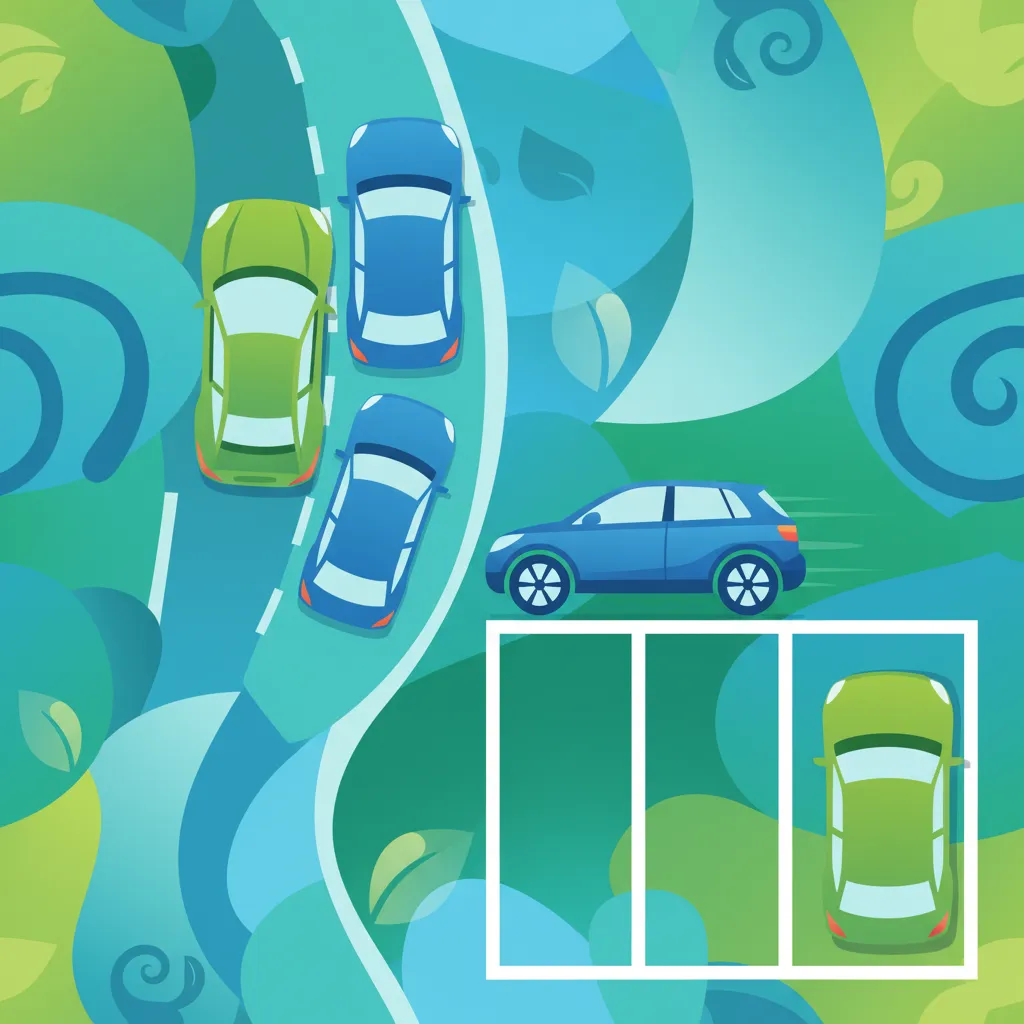
This lesson revisits the practical skills of positioning a vehicle within a designated space. It describes the characteristics of the three main parking styles: parallel (fickparkering), angled, and perpendicular. The content focuses on the conceptual steps for each maneuver, such as approach, turning points, and final positioning, reinforcing the importance of slow, controlled movements and constant observation of the surroundings.

This lesson teaches the correct methodology for negotiating curves and turns of varying sharpness. You will learn the principle of 'slow in, fast out,' involving braking before the curve and gently accelerating through it to maintain stability and grip. The lesson also covers how to choose the correct line (placering) through a bend and how to use your vision effectively to look far ahead for a safe and controlled passage.
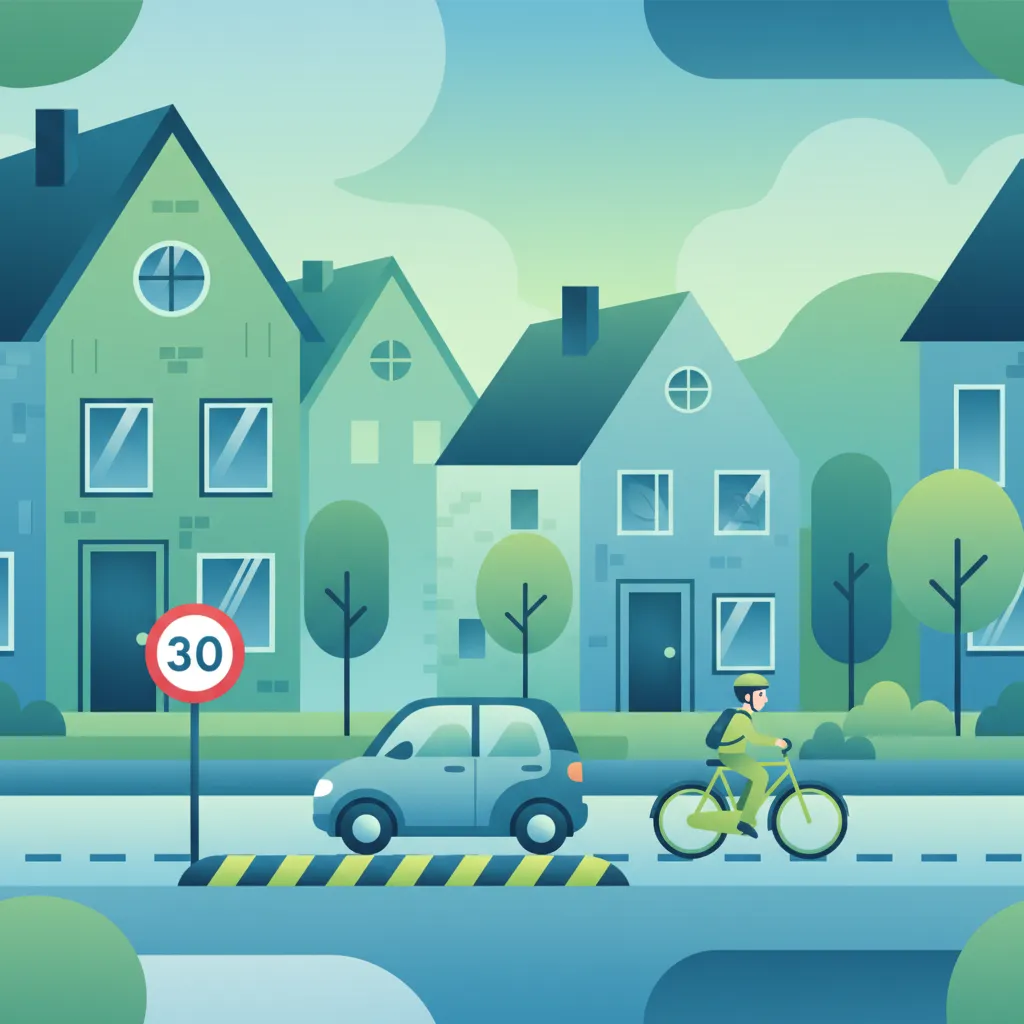
This lesson focuses on the high level of caution required when driving in residential areas. You will learn about the rules for special zones like 'gångfartsområde' (walking speed area) and the need to navigate around speed calming measures like speed bumps. The central theme is anticipating unpredictable behavior from residents, especially children, and managing the risks posed by parked cars that severely limit visibility.

This lesson provides critical knowledge on how to prevent and manage a skid. You will learn to differentiate between understeer (front-wheel skid) and oversteer (rear-wheel skid) and the correct steering and pedal inputs required to recover control in each case. The importance of looking and steering in the desired direction of travel is a key focus, along with understanding how modern safety systems like ABS and ESP assist the driver.

This lesson focuses on the three fundamental inputs for controlling a car: steering, acceleration, and braking. You will learn the correct hand positioning on the steering wheel for maximum control and techniques for smooth, progressive application of the gas and brake pedals. The content explains how these inputs affect the vehicle's balance and stability, forming the basis for all advanced driving and maneuvering techniques.

This lesson explains the function of key electronic driver aids. You will learn how the Anti-lock Braking System (ABS) prevents wheels from locking during hard braking, allowing you to maintain steering control. The lesson also covers the Electronic Stability Program (ESP), which helps prevent skids by automatically braking individual wheels, and Traction Control (TCS), which prevents wheel spin during acceleration on slippery surfaces.

This lesson teaches the physical skill of applying maximum braking force while maintaining control of the motorcycle. You will learn the technique of progressive braking to avoid locking the wheels and how to react if a skid does occur. Understanding how to manage both front and rear wheel skids and how an ABS system assists in these situations gives you the best possible chance of stopping safely and quickly in an emergency.

This lesson delves into the dynamics of cornering on a two-wheeled vehicle, introducing the essential technique of counter-steering to initiate turns efficiently. It explains the importance of choosing a proper line, managing speed before the turn, and looking through the corner to the exit. The content also provides guidance on how to recognize and correct for a loss of traction or a skid.

This lesson breaks down the three pillars of motorcycle control: balance, throttle, and steering. You will learn how the motorcycle maintains stability at speed and how to control it at low speeds, the art of smooth and precise throttle application, and the essential technique of counter-steering to initiate turns. Understanding how these three inputs work together is the first step toward becoming a smooth, confident, and safe rider who is truly in control of their machine.
Understand the legal requirements and theory behind legal parking, stopping, and loading zones in Sweden. This lesson provides a comprehensive overview of rules, signs, and safe driving principles essential for navigating parking situations and performing manoeuvres correctly according to Swedish traffic law.
This lesson covers the general, nationwide rules that govern where you may and may not park or stop, even without specific signs. You will learn about the prohibitions on stopping near intersections, on pedestrian crossings, and at bus stops. The content clarifies the legal definitions and provides clear guidelines on maintaining safe distances and ensuring that your parked vehicle does not obstruct traffic or create a hazard.
This lesson revisits the practical skills of positioning a vehicle within a designated space. It describes the characteristics of the three main parking styles: parallel (fickparkering), angled, and perpendicular. The content focuses on the conceptual steps for each maneuver, such as approach, turning points, and final positioning, reinforcing the importance of slow, controlled movements and constant observation of the surroundings.
This lesson covers parking areas that are reserved for specific purposes or permit holders. The primary focus is on spaces designated for people with disabilities, explaining the requirement of a valid permit. It also addresses other restricted areas such as residential parking zones (boendeparkering), loading zones, and areas that must be kept clear for emergency vehicles, highlighting the legal and ethical reasons for respecting these designations.

This lesson explains the various systems used to regulate parking duration and payment. You will learn how to correctly set and display a parking disc (P-skiva) in time-limited zones and how to operate parking meters and mobile payment apps. The lesson also demystifies 'date parking' (datumparkering), a rule used in some areas for street cleaning, and clarifies the difference between a public parking fine (parkeringsanmärkning) and a private control fee (kontrollavgift).

This lesson focuses on the specific activity of stopping for the purpose of passenger embarkation/disembarkation or loading/unloading goods. You will learn that this is often permissible in areas marked with a 'no parking' sign, as long as the stop is brief and continuous. The lesson distinguishes this from a 'no stopping' zone, where any voluntary stop is prohibited, ensuring you understand the nuanced difference.
This lesson focuses on the often-confusing topic of moped parking. It covers how to interpret parking signs, including those indicating prohibitions (Parkeringsförbud), and where to find designated parking spots for two-wheelers. The content provides practical advice on where it is legal to park and how to do so without causing an obstruction, thereby avoiding fines.

This lesson clarifies the legal distinction between stopping temporarily and parking. It identifies areas where stopping is prohibited, such as near intersections or on pedestrian crossings, to maintain traffic flow and safety. The content also discusses designated waiting areas at traffic lights, often marked for cyclists and mopeds, which can offer a safer position.
This lesson focuses on the high level of caution required when driving in residential areas. You will learn about the rules for special zones like 'gångfartsområde' (walking speed area) and the need to navigate around speed calming measures like speed bumps. The central theme is anticipating unpredictable behavior from residents, especially children, and managing the risks posed by parked cars that severely limit visibility.

This lesson details a driver's responsibility towards pedestrians. You will learn the strict rule of yielding to pedestrians who are on or about to enter a marked, uncontrolled crosswalk. The content also covers the specific, highly restrictive rules for driving in designated pedestrian zones (gågata) and 'walking speed' areas (gångfartsområde), where pedestrians have complete priority and vehicle traffic is severely limited.
This lesson details the full range of Swedish regulatory signs, which establish legally enforceable rules for all road users. You will learn to interpret prohibitory signs (förbudsmärken) such as speed limits and no-entry signs, as well as mandatory signs (påbudsmärken) that dictate direction or lane usage. Understanding these signs is crucial as they directly regulate traffic flow, ensure safety at critical points, and carry legal consequences if ignored.
Find clear answers to common questions learners have about Reverse Driving and Parking Manoeuvres. Learn how the lesson is structured, which driving theory objectives it supports, and how it fits into the overall learning path of units and curriculum progression in Sweden. These explanations help you understand key concepts, lesson flow, and exam focused study goals.
The most critical rule when reversing in Sweden is to always maintain continuous 360-degree observation and proceed at a very slow speed. You must be prepared to stop immediately if any person, vehicle, or obstacle appears. This ensures you do not collide with anything or endanger vulnerable road users like pedestrians or cyclists.
Legality of parking in Sweden depends on road signs and markings. Look for signs indicating 'P' (parking) and any accompanying signs detailing restrictions like time limits (e.g., '2 timmar'), payment requirements (e.g., 'Avgift'), or specific zones (e.g., 'Parkering förbjuden'). If no signs are present, general parking rules apply, such as not blocking driveways or intersections.
Key reference points vary by vehicle, but common ones include aligning your rear bumper with the target car's rear bumper before turning, using your side mirror to see the rear wheel approach the kerb, and using your windscreen to judge the distance to the car in front. Practice and understanding your car's dimensions are crucial.
The theory test includes questions that present scenarios involving reversing or parking. These might ask about the correct procedure, priority rules when reversing into traffic, or identifying unsafe situations. You'll need to understand the principles of safe observation and manoeuvring to answer these correctly.
'Stanna' means to stop briefly, usually to let passengers in or out, or for a short period due to traffic. 'Parkera' means to leave your vehicle for a longer duration. The rules and restrictions for stopping and parking can differ significantly, so understanding this distinction is important.