
Welcome to the Swedish Motorcycle Theory Course! This lesson focuses on Light Signals, Horn Use, and Audible Alerts, a vital component of the theory test. Understanding how to interpret and correctly use traffic lights, turn signals, hazard lights, and the horn is fundamental for safe communication with other road users and preventing accidents. This knowledge directly applies to many exam scenarios and ensures you ride legally and predictably.

Effective communication on the road is paramount for safety, especially for motorcyclists. This lesson, part of your Swedish Motorcycle Theory Course: A Licence Exam Preparation, will equip you with a comprehensive understanding of light signals, horn use, and other audible alerts. Mastering these communication tools ensures your intentions are clearly conveyed to other road users, reducing misunderstandings and preventing collisions. It is a fundamental aspect of safe riding and strict compliance with Swedish traffic law.
Signals, whether visual or audible, serve as the universal language of the road. They reduce uncertainty, align expectations, and facilitate cooperative manoeuvring between all vehicle types. This standardised approach ensures that your cues are predictable and easily recognisable by other road users within their crucial reaction time windows. Swedish law, particularly the Road Traffic Ordinance (Trafikförordningen) and the Road Traffic Act (Vägtrafiklagen), explicitly outlines the forms and conditions for using these signals to prevent ad-hoc or ambiguous communication that could endanger vulnerable road users, including motorcyclists, pedestrians, and cyclists.
Core Principles of Signalling: Always strive for predictable signalling, ensure timeliness by activating signals early, confirm visibility and audibility under all conditions, adhere to legality and proportionality in your usage, and employ contextual adaptation based on your environment.
Traffic lights are electrically powered signalling devices primarily found at intersections, displaying specific coloured lights (red, amber, green) in prescribed sequences. These signals are crucial for determining when a motorcyclist may enter, cross, or turn at an intersection. Adhering to their rules is fundamental for maintaining orderly traffic flow and preventing crashes.
The standard three-colour traffic light cycle dictates specific actions for road users:
A flashing amber light is a warning signal. Unlike a steady amber light, it does not precede a red light but rather indicates a need for increased caution. When you encounter a flashing amber light, you must proceed with caution and be prepared to stop. Crucially, you must give way to traffic from the right unless other priority rules (e.g., specific road signs) dictate otherwise. It signifies that the intersection may not be controlled by priority lights, requiring you to apply general right-of-way rules.
Traffic lights can also include arrow signals that specifically regulate turning movements:
Beyond vehicle traffic, specific light signals are designed for pedestrians and sometimes for special lanes:
man symbol. A red man means pedestrians must not cross, while a green man indicates it is safe to cross. Motorcyclists should always be aware of these signals as they indicate potential pedestrian movement.Common Misunderstanding: Never assume a flashing amber light means "free to go." It always requires caution and typically means yielding to traffic from the right. Misinterpreting this can lead to serious collisions.
Turn indicators, also known as directional signals or blinkers, are illuminated devices (typically amber) on your motorcycle that flash to communicate your intended change of direction or lane. Proper use of these signals is vital for road safety, especially given a motorcycle's smaller profile compared to other vehicles.
According to Swedish traffic regulations (Trafikförordningen 3 kap. 14 §§), you must activate your turn indicator at least three seconds before initiating an intended manoeuvre. This includes turning, changing lanes, or overtaking another vehicle.
Anticipate: Decide your manoeuvre well in advance.
Activate Early: Switch on the indicator (left or right) a minimum of three seconds before you begin to steer or change your position on the road. This provides ample time for other road users to perceive your intention and react safely.
Maintain Visibility: Ensure both front and rear indicators on the chosen side are functioning and clearly visible.
It is not enough to just activate the indicator; you must keep it on until the manoeuvre is fully completed. This means the indicator should remain flashing throughout the turn, lane change, or overtaking action, and only be deactivated once your motorcycle is safely established in the new lane or direction, and you are clear of any potential conflict points.
Exception for Emergencies: In situations demanding immediate action for safety (e.g., sudden emergency avoidance), the three-second rule may be waived. However, you should still use your indicator as soon as it is practically possible to alert others to your evasive action.
Your turn indicators must be clearly visible to vehicles behind you and to your sides. The colour of turn indicators must be amber; no other colour is legally permitted for this function. Regularly check that your indicators are clean and functioning correctly, especially before long rides or in adverse weather conditions.
Hazard lights, or varningsblinkers in Swedish, involve the simultaneous flashing of both left and right turn indicators. This creates a bilateral warning signal designed to alert other road users that your motorcycle is a temporary obstruction or that you are experiencing reduced control.
The primary and most common legal use for hazard lights is when your motorcycle is stopped on the road and creates a potential hazard. This typically occurs in situations such as:
In such cases, hazard lights significantly increase your motorcycle's visibility and warn approaching traffic of the stationary obstacle. You should also deploy a warning triangle if available and safe to do so.
Generally, using hazard lights while moving is prohibited in Sweden. They are specifically reserved for situations where your vehicle is a hazard due to being stationary or exceptionally slow.
However, there is a very specific and limited exception on motorways (motorvägar): Hazard lights may be used while moving if your motorcycle is experiencing a breakdown and is travelling at a speed of 30 km/h or less on the hard shoulder, after you have already signalled your intention to pull over. This is to warn faster-moving traffic of your significantly reduced speed and potential danger.
Crucial Restriction: Never use hazard lights for "anticipatory" signalling, such as indicating an upcoming turn, a lane change, or to signal "thank you." This misuse creates ambiguity and can confuse other road users, potentially leading to dangerous situations.
Your motorcycle's horn, or signalhorn, is an acoustic signalling device designed to produce a short, sharp sound. Its use is strictly regulated in Sweden and is reserved for specific purposes.
The horn may only be used to warn other road users of a danger that is immediate or imminent. For example:
The purpose is solely to alert and prevent an accident, not to express frustration or impatience.
Misuse of the horn is prohibited and can lead to penalties. You must not use the horn for:
Such uses contribute to noise pollution and can distract or annoy other road users, potentially increasing stress and reducing concentration.
The horn must be audible to road users in the vicinity. Swedish regulations specify that the sound level of a motorcycle horn must not exceed 110 dB (A) when measured at a distance of 2 metres. The duration of the horn blast should be brief, typically no more than one second, to effectively convey urgency without becoming a nuisance. Prolonged sounding of the horn may be classified as a violation.
Beyond the standard horn, some motorcycles may be equipped with other sound-producing devices. These auxiliary audible warning devices also have specific rules governing their use.
While less common on standard motorcycles, some vehicles might have:
Similar to the horn, auxiliary audible devices must comply with sound-level regulations, generally not exceeding 110 dB at 2 metres. They must be strictly intended for safety purposes; ornamental or "musical" sounds are explicitly prohibited. Furthermore, their use must be limited to the intended situation—for example, a reverse alarm should only sound when the motorcycle is actually moving backward. Using them improperly can cause confusion and may be deemed a violation.
Understanding the specific legal framework ensures compliance and contributes significantly to road safety. The primary sources for these regulations in Sweden are the Road Traffic Ordinance (Trafikförordningen) and the Road Traffic Act (Vägtrafiklagen).
The Trafikförordningen (Traffic Ordinance) is the core legislative instrument detailing most traffic rules and signal usage:
These regulations are designed to create a predictable and safe traffic environment for all users.
Violations of signalling rules can carry significant consequences, ranging from fines to penalty points on your licence, and even potential licence suspension for repeated or severe misuse.
Turning off the indicator prematurely: This is a common error that leaves other road users guessing your intentions. It typically results in a fine and possible penalty points.
Using hazard lights while riding normally: This creates confusion, as hazard lights signify a stationary hazard. It can lead to a fine and is considered a serious misuse.
Improper horn use: Honking out of anger, impatience, or for non-emergency reasons is illegal and can incur a fine.
Failure to signal: Any failure to use indicators for turns, lane changes, or overtaking is a violation, increasing accident risk and liability.
Riding with non-approved auxiliary horns: Installing a horn that exceeds sound limits or is not for safety purposes can result in a fine and require removal of the device.
The effectiveness of your signals can be significantly affected by external factors. As a responsible motorcyclist, you must adapt your signalling practices to prevailing weather and road conditions to ensure your intentions are always clearly communicated.
Adverse weather conditions like fog, heavy rain, or snowfall drastically reduce visibility distances for all road users.
Different road environments also necessitate slight adjustments to your signalling approach:
Vulnerable road users require extra consideration in your signalling:
The principles and rules governing light signals and audible alerts are not arbitrary; they are deeply rooted in human psychology, physics, and extensive traffic safety research. Understanding the underlying reasons for these rules can help reinforce their importance.
Correct and timely signalling directly contributes to reducing collisions:
Human perception and reaction times play a critical role in road safety. On average, a driver's perception-reaction time (the interval between seeing a stimulus and initiating a response) is about 0.7 to 1.5 seconds.
Swedish traffic safety reports consistently highlight that inadequate signalling is a significant contributing factor in many side-collision incidents involving motorcycles. By mastering these signals, you are not just complying with the law; you are actively contributing to your own safety and the safety of everyone on the road.
Lesson content overview
Explore all units and lessons included in this driving theory course.
Explore search topics learners often look for when studying Light Signals, Horn Use, and Audible Alerts. These topics reflect common questions about road rules, driving situations, safety guidance, and lesson level theory preparation for learners in Sweden.
Browse additional driving theory lessons that cover connected traffic rules, road signs, and common driving situations related to this topic. Improve your understanding of how different rules interact across everyday traffic scenarios.
Explore advanced scenarios and nuances of light signals, turn indicators, and horn use beyond the basics. This lesson delves into specific situations and Swedish regulations governing audible alerts to ensure clear communication and safety in diverse traffic conditions.

This lesson covers the essential topic of communication in traffic using the vehicle's built-in signaling devices. You will learn the rules for using your turn indicators (körriktningsvisare) in good time before turning or changing lanes. The content also explains the proper use of hazard lights (varningsblinkers) in emergency situations and the very limited, specific circumstances in which using the horn (ljudsignal) is permitted to avert immediate danger.

This lesson covers the correct use of a moped's communication tools: the turn signals and the horn. It explains that signals should be used well in advance of any turn or lane change to inform other road users of your intentions. The content also clarifies that the horn is primarily a warning device to alert others of your presence in potentially dangerous situations, not a tool to express frustration.
This lesson provides detailed guidance on navigating complex traffic points such as signalized intersections, multi-lane roundabouts, and pedestrian crossings. You will learn the correct procedures for entering and exiting roundabouts, the specific rules for yielding to pedestrians and cyclists at designated crossings, and how to interpret complex traffic light signals. These skills are vital for safe urban and suburban riding, where interaction with vulnerable road users is frequent.
This lesson focuses on Swedish warning signs designed to alert drivers to potential dangers. You will study signs indicating sharp bends, slippery surfaces, animal crossings, and temporary hazards like road construction. Correctly interpreting these signs allows a motorcyclist to proactively adjust speed, lane position, and readiness to react, which is essential for maintaining control and safety, especially in adverse weather or on unfamiliar roads.
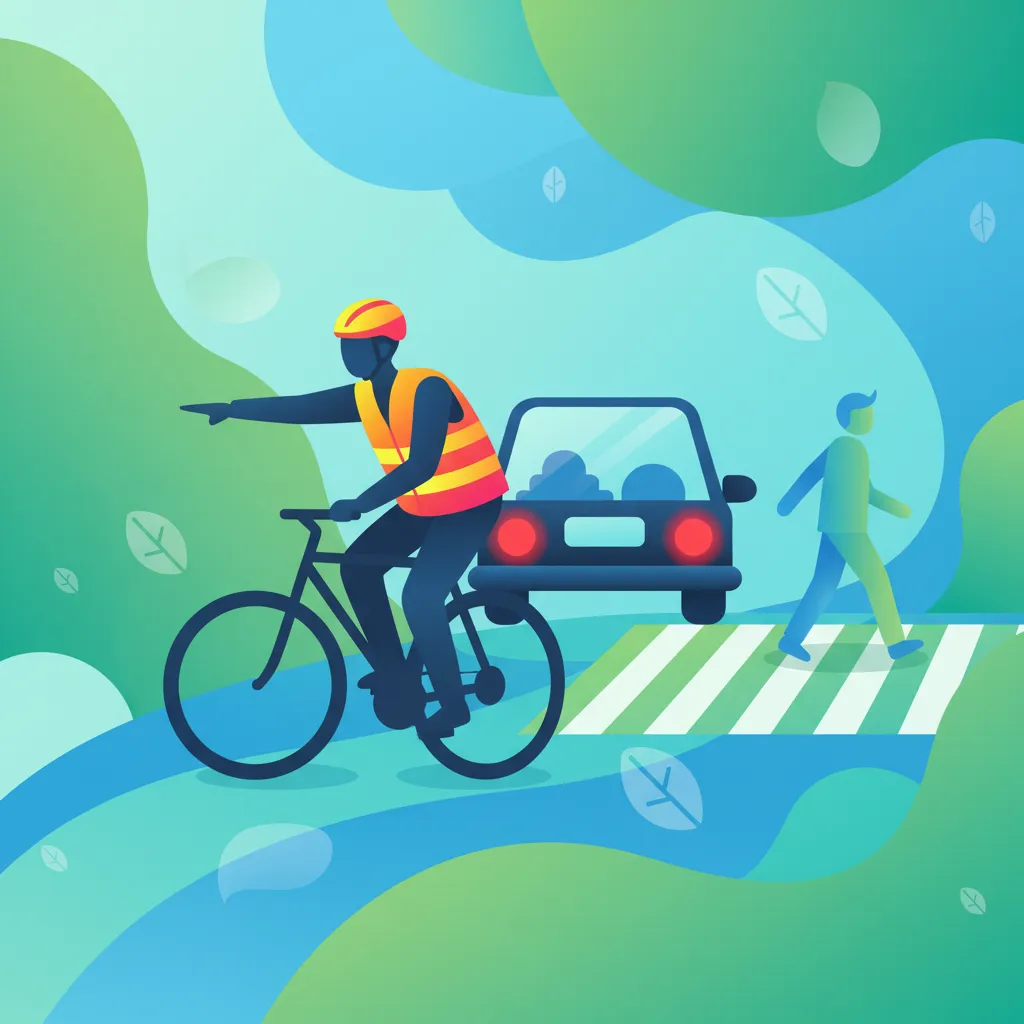
This lesson teaches you how to make an accident scene as safe as possible for yourself, any other involved parties, and approaching traffic. You will learn the correct use of hazard lights, the placement of warning triangles, and the importance of wearing a high-visibility vest. The content also covers how to identify and manage immediate post-crash hazards, such as spilled fuel or unstable vehicles, to prevent the situation from worsening.

This lesson focuses on the variety of road markings used on Swedish roads and their meaning for motorcyclists. You will learn the difference between solid and broken lines regarding overtaking, how to position yourself correctly at intersections based on markings, and how to interpret symbols painted on the road surface. Adhering to these markings is essential for maintaining correct lane discipline and ensuring predictability for other road users.
This lesson focuses on the specific techniques required for riding in busy city and town environments. You will learn how to maintain correct lane positioning amidst dense traffic, navigate complex intersections with multiple signals, and manage the motorcycle at low speeds in stop-and-go conditions. Emphasis is placed on heightened awareness of pedestrians, cyclists, and vehicles making sudden maneuvers, which are common hazards in urban settings.
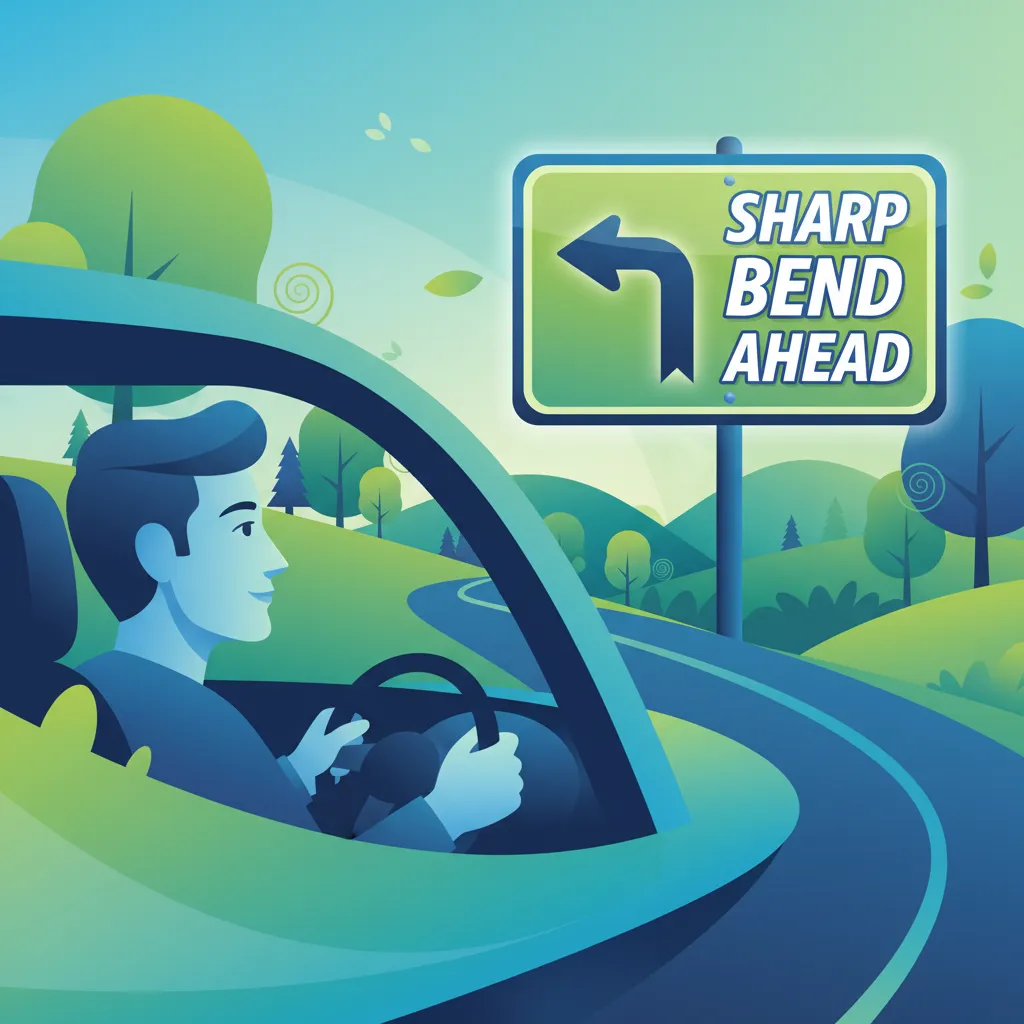
This lesson teaches riders to interpret warning signs (Varningsskyltar), which alert them to potential dangers on the road ahead. It covers a wide range of signs, including those for sharp curves, slippery surfaces, wildlife crossings, and upcoming roadworks. Understanding these triangular signs allows riders to anticipate hazards, adjust their speed and position proactively, and enhance their overall safety.
This lesson covers the critical maneuvers of overtaking and merging, which require precise judgment and communication. You will learn how to assess traffic speed and gaps, the importance of checking blind spots, and the correct use of signals to indicate your intentions. The content includes procedures for merging onto motorways from an on-ramp and how to perform safe overtaking maneuvers on various types of roads, minimizing risk to yourself and others.

This lesson teaches the crucial skill of adapting your speed to the dynamic and often congested conditions of urban riding. You will learn to modulate your speed smoothly in response to traffic flow, pedestrian activity, and complex intersections to maintain safety and control. Techniques covered include using engine braking effectively, anticipating the actions of other road users, and selecting a speed that maximizes your reaction time in a high-density environment.
Learn to effectively interpret signals from other vehicles, pedestrians, and cyclists, and understand how your own signals are perceived. This lesson focuses on anticipation, defensive riding strategies, and ensuring smooth interaction in busy Swedish traffic environments.
This lesson focuses on Swedish warning signs designed to alert drivers to potential dangers. You will study signs indicating sharp bends, slippery surfaces, animal crossings, and temporary hazards like road construction. Correctly interpreting these signs allows a motorcyclist to proactively adjust speed, lane position, and readiness to react, which is essential for maintaining control and safety, especially in adverse weather or on unfamiliar roads.
This lesson focuses on the variety of road markings used on Swedish roads and their meaning for motorcyclists. You will learn the difference between solid and broken lines regarding overtaking, how to position yourself correctly at intersections based on markings, and how to interpret symbols painted on the road surface. Adhering to these markings is essential for maintaining correct lane discipline and ensuring predictability for other road users.
This lesson teaches riders to interpret warning signs (Varningsskyltar), which alert them to potential dangers on the road ahead. It covers a wide range of signs, including those for sharp curves, slippery surfaces, wildlife crossings, and upcoming roadworks. Understanding these triangular signs allows riders to anticipate hazards, adjust their speed and position proactively, and enhance their overall safety.
This lesson covers the essential topic of communication in traffic using the vehicle's built-in signaling devices. You will learn the rules for using your turn indicators (körriktningsvisare) in good time before turning or changing lanes. The content also explains the proper use of hazard lights (varningsblinkers) in emergency situations and the very limited, specific circumstances in which using the horn (ljudsignal) is permitted to avert immediate danger.
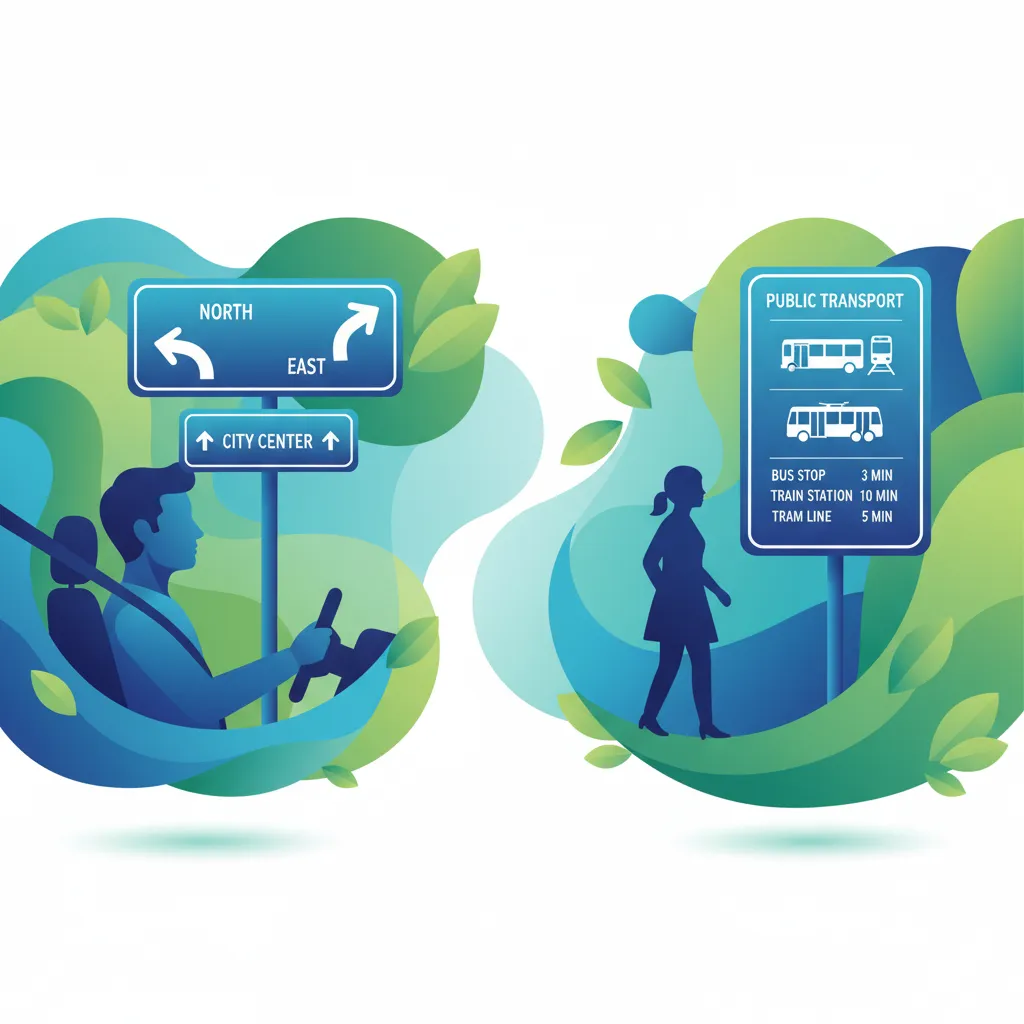
This lesson explains how to read and use Swedish informational and directional signs for effective route planning and navigation. You will learn to follow signs for specific destinations, identify road numbers, and recognize indicators for services such as fuel stations and rest areas. For motorcyclists on long journeys, this knowledge is crucial for making timely decisions about lane changes, exits, and stops without causing disruption to traffic flow.

This lesson provides in-depth analysis of how to safely interact with the full spectrum of road users. You will learn about the specific characteristics of each, such as the large blind spots of trucks, the potential for sudden movements from cyclists, and the unpredictability of pedestrians. The content teaches strategies for communication, anticipation, and defensive positioning to ensure safe and respectful coexistence on the road for everyone.
This lesson provides detailed guidance on navigating complex traffic points such as signalized intersections, multi-lane roundabouts, and pedestrian crossings. You will learn the correct procedures for entering and exiting roundabouts, the specific rules for yielding to pedestrians and cyclists at designated crossings, and how to interpret complex traffic light signals. These skills are vital for safe urban and suburban riding, where interaction with vulnerable road users is frequent.
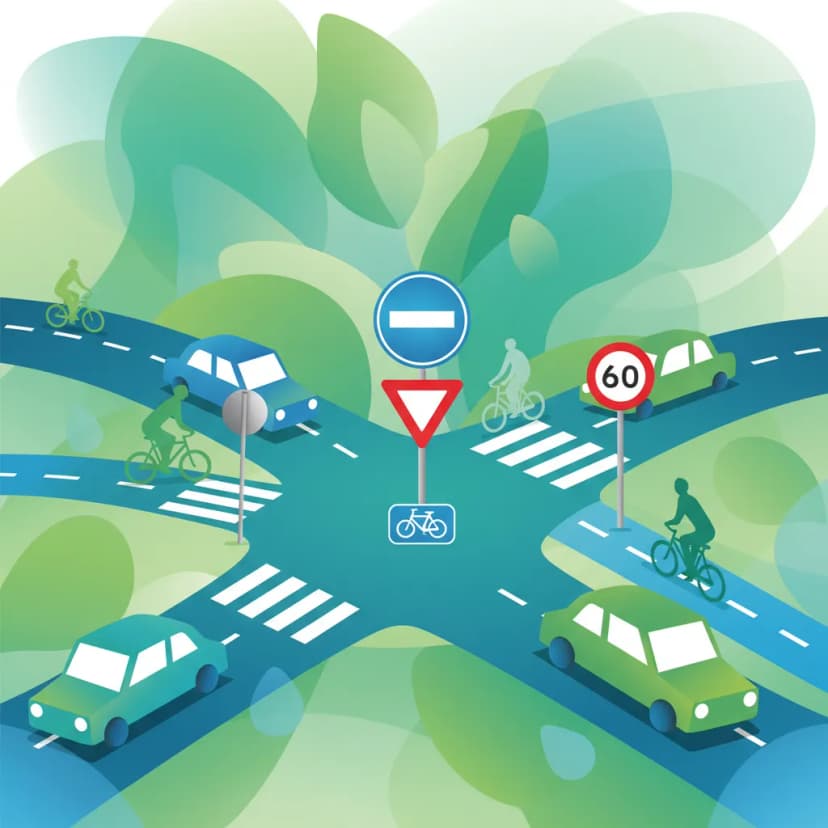
This lesson details the full range of Swedish regulatory signs, which dictate mandatory actions and prohibitions for all road users. You will learn to identify signs that establish speed limits, restrict access, prohibit overtaking, and define parking rules. Understanding these signs is critical for legal compliance and safe interaction with other traffic, as they form the basis of enforceable road law under the Trafikförordning regulations.

This lesson goes beyond mechanical signals to cover the subtle art of non-verbal communication in traffic. It highlights the importance of making eye contact with drivers to ensure you have been seen before making a move. The content also reviews standard hand signals as a backup to electronic signals and discusses how clear, confident body language can make a rider's intentions more predictable.
This lesson covers the critical maneuvers of overtaking and merging, which require precise judgment and communication. You will learn how to assess traffic speed and gaps, the importance of checking blind spots, and the correct use of signals to indicate your intentions. The content includes procedures for merging onto motorways from an on-ramp and how to perform safe overtaking maneuvers on various types of roads, minimizing risk to yourself and others.
Find clear answers to common questions learners have about Light Signals, Horn Use, and Audible Alerts. Learn how the lesson is structured, which driving theory objectives it supports, and how it fits into the overall learning path of units and curriculum progression in Sweden. These explanations help you understand key concepts, lesson flow, and exam focused study goals.
In Sweden, the horn on a motorcycle should primarily be used to warn other road users of immediate danger or to prevent an accident. It is not intended for use as a greeting, to express impatience, or to signal turns. Using the horn unnecessarily can lead to confusion and is a violation of traffic rules.
Turn indicators (blinkers) are used to signal your intention to turn left or right or to change lanes. Hazard warning lights, which flash both indicators simultaneously, are used to indicate that your vehicle is stopped in a hazardous location, is experiencing a breakdown, or is travelling at a significantly reduced speed due to an emergency. They should not be used when simply turning.
A flashing green traffic light indicates that the green phase is about to end and the light will soon turn yellow. You should prepare to stop if it is safe to do so. If you are already within the intersection or too close to stop safely, you should proceed through the intersection cautiously.
While the basic sequence of traffic lights applies to all vehicles, motorcyclists need to be particularly attentive. Some traffic light systems may have specific sensors designed to detect motorcycles, ensuring they do not get stuck at a light that fails to detect their presence. Always be aware of the signal status and be prepared to react accordingly.
If you realise your signal was not seen or was unclear, and it could lead to a misunderstanding, the safest course of action is to stop safely if possible, or slow down significantly and make eye contact with other road users if possible. You may need to use other cues, like hand gestures or a brief, appropriate horn sound if there's an immediate danger, to clarify your intention.