
Welcome to the lesson on Performing Controlled Stops and Slow-Speed Maneuvers, part of Unit 5 on Vehicle Control and Maneuvering for your Category AM moped license. In busy Swedish urban areas, precise control at low speeds is vital for safety and confidence. This lesson builds directly on basic vehicle handling to equip you with the skills needed for navigating confined spaces and traffic effectively.
For any moped rider, especially those navigating the urban landscapes of Sweden, developing precise control at low speeds is not just a skill – it's a fundamental aspect of safety and confidence. This comprehensive lesson, part of the Swedish Driving License Theory Course – Category AM (Moped), delves into the essential techniques for performing controlled stops and executing various low-speed maneuvers. From tight turns and U-turns to seamless navigation in congested traffic or parking areas, understanding these methods ensures you can handle your moped with confidence and minimize risks.
The ability to control your moped effectively at speeds below approximately 20 km/h is paramount for safe riding. In Sweden, as in many countries, urban environments often present scenarios requiring delicate handling: crowded pedestrian zones, intricate parking lots, stop-and-go traffic, and narrow alleyways. Mastery of low-speed techniques directly translates to preventing collisions with pedestrians, cyclists, other vehicles, and stationary objects.
Beyond collision avoidance, excellent low-speed control builds rider confidence, reduces anxiety in challenging situations, and prolongs the life of your moped's drivetrain and brakes by preventing jerky movements and excessive wear. Swedish traffic law emphasizes a rider's responsibility to stop safely and execute maneuvers with due care, making these skills essential not only for practical riding but also for legal compliance.
Effective low-speed maneuvering relies on a synergistic application of several core principles. Unlike high-speed riding where centrifugal force plays a significant role in stability during turns, at low speeds, precise input from throttle, brakes, and steering is critical. The goal is to maintain balance and control without abrupt movements or losing momentum.
At speeds below approximately 20 km/h, the rear brake becomes the primary tool for deceleration and stopping. This approach is crucial because applying the front brake aggressively at low speeds significantly increases the risk of the front wheel locking up, leading to a loss of steering control and a potential fall. The rear brake helps maintain stability and allows for fine-tuned speed modulation.
Achieving a smooth, controlled stop or deceleration requires more than just applying the brake; it demands precise coordination between the throttle and the rear brake. Simultaneously and progressively reducing throttle while applying the rear brake prevents abrupt engine braking or engine surge, which can destabilize the moped. This coordination maintains consistent tension in the drive chain or belt, contributing to overall stability.
While traditional counter-steering (pushing the handlebar in the opposite direction of the turn) is used at higher speeds, at very low speeds, the technique adapts. For tight turns and U-turns, you gently turn the handlebars in the direction of the desired turn, complemented by a slight lean of your body and often a subtle application of the rear brake. This shifts the moped's center of gravity and helps initiate a tight turning radius without needing excessive lean angle, which would be unstable at low speeds.
Creep-control, or the slow-speed crawl, is the technique of maintaining a very slow, controlled forward motion (typically 2–5 km/h) without coming to a complete stop. This is achieved by carefully balancing a slight throttle input with gentle, consistent pressure on the rear brake. It's indispensable for navigating busy parking lots, heavy traffic queues, or intricate urban areas where continuous movement, however slow, is more efficient and safer than constant stopping and starting.
Some mopeds are equipped with a neutral gear. Engaging neutral allows the moped to roll forward without engine power, with speed controlled entirely by the brakes. This can be beneficial for very precise positioning, such as aligning a moped perfectly parallel to a curb or entering a specific parking spot without the risk of engine drag influencing speed. However, it requires vigilance as the moped can accelerate unexpectedly on inclines if not properly managed with the brake.
Knowing your stopping distance is fundamental. This is the total distance your moped travels from the moment you decide to brake until it comes to a complete halt. Factors like speed, road surface (dry, wet, icy), tire condition, moped load, and your reaction time all influence this distance. At low speeds, while the distances are shorter, anticipating the required space ensures you can stop safely without colliding with unforeseen obstacles or road users.
Developing these techniques through practice will transform your low-speed moped handling, making you a more skilled and safer rider.
When your speed drops below 20 km/h, especially when approaching a pedestrian crossing, a parking spot, or preparing for a U-turn, the rear brake becomes your primary decelerating force.
At low speeds, the physics of braking change. Aggressively using the front brake can cause the front wheel to lock up, leading to a loss of steering control and potentially a fall, particularly if the road surface has low traction (wet leaves, gravel, uneven pavement). The rear brake, while offering less overall stopping power than the front brake, provides stability and allows you to maintain steering input, enabling you to adjust your path if needed.
Practice gentle, progressive rear braking in a safe, open area to develop a feel for the traction limit before needing it in real traffic.
Effective deceleration isn't just about slowing down; it's about doing so smoothly and safely. Throttle-brake coordination is key to this.
As you prepare to decelerate or stop, simultaneously ease off the throttle while gradually applying the rear brake. This coordinated action prevents the sudden surge or abrupt loss of power that can occur if you simply cut the throttle and then brake, or vice versa. Smooth coordination avoids engine braking shock, maintains constant tension in the drive system, and ensures your moped remains stable.
Completely cutting the throttle before applying the brake can cause a sudden, uncomfortable deceleration and may even lead to a momentary loss of traction at the rear wheel, especially on slippery surfaces.
Performing a tight U-turn or navigating a challenging curve in a parking lot requires a specific low-speed steering technique that differs from high-speed counter-steering.
At very low speeds, you turn the handlebars in the direction you want to go. This is typically combined with a slight lean of your body in the same direction and often a gentle drag of the rear brake. The rear brake helps compress the front suspension slightly, shifting weight forward and making the moped more agile for tight turns. This technique allows you to achieve a much tighter turning radius than simply turning the handlebars without body input or brake assistance.
Creep-control is your go-to technique for navigating environments where you need to move slowly and precisely without coming to a full stop.
Imagine inching through a crowded parking lot, trying to fit into a tight space, or moving through heavily congested city traffic. Instead of repeatedly stopping and starting, which can be tiring and inefficient, use creep-control. Apply just enough throttle to maintain minimal forward momentum (2–5 km/h) and feather the rear brake to regulate this speed. This allows for constant observation of your surroundings and immediate adjustments without losing balance.
In very slow, dense traffic, activating your moped's hazard lights can increase your visibility to other road users, especially if you are frequently stopping or moving very slowly.
Not all mopeds have a neutral gear, but for those that do, it can be a valuable tool for extremely precise positioning.
Shifting into neutral allows the moped to roll freely without any engine power or drag. This is particularly useful when you need to cover a short distance with extreme precision, such as parking parallel to a curb or lining up perfectly at a loading dock. Once in neutral, your speed is solely controlled by the rear brake. Be cautious, however: on any incline, the moped will accelerate due to gravity if the brake is not adequately applied. Ensure you can quickly re-engage a gear if engine power is suddenly needed.
Compliance with Swedish traffic law is mandatory. Several regulations and guidelines from Transportstyrelsen (the Swedish Transport Agency) directly or indirectly pertain to controlled stops and slow-speed maneuvers.
The Swedish Traffic Ordinance (Trafikförordningen, RVV) § 38 states that "a driver must be able to stop the vehicle without endangering traffic." This overarching rule implicitly demands mastery of controlled stopping techniques, including the appropriate use of brakes at various speeds. Your ability to execute a controlled stop ensures safety for following traffic and vulnerable road users (VRUs).
RVV § 39, concerning "Driving in dense traffic," stipulates that "speed must be reduced to a level that does not impede flow." While this may seem contradictory to slow-speed maneuvers, it emphasizes maintaining a "reasonable" speed. Using creep-control to keep pace with slow-moving traffic, rather than creating gaps or abrupt stops, is a practical application of this rule. You should never be so slow that you become an obstruction or a hazard.
Transportstyrelsen's "Moped Driver Handbook" (often updated, latest verifiable edition should be consulted for specifics) generally recommends that when traveling at speeds up to approximately 20 km/h, the rear brake should be the primary brake. This recommendation is a best practice aimed at preventing front-wheel lock-up and maintaining steering control, aligning with the principles discussed earlier.
RVV § 14 states that a U-turn may only be performed where visibility is sufficient and the maneuver does not endanger other traffic. While not explicitly detailing the technique, this rule necessitates skilled low-speed maneuvering. A U-turn must be executed smoothly and safely, often requiring the tight turn techniques (low-speed counter-steering, creep-control, and rear-brake modulation) discussed in this lesson.
Awareness of common errors is just as important as knowing the correct techniques. Avoiding these pitfalls will significantly enhance your safety and confidence.
Mastering the basics is the first step; adapting them to different conditions is what makes a truly skilled rider.
The principles and techniques discussed are more than just theoretical knowledge; they are practical tools that profoundly impact your riding experience and safety.
Accident statistics consistently show that a significant portion of urban moped incidents occur at low speeds. These often involve collisions with stationary objects, other vehicles during parking, or vulnerable road users. By mastering controlled stops and slow-speed maneuvers, you directly reduce your risk of becoming part of these statistics, ensuring a safer journey for yourself and others.
Riding a moped, especially in challenging urban environments, can be stressful. The confidence gained from knowing you can handle your moped precisely at low speeds significantly reduces this stress. This enhanced confidence makes riding more enjoyable and allows you to focus better on your surroundings, further improving safety.
Learning these techniques also deepens your understanding of how your moped behaves. You'll develop a "feel" for its balance, its braking limits, and how it reacts to your inputs. This intuitive understanding is invaluable, enabling you to react instinctively and correctly in unpredictable situations. Swedish Transport Agency data has even shown a noticeable reduction in low-speed collision reports in urban areas among riders who consistently employ rear-brake-only stopping techniques.
Lesson content overview
Explore all units and lessons included in this driving theory course.
Explore search topics learners often look for when studying Performing Controlled Stops and Slow-Speed Maneuvers. These topics reflect common questions about road rules, driving situations, safety guidance, and lesson level theory preparation for learners in Sweden.
Browse additional driving theory lessons that cover connected traffic rules, road signs, and common driving situations related to this topic. Improve your understanding of how different rules interact across everyday traffic scenarios.
Learn essential techniques for performing controlled stops and precise low-speed maneuvers. This lesson covers clutch, throttle, and brake coordination vital for urban riding and tight spaces in Sweden, enhancing your AM licence theory knowledge.
This lesson teaches the art of smooth throttle control, which is essential for predictable and safe riding. It explains how to apply gradual acceleration to seamlessly merge with traffic and maintain traction, especially on loose or wet surfaces. The goal is to develop a refined feel for the engine's response, allowing for precise speed adjustments in any situation.
This lesson provides a detailed guide to using a moped's braking system effectively and safely. It explains the different roles of the front and rear brakes and the concept of balanced braking to maximize stopping power without losing traction. Learners will understand techniques for both normal, controlled stops and emergency braking situations, including how to manage weight transfer.
This lesson explains how to identify and interact with various types of mopeds and other low-speed vehicles common on Swedish roads. You will learn the difference between Class I and Class II mopeds and their place on the road, as well as how to recognize A-tractors by their LGF (långsamtgående fordon) sign. The key focus is on managing the large speed differential and making safe judgments when deciding to overtake.

This lesson teaches the physical skill of applying maximum braking force while maintaining control of the motorcycle. You will learn the technique of progressive braking to avoid locking the wheels and how to react if a skid does occur. Understanding how to manage both front and rear wheel skids and how an ABS system assists in these situations gives you the best possible chance of stopping safely and quickly in an emergency.

This lesson delves into the dynamics of cornering on a two-wheeled vehicle, introducing the essential technique of counter-steering to initiate turns efficiently. It explains the importance of choosing a proper line, managing speed before the turn, and looking through the corner to the exit. The content also provides guidance on how to recognize and correct for a loss of traction or a skid.

This lesson details the specific hazards associated with riding on wet roads, including significantly increased stopping distances and the risk of aquaplaning. It explains how to recognize conditions where aquaplaning is likely and the importance of reducing speed. Riders will learn to use smoother throttle, braking, and steering inputs to maintain traction and control.
This lesson provides practical instructions for safely navigating different types of intersections and roundabouts. It covers procedures for approaching, entering, and exiting roundabouts, emphasizing the rule to yield to traffic already circulating. The content also addresses how to handle signal-controlled and uncontrolled intersections, ensuring riders select the correct lane and manage their speed appropriately.
This lesson focuses on the three fundamental inputs for controlling a car: steering, acceleration, and braking. You will learn the correct hand positioning on the steering wheel for maximum control and techniques for smooth, progressive application of the gas and brake pedals. The content explains how these inputs affect the vehicle's balance and stability, forming the basis for all advanced driving and maneuvering techniques.
This lesson teaches the crucial skill of adapting speed to prevailing conditions, emphasizing that the posted speed limit is a maximum, not a target. It covers various scenarios such as rain, fog, heavy traffic, and poor road surfaces, explaining why reducing speed is essential for maintaining vehicle control and safety. The goal is to cultivate a proactive mindset where the rider constantly assesses risk and adjusts their speed accordingly.
This lesson explores the critical relationship between the rider's body and the moped's stability. It explains how to maintain balance using correct posture and weight distribution for different maneuvers. The content covers basic steering inputs and how body positioning, such as leaning into turns, directly influences the vehicle's handling and responsiveness.
Explore the complexities of riding in confined urban environments. This lesson focuses on safe interaction with other road users, understanding traffic dynamics, and mastering maneuvers in crowded city conditions for Swedish AM licence theory.
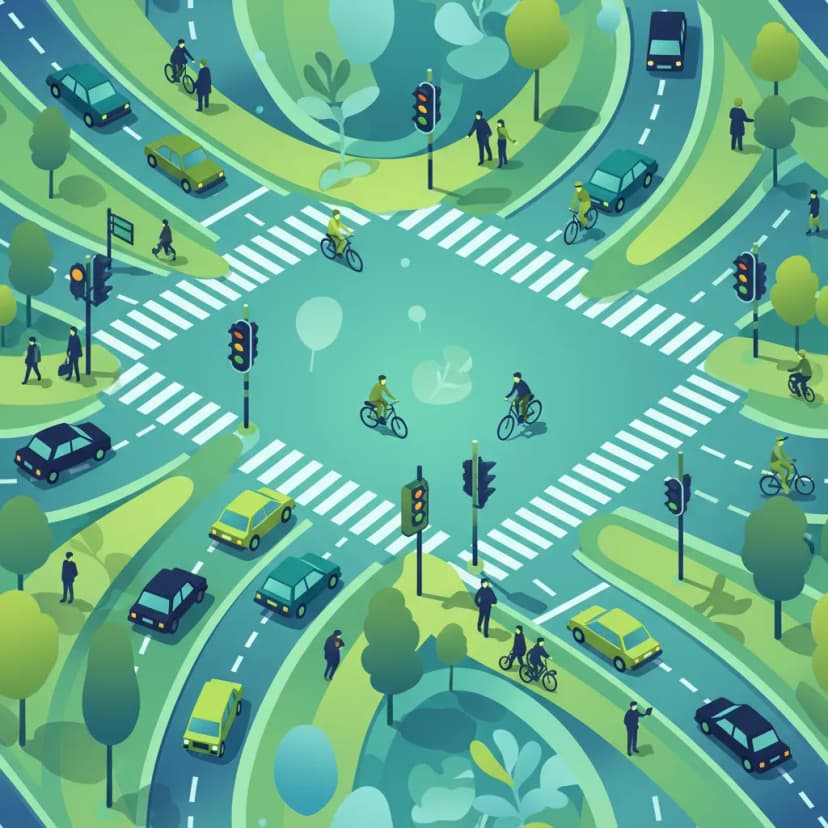
This lesson focuses on the specific techniques required for riding in busy city and town environments. You will learn how to maintain correct lane positioning amidst dense traffic, navigate complex intersections with multiple signals, and manage the motorcycle at low speeds in stop-and-go conditions. Emphasis is placed on heightened awareness of pedestrians, cyclists, and vehicles making sudden maneuvers, which are common hazards in urban settings.
This lesson focuses on the unique challenges of driving in urban environments. You will learn techniques for anticipating the actions of vulnerable road users like pedestrians and cyclists, especially near crossings and bus stops. The content covers how to navigate narrow streets, one-way systems, and areas with heavy traffic, emphasizing the need for lower speeds, heightened awareness, and a defensive mindset.
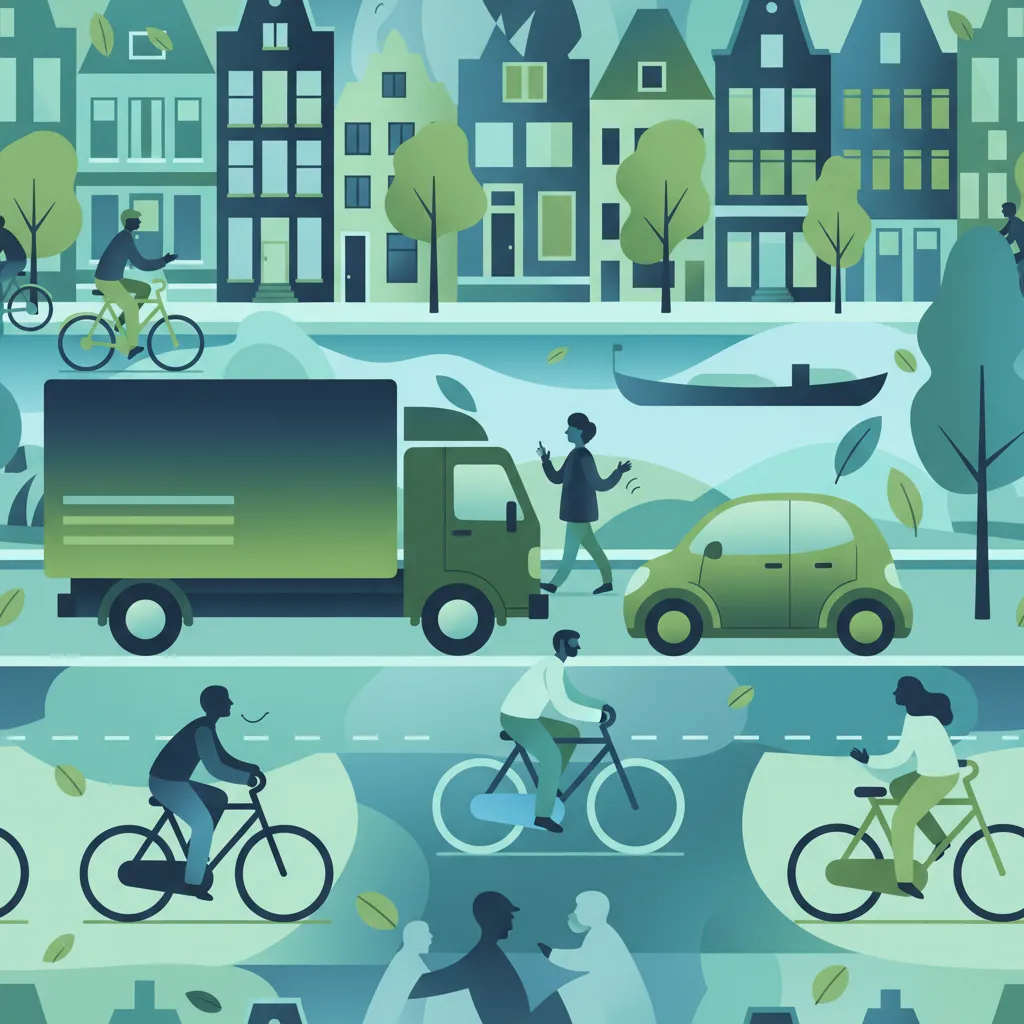
This lesson provides in-depth analysis of how to safely interact with the full spectrum of road users. You will learn about the specific characteristics of each, such as the large blind spots of trucks, the potential for sudden movements from cyclists, and the unpredictability of pedestrians. The content teaches strategies for communication, anticipation, and defensive positioning to ensure safe and respectful coexistence on the road for everyone.
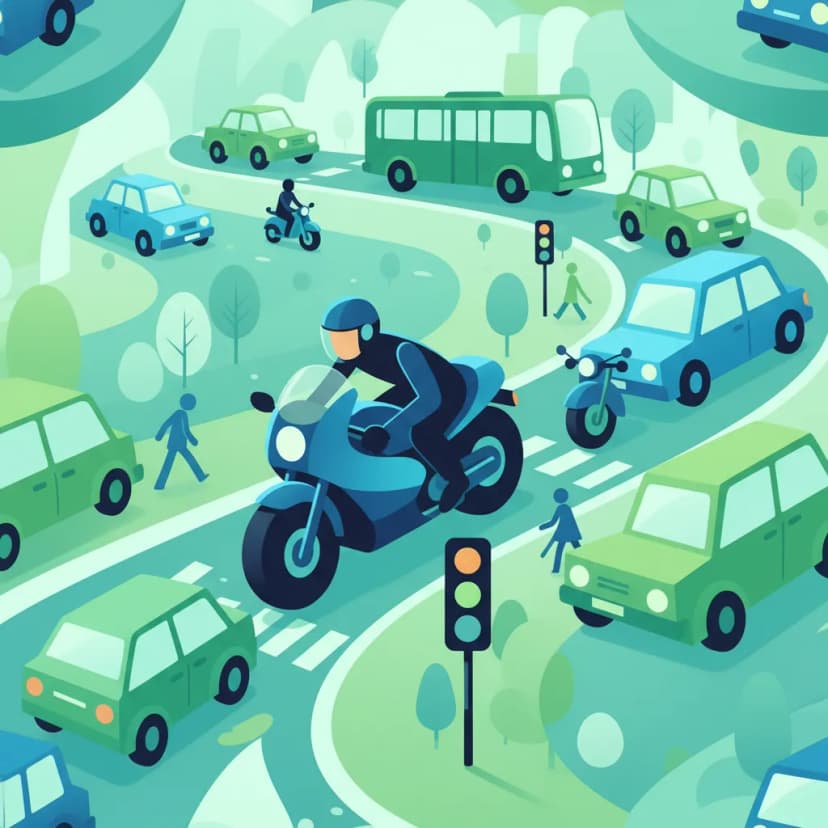
This lesson teaches the crucial skill of adapting your speed to the dynamic and often congested conditions of urban riding. You will learn to modulate your speed smoothly in response to traffic flow, pedestrian activity, and complex intersections to maintain safety and control. Techniques covered include using engine braking effectively, anticipating the actions of other road users, and selecting a speed that maximizes your reaction time in a high-density environment.
This lesson provides detailed guidance on navigating complex traffic points such as signalized intersections, multi-lane roundabouts, and pedestrian crossings. You will learn the correct procedures for entering and exiting roundabouts, the specific rules for yielding to pedestrians and cyclists at designated crossings, and how to interpret complex traffic light signals. These skills are vital for safe urban and suburban riding, where interaction with vulnerable road users is frequent.
This lesson tackles the challenge of navigating some of the most complex road features, such as large multi-lane roundabouts and grade-separated interchanges. You will learn the importance of advance planning, choosing the correct lane on approach, clear signaling, and comprehensive observation to safely move through these busy areas. Mastering these junctions is a key indicator of an advanced and competent rider who can handle any road layout.
This lesson provides practical instructions for safely navigating different types of intersections and roundabouts. It covers procedures for approaching, entering, and exiting roundabouts, emphasizing the rule to yield to traffic already circulating. The content also addresses how to handle signal-controlled and uncontrolled intersections, ensuring riders select the correct lane and manage their speed appropriately.
This lesson focuses on the specific challenges mopeds face when interacting with cars and heavy vehicles. It highlights the significant blind spots (or 'no-zones') around trucks and buses and teaches riders how to position themselves to remain visible. The content also covers the dangers of wind turbulence when near large vehicles and the importance of maintaining a generous space cushion.
This lesson provides clear guidance on selecting the appropriate lane on multi-lane roads to match your intended direction of travel. It covers the rules and best practices for moving into turning lanes, positioning for overtakes, and maintaining a steady course. The focus is on making early, predictable decisions to ensure smooth integration with surrounding traffic.
This lesson covers the critical maneuvers of overtaking and merging, which require precise judgment and communication. You will learn how to assess traffic speed and gaps, the importance of checking blind spots, and the correct use of signals to indicate your intentions. The content includes procedures for merging onto motorways from an on-ramp and how to perform safe overtaking maneuvers on various types of roads, minimizing risk to yourself and others.
Find clear answers to common questions learners have about Performing Controlled Stops and Slow-Speed Maneuvers. Learn how the lesson is structured, which driving theory objectives it supports, and how it fits into the overall learning path of units and curriculum progression in Sweden. These explanations help you understand key concepts, lesson flow, and exam focused study goals.
The most crucial skill is the smooth coordination of throttle, clutch, and rear brake. This allows for precise control over speed and balance at very low speeds, essential for tight turns and navigating congested areas safely on your Swedish moped.
Find a safe, open area like an empty parking lot. Practice applying both the front and rear brakes progressively. Focus on feeling the bike slow down smoothly without locking either wheel. Gradually increase the braking force while maintaining balance, simulating emergency stops you might face on Swedish roads.
Common errors include turning too sharply at too high a speed, not looking through the turn, and relying too much on one control. Learners often forget to use the rear brake for stability or to counter-steer correctly. Practicing these maneuvers slowly and deliberately is key to avoiding these pitfalls during your AM theory preparation.
While the theory exam is primarily knowledge-based, questions often assess your understanding of safe riding techniques. This lesson prepares you for scenarios and questions related to vehicle control in urban traffic, demonstrating an awareness of how to handle the moped safely and efficiently, which is crucial for passing.
Yes, using the clutch can help maintain a very slow speed without stalling the engine, especially during tight turns or U-turns. However, it's essential to combine it with gentle throttle and the rear brake to manage speed and stability effectively, rather than relying on the clutch alone.