Navigating Sweden requires a keen eye for information and directional signs. This lesson is crucial for understanding how to interpret these vital road markers, helping you plan your route effectively and locate essential services. Building on your knowledge of basic road signs, we'll focus on the signs that guide you, ensuring safe and confident navigation throughout your motorcycle journeys.

Navigating the roads effectively and safely requires a comprehensive understanding of all traffic signs. While regulatory and warning signs command immediate actions or highlight potential dangers, informational and directional signs provide crucial guidance for route planning, decision-making, and identifying essential services. For motorcyclists undertaking the Swedish Motorcycle Theory Course, mastering the interpretation of these signs is vital for smooth lane changes, timely exits, and preventing disruptions to traffic flow, ultimately enhancing both safety and efficiency on the road.
This lesson explores the various categories of Swedish informational and directional signs, explaining their purpose, typical placement, and specific implications for motorcycle riders. By the end of this chapter, you will be able to confidently interpret these signs to navigate Swedish roads, locate services, and plan your journey effectively, making you a more prepared and safer rider.
Swedish informational and directional signs operate on several key principles designed to ensure clarity and safety for all road users, including motorcyclists. Understanding these principles is fundamental to their correct interpretation and application.
Informational and directional signs, while highly relevant, are always secondary to regulatory and warning signs. They provide guidance and data but never override mandatory instructions such as speed limits, stop signs, or no-entry restrictions. Motorcyclists must first adhere to all regulatory signs, using informational signs to plan their route and anticipate conditions without contravening any mandatory rules. This prevents confusion and maintains legal clarity on the road.
Motorcyclists have a narrower field of view and often require more lead time to execute maneuvers smoothly, especially at higher speeds. It is crucial to read and interpret signs far enough ahead to enable gradual lane changes, speed adjustments, and confident decision-making. Abrupt braking or sudden swerving, particularly on a motorcycle, can destabilize the vehicle and significantly increase the risk of collision, making early sign perception a cornerstone of safe riding.
All Swedish road signs are designed, positioned, and often illuminated to be clearly readable at typical approach speeds, even for motorcyclists who may have a slightly different eye level or a more concentrated visual focus on the road ahead. This ensures that riders can quickly process information despite varying light conditions or weather. Riders should always adjust their speed to maintain an adequate perception-reaction time (PRT) to account for potential visibility challenges and ensure they can safely respond to sign information.
Swedish road signs employ a system of internationally recognized symbols and pictograms, particularly those adopted within the European Union. This standardization facilitates quick understanding without heavy reliance on language, which is beneficial for both local and international riders. Symbols for fuel, food, and accommodation, for example, are universally recognizable, aiding navigation even when traveling outside familiar linguistic zones.
The precise meaning and urgency of a sign can vary based on the specific road type, adjacent signage, and prevailing environmental conditions. For instance, a directional sign on a motorway will have different implications for lane usage than a similar sign on a city street. Motorcyclists must interpret signs in their immediate context, considering the overall road layout, surrounding traffic, and any other nearby signage to make informed decisions.
General information signs in Sweden feature a blue background with white text or symbols. These signs provide non-mandatory but highly useful data, guiding drivers towards localities, indicating distances, and providing general directions. They help riders confirm their route and anticipate upcoming destinations.
These signs display the names of towns, cities, or specific localities. They serve as a constant reassurance that a motorcyclist is heading in the correct direction. For example, a sign simply stating "Malmö" indicates that the city is ahead on the current route.
Often combined with city names, distance signs indicate the approximate number of kilometers to a specific destination. A sign reading "Uppsala 30 km" informs the rider that Uppsala is approximately 30 kilometers away. While these values are generally accurate, they often refer to the start of the urban area rather than the exact city centre. Motorcyclists use these to gauge remaining travel time and plan stops.
Directional arrows on blue signs clarify the path to a destination, indicating whether to continue straight, turn left, or turn right. For instance, a sign with an arrow pointing left towards "Linköping" signifies that Linköping is accessible by turning left at the upcoming junction. While not legally binding in the same way as regulatory signs, ignoring these directions will likely lead to a deviation from the intended route.
Motorcyclists should use general information signs in conjunction with their route plan or GPS. Regularly checking these signs helps prevent inadvertently taking a wrong turn or missing a major destination.
On motorways (motorväg) and expressways (motortrafikled), directional signs typically feature a green background with white text and symbols. These signs are crucial for high-speed navigation, indicating lane allocations, upcoming exits, and primary destinations. They are designed to provide clear, early guidance to facilitate smooth and safe maneuvers in fast-moving traffic.
White arrows displayed on green directional signs indicate specific lane usage for upcoming exits or through traffic. For example, an arrow pointing right with an exit number signifies that the rightmost lane is for exiting traffic. Motorcyclists must observe these arrows carefully and position themselves in the correct lane well in advance to avoid sudden, dangerous lane changes.
Each exit on a Swedish motorway is assigned a unique numeric identifier. These "Exit 12" signs appear on green panels, often accompanied by the destination accessible via that exit. Exit numbers are essential for navigation, especially when following GPS instructions or maps, and help riders confirm they are taking the correct turn-off.
Large green signs often feature multiple destinations stacked vertically, each with its corresponding distance and sometimes a directional arrow. These panels provide a comprehensive overview of upcoming major towns or cities, allowing riders to confirm their route over longer distances.
On motorways and expressways, once an exit lane is clearly signposted with a dedicated arrow, a driver is legally obligated to stay within that lane until the exit. Changing lanes out of or into an exit lane late can be extremely hazardous and is prohibited.
Route number signs are official identifiers for different categories of roads in Sweden, displayed on white backgrounds, often with a red border. These signs are indispensable for long-distance navigation and route planning, complementing map and GPS systems.
Major international routes passing through Sweden are designated with an "E" prefix, such as "E20" or "E4." These European routes are part of a continent-wide network and are clearly marked to facilitate cross-border travel.
National roads, known as Riksvägar, are Sweden's primary domestic arteries. Their numbers are displayed on white signs, sometimes with an "R" prefix but often just as a plain number (e.g., "73" for Riksväg 73). These form the backbone of the national road network.
County roads, or Länsvägar, are designated with an "L" prefix followed by a number (e.g., "L101"). These roads serve regional connections within specific counties.
When your navigation system (GPS) contradicts a physical route number sign, the physical sign is considered the authoritative source. Always prioritize official road signs over digital maps, as map data can sometimes be outdated or inaccurate compared to real-world signage.
Distance signs, typically white with black text and arrows, indicate the remaining distance in kilometers to named destinations. They are usually placed at regular intervals along a route, providing riders with continuous updates on their progress.
These signs feature one destination with its corresponding distance, often accompanied by a directional arrow. For instance, "Uppsala → 45 km" shows that Uppsala is 45 kilometers ahead on the current road.
Some distance signs list several towns or cities, each with its own distance. These are particularly common after major junctions or on long stretches of road, helping riders to plan for upcoming turns or service stops.
Motorcyclists should use distance signs in conjunction with their fuel gauge and knowledge of their motorcycle's range. This allows for proactive fuel stop planning, preventing the risk of running out of fuel in inconvenient or dangerous locations.
Service signs are easily identifiable by their blue background and white pictograms. These signs alert drivers to the availability of various services essential for long journeys, such as fuel, food, and rest areas. For motorcyclists, knowing where these services are located is crucial for managing fatigue and maintaining vehicle readiness.
This symbol indicates a fuel station is available, often specifying the distance to it. Motorcyclists should plan their fuel stops well in advance, especially on rural roads where stations might be sparse.
This symbol points to a restaurant or café, allowing riders to plan meal breaks.
A bed symbol indicates available accommodation, useful for multi-day trips.
These signs indicate designated rest areas, which often include parking, picnic tables, and toilets. For motorcyclists, these are important for managing rider fatigue. Stopping only in designated areas is mandatory.
A wrench symbol denotes a repair shop or service facility. This information is critical in case of a mechanical issue, guiding riders to the nearest assistance.
On motorways, stopping is permitted only in designated service areas. Pulling over on the hard shoulder for rest or to check a map, even near a service sign, is illegal and highly dangerous, potentially obstructing emergency services.
Tourist and attraction signs have a distinctive brown background with white text or symbols. These signs mark points of interest, cultural heritage sites, natural attractions, and recreational areas. While not directly related to mandatory traffic flow, they alert riders to potential diversions and often indicate areas where increased pedestrian traffic or reduced speeds might be expected.
These signs might feature symbols representing museums, historic buildings, or archaeological sites.
Symbols indicating parks, lakes, forests, or wildlife areas guide riders to natural attractions.
Signs for campsites, ski lifts, or other outdoor activity areas are also common.
When you see a brown tourist sign, especially near urban or village areas, be extra vigilant for increased pedestrian activity, parked cars, or cyclists. Anticipate the need to reduce speed and be prepared for sudden movements from visitors.
Lane guidance arrows can appear as markings painted directly on the road surface or as symbols on overhead sign boards. They are crucial for maintaining lane discipline and ensuring smooth traffic flow, especially in complex junctions or multi-lane environments.
These arrows indicate that a specific lane is dedicated for turning in a particular direction (e.g., left-turn only, right-turn only). Motorcyclists must be in the correct lane for their intended direction well before the junction.
These arrows confirm that a lane is for continuing straight ahead.
While uncommon in Sweden, some urban areas might feature lanes specifically designated for motorcycles. If such a lane is present, only motorcycles are permitted to use it, and other vehicles must use adjacent lanes.
Lane discipline involves adhering strictly to the intended purpose of each lane, as indicated by road markings and signs. For motorcyclists, this means positioning correctly and avoiding last-minute lane changes, which can be particularly dangerous on two wheels.
The effectiveness of road signs heavily relies on their correct placement and visibility. Regulations govern the height, lateral offset, illumination, and sight-line clearance of all signs to ensure they are readable by all road users.
Signs are mounted at specific heights above the road surface, typically between 2.0 and 3.5 meters, to ensure they are visible over other traffic, including trucks and buses, without being obscured by roadside obstacles.
Signs are positioned at a specific distance from the edge of the carriageway, usually 0.5 to 1.0 meter, to optimize visibility for drivers while maintaining clearance from the road itself.
Many signs, especially on major roads, are either retro-reflective or actively backlit to ensure clear visibility during night-time hours or in adverse weather conditions. Minor signs may rely solely on reflectivity.
Adjust your riding position and speed to maintain an adequate sightline, especially when following larger vehicles.
Be aware that glare from the sun at dawn or dusk can temporarily obscure signs; use anti-glare visors if available.
Report any signs that are obstructed by foliage, faded, or poorly illuminated to the relevant road authority.
While informational signs are not regulatory, ignoring them can lead to dangerous situations or violations of other traffic laws. Sweden's Traffic Ordinance (Trafikförordningen) contains several provisions that relate to how drivers, including motorcyclists, must interact with these signs.
Although informational, directional signs—especially green motorway signs—guide mandatory traffic flow. Drivers must follow the instructions indicated by these signs unless a higher-priority regulatory sign contradicts them. Failure to do so can disrupt traffic and cause hazardous situations.
When an exit lane is clearly signposted with a dedicated arrow and exit number, the driver is legally obligated to move into and stay within that lane from the point the sign appears until the exit ramp. This rule is critical on motorways to prevent sudden lane changes that can lead to collisions.
Stopping on the hard shoulder of a motorway is generally prohibited. Service signs indicate designated areas where stopping for fuel, rest, or other services is permitted. Drivers must only use these marked service area bays. Overtaking within these designated service areas is also prohibited unless explicitly permitted by local signage.
The route number displayed on official signs (E, R, or L) is the authoritative identifier for that stretch of road. If this conflicts with information from a navigation device, the physical sign must be prioritized. This ensures consistency and safety across the road network.
While there is no direct legal obligation to adhere to exact distances shown on signs, drivers are strongly recommended to use this information for planning. Misjudging distances can lead to missed exits or, in the case of fuel, becoming stranded.
Road authorities are legally responsible for ensuring that all informational and directional signs are positioned, maintained, and illuminated according to the Swedish Road Signage Guidelines (Vägvisningsföreskrifterna). While drivers are not responsible for sign maintenance, they have a duty to report non-visible or damaged signs.
In rare instances where a lane is explicitly marked as "motorcycle-only" (e.g., with a specific lane guidance arrow), only motorcycles are permitted to use it. Other vehicle types must use adjacent lanes. This enhances safety by separating motorcycles from heavier traffic.
Misinterpreting or ignoring informational and directional signs can lead to common violations and dangerous situations for motorcyclists. Understanding these pitfalls can help you avoid them.
Attempting to change lanes abruptly after passing a green motorway exit sign violates lane usage rules and creates a high risk of collision. The correct action is to move into the exit lane as soon as the dedicated exit arrow appears and maintain your lane until the ramp. This maneuver, when done improperly, can result in fines and points on your license.
A service sign indicates a designated service zone, not merely proximity to services. Stopping on the hard shoulder of a motorway, even if a service station is nearby, is an illegal and extremely dangerous practice. You must continue until you reach the marked entry to the service area.
Blue city signs are for information only. Mistaking them for a mandatory route instruction can lead to unnecessary detours if the actual road numbering or your GPS indicates a different, more direct path. Always treat blue signs as guidance, prioritizing regulatory signs and confirmed route numbers.
Failing to act on a fuel service symbol when your fuel gauge is low can lead to running out of fuel, stranding you and potentially obstructing traffic. Plan your fuel stops proactively by noting service signs and distances.
If a lane is explicitly marked for motorcycles only, other vehicles, including cars, should not occupy it. Conversely, if no such marking exists, motorcyclists must use general traffic lanes. Incorrect lane usage can lead to fines and increase accident risk.
Distance signs provide approximate distances, usually to the beginning of the urban area or a major junction, not necessarily the exact city centre. Relying on them as precise measurements for every aspect of navigation can cause you to miss an exit or misjudge arrival times.
A lane guidance arrow indicating a turn-only lane means that lane is exclusively for turning. Attempting to overtake other vehicles in such a lane, assuming it's a through lane, is a hazardous maneuver and a violation of lane usage regulations.
If vegetation or other objects obstruct your view of a sign, riding at speed prevents adequate perception-reaction time. Always adjust your speed to ensure you can clearly see and react to all signage, even if it means slowing down considerably.
The meaning and importance of information and directional signs can change significantly based on various conditions and contexts. Motorcyclists must be adept at adapting their interpretation and riding behavior accordingly.
The design and regulations surrounding informational and directional signs are deeply rooted in safety principles, especially for motorcyclists.
To solidify your understanding, consider these practical scenarios involving Swedish informational and directional signs.
Imagine you are riding your motorcycle on a four-lane Swedish motorway at 110 km/h on a clear day with moderate traffic. Your destination is Göteborg, and your GPS indicates you need to take Exit 12.
You're on a two-lane rural road in central Sweden on a misty morning, and your fuel gauge is showing low. You haven't seen a fuel station in a while.
You're riding through a picturesque urban street in a historic Swedish town on a sunny day. You see a brown sign:
You're on an urban arterial road that you often use, following familiar blue directional signs. Today, however, you encounter an orange sign:
Mastering the interpretation of Swedish informational and directional signs is an indispensable skill for every motorcyclist. These signs, while non-mandatory in the same way as regulatory signs, provide the critical data needed for safe, efficient, and compliant navigation.
By consistently applying these principles, you will enhance your ability to read, interpret, and react appropriately to all Swedish informational and directional signs. This will not only ensure your legal compliance but, more importantly, elevate your safety and confidence as a motorcycle rider on any Swedish road.
Lesson content overview
Explore all units and lessons included in this driving theory course.
Explore search topics learners often look for when studying Information and Directional Signs. These topics reflect common questions about road rules, driving situations, safety guidance, and lesson level theory preparation for learners in Sweden.
Browse additional driving theory lessons that cover connected traffic rules, road signs, and common driving situations related to this topic. Improve your understanding of how different rules interact across everyday traffic scenarios.
Understand how to interpret Swedish directional and information signs for effective route planning and navigation. This lesson covers understanding road numbers, destinations, and service indicators to make informed decisions on the road.
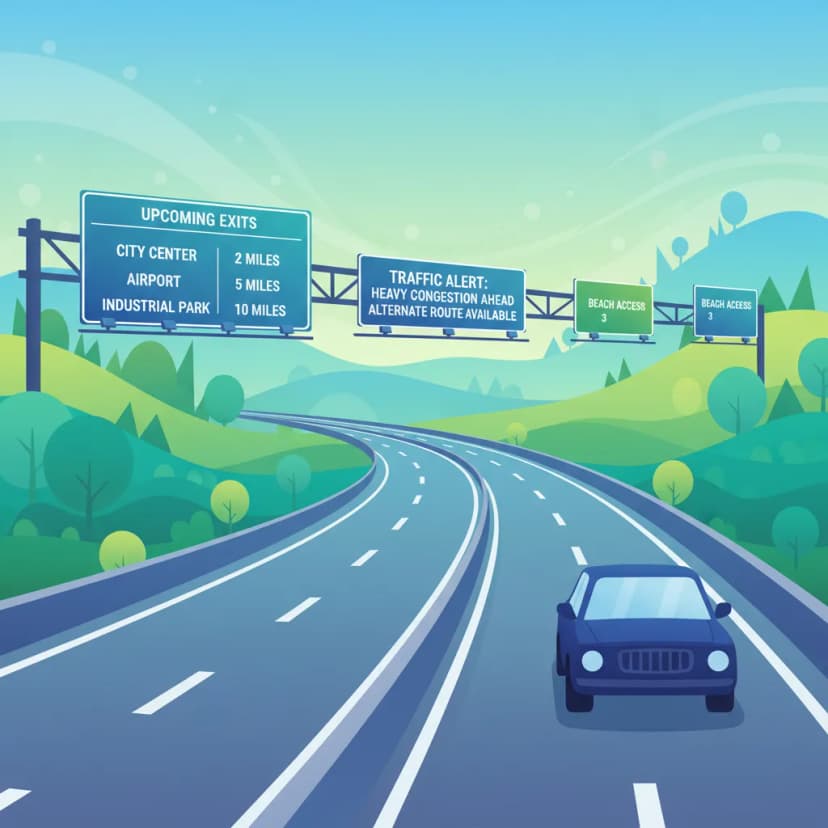
This lesson covers the extensive category of informational and directional signs that aid navigation throughout Sweden. You will learn to interpret signs for motorways, national roads, and local destinations, as well as symbols indicating services like gas stations, parking, and rest areas. Proper understanding of these signs allows for efficient route planning, reduces driver uncertainty, and contributes to smoother, safer traffic flow on all types of roads.
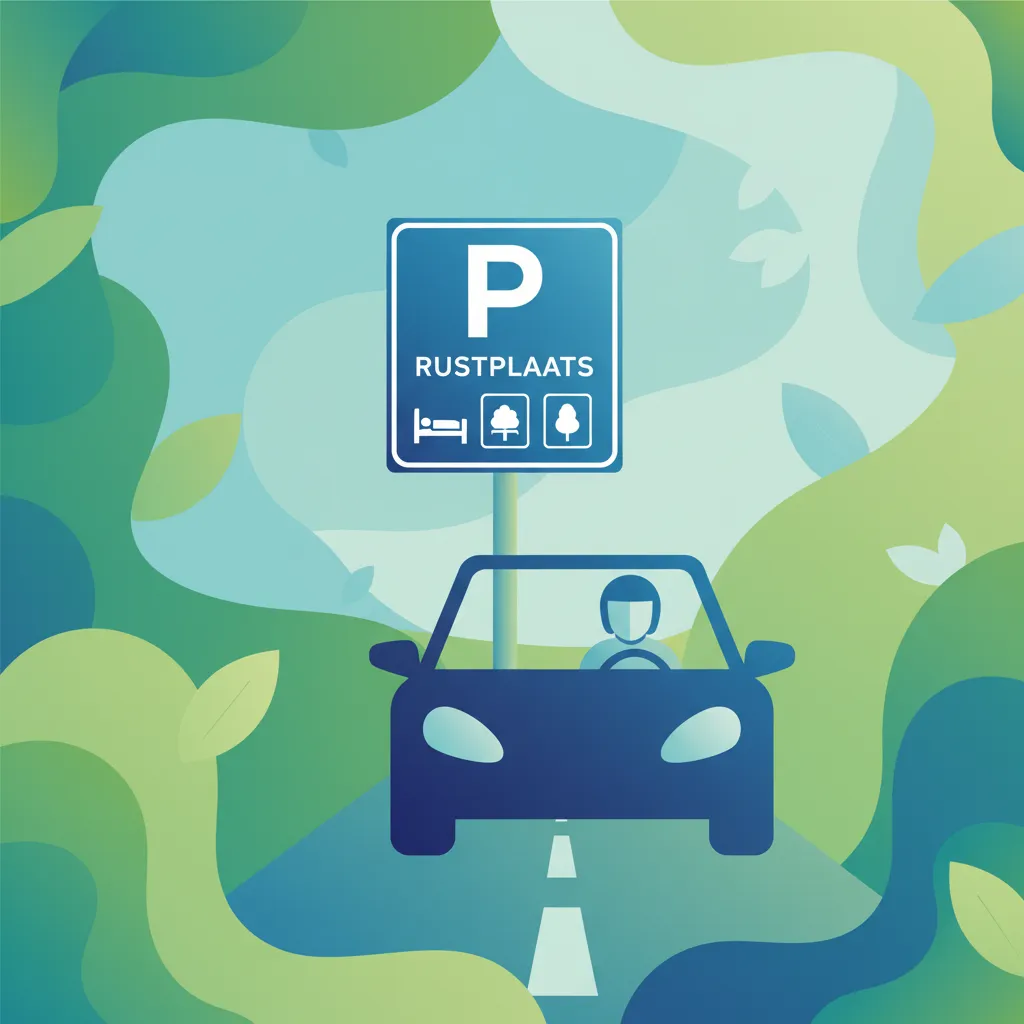
This lesson explains the function of informational signs (Informationsskyltar), which provide guidance for navigation and access to services. It covers signs indicating distances to destinations, route numbers, and locations of fuel stations or parking areas. For moped riders, this includes identifying signs for designated moped or cycle lanes, helping them to plan and follow routes efficiently and legally.

This lesson explains the function and legal significance of various road markings (vägmarkeringar) in Sweden. You will learn the difference between broken lines that permit overtaking and solid lines that forbid it, as well as the meaning of stop lines, pedestrian crossings, and lane direction arrows. These markings work in conjunction with signs to organize traffic flow, separate lanes, and provide critical information directly on the road surface.

This lesson focuses on Swedish warning signs designed to alert drivers to potential dangers. You will study signs indicating sharp bends, slippery surfaces, animal crossings, and temporary hazards like road construction. Correctly interpreting these signs allows a motorcyclist to proactively adjust speed, lane position, and readiness to react, which is essential for maintaining control and safety, especially in adverse weather or on unfamiliar roads.
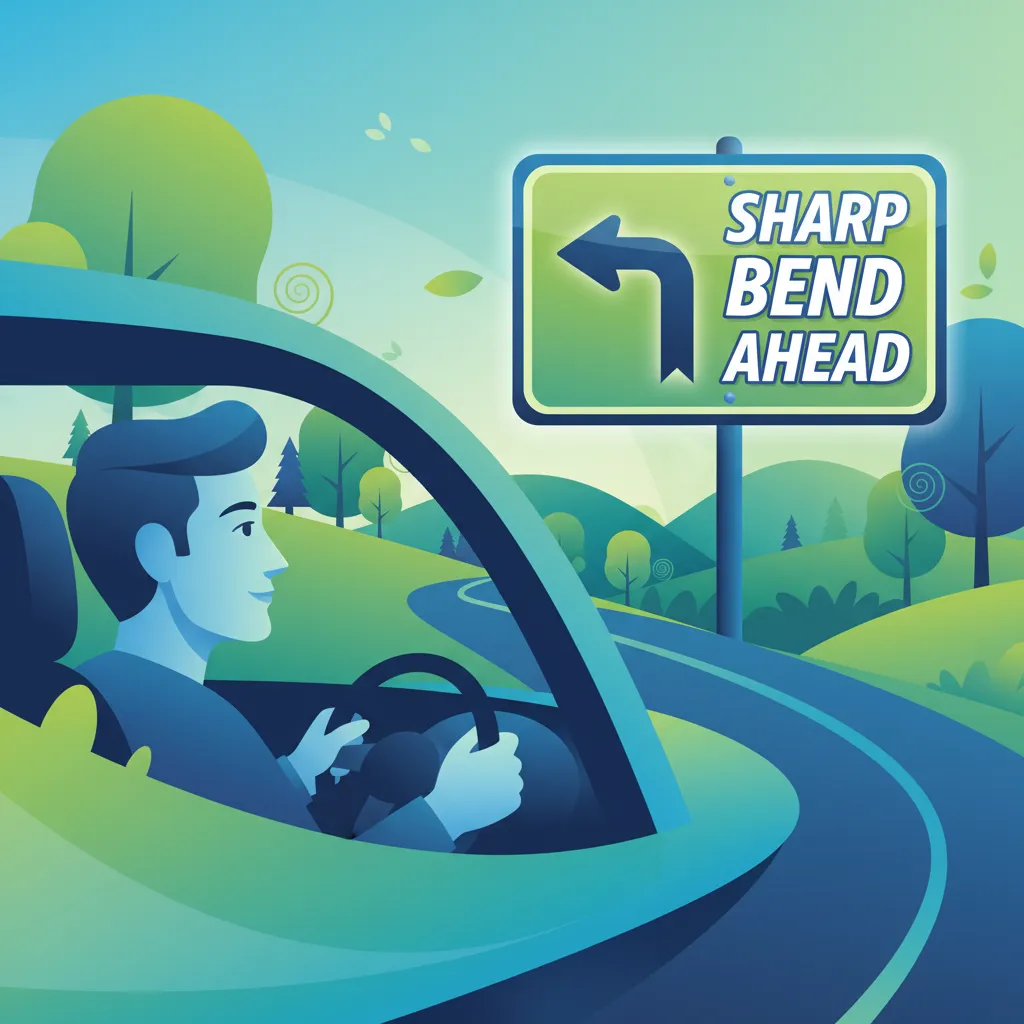
This lesson teaches riders to interpret warning signs (Varningsskyltar), which alert them to potential dangers on the road ahead. It covers a wide range of signs, including those for sharp curves, slippery surfaces, wildlife crossings, and upcoming roadworks. Understanding these triangular signs allows riders to anticipate hazards, adjust their speed and position proactively, and enhance their overall safety.
This lesson prepares riders for encountering roadworks, which can introduce temporary and often confusing changes to the road layout. It explains how to interpret the specific orange-colored signs used in these zones, including new speed limits, lane diversions, and warnings about surface hazards. The key takeaway is to reduce speed and increase vigilance when navigating through construction areas.
This lesson focuses on Swedish warning signs (varningsmärken), designed to alert drivers to potential dangers ahead. You will study the meaning of triangular signs indicating hazards such as sharp bends, pedestrian crossings, risk of animals on the road, or temporary road work. The objective is to develop proactive driving habits by understanding how to anticipate risks and adapt speed and positioning appropriately when a warning sign is present.

This lesson covers the essential topic of communication in traffic using the vehicle's built-in signaling devices. You will learn the rules for using your turn indicators (körriktningsvisare) in good time before turning or changing lanes. The content also explains the proper use of hazard lights (varningsblinkers) in emergency situations and the very limited, specific circumstances in which using the horn (ljudsignal) is permitted to avert immediate danger.

This lesson focuses on the variety of road markings used on Swedish roads and their meaning for motorcyclists. You will learn the difference between solid and broken lines regarding overtaking, how to position yourself correctly at intersections based on markings, and how to interpret symbols painted on the road surface. Adhering to these markings is essential for maintaining correct lane discipline and ensuring predictability for other road users.
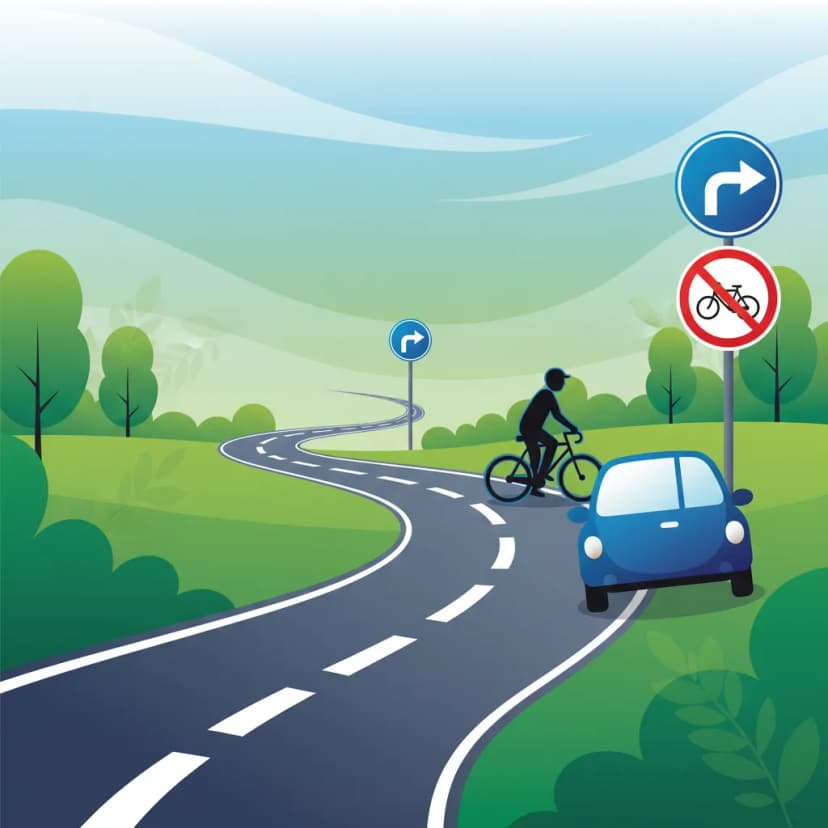
This lesson details the full range of Swedish regulatory signs, which establish legally enforceable rules for all road users. You will learn to interpret prohibitory signs (förbudsmärken) such as speed limits and no-entry signs, as well as mandatory signs (påbudsmärken) that dictate direction or lane usage. Understanding these signs is crucial as they directly regulate traffic flow, ensure safety at critical points, and carry legal consequences if ignored.
Learn how Swedish road signs, including informational and directional types, work in conjunction with traffic rules and road markings. This lesson helps understand how to combine sign information with general traffic laws for safer riding.
This lesson explains the function and legal significance of various road markings (vägmarkeringar) in Sweden. You will learn the difference between broken lines that permit overtaking and solid lines that forbid it, as well as the meaning of stop lines, pedestrian crossings, and lane direction arrows. These markings work in conjunction with signs to organize traffic flow, separate lanes, and provide critical information directly on the road surface.
This lesson focuses on the variety of road markings used on Swedish roads and their meaning for motorcyclists. You will learn the difference between solid and broken lines regarding overtaking, how to position yourself correctly at intersections based on markings, and how to interpret symbols painted on the road surface. Adhering to these markings is essential for maintaining correct lane discipline and ensuring predictability for other road users.
This lesson focuses on the importance of road markings (Vägmarkering) for guiding traffic flow and ensuring safety. It explains the meaning of different line types, such as solid and broken lines, and the function of stop lines and pedestrian crosswalks. The content highlights markings specific to cycle and moped lanes, teaching riders how to correctly position themselves on the road based on these visual cues.
This lesson explores how the environment affects sign interpretation, contrasting the high density and visual complexity of urban settings with the sparser signage of rural areas. It teaches riders to manage visual clutter in cities and maintain focus over long distances on country roads. By understanding these contextual differences, riders can better anticipate rules and hazards regardless of their location.
This lesson covers the essential topic of communication in traffic using the vehicle's built-in signaling devices. You will learn the rules for using your turn indicators (körriktningsvisare) in good time before turning or changing lanes. The content also explains the proper use of hazard lights (varningsblinkers) in emergency situations and the very limited, specific circumstances in which using the horn (ljudsignal) is permitted to avert immediate danger.
This lesson focuses on Swedish warning signs (varningsmärken), designed to alert drivers to potential dangers ahead. You will study the meaning of triangular signs indicating hazards such as sharp bends, pedestrian crossings, risk of animals on the road, or temporary road work. The objective is to develop proactive driving habits by understanding how to anticipate risks and adapt speed and positioning appropriately when a warning sign is present.
This lesson covers the extensive category of informational and directional signs that aid navigation throughout Sweden. You will learn to interpret signs for motorways, national roads, and local destinations, as well as symbols indicating services like gas stations, parking, and rest areas. Proper understanding of these signs allows for efficient route planning, reduces driver uncertainty, and contributes to smoother, safer traffic flow on all types of roads.

This lesson offers a detailed guide to interpreting the various lines and symbols painted on the road surface. It clarifies the rules associated with solid versus broken lines regarding lane changes and overtaking. The content also explains the function of arrows, stop lines, and other markings that provide crucial positioning and priority information to the rider.
This lesson provides a detailed explanation of the Swedish traffic signal system. You will learn the precise legal meaning of solid red, yellow, and green lights, as well as green arrows which permit turning when oncoming traffic is stopped. It also covers procedures for flashing yellow signals and what to do when traffic lights are out of order, emphasizing that standard priority rules like the right-hand rule then apply.
This lesson teaches riders to interpret warning signs (Varningsskyltar), which alert them to potential dangers on the road ahead. It covers a wide range of signs, including those for sharp curves, slippery surfaces, wildlife crossings, and upcoming roadworks. Understanding these triangular signs allows riders to anticipate hazards, adjust their speed and position proactively, and enhance their overall safety.
Find clear answers to common questions learners have about Information and Directional Signs. Learn how the lesson is structured, which driving theory objectives it supports, and how it fits into the overall learning path of units and curriculum progression in Sweden. These explanations help you understand key concepts, lesson flow, and exam focused study goals.
Directional signs primarily guide you towards destinations, indicating routes, distances, and upcoming turns or exits. Information signs, on the other hand, provide details about services like rest areas, hospitals, fuel stations, or points of interest, helping you manage your journey and needs along the way. Both are crucial for navigation and safe riding.
Understanding road numbers is very important. These numbers identify specific routes, such as European routes (E) and national roads (Riksväg - Rv). Being able to interpret these signs helps you follow the correct path and is frequently tested in the Swedish theory exam, as it's fundamental for navigation.
Yes, informational signs can indicate temporary conditions. Look out for signs with yellow backgrounds or temporary symbols that might direct you around road works, show temporary diversions, or inform you about specific conditions ahead. These are vital for adapting your route and riding safely.
While most service and rest area signs are general for all vehicles, motorcyclists should pay attention to their placement and proximity. Understanding these signs helps plan stops for rest, fuel, or maintenance efficiently, ensuring you can maintain focus and comfort during longer rides. The theory test assesses your ability to recognise and use all general traffic signs.
Focus on understanding the purpose and meaning of each type of information and directional sign. Practice by visualising yourself on a motorcycle, planning a route, and identifying necessary services. Many practice tests include scenarios where you must choose the correct sign or interpret navigation instructions.