Welcome to the 'Swedish Road Signs & Signals for Motorcyclists' unit. This lesson focuses on regulatory signs, the mandatory commands and prohibitions that govern all road users. Understanding these signs is crucial for legal compliance and safe motorcycle operation in Sweden, forming a key part of the Category A theory test.
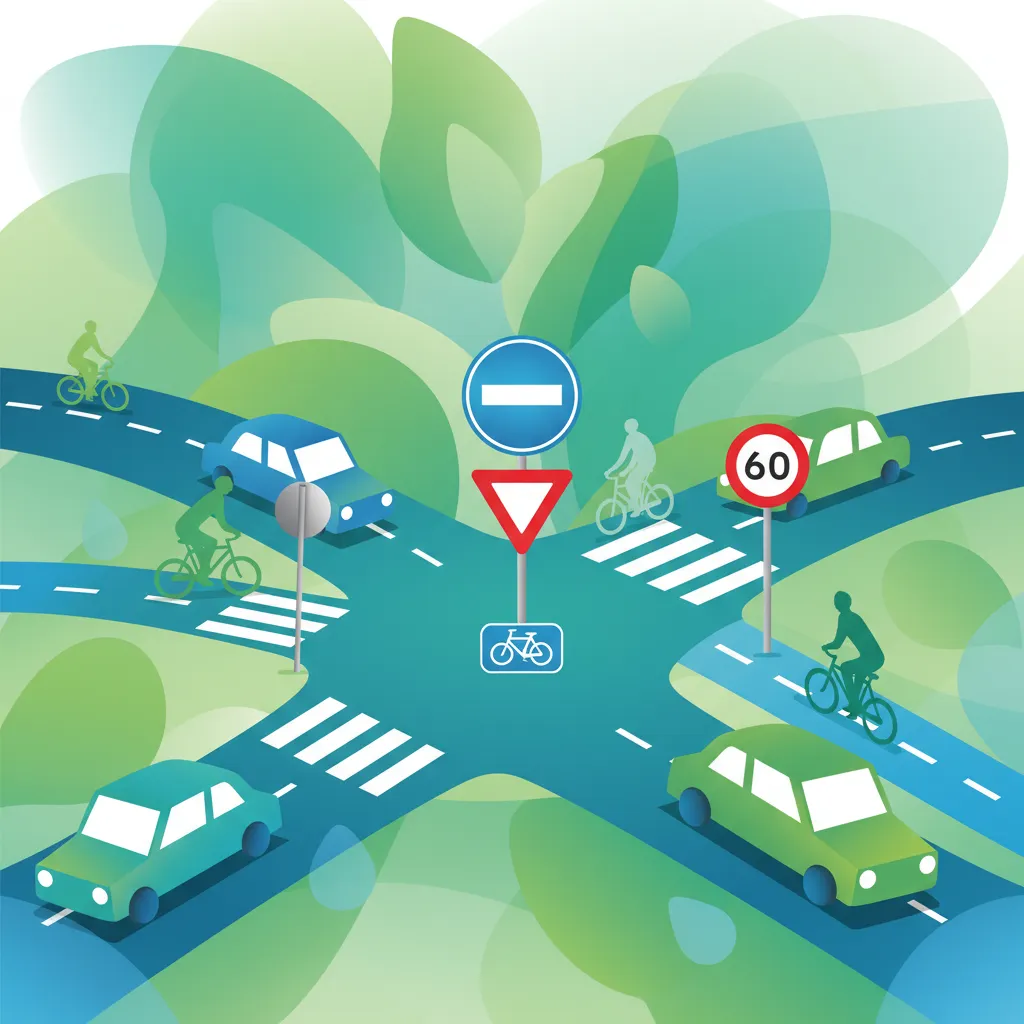
As a motorcyclist preparing for the Swedish Category A theory test, a thorough understanding of regulatory road signs is paramount. These signs are not merely suggestions; they are legally binding directives that prescribe mandatory actions or outright prohibitions for all road users, including motorcyclists. They form the backbone of traffic law under the Trafikförordning (Swedish Traffic Ordinance). Correctly interpreting and obeying these signs is essential for your safety, the safety of others, and for ensuring you comply with the law, avoiding fines, and penalty points.
This lesson will provide a comprehensive guide to Swedish regulatory signs, focusing on their meaning, legal implications, and practical application in various riding scenarios. We will delve into how these signs influence speed limits, access restrictions, overtaking rules, parking regulations, and mandatory directions, equipping you with the knowledge to navigate Sweden's roads confidently and legally.
Regulatory signs are the backbone of Sweden's traffic management system, communicating compulsory behaviours and prohibitions through a universal visual language. Understanding their underlying principles is crucial for every road user.
Every sign classified as "regulatory" establishes a legal duty or prohibition. This authority stems directly from the Trafikförordning (Swedish Traffic Ordinance, 1998:149), which mandates uniform compliance across the country. Failure to obey a regulatory sign is a traffic offence, which can lead to fines, penalty points, and potentially impact your driving licence. The strict legal nature of these signs is designed to prevent accidents, reduce conflicts, and ensure a predictable and safe traffic flow for everyone.
Swedish regulatory signs utilize a consistent system of shapes and colours to convey their meaning quickly and unambiguously. This visual encoding allows drivers and riders to discriminate between different types of instructions even at a glance or under limited visibility.
While signs provide clear instructions, their interpretation is often relative to the specific road environment. For example, a "50 km/h" speed limit in an urban area carries different safety implications than the same limit on a rural road during adverse weather. Riders must always consider the prevailing conditions, such as road function, traffic composition, and environmental factors, in conjunction with the explicit sign instruction.
In situations where multiple signs might seem to conflict, a hierarchy applies to ensure the safest and most specific rule prevails. Generally, temporary signs (often with orange or yellow backgrounds, or specific supplementary plates indicating "temporary" or "tillfällig") override permanent signs. Similarly, more restrictive signs take precedence over less restrictive ones if their application overlaps. This principle helps prevent ambiguity and guides drivers in complex situations, especially in construction zones or during special events.
Let's explore the specific types of regulatory signs you will encounter on Swedish roads, focusing on their appearance, purpose, and legal implications.
Speed limit signs are among the most common and critical regulatory signs, dictating the maximum permissible speed for all vehicles on a given road segment.
These signs are blue with a white numerical value (e.g., "50") and a red border. They indicate the maximum speed you must not exceed.
Exceeding the posted speed limit is a serious offence under Trafikförordning 3 kap. 5 §. It significantly increases stopping distances and crash severity. Always adjust your speed to be at or below the indicated limit.
The "No Entry" sign is an absolute prohibition against entering a road segment from the direction it faces.
This red circular sign with a white horizontal bar clearly means that you must not enter the road segment ahead. It is often placed at the end of a one-way street or where a road is closed for safety or construction. Violating this sign can lead to head-on collisions if traffic is flowing from the opposite direction, and it constitutes a traffic offence under Trafikförordning 3 kap. 21 §.
One-way street signs are vital for managing traffic flow in urban areas, ensuring vehicles move in a single, predictable direction.
This blue circular sign with a white arrow dictates that you must only travel in the direction the arrow points. Entering a one-way street against the arrow is a severe violation, risking head-on encounters and disrupting traffic flow. Trafikförordning 3 kap. 22 § specifies that violations of one-way rules are punishable.
These signs are placed in locations where overtaking would be unsafe due to limited visibility, narrow roads, or high-risk situations.
The red circular sign with black car silhouettes and a diagonal red line prohibits all motor vehicles from overtaking. Sometimes, a supplementary plate might specify a restriction for particular vehicle types (e.g., "Motorcyklar förbjudet att köra om" – motorcycles prohibited from overtaking, though less common as a primary sign). It is crucial to remain behind the vehicle ahead while this sign is in force. Overtaking where prohibited is a significant risk, especially for motorcyclists, and is an offence under Trafikförordning 3 kap. 8 §.
These signs regulate where you can halt your vehicle, whether for a brief stop or extended parking. Understanding the distinction is crucial.
Both types of signs can be accompanied by supplementary plates indicating specific hours or days when the restriction applies. Violating these rules results in fines and potential towing, as regulated by Trafikförordning 3 kap. 12-13 §§.
These signs dictate a compulsory direction of travel, often found at intersections, roundabouts, or prior to restricted access points.
Blue circular signs with white arrows indicate a mandatory direction, such as "straight only," "left turn only," or "right turn only." You must follow the indicated direction; deviating from it is a traffic offence under Trafikförordning 3 kap. 24 §. These signs help eliminate conflicting movements at complex intersections and guide traffic flow efficiently.
These crucial signs inform you when a previously indicated regulatory restriction ceases to apply.
A white circular sign with a black diagonal line signifies the termination of a preceding restriction (e.g., speed limit, no overtaking zone, no parking). After passing this sign, default regulations for the area typically apply. For instance, after an "End of speed limit" sign following a 30 km/h zone in a built-up area, the default speed limit of 50 km/h would likely apply, unless another speed limit sign is immediately encountered. Failing to recognise these signs can lead to unnecessary adherence to a restriction, potentially slowing down traffic, or, conversely, not resuming a default legal speed when appropriate.
These signs alert drivers to upcoming pedestrian crossings, where yielding to pedestrians is mandatory.
A blue rectangular sign (or sometimes a square sign with a white triangle inside containing a 'Z' for Zebra crossing) signals a marked pedestrian crossing ahead. At such crossings, you must give way to pedestrians who are on or about to enter the crossing. Trafikförordning 3 kap. 14 § explicitly states this obligation. Approaching these crossings with caution and being prepared to stop is essential for pedestrian safety.
These signs designate specific lanes for particular user groups, ensuring proper road space allocation.
These blue rectangular or circular signs with a white bicycle or motorcycle silhouette indicate a lane reserved for that specific user group. If you see a sign for a "motorcykelbana" (motorcycle lane), only motorcycles are permitted to use it. Similarly, a bicycle lane is exclusively for cyclists. Misusing a dedicated lane is a traffic offence under Trafikförordning 3 kap. 6 § and can endanger other road users. Always ensure you are in the correct lane for your vehicle type.
These signs are vital for adapting to altered road conditions and ensuring safety in work zones. They typically feature orange or red borders to distinguish them from permanent signage. You must obey the rules indicated by these temporary signs, which take precedence over any permanent signs in the area. This includes reduced speed limits, lane closures, or modified traffic flows.
Obeying regulatory signs is a legal requirement in Sweden. Violations carry specific penalties designed to deter unsafe driving practices.
The Trafikförordning (1998:149) is the primary legal document governing traffic rules, including road signs.
Trafikförordning 3 kap. 5 § mandates that drivers must not exceed the indicated speed.Trafikförordning 3 kap. 21 § prohibits entry into roads marked with a "No Entry" sign.Trafikförordning 3 kap. 22 § requires adherence to the direction indicated by "One-Way" signs.Trafikförordning 3 kap. 8 § states that overtaking must be safe and permitted, making it illegal where "No Overtaking" signs are posted.Trafikförordning 3 kap. 12-13 §§ regulate parking and stopping, making violations of "No Parking" and "No Stopping" signs punishable.Trafikförordning 3 kap. 24 § makes it an offence to ignore a mandatory direction sign.Trafikförordning 3 kap. 14 § obliges drivers to yield to pedestrians at marked crossings.Trafikförordning 3 kap. 6 § prohibits the misuse of lanes reserved for specific vehicle classes (e.g., motorcycle or bicycle lanes).Disregarding regulatory signs often leads to both immediate safety risks and legal consequences.
| Violation Type | Why it is Wrong | Typical Consequence (Fines/Points) |
|---|---|---|
| Exceeding speed limit | Increases stopping distance, reduces reaction time, higher crash severity. | Fine, penalty points, license impact |
| Entering a no-entry road | Creates head-on collision risk, disrupts traffic flow. | Fine, penalty points |
| Overtaking in a no-overtaking zone | High collision risk due to limited visibility or road conditions. | Fine, penalty points |
| Parking in a no-parking/stopping zone | Blocks traffic, hinders emergency services, reduces road capacity. | Fine, possible towing |
| Ignoring a mandatory turn | Causes dangerous last-minute manoeuvres, disrupts traffic flow. | Fine, penalty points |
| Riding in a bicycle lane | Endangers cyclists, violates lane allocation, risks side-swipes. | Fine |
| Not yielding at a pedestrian crossing | Puts vulnerable pedestrians at severe risk. | Fine, penalty points |
Remember that fines and penalty points accumulate. Repeated violations can lead to driver's license suspension. Always prioritize safety and legal compliance over convenience or speed.
The interpretation and adherence to regulatory signs are not static; they must adapt to changing circumstances.
Trafikförordning 3 kap. 5 §). Visibility-reducing conditions also heighten the importance of obeying "no overtaking" signs, as the risks are amplified.Understanding the rationale behind regulatory signs enhances your ability to make safe and informed decisions on the road.
Transportstyrelsen consistently shows that a significant percentage of accidents, especially in urban areas, involve failure to obey speed limits or other regulatory signs. For instance, data from 2022 indicated that 38% of urban motorcycle accidents were linked to speed limit violations. These statistics underscore the direct link between sign compliance and accident prevention.This lesson on regulatory signs is a fundamental building block for your entire Swedish Motorcycle Theory Course.
To fully grasp the concepts in this lesson, it's helpful to have:
Trafikförordning and Transportstyrelsen.The knowledge gained here directly supports several future lessons:
This lesson has provided a comprehensive overview of Swedish regulatory road signs and their profound importance for motorcyclists. We have explored the legal foundation of these signs under Trafikförordning, their distinct visual language (shapes and colours), and the critical need for contextual interpretation and adherence to sign hierarchies.
You are now familiar with the full range of regulatory signs, including speed limits, no-entry zones, one-way streets, overtaking prohibitions, parking and stopping rules, mandatory directions, end-of-restriction indicators, pedestrian crossing warnings, and dedicated lane signs. We also delved into how external factors like weather, light, and road type necessitate adaptive behaviour, always prioritizing safety above simply obeying the letter of the law.
Remember that strict compliance with these signs is not just about avoiding fines and penalty points; it is fundamentally about ensuring predictable traffic flow, preventing collisions, and contributing to overall road safety for yourself and others. By diligently applying this knowledge, you will be well-prepared for your Swedish Motorcycle Theory Course and, more importantly, for safe and responsible riding on Swedish roads.
Lesson content overview
Explore all units and lessons included in this driving theory course.
Explore search topics learners often look for when studying Regulatory Signs and Their Meaning. These topics reflect common questions about road rules, driving situations, safety guidance, and lesson level theory preparation for learners in Sweden.
Browse additional driving theory lessons that cover connected traffic rules, road signs, and common driving situations related to this topic. Improve your understanding of how different rules interact across everyday traffic scenarios.
Understand the specific prohibitions and mandatory actions dictated by Swedish regulatory signs. This lesson explores how signs for speed limits, overtaking, and access enforce traffic law under Trafikförordning, providing essential knowledge for safe driving.
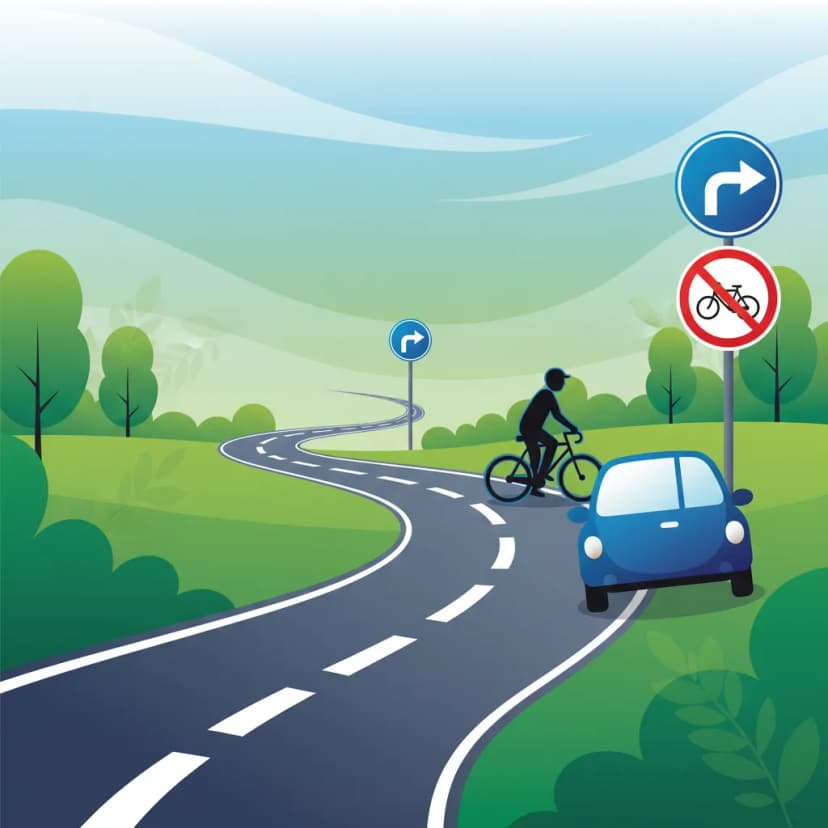
This lesson details the full range of Swedish regulatory signs, which establish legally enforceable rules for all road users. You will learn to interpret prohibitory signs (förbudsmärken) such as speed limits and no-entry signs, as well as mandatory signs (påbudsmärken) that dictate direction or lane usage. Understanding these signs is crucial as they directly regulate traffic flow, ensure safety at critical points, and carry legal consequences if ignored.

This lesson focuses on regulatory signs (Regulationsskyltar), which issue mandatory instructions and prohibitions that all road users must follow. It details common signs such as speed limits, stop and give way signs, and mandatory direction arrows. Special attention is given to signs directly affecting mopeds, like 'no moped' signs and those indicating designated moped lanes, ensuring riders can navigate legally and safely.

This lesson explains the function and legal significance of various road markings (vägmarkeringar) in Sweden. You will learn the difference between broken lines that permit overtaking and solid lines that forbid it, as well as the meaning of stop lines, pedestrian crossings, and lane direction arrows. These markings work in conjunction with signs to organize traffic flow, separate lanes, and provide critical information directly on the road surface.

This lesson covers the extensive category of informational and directional signs that aid navigation throughout Sweden. You will learn to interpret signs for motorways, national roads, and local destinations, as well as symbols indicating services like gas stations, parking, and rest areas. Proper understanding of these signs allows for efficient route planning, reduces driver uncertainty, and contributes to smoother, safer traffic flow on all types of roads.
This lesson explains the function of informational signs (Informationsskyltar), which provide guidance for navigation and access to services. It covers signs indicating distances to destinations, route numbers, and locations of fuel stations or parking areas. For moped riders, this includes identifying signs for designated moped or cycle lanes, helping them to plan and follow routes efficiently and legally.

This lesson covers the essential topic of communication in traffic using the vehicle's built-in signaling devices. You will learn the rules for using your turn indicators (körriktningsvisare) in good time before turning or changing lanes. The content also explains the proper use of hazard lights (varningsblinkers) in emergency situations and the very limited, specific circumstances in which using the horn (ljudsignal) is permitted to avert immediate danger.

This lesson explains how to read and use Swedish informational and directional signs for effective route planning and navigation. You will learn to follow signs for specific destinations, identify road numbers, and recognize indicators for services such as fuel stations and rest areas. For motorcyclists on long journeys, this knowledge is crucial for making timely decisions about lane changes, exits, and stops without causing disruption to traffic flow.
This lesson provides a detailed explanation of the Swedish traffic signal system. You will learn the precise legal meaning of solid red, yellow, and green lights, as well as green arrows which permit turning when oncoming traffic is stopped. It also covers procedures for flashing yellow signals and what to do when traffic lights are out of order, emphasizing that standard priority rules like the right-hand rule then apply.

This lesson focuses on Swedish warning signs designed to alert drivers to potential dangers. You will study signs indicating sharp bends, slippery surfaces, animal crossings, and temporary hazards like road construction. Correctly interpreting these signs allows a motorcyclist to proactively adjust speed, lane position, and readiness to react, which is essential for maintaining control and safety, especially in adverse weather or on unfamiliar roads.
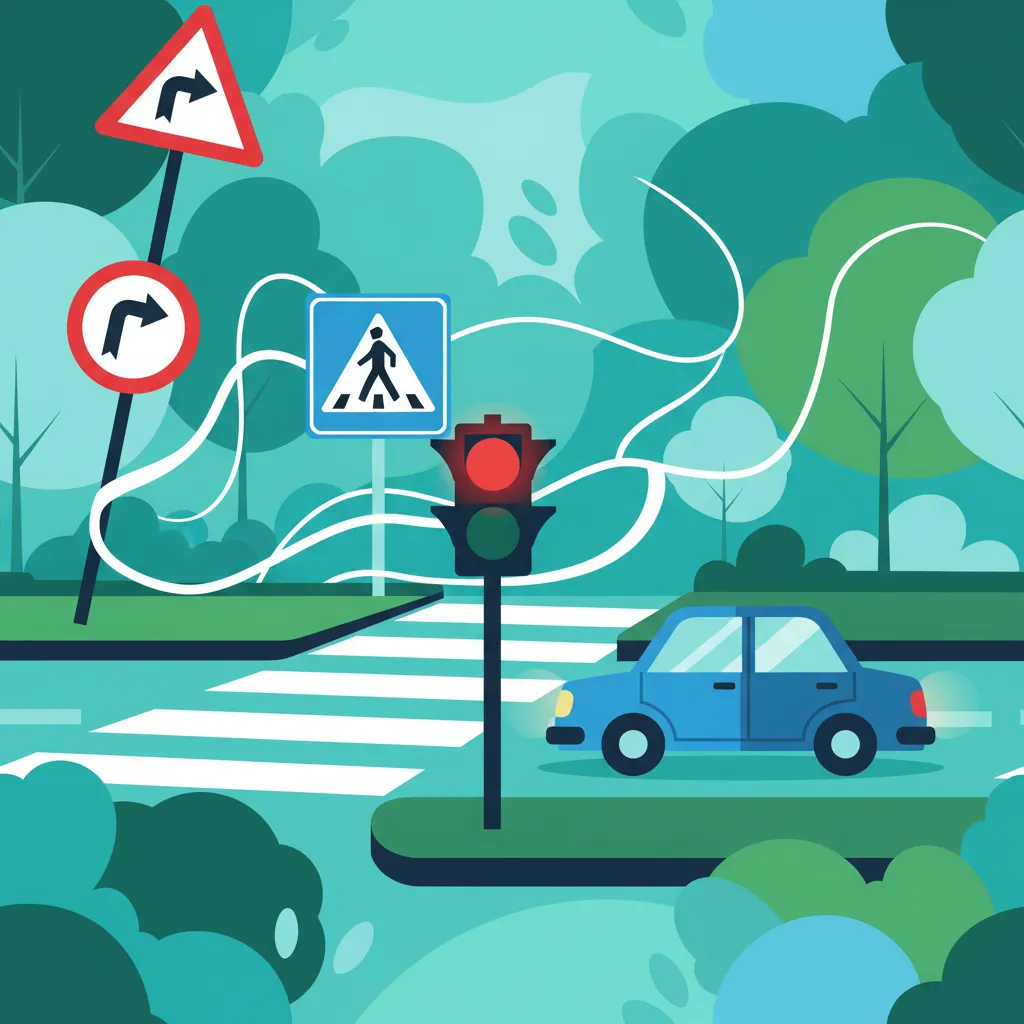
This lesson focuses on Swedish warning signs (varningsmärken), designed to alert drivers to potential dangers ahead. You will study the meaning of triangular signs indicating hazards such as sharp bends, pedestrian crossings, risk of animals on the road, or temporary road work. The objective is to develop proactive driving habits by understanding how to anticipate risks and adapt speed and positioning appropriately when a warning sign is present.
Gain a comprehensive understanding of all Swedish road signs. This lesson covers regulatory, warning, and informational signs, explaining their purpose and how they affect road user behaviour and legal compliance in Sweden.
This lesson covers the extensive category of informational and directional signs that aid navigation throughout Sweden. You will learn to interpret signs for motorways, national roads, and local destinations, as well as symbols indicating services like gas stations, parking, and rest areas. Proper understanding of these signs allows for efficient route planning, reduces driver uncertainty, and contributes to smoother, safer traffic flow on all types of roads.
This lesson explains how to read and use Swedish informational and directional signs for effective route planning and navigation. You will learn to follow signs for specific destinations, identify road numbers, and recognize indicators for services such as fuel stations and rest areas. For motorcyclists on long journeys, this knowledge is crucial for making timely decisions about lane changes, exits, and stops without causing disruption to traffic flow.
This lesson explains the function and legal significance of various road markings (vägmarkeringar) in Sweden. You will learn the difference between broken lines that permit overtaking and solid lines that forbid it, as well as the meaning of stop lines, pedestrian crossings, and lane direction arrows. These markings work in conjunction with signs to organize traffic flow, separate lanes, and provide critical information directly on the road surface.
This lesson explains the function of informational signs (Informationsskyltar), which provide guidance for navigation and access to services. It covers signs indicating distances to destinations, route numbers, and locations of fuel stations or parking areas. For moped riders, this includes identifying signs for designated moped or cycle lanes, helping them to plan and follow routes efficiently and legally.
This lesson focuses on Swedish warning signs designed to alert drivers to potential dangers. You will study signs indicating sharp bends, slippery surfaces, animal crossings, and temporary hazards like road construction. Correctly interpreting these signs allows a motorcyclist to proactively adjust speed, lane position, and readiness to react, which is essential for maintaining control and safety, especially in adverse weather or on unfamiliar roads.
This lesson details the full range of Swedish regulatory signs, which establish legally enforceable rules for all road users. You will learn to interpret prohibitory signs (förbudsmärken) such as speed limits and no-entry signs, as well as mandatory signs (påbudsmärken) that dictate direction or lane usage. Understanding these signs is crucial as they directly regulate traffic flow, ensure safety at critical points, and carry legal consequences if ignored.
This lesson focuses on Swedish warning signs (varningsmärken), designed to alert drivers to potential dangers ahead. You will study the meaning of triangular signs indicating hazards such as sharp bends, pedestrian crossings, risk of animals on the road, or temporary road work. The objective is to develop proactive driving habits by understanding how to anticipate risks and adapt speed and positioning appropriately when a warning sign is present.
This lesson teaches riders to interpret warning signs (Varningsskyltar), which alert them to potential dangers on the road ahead. It covers a wide range of signs, including those for sharp curves, slippery surfaces, wildlife crossings, and upcoming roadworks. Understanding these triangular signs allows riders to anticipate hazards, adjust their speed and position proactively, and enhance their overall safety.

This lesson focuses on the variety of road markings used on Swedish roads and their meaning for motorcyclists. You will learn the difference between solid and broken lines regarding overtaking, how to position yourself correctly at intersections based on markings, and how to interpret symbols painted on the road surface. Adhering to these markings is essential for maintaining correct lane discipline and ensuring predictability for other road users.
This lesson provides a detailed explanation of the Swedish traffic signal system. You will learn the precise legal meaning of solid red, yellow, and green lights, as well as green arrows which permit turning when oncoming traffic is stopped. It also covers procedures for flashing yellow signals and what to do when traffic lights are out of order, emphasizing that standard priority rules like the right-hand rule then apply.
Find clear answers to common questions learners have about Regulatory Signs and Their Meaning. Learn how the lesson is structured, which driving theory objectives it supports, and how it fits into the overall learning path of units and curriculum progression in Sweden. These explanations help you understand key concepts, lesson flow, and exam focused study goals.
Prohibition signs, often circular with a red border, tell you what you must NOT do, such as 'No Entry' or 'No Overtaking'. Mandatory instruction signs, also often circular but sometimes blue, tell you what you MUST do, like 'Turn left only' or 'Compulsory cycle lane'. Both are legally binding for all road users.
Swedish speed limit signs (circular, red border) indicate the maximum legal speed for your vehicle category, including motorcycles. These limits can vary by road type and location, such as urban areas (often 50 km/h or 70 km/h) or motorways (110 km/h or 120 km/h). Always pay attention to these signs as they are strictly enforced, and exceeding them carries penalties.
While most regulatory signs apply to all vehicles, including motorcycles, some might have specific implications for two-wheeled traffic. For instance, signs prohibiting certain vehicle types or movements might indirectly affect motorcyclists. The core meaning of each sign, however, is universal for all road users unless explicitly stated otherwise.
Ignoring a regulatory sign in Sweden is a traffic violation and can result in fines (bötter), penalty points on your licence, or even temporary suspension, depending on the severity and type of sign. For example, ignoring a 'No Entry' sign could lead to a serious collision, while ignoring a parking prohibition could result in a parking ticket.
Blue circular signs in Sweden typically indicate mandatory actions or requirements. For example, a blue sign with a white arrow might mean you must follow that direction. A blue sign with a bicycle symbol indicates a mandatory cycle path. These signs impose a duty on road users to comply with the instruction shown.