
Logo
Swedish Driving Theory Courses

Lesson 2 of the Vehicle Safety Systems and Basic Mechanics unit

Swedish Driving Theory B: Airbags, Seatbelts and Child Seats

This lesson is part of Unit 8: Vehicle Safety Systems. It focuses on the critical safety features that protect occupants during a collision – seatbelts and airbags. You will also learn essential rules for child safety in vehicles, ensuring all passengers travel safely on Swedish roads. This knowledge is vital for passing your Category B theory test.

seatbeltsairbagschild safetychild seatsbooster seats
Swedish Driving Theory B: Airbags, Seatbelts and Child Seats
Swedish Driving Theory B

Airbags, Seatbelts, and Child Seats: Essential Occupant Protection in Sweden

Welcome to this lesson on critical vehicle safety systems for the Swedish Driving License Theory Course for Category B Cars. Understanding how airbags, seatbelts, and child restraint systems function and the legal requirements governing their use is paramount for safe driving and passing your theory test. These systems are the primary means of protecting vehicle occupants in the event of a collision, drastically reducing the risk of severe injury or fatality.

In Sweden, as throughout the European Union, strict regulations are in place to ensure that all vehicle occupants are properly secured. This lesson will explore the underlying physics of a crash, the design and purpose of each safety device, and the specific legal obligations drivers must adhere to, as outlined in the Trafikförordning (Swedish Road Traffic Ordinance) and relevant EU directives.

The Essential Role of Seatbelts in Swedish Vehicle Safety

Seatbelts are arguably the most fundamental safety device in any vehicle, designed to keep occupants securely in their seats during sudden stops or collisions. Their primary purpose is to manage the significant forces generated when a moving vehicle rapidly decelerates, preventing occupants from being thrown forward into the vehicle's interior or, worse, ejected from the vehicle entirely.

Understanding the Three-Point Seatbelt (3-pt) System

The standard three-point seatbelt, common in all modern passenger cars, consists of a single continuous strap that secures the occupant at three crucial points: across the shoulder, over the chest, and low across the hips. This design provides simultaneous restraint for both the torso and the pelvis, effectively distributing crash forces over the strongest parts of the body. When correctly fastened, the belt limits forward and downward motion, ensuring the occupant remains within the vehicle's protective space.

Advanced Seatbelt Technologies: Pretensioners and Load Limiters

Modern seatbelt systems incorporate advanced technologies to maximize their effectiveness:

  • Seatbelt Pretensioners: These are electromechanical devices that activate milliseconds after a crash is detected. Their role is to rapidly retract any slack in the seatbelt, pulling the occupant firmly back into the seat. By removing this slack, the pretensioner ensures that the occupant is restrained almost instantly, before the vehicle's full deceleration has taken effect. This quick response minimizes the distance an occupant can move forward, significantly reducing the impact velocity with the dashboard or steering wheel.

  • Load Limiters: After the pretensioner has tightened the belt, load limiters come into play. These mechanisms are designed to allow a controlled amount of belt stretch or "give" once a certain force threshold (typically around 6 kN or 600 kg of force) is reached. This controlled yielding prevents the seatbelt itself from causing excessive injury to the occupant's chest by limiting the peak forces exerted on the body. It's a delicate balance: the belt must be tight enough to restrain effectively but also yield enough to prevent severe belt-induced trauma.

In Sweden, the law is unequivocal regarding seatbelt use:

Definition

Trafikförordning § 4 (1)

All persons in a motor vehicle shall be restrained by a seat belt or an appropriate child restraint system.

This means every single occupant, regardless of age or seating position (front or rear), must be buckled up. As a driver, you carry significant responsibility for ensuring this compliance:

Definition

Trafikförordning § 13 (2)

The driver shall ensure that the seatbelts of front-seat passengers are fastened before moving the vehicle.

While this specific clause targets front-seat passengers, a responsible driver understands the broader obligation to ensure all passengers, including those in the rear, are properly secured before starting a journey. Ignoring these rules not only jeopardizes lives but also constitutes a traffic violation.

Correct Seatbelt Usage: Ensuring Maximum Protection

For a seatbelt to offer its intended protection, it must be worn correctly:

  1. Shoulder Strap: The shoulder strap should lie across the middle of your collarbone (clavicle) and chest, not too close to your neck or off your shoulder.
  2. Lap Belt: The lap belt must be positioned low across your hips, touching your thigh bones. It should never rest over your abdomen, as this can cause severe internal injuries in a collision.
  3. Snug Fit: The belt should be snug against your body, with no twists or slack. Any slack reduces the effectiveness of the pretensioner and increases the distance you could move forward in a crash.
  4. Height Adjustment: Many vehicles have an upper-belt height adjuster, allowing taller or shorter occupants to position the shoulder strap correctly. Always use this feature if available.

Warning

Never place the lap belt over your abdomen. In a collision, this can lead to "seatbelt syndrome," causing severe internal organ damage.

Seatbelt Reminder Systems

Most modern vehicles are equipped with a seatbelt reminder system, which provides an audible chime and/or a visual warning light (often on the dashboard or overhead console) if a seatbelt is unfastened. These systems are mandated for driver and front passenger seats and serve as an important prompt to encourage compliance with mandatory belt-use laws.

Airbag Systems: Supplemental Restraint for Enhanced Protection

Airbags are a crucial component of a vehicle's passive safety system, designed to work in conjunction with seatbelts to provide an additional layer of protection. They are not a substitute for seatbelts but rather a supplemental restraint system (SRS).

How Airbags Work: A Split-Second Deployment

Airbags are inflatable cushions, typically made of nylon fabric, that expand rapidly during a collision. The deployment process is remarkably fast, often occurring within 30-50 milliseconds—faster than a blink of an eye.

The process involves:

  1. Sensors: Vehicle crash sensors (accelerometers, pressure sensors) detect sudden, severe deceleration characteristic of a collision.
  2. Control Unit: A central control unit receives signals from these sensors and determines if a deployment is necessary.
  3. Inflator: If deployment is triggered, an inflator rapidly releases a non-toxic gas (usually nitrogen) to fill the airbag.
  4. Cushioning: The inflated airbag provides a soft barrier between the occupant and the vehicle's hard interior surfaces, increasing the distance over which deceleration occurs. This significantly reduces the peak forces exerted on the occupant's head and chest.
  5. Deflation: The airbag begins to deflate almost immediately after full inflation, allowing the occupant to move freely.

Types of Airbags in Modern Vehicles

Modern vehicles often feature multiple airbags strategically placed around the cabin to protect occupants from various impact directions:

  • Front Airbags (Driver & Passenger): These are the most common type, protecting the head and chest in frontal impacts. The driver's airbag is typically located in the steering wheel, and the front passenger airbag is in the dashboard.
  • Side-Impact (Thorax) Airbags: Mounted in the sides of the seats or doors, these protect the torso in side-on collisions.
  • Curtain (Head-Side) Airbags: Deploying from the roof rail, these airbags cover the side windows, providing head protection for both front and rear outboard occupants in side impacts or rollovers.
  • Knee Airbags: Located below the steering column on the driver's side and sometimes below the glove compartment on the passenger side, these help protect lower limbs and can prevent occupants from submarining (sliding under the dashboard).

The Synergy of Airbags and Seatbelts

It is crucial to understand that airbags are designed to work with seatbelts, not replace them. A seatbelt correctly restrains the occupant, ensuring they are positioned for the airbag to effectively cushion them. Without a seatbelt, an occupant can be thrown towards the deploying airbag at high speed, leading to severe injuries from the force of the airbag itself, which inflates with tremendous power. Combining a three-point belt with an airbag can reduce the risk of fatal thoracic and head injuries by up to 70% compared with a belt alone.

Passenger Airbag Deactivation: A Critical Safety Measure for Children

One of the most vital rules concerning airbags involves the front passenger airbag when transporting children:

Definition

Trafikförordning § 4 (3)

When a rear-facing child seat is placed in the front passenger seat, the front passenger airbag must be deactivated.

A deploying front passenger airbag can cause catastrophic, even fatal, injury to an infant or child in a rear-facing child seat. The force of the airbag deploying into the back of the child seat can propel it violently backward, causing severe head and neck trauma.

Warning

Never place a rear-facing child seat in the front passenger seat unless you are absolutely certain the passenger airbag is deactivated. Always verify the "AIRBAG OFF" indicator light.

How to Deactivate the Passenger Airbag

The method for deactivating the front passenger airbag varies between vehicle models:

Passenger Airbag Deactivation Procedure

  1. Manual Switch: Many cars have a dedicated switch, often located in the glove compartment or on the side of the dashboard (visible when the passenger door is open). This is typically a rotary switch that you turn with the ignition key.

  2. Key-Activated System: Some vehicles require you to use the car's ignition key in a specific lock cylinder, usually on the side of the dashboard.

  3. Electronic Sensor-Based Deactivation: Newer, more advanced vehicles may have intelligent weight or presence sensors that can automatically detect the presence of a rear-facing child seat and deactivate the airbag. However, always verify that the "AIRBAG OFF" indicator light illuminates.

  4. Verification: After deactivating, always look for the "AIRBAG OFF" indicator light on the dashboard or overhead console. This light confirms that the airbag is disabled. If it does not illuminate, the airbag may still be active, and the rear-facing child seat must not be placed in the front.

If your vehicle does not have a mechanism to deactivate the front passenger airbag, it is strictly prohibited to place a rear-facing child seat in that position. In such cases, the child must be seated in the rear of the vehicle.

Airbag Warning Lights

A warning light, often displaying an airbag symbol or the word "AIRBAG" (sometimes combined with "SRS"), indicates a fault in the airbag system. If this light illuminates and stays on after starting the engine, it means the system is not fully functional. Driving with a faulty airbag system compromises occupant safety and may be a legal and inspection issue. Such a fault should be addressed by a qualified mechanic promptly.

Child Restraint Systems: Protecting Our Youngest Passengers

Children are particularly vulnerable in vehicle collisions because their bodies are still developing. Standard adult seatbelts are not designed for their smaller stature and bone structure, making dedicated child restraint systems (CRS) essential. Swedish law, aligning with EU regulations, mandates the use of appropriate CRS based on a child's height and weight.

The core legal principle is clear:

Definition

Trafikförordning § 4 (2)

Children who have not yet reached a height of 135 cm shall be restrained by an appropriate child restraint system.

This height threshold is critical. Until a child reaches 135 cm, they must use a child seat, booster seat, or infant carrier that is suitable for their size and weight. The type of restraint system changes as a child grows.

Hierarchy of Child Restraints

The progression through child restraint systems is designed to provide the best possible protection at each stage of a child's development:

  1. Infant Carriers (Rear-Facing: Up to ~13 kg or 75 cm)

    • Description: Small, portable, bucket-style seats designed for newborns and very young infants. They are always installed rear-facing.
    • Purpose: Rear-facing provides superior protection for an infant's delicate head, neck, and spine by cradling them and distributing crash forces over their entire back.
    • Usage: Used from birth until the child reaches the maximum weight or height limit of the carrier, typically around 9-12 months.
    • Installation: Can be installed using the vehicle's seatbelt or, increasingly, via ISOFIX anchor points.
  2. Child Seats (Rear-Facing: Up to ~18-25 kg or 100-125 cm)

    • Description: Larger rear-facing seats that allow children to remain in this safer orientation for longer, often up to 4-5 years of age or even longer in some models.
    • Purpose: Extended rear-facing use is strongly recommended in Sweden and is considered the safest option for young children, offering significantly better protection for the head and neck compared to forward-facing seats.
    • Usage: Used after outgrowing an infant carrier, until the child reaches the seat's maximum weight or height limit. Swedish recommendations often go beyond the minimum EU requirement, encouraging rear-facing until at least four years old.
    • Installation: Typically installed using ISOFIX, vehicle seatbelts, and often a top-tether strap.
  1. Forward-Facing Child Seats (Approx. 15-25 kg or 100-125 cm)

    • Description: Seats designed for children who have outgrown rear-facing seats but are still too small for a booster. These seats usually feature a five-point harness to secure the child.
    • Purpose: Provides restraint once the child's neck and spine are sufficiently developed to withstand crash forces in a forward-facing orientation.
    • Usage: Only used after the child has exceeded the rear-facing weight or height limits, and only if they are not yet tall enough for a booster cushion.
    • Installation: Secured by ISOFIX or the vehicle's seatbelt, often with a top-tether.
  2. Booster Cushions (From 135 cm up to 150 cm)

    • Description: A simple elevated cushion or a high-back booster seat that raises the child's seating position.
    • Purpose: Booster cushions do not have their own harness. Instead, they elevate the child so that the vehicle's adult three-point seatbelt fits correctly – the lap belt low over the hips and the shoulder strap across the middle of the chest and collarbone.
    • Usage: Mandatory only once the child reaches 135 cm in height. Children must continue using a booster until they are 150 cm tall (or legally, 135 cm is the minimum, but 150 cm is the recommended height for optimal adult seatbelt fit).
    • Installation: The child and booster are secured by the vehicle's adult seatbelt. Some high-back boosters may also attach via ISOFIX to prevent them from becoming a projectile when unoccupied.

The ISOFIX Anchor System

ISOFIX is a standardized international system for securely attaching child seats directly to the car chassis, without using the vehicle's seatbelts for installation.

  • Components: It consists of two lower anchors (metal bars) located in the crease between the backrest and the seat cushion, and often a top-tether anchor point (a metal ring) behind the seat (either on the parcel shelf or floor).
  • Benefits: ISOFIX dramatically reduces the likelihood of incorrect child seat installation, which is a common problem with belt-installed seats. It provides a rigid, secure connection, ensuring the child seat performs optimally in a crash.
  • Regulation: All new passenger cars sold in Sweden (and the EU) after 2005 are required to have ISOFIX anchor points in at least two rear seating positions (UN ECE Regulation No 136).

Tip

When installing a child seat, always perform the "tug test." After securing the seat (whether with ISOFIX or seatbelt), vigorously tug the seat at the belt path or ISOFIX connectors. It should not move more than 2-3 cm side-to-side or front-to-back.

Swedish Laws and Regulations on Occupant Safety

Compliance with occupant safety regulations is not just about avoiding fines; it's about protecting lives. Here's a summary of key Swedish laws and their implications for drivers:

  1. Mandatory Seatbelt Use for All: As per Trafikförordning § 4 (1), every person in a moving motor vehicle must use a seatbelt or appropriate child restraint. This applies equally to front and rear seats.
    • Rationale: To prevent ejection and significantly reduce injury severity in collisions or sudden stops.
    • Driver's Responsibility: The driver is legally responsible for ensuring front-seat passengers are belted (§ 13 (2)) and, by extension, all occupants are safely restrained.
  2. Child Restraint for Children Under 135 cm: Trafikförordning § 4 (2) states that children below 135 cm must use an appropriate child restraint system.
    • Rationale: Adult seatbelts are not safe for shorter children, as they can cause severe neck and abdominal injuries.
    • Appropriate System: The specific type of CRS depends on the child's age, weight, and height, following the hierarchy of infant carrier → rear-facing child seat → forward-facing child seat → booster cushion.
  3. Passenger Airbag Deactivation for Rear-Facing Child Seats: Trafikförordning § 4 (3) explicitly prohibits placing a rear-facing child seat in the front passenger seat unless the airbag is deactivated.
    • Rationale: A deploying airbag can cause fatal injuries to a child in a rear-facing seat.
    • Driver's Responsibility: It is the driver's duty to confirm airbag deactivation status before placing a rear-facing seat in the front and before moving the vehicle.
  4. Functional Safety Systems: Seatbelt pretensioners, load limiters, and airbags must be functional. An illuminated airbag warning light indicates a fault that must be repaired.
    • Rationale: These systems are integral to vehicle safety design; a malfunctioning component compromises the entire safety envelope.
  5. ISOFIX Usage: While not strictly mandatory to use ISOFIX if a belt installation is also approved for the seat, it is highly recommended where available (UN ECE Regulation No 136).
    • Rationale: ISOFIX dramatically reduces installation errors and provides a more secure connection.
  6. Booster Cushion Height Limit: Children must be at least 135 cm tall to use a booster cushion effectively.
    • Rationale: To ensure the adult three-point seatbelt correctly positions over the child's shoulder and hips, preventing internal injuries.

Note

Regular vehicle inspections (Besiktning) in Sweden include checks on the functionality of seatbelts and airbag warning systems, reinforcing the legal requirement for these safety features to be in working order.

Practical Scenarios and Common Mistakes to Avoid

Understanding the rules is one thing; applying them correctly in real-life driving is another. Here are some common situations and potential pitfalls to be aware of:

Scenario 1: Unbelted Rear Passenger

  • Situation: You are driving on a motorway at 100 km/h, and a passenger in the rear seat has not fastened their seatbelt.
  • Why it's wrong: This violates Trafikförordning § 4 (1). An unbelted rear passenger can be ejected or become a projectile, posing a serious threat to themselves and other occupants in a collision.
  • Correct behavior: Always check that all passengers are buckled up before starting the journey, and remind them if they forget.
  • Consequence: A fine for the unbelted passenger and increased injury risk for everyone in the car.

Scenario 2: Rear-Facing Child Seat in Front with Active Airbag

  • Situation: You have an infant in a rear-facing car seat on the front passenger seat, but you forgot to deactivate the passenger airbag.
  • Why it's wrong: This is a direct violation of Trafikförordning § 4 (3) and extremely dangerous. A frontal collision, even a minor one, could trigger the airbag, causing severe or fatal injuries to the infant.
  • Correct behavior: Always deactivate the passenger airbag and verify the "AIRBAG OFF" indicator before placing a rear-facing child seat in the front. If deactivation is not possible, the child seat must go in the rear.
  • Consequence: Catastrophic injury to the child and severe legal liability for the driver.

Scenario 3: Using a Booster Cushion Prematurely

  • Situation: Your child is 5 years old and 125 cm tall. You've placed them in a booster cushion in the back seat.
  • Why it's wrong: The child does not meet the legal minimum height of 135 cm for using a booster cushion (Trafikförordning § 4 (2), aligned with EU regulations). The adult seatbelt will not fit correctly, likely resting on the child's abdomen and neck instead of the hips and collarbone.
  • Correct behavior: The child should still be in a forward-facing child seat with a five-point harness until they reach at least 135 cm.
  • Consequence: Increased risk of severe abdominal and neck injuries in a crash, and a potential fine for improper child restraint.

Scenario 4: Ignoring a Seatbelt Reminder

  • Situation: You start your car, and the seatbelt reminder chime sounds, indicating your front passenger is unbuckled. You ignore it, assuming they'll buckle up later.
  • Why it's wrong: The reminder system is there for a reason, and ignoring it means an occupant is traveling unprotected. This habit can lead to lapses in judgment and non-compliance.
  • Correct behavior: Immediately ask the passenger to fasten their seatbelt and ensure the reminder light extinguishes before driving.
  • Consequence: Potential fine and significantly increased risk in a sudden stop or collision.

Scenario 5: Faulty Airbag System

  • Situation: The airbag warning light on your dashboard illuminates and stays on. You decide to postpone fixing it.
  • Why it's wrong: An illuminated airbag warning light means the airbag system may not deploy correctly or at all in a crash, severely compromising your vehicle's occupant protection.
  • Correct behavior: Have the vehicle inspected and repaired by a qualified mechanic as soon as possible. Do not drive the vehicle if a critical safety system is compromised.
  • Consequence: You are operating a vehicle with a known safety defect, increasing injury risk for all occupants in an accident. It may also lead to issues during the annual vehicle inspection (Besiktning).

Safety and Reasoning Insights: The Science Behind the Rules

The regulations concerning seatbelts, airbags, and child seats are firmly rooted in the physics of collisions and extensive research into human physiology and injury tolerance.

  • Inertia and Deceleration: In a crash, your body continues to move forward at the vehicle's original speed due to inertia. The vehicle then rapidly decelerates. Seatbelts apply a controlled deceleration force to your body, while airbags increase the distance over which this deceleration occurs. This dual action dramatically reduces the peak forces (G-forces) on your body, keeping them within human tolerance limits. For example, a belted occupant in an airbag-equipped car might experience 15-20g, whereas an unbelted occupant could experience over 100g.
  • Protection of Vulnerable Body Parts: The design of these systems targets the most vulnerable parts of the body. Seatbelts protect the torso and pelvis, while airbags primarily protect the head and chest. Child seats are specifically engineered to support a child's proportionally larger head and weaker neck muscles, which are highly susceptible to injury in a collision.
  • Statistical Evidence: Data from the Swedish Transport Agency (Trafikverket) consistently shows that proper seatbelt use reduces the risk of fatality by approximately 45% and serious injury by 60%. When combined with airbags, the reduction in fatal head injuries can be even greater, by an additional 20%. Rear-facing child seats have been proven to reduce head injury risk by up to 75% for young children compared to forward-facing seats.
  • Integrated Safety: These systems are designed to work together as an integrated safety package. The timing of pretensioner activation, airbag deployment, and load limiter engagement is precisely synchronized to manage crash energy effectively. Any failure or improper use of one component can compromise the entire system.

By understanding the "why" behind these rules, drivers can develop a deeper commitment to ensuring their own safety and the safety of all passengers, making Swedish roads safer for everyone.


Three-point seatbelt
A restraint system securing an occupant at the lap and shoulder with a single continuous strap.
Pretensioner
An electromechanical device that rapidly retracts seatbelt slack during a crash.
Load limiter
A mechanism that allows controlled belt stretch to limit peak forces on the chest during a crash.
Airbag
An inflatable cushion that deploys rapidly during a crash to provide a soft barrier between occupant and vehicle interior.
Passenger airbag deactivation
The process of disabling the front passenger airbag, mandatory when a rear-facing child seat is present.
Child restraint system (CRS)
A device designed to protect child occupants too small for adult seatbelts, including infant carriers, child seats, and boosters.
Rear-facing child seat
A child restraint system installed with the child facing the rear of the vehicle, offering superior head and neck protection.
Booster cushion
A child restraint that raises a child's seating position to correctly fit the vehicle's adult seatbelt.
ISOFIX
A standardized anchor system providing a rigid connection between a child seat and the vehicle chassis.
Trafikförordning
The Swedish Road Traffic Ordinance, which codifies vehicle safety rules and traffic laws.
Crash pulse
The time-varying acceleration profile experienced by a vehicle or occupant during a collision.
Top-tether
An upper anchor point in the ISOFIX system that limits forward rotation of a child seat.
EU Regulation 44/2009
A European legislative framework defining weight/height limits for child restraint categories, incorporated into Swedish law.
Seatbelt reminder
An audible and/or visual signal alerting that a seatbelt is not fastened.
Vehicle inspection (Besiktning)
Mandatory periodic technical inspection for vehicles in Sweden to ensure roadworthiness and safety compliance.

Learn more with these articles

Check out these practice sets


Search topics related to Airbags, Seatbelts and Child Seats

Explore search topics learners often look for when studying Airbags, Seatbelts and Child Seats. These topics reflect common questions about road rules, driving situations, safety guidance, and lesson level theory preparation for learners in Sweden.

swedish seatbelt law category Bchild seat rules sweden driving theorypassenger airbag deactivate swedenhow do airbags work theory test swedencar safety systems driving examtypes of child restraints swedenwhat age child needs booster seat swedendriving theory sweden seatbelt airbag

Related driving theory lessons for Airbags, Seatbelts and Child Seats

Browse additional driving theory lessons that cover connected traffic rules, road signs, and common driving situations related to this topic. Improve your understanding of how different rules interact across everyday traffic scenarios.

How Seatbelts and Airbags Work in Swedish Driving Theory

Understand the passive safety systems designed to protect occupants during a collision. This lesson details the function of seatbelts and airbags, emphasizing Swedish regulations and their critical role in vehicle safety for all passengers.

seatbeltsairbagsvehicle safetypassive safetySwedish driving rules
Helmet Standards, Protective Clothing, and Visibility Aids lesson image

Helmet Standards, Protective Clothing, and Visibility Aids

This lesson focuses on the single most important piece of safety gear: the helmet. You will learn about the legal standards helmets must meet in Sweden (e.g., ECE ratings) and how to ensure a proper fit. The content also covers the full range of personal protective equipment (PPE), including jackets, pants, gloves, and boots, explaining the importance of abrasion resistance, impact armor, and high-visibility features for rider protection.

Swedish Motorcycle Theory ALegal Responsibilities, Documentation & Protective Equipment
View lesson
Legal Obligations Regarding Safety Equipment lesson image

Legal Obligations Regarding Safety Equipment

This lesson serves as a summary of the legal requirements for safety equipment in Sweden. It reiterates the mandatory helmet law for both the rider and any passenger. It also touches on the rider's responsibility to ensure the moped itself is legally equipped with functioning lights, brakes, and other essential safety features, linking personal gear with vehicle roadworthiness.
Swedish Moped Theory AMProtective Equipment and Personal Safety
View lesson
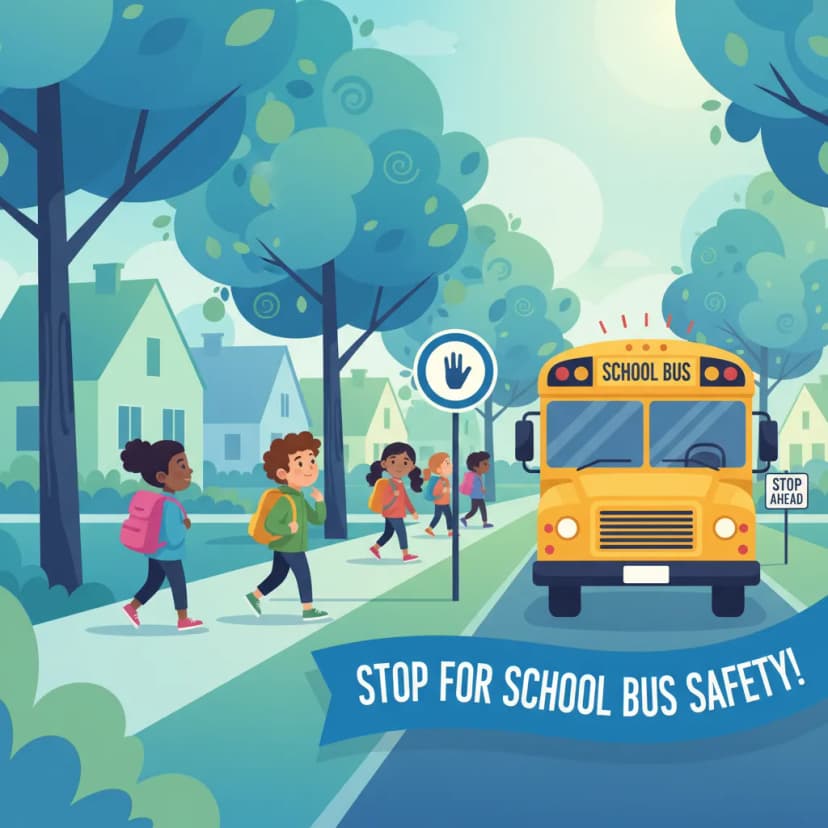
School Buses and Children lesson image

School Buses and Children

This lesson highlights the extreme caution needed in areas where children are present. You will learn to recognize school zone signs and the specific sign for a school bus, and understand your duty to slow down and be prepared to stop when a school bus has stopped for passengers. The lesson emphasizes that children can be impulsive and have poor risk judgment, requiring drivers to be exceptionally vigilant and maintain very low speeds.

Swedish Driving Theory BInteraction with Vulnerable Road Users
View lesson
ABS, ESP and Traction Control lesson image

ABS, ESP and Traction Control

This lesson explains the function of key electronic driver aids. You will learn how the Anti-lock Braking System (ABS) prevents wheels from locking during hard braking, allowing you to maintain steering control. The lesson also covers the Electronic Stability Program (ESP), which helps prevent skids by automatically braking individual wheels, and Traction Control (TCS), which prevents wheel spin during acceleration on slippery surfaces.
Swedish Driving Theory BVehicle Safety Systems and Basic Mechanics
View lesson
Legal Parking Rules lesson image

Legal Parking Rules

This lesson covers the general, nationwide rules that govern where you may and may not park or stop, even without specific signs. You will learn about the prohibitions on stopping near intersections, on pedestrian crossings, and at bus stops. The content clarifies the legal definitions and provides clear guidelines on maintaining safe distances and ensuring that your parked vehicle does not obstruct traffic or create a hazard.

Swedish Driving Theory BParking, Stopping, and Loading Zones
View lesson
Licence Requirements, Registration, and Insurance Obligations lesson image

Licence Requirements, Registration, and Insurance Obligations

This lesson explains the process for obtaining the correct category of motorcycle license (Körkort A) in Sweden and the legal necessity of keeping it current. You will learn about the procedures for registering your motorcycle with Transportstyrelsen and the mandatory insurance coverage you must have to legally ride on public roads. Understanding these administrative requirements is the first step to being a fully compliant and responsible vehicle operator.

Swedish Motorcycle Theory ALegal Responsibilities, Documentation & Protective Equipment
View lesson
Mandatory Documents, Vehicle Inspection, and Roadworthiness Checks lesson image

Mandatory Documents, Vehicle Inspection, and Roadworthiness Checks

This lesson details the documents you are legally required to carry with you when riding, such as your license and registration certificate. It provides a comprehensive explanation of the mandatory periodic vehicle inspection (besiktning) process in Sweden, outlining what is checked and why it's important for safety. Finally, it reinforces the habit of performing your own pre-ride checks to ensure your motorcycle is always in a safe, roadworthy condition.

Swedish Motorcycle Theory ALegal Responsibilities, Documentation & Protective Equipment
View lesson
Periodic Vehicle Inspection (Besiktning) lesson image

Periodic Vehicle Inspection (Besiktning)

This lesson explains the legal requirement for periodic vehicle inspection in Sweden. You will learn about the role of the 'besiktning' in ensuring that vehicles on the road meet minimum safety and environmental standards. The content covers how to find out when your vehicle is due for inspection, what key components are checked (such as brakes, steering, and emissions), and the possible outcomes, including approval, recommendations for repair, or a driving prohibition (körförbud).
Swedish Driving Theory BVehicle Safety Systems and Basic Mechanics
View lesson
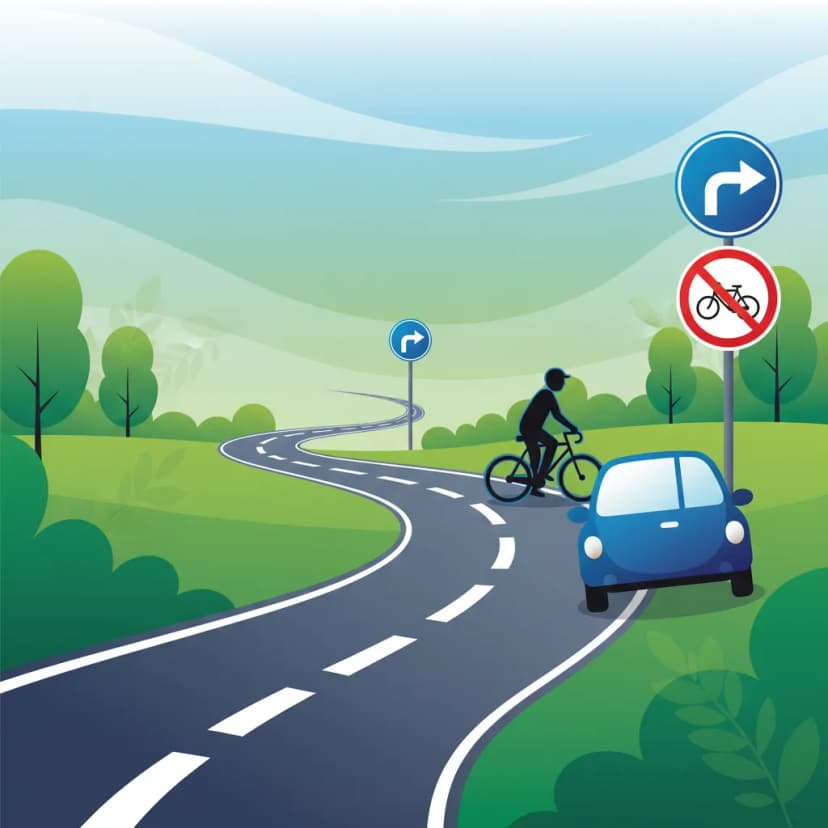
Residential Areas and Speed Calming lesson image

Residential Areas and Speed Calming

This lesson focuses on the high level of caution required when driving in residential areas. You will learn about the rules for special zones like 'gångfartsområde' (walking speed area) and the need to navigate around speed calming measures like speed bumps. The central theme is anticipating unpredictable behavior from residents, especially children, and managing the risks posed by parked cars that severely limit visibility.
Swedish Driving Theory BDriving in Different Environments
View lesson
Regulatory Signs (Vägförbud & Påbud) lesson image

Regulatory Signs (Vägförbud & Påbud)

This lesson details the full range of Swedish regulatory signs, which establish legally enforceable rules for all road users. You will learn to interpret prohibitory signs (förbudsmärken) such as speed limits and no-entry signs, as well as mandatory signs (påbudsmärken) that dictate direction or lane usage. Understanding these signs is crucial as they directly regulate traffic flow, ensure safety at critical points, and carry legal consequences if ignored.

Swedish Driving Theory BRoad Signs and Signals
View lesson

Child Seat Laws and Regulations in Sweden for Drivers

Master Swedish driving theory on child safety in vehicles. Learn about the types of child restraints, legal age and height requirements, and the crucial importance of proper installation and passenger airbag deactivation.

child safetychild seatsbooster seatsSwedish driving lawscategory B
School Buses and Children lesson image

School Buses and Children

This lesson highlights the extreme caution needed in areas where children are present. You will learn to recognize school zone signs and the specific sign for a school bus, and understand your duty to slow down and be prepared to stop when a school bus has stopped for passengers. The lesson emphasizes that children can be impulsive and have poor risk judgment, requiring drivers to be exceptionally vigilant and maintain very low speeds.

Swedish Driving Theory BInteraction with Vulnerable Road Users
View lesson
Residential Areas and Speed Calming lesson image

Residential Areas and Speed Calming

This lesson focuses on the high level of caution required when driving in residential areas. You will learn about the rules for special zones like 'gångfartsområde' (walking speed area) and the need to navigate around speed calming measures like speed bumps. The central theme is anticipating unpredictable behavior from residents, especially children, and managing the risks posed by parked cars that severely limit visibility.

Swedish Driving Theory BDriving in Different Environments
View lesson
Legal Parking Rules lesson image

Legal Parking Rules

This lesson covers the general, nationwide rules that govern where you may and may not park or stop, even without specific signs. You will learn about the prohibitions on stopping near intersections, on pedestrian crossings, and at bus stops. The content clarifies the legal definitions and provides clear guidelines on maintaining safe distances and ensuring that your parked vehicle does not obstruct traffic or create a hazard.

Swedish Driving Theory BParking, Stopping, and Loading Zones
View lesson
Pedestrians and Gågata Rules lesson image

Pedestrians and Gågata Rules

This lesson details a driver's responsibility towards pedestrians. You will learn the strict rule of yielding to pedestrians who are on or about to enter a marked, uncontrolled crosswalk. The content also covers the specific, highly restrictive rules for driving in designated pedestrian zones (gågata) and 'walking speed' areas (gångfartsområde), where pedestrians have complete priority and vehicle traffic is severely limited.

Swedish Driving Theory BInteraction with Vulnerable Road Users
View lesson
Helmet Standards, Protective Clothing, and Visibility Aids lesson image

Helmet Standards, Protective Clothing, and Visibility Aids

This lesson focuses on the single most important piece of safety gear: the helmet. You will learn about the legal standards helmets must meet in Sweden (e.g., ECE ratings) and how to ensure a proper fit. The content also covers the full range of personal protective equipment (PPE), including jackets, pants, gloves, and boots, explaining the importance of abrasion resistance, impact armor, and high-visibility features for rider protection.

Swedish Motorcycle Theory ALegal Responsibilities, Documentation & Protective Equipment
View lesson
Signalling with Lights and Horn lesson image

Signalling with Lights and Horn

This lesson covers the essential topic of communication in traffic using the vehicle's built-in signaling devices. You will learn the rules for using your turn indicators (körriktningsvisare) in good time before turning or changing lanes. The content also explains the proper use of hazard lights (varningsblinkers) in emergency situations and the very limited, specific circumstances in which using the horn (ljudsignal) is permitted to avert immediate danger.
Swedish Driving Theory BVehicle Control and Maneuvering
View lesson
Disabled and Restricted Areas lesson image

Disabled and Restricted Areas

This lesson covers parking areas that are reserved for specific purposes or permit holders. The primary focus is on spaces designated for people with disabilities, explaining the requirement of a valid permit. It also addresses other restricted areas such as residential parking zones (boendeparkering), loading zones, and areas that must be kept clear for emergency vehicles, highlighting the legal and ethical reasons for respecting these designations.

Swedish Driving Theory BParking, Stopping, and Loading Zones
View lesson
Urban Traffic and Pedestrian Zones lesson image

Urban Traffic and Pedestrian Zones

This lesson focuses on the unique challenges of driving in urban environments. You will learn techniques for anticipating the actions of vulnerable road users like pedestrians and cyclists, especially near crossings and bus stops. The content covers how to navigate narrow streets, one-way systems, and areas with heavy traffic, emphasizing the need for lower speeds, heightened awareness, and a defensive mindset.

Swedish Driving Theory BDriving in Different Environments
View lesson
Emergency Vehicles and Sirens lesson image

Emergency Vehicles and Sirens

This lesson provides clear instructions on the correct response to an approaching emergency vehicle with its sirens and lights active. You will learn your absolute duty to give way and the best methods for doing so, which typically involve pulling over to the right and stopping. The lesson stresses the importance of acting calmly and predictably, avoiding sudden braking or swerving that could endanger the emergency vehicle or other traffic.
Swedish Driving Theory BInteraction with Vulnerable Road Users
View lesson
Swedish Speed Limit Structure (Vägens hastighetsgränser) lesson image

Swedish Speed Limit Structure (Vägens hastighetsgränser)

This lesson explains the hierarchical structure of speed limits in Sweden as defined by the Trafikförordning. It covers the default 'base speeds', including 50 km/h in built-up areas and 70 km/h outside them, and how these are modified by specific road signs. You will learn to identify speed limit signs for different road types, such as motorways and residential zones, and understand the legal framework that governs maximum permissible speeds.

Swedish Driving Theory BSpeed Limits and Distance Management
View lesson

Frequently asked questions about Airbags, Seatbelts and Child Seats

Find clear answers to common questions learners have about Airbags, Seatbelts and Child Seats. Learn how the lesson is structured, which driving theory objectives it supports, and how it fits into the overall learning path of units and curriculum progression in Sweden. These explanations help you understand key concepts, lesson flow, and exam focused study goals.

What are the rules for using child seats in Sweden for a Category B license?

In Sweden, children under 7 must use an approved child restraint system (child seat or booster cushion) appropriate for their age and size. For children under 3, a rear-facing seat is generally required. Always ensure the restraint is properly fitted and used according to the manufacturer's instructions and Swedish traffic regulations.

When MUST I deactivate the front passenger airbag?

You must always deactivate the front passenger airbag if you are placing a rear-facing child seat in the front passenger seat. A deployed airbag can cause severe injury or death to a child in a rear-facing seat. Always check your vehicle's manual for specific instructions on airbag deactivation.

Do adults always have to wear a seatbelt in Sweden?

Yes, all occupants in a vehicle, both front and rear, must wear a seatbelt if one is available. This is a fundamental rule enforced by Swedish traffic law (Trafikförordning) to maximise safety for everyone in the car during a collision.

How do seatbelts and airbags work together?

Seatbelts restrain the occupant, preventing them from being thrown forward or sideways during a sudden stop or collision. Airbags deploy rapidly to cushion the head and chest impact, working in conjunction with the seatbelt to significantly reduce the risk of serious injury or fatality.

What is the difference between a child seat and a booster cushion?

A child seat typically provides full support for younger children, often with a harness. A booster cushion (or 'bälteskudde' in Swedish) raises the child's seating position so that the vehicle's standard seatbelt fits correctly across their pelvis and chest, rather than their abdomen and neck.

Continue your Swedish driving theory learning journey

Swedish road signsSwedish article topicsSearch Swedish road signsSwedish driving theory homeSwedish road sign categoriesSwedish Moped Theory AM courseSearch Swedish theory articlesSwedish driving theory coursesSwedish Driving Theory B courseSwedish driving theory articlesSwedish driving theory practiceSwedish practice set categoriesSwedish Motorcycle Theory A courseSearch Swedish driving theory practiceRoad Signs and Signals unit in Swedish Driving Theory BVehicle Control and Maneuvering unit in Swedish Driving Theory BPriority Rules and Intersections unit in Swedish Driving Theory BSpeed Limits and Distance Management unit in Swedish Driving Theory BAccident Response & Roadside Safety unit in Swedish Motorcycle Theory AAdverse Weather & Low-Grip Conditions unit in Swedish Motorcycle Theory ASpeed Limits and Safe Following Distances unit in Swedish Moped Theory AMEmergency Maneuvers & Obstacle Avoidance unit in Swedish Motorcycle Theory AEmergency Situations and Accident Procedures unit in Swedish Driving Theory BBasic Maintenance Checks lesson in Vehicle Safety Systems and Basic MechanicsABS, ESP and Traction Control lesson in Vehicle Safety Systems and Basic MechanicsAirbags, Seatbelts and Child Seats lesson in Vehicle Safety Systems and Basic MechanicsDashboard Warnings and Indicator Lights lesson in Vehicle Safety Systems and Basic MechanicsPeriodic Vehicle Inspection (Besiktning) lesson in Vehicle Safety Systems and Basic MechanicsLegal Responsibilities, Documentation & Protective Equipment unit in Swedish Motorcycle Theory A