This lesson focuses on the critical importance of caution around school buses and children. As part of the 'Interaction with Vulnerable Road Users' unit within our Swedish Driving License Theory Course for Category B Cars, you'll learn to identify specific signs and react safely. Understanding these rules is vital for both passing your theory test and ensuring the safety of the youngest road users.
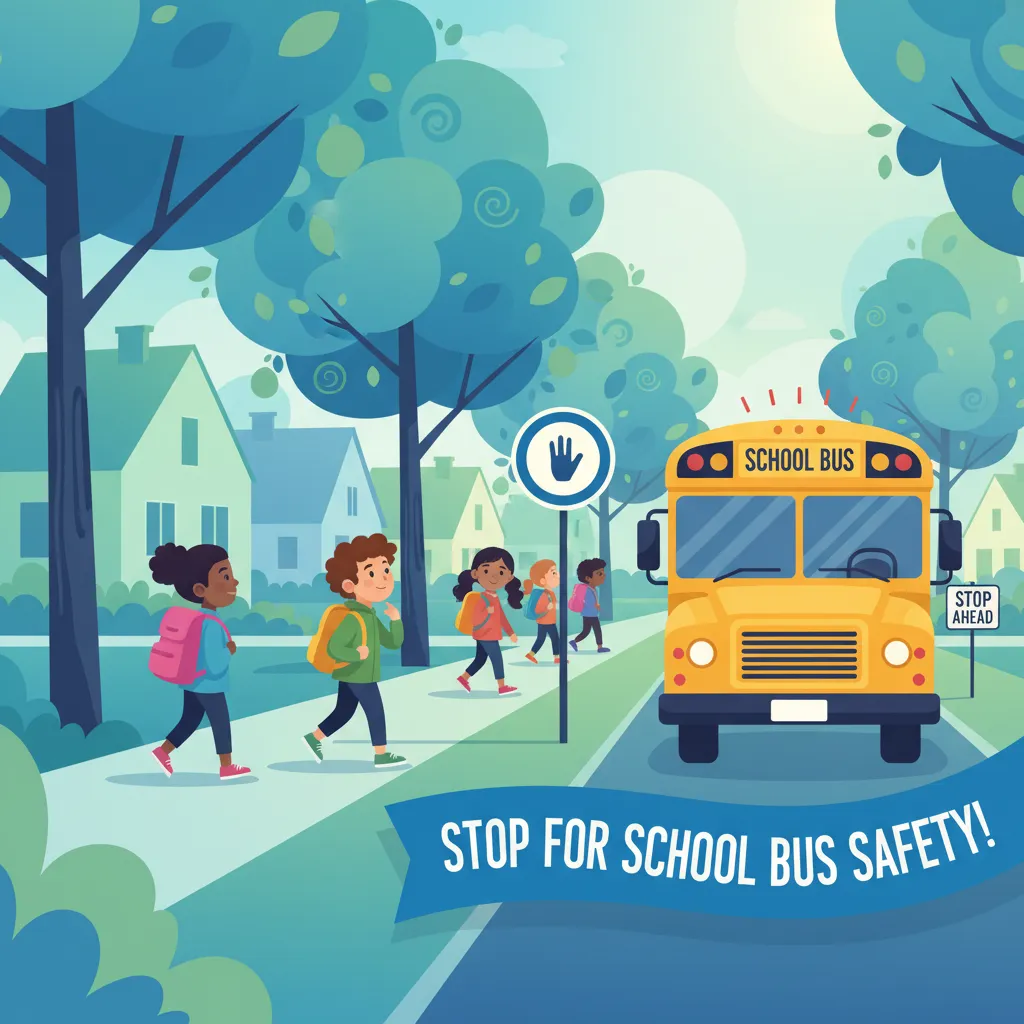
As you progress through your Swedish Driving License Theory Course for Category B Cars, one of the most vital areas of study involves understanding how to interact safely with school buses and children. Children, due to their unpredictable nature and developing risk perception, are among the most vulnerable road users. This lesson will equip you with the knowledge to identify specific traffic signs, understand your legal obligations around school buses, and maintain the heightened vigilance required to prevent accidents involving young pedestrians. Mastering these rules is not just a legal requirement but a fundamental responsibility for every safe driver.
Children are unique road users. Their developing brains mean they often have a longer reaction time, lower visual acuity, and a tendency to act impulsively without fully grasping the dangers of traffic. They might dart into the road unexpectedly, misjudge the speed of an approaching vehicle, or be distracted by friends or toys. These factors make them particularly susceptible to serious injuries or fatalities in collisions.
The Swedish traffic laws, specifically the Trafikförordning (Traffic Ordinance) and Vägtrafiklag (Road Traffic Act), reflect a fundamental "safety-first" intent when it comes to children. They establish clear, enforceable duties for drivers to create a predictable "protected zone" around school buses and in school areas. Adhering to these rules is crucial for minimizing the risk of accidents and ensuring the safety of our youngest road users.
Recognizing specific traffic signs is the first step towards safe driving around schools and school buses. These signs provide critical warnings and inform you of special rules that apply to the area ahead.
The school zone sign, known in Sweden as "Skolområde," marks an area where children are likely to be present and specific speed restrictions apply.
This sign is a clear indicator that you are entering an area where you must exercise extreme caution. It typically indicates a permanent school zone, meaning the rules apply year-round. Sometimes, you might encounter a similar sign with additional information, such as a yellow plate or specific hours, indicating a temporary school zone that is active only during certain times (e.g., school hours or for special events). Regardless of its permanence, the practical meaning is the same: you must not exceed the indicated speed limit and be prepared to stop for children at any moment.
The school bus warning sign alerts drivers to areas where a school bus might be stopping to pick up or drop off children.
This sign serves as a proactive warning. When you see this sign, it means you should anticipate a school bus either stopped or about to stop ahead. Your immediate response should be to reduce speed and prepare to halt at a safe distance. This sign is universally applied to school bus stopping areas and signals the potential for the critical stop-and-yield rule to come into effect.
The most stringent rules concerning school buses involve the mandatory stop-and-yield protocol. These rules are designed to create a safe zone for children as they board or alight the bus, protecting them from passing traffic.
The obligation for other drivers to stop is triggered by a very specific combination of signals from the school bus. You must stop when a school bus displays flashing amber lights AND its stop sign (or stop arm) is extended. Both signals must be active for the stop-and-yield rule to apply.
The flashing amber lights alone are not enough to mandate a stop. It is the combination with the extended stop arm that creates the legally protected zone. This rule applies to all traffic on the same roadway segment, in both directions, unless a physical median or barrier clearly separates the lanes of traffic. Drivers sometimes mistakenly ignore the flashing lights if no children are immediately visible; however, the law requires stopping regardless of visual confirmation of children.
When a school bus has stopped and activated its stop signals, it is not enough to simply stop. You must also maintain a specific distance from the bus. A minimum protective distance of 5 metres (approximately 16 feet) must be maintained between your vehicle and the rear of a stopped school bus.
This legal buffer is crucial. It ensures there is ample space for children to exit the bus safely and for drivers to react if a child runs into traffic unexpectedly. Stopping too close not only endangers children but is also a violation of traffic regulations, potentially leading to fines for unsafe following distance. Always err on the side of caution and give the bus, and the children around it, plenty of space.
One of the most critical prohibitions is against overtaking a stopped school bus that has its stop sign extended and amber lights flashing. This rule applies universally to traffic on the same road segment.
Overtaking a stopped school bus can have catastrophic consequences. Children often exit the bus and immediately cross the road, sometimes without looking, assuming traffic will stop. An overtaking vehicle is directly entering this dangerous zone.
You must remain stopped behind the bus until all its signals are withdrawn (the stop arm is retracted, and the amber lights stop flashing). Only then may you proceed cautiously, continuing to scan for any children who may still be in the vicinity.
Beyond the specific rules for stopped school buses, general driving behavior in areas where children are present is equally important. This primarily concerns speed limits and maintaining a heightened sense of awareness.
Within any designated school zone, clearly marked by the "Skolområde" sign, the maximum speed limit is typically 30 km/h (approximately 18 mph), unless a lower limit is explicitly posted. This reduced speed limit is a fundamental safety measure.
Reducing your speed dramatically shortens your vehicle's stopping distance and significantly reduces the impact severity in the event of a collision. At 30 km/h, a typical car requires approximately 12 metres to stop (including a 1.5-second reaction time). Reducing that speed to 20 km/h cuts the stopping distance to about 7 metres, a vital difference in an environment with unpredictable children.
It is mandatory to reduce your speed to the posted limit before entering the school zone and maintain it throughout the entire area. Using your speedometer diligently and avoiding distractions that could lead to speeding are essential. Traffic authorities often deploy speed cameras or increase police patrols in these zones, particularly during peak school hours, to enforce these vital speed restrictions.
Children are categorised as vulnerable road users for compelling reasons. Their risk profile includes:
Psychological studies show that children under 12 often have an average "gap acceptance" of 2-3 metres when crossing a road, which is far less than an adult pedestrian. This means they are likely to step into smaller gaps in traffic that an adult would consider unsafe.
As a driver, this means you must:
Heightened vigilance isn't just a recommendation; it's a critical strategy to compensate for children's inherent vulnerability and unpredictable behaviour.
Swedish traffic laws are very clear regarding the responsibilities of drivers around school buses and children. Violations can lead to significant penalties, reflecting the severity of the potential harm.
The core legal obligations are enshrined in:
Failure to comply with these regulations is considered a traffic offence. The legal system places a high degree of responsibility on drivers to protect children.
Even experienced drivers can make mistakes when navigating school zones or encountering school buses. Being aware of these common violations can help you avoid them:
Understanding and actively avoiding these common errors is key to safe driving and avoiding legal repercussions such as fines and penalty points.
Safe driving around school buses and children requires adaptability. Different conditions and road types can influence how you apply the fundamental rules.
Weather conditions significantly impact driving safety, especially around vulnerable road users.
The road configuration plays a crucial role in determining whether opposing traffic must stop for a school bus.
Your vehicle's condition and the presence of other vulnerable users also demand consideration.
Let's illustrate these rules with practical examples to solidify your understanding.
The emphasis on school bus and child safety is firmly rooted in understanding human behavior and accident statistics:
These insights reinforce that strict adherence to school bus and school zone regulations is not merely bureaucratic but is a scientifically and statistically proven method to save lives and prevent injuries.
Lesson content overview
Explore all units and lessons included in this driving theory course.
Explore search topics learners often look for when studying School Buses and Children. These topics reflect common questions about road rules, driving situations, safety guidance, and lesson level theory preparation for learners in Sweden.
Browse additional driving theory lessons that cover connected traffic rules, road signs, and common driving situations related to this topic. Improve your understanding of how different rules interact across everyday traffic scenarios.
Understand the specific Swedish traffic regulations concerning school buses and the presence of children. Learn about required precautions, signs, and your duty to yield to ensure the safety of vulnerable road users. Essential theory for Category B exam.
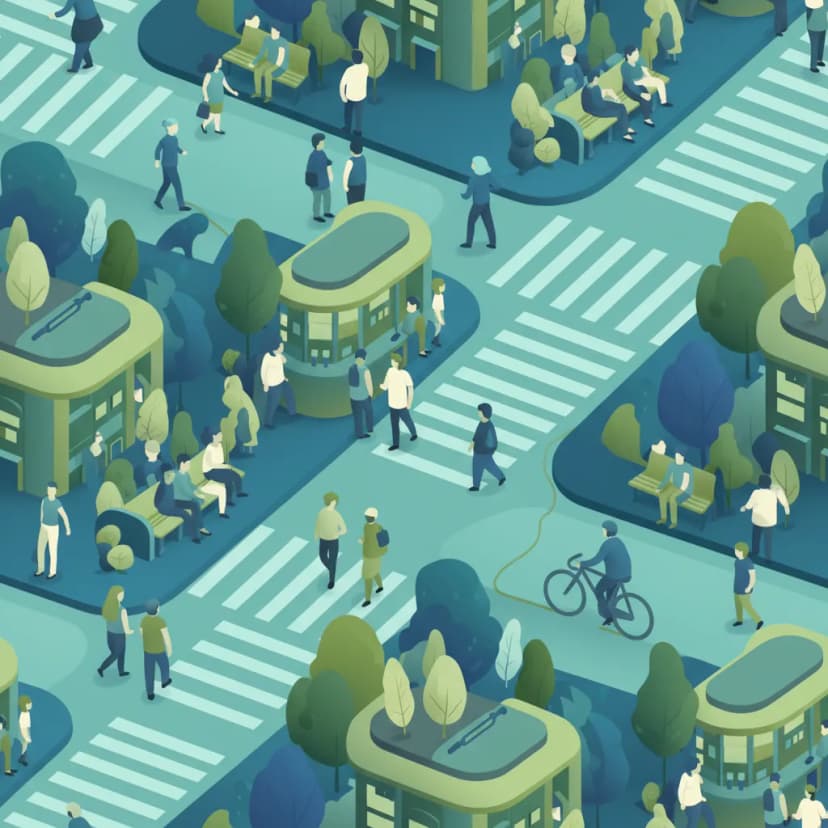
This lesson details a driver's responsibility towards pedestrians. You will learn the strict rule of yielding to pedestrians who are on or about to enter a marked, uncontrolled crosswalk. The content also covers the specific, highly restrictive rules for driving in designated pedestrian zones (gågata) and 'walking speed' areas (gångfartsområde), where pedestrians have complete priority and vehicle traffic is severely limited.
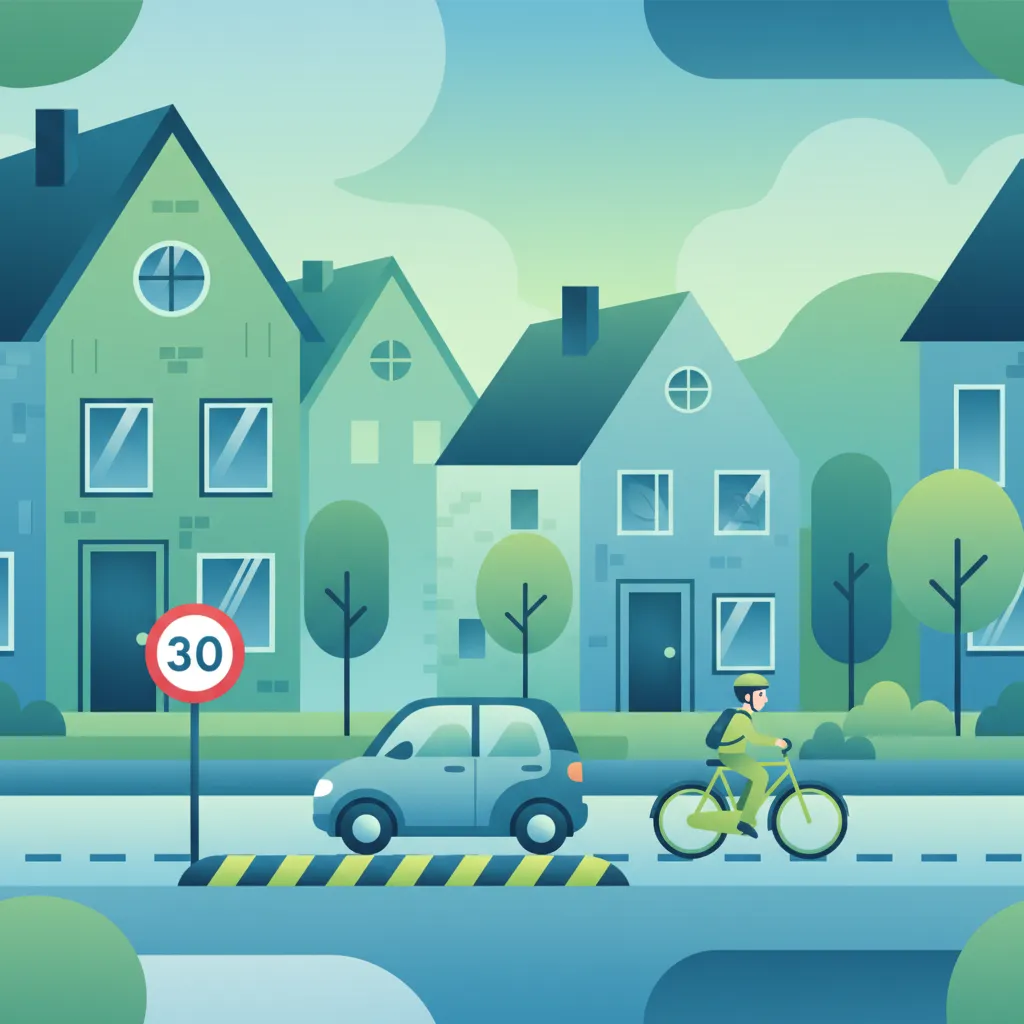
This lesson focuses on the high level of caution required when driving in residential areas. You will learn about the rules for special zones like 'gångfartsområde' (walking speed area) and the need to navigate around speed calming measures like speed bumps. The central theme is anticipating unpredictable behavior from residents, especially children, and managing the risks posed by parked cars that severely limit visibility.
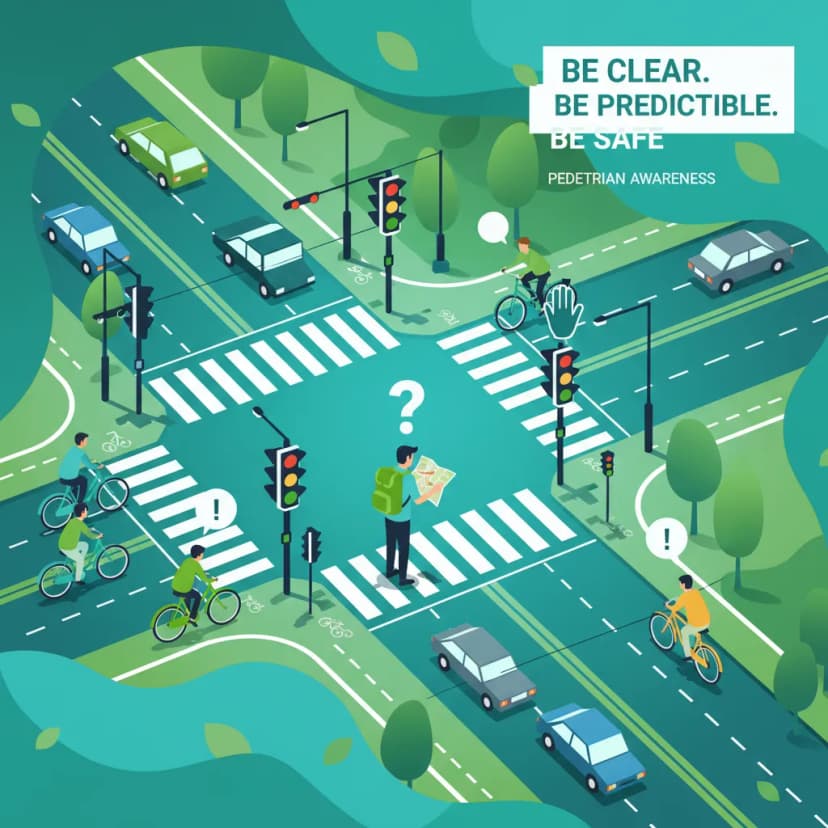
This lesson is dedicated to pedestrian safety, teaching riders to be constantly aware of people on foot, especially in busy urban environments. It reinforces the absolute duty to yield at marked crossings and encourages a cautious approach in areas like schools and shopping districts. The content stresses anticipating unpredictable actions, particularly from children or distracted pedestrians.
This lesson focuses on the unique challenges of driving in urban environments. You will learn techniques for anticipating the actions of vulnerable road users like pedestrians and cyclists, especially near crossings and bus stops. The content covers how to navigate narrow streets, one-way systems, and areas with heavy traffic, emphasizing the need for lower speeds, heightened awareness, and a defensive mindset.
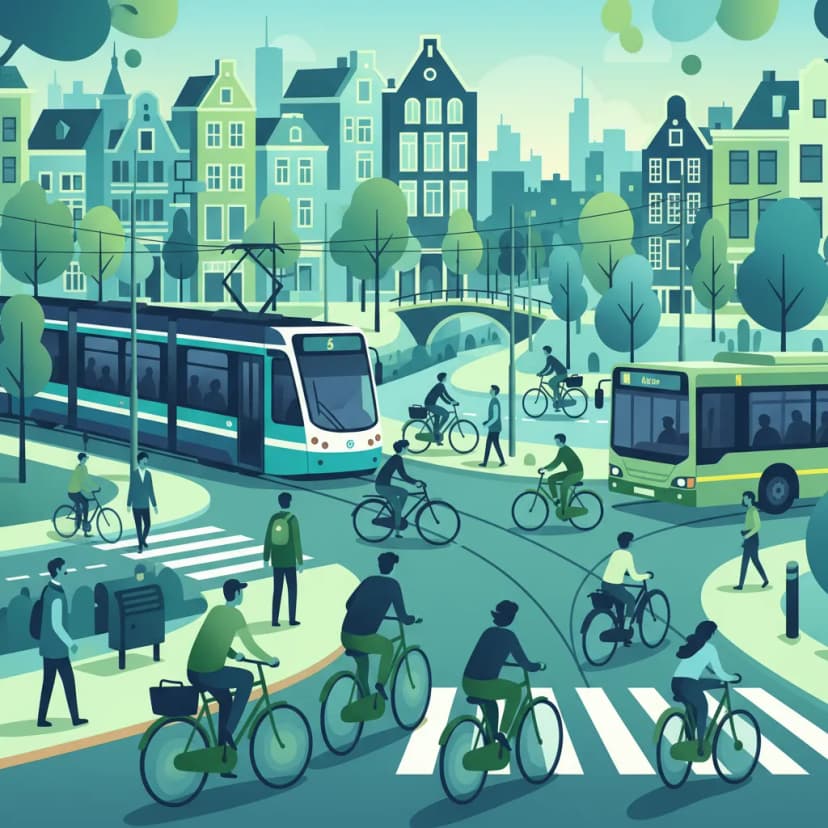
This lesson explains the specific traffic rules related to public transport vehicles. You will learn about your duty to yield to buses signaling to leave a stop (on roads with a speed limit of 50 km/h or less) and the fact that trams generally have priority. The lesson covers how to safely pass stopped buses and trams, being mindful of disembarking passengers who may cross the road unexpectedly.
This lesson addresses the unique hazards associated with public transportation. It explains how to safely navigate around buses that are stopping to pick up or drop off passengers and the importance of watching for pedestrians. It also covers the physical danger of slippery tram tracks, especially when wet, and reiterates that trams typically have absolute priority.
This lesson focuses on the specific activity of stopping for the purpose of passenger embarkation/disembarkation or loading/unloading goods. You will learn that this is often permissible in areas marked with a 'no parking' sign, as long as the stop is brief and continuous. The lesson distinguishes this from a 'no stopping' zone, where any voluntary stop is prohibited, ensuring you understand the nuanced difference.
This lesson covers the general, nationwide rules that govern where you may and may not park or stop, even without specific signs. You will learn about the prohibitions on stopping near intersections, on pedestrian crossings, and at bus stops. The content clarifies the legal definitions and provides clear guidelines on maintaining safe distances and ensuring that your parked vehicle does not obstruct traffic or create a hazard.
This lesson clarifies the legal distinction between stopping temporarily and parking. It identifies areas where stopping is prohibited, such as near intersections or on pedestrian crossings, to maintain traffic flow and safety. The content also discusses designated waiting areas at traffic lights, often marked for cyclists and mopeds, which can offer a safer position.
This lesson details the specific priority rules at pedestrian and tram crossings (Spårvagnskorsning). It reinforces the legal obligation for moped riders to stop for pedestrians at marked zebra crossings and explains that trams almost always have priority. Learners will understand the importance of approaching these crossings with caution, scanning for hazards, and being prepared to stop.
Gain essential knowledge on interacting with vulnerable road users like children, pedestrians, and cyclists in Sweden. This lesson focuses on driver responsibility, speed adaptation, and anticipating unpredictable behaviour in various traffic environments.
This lesson focuses on the unique challenges of driving in urban environments. You will learn techniques for anticipating the actions of vulnerable road users like pedestrians and cyclists, especially near crossings and bus stops. The content covers how to navigate narrow streets, one-way systems, and areas with heavy traffic, emphasizing the need for lower speeds, heightened awareness, and a defensive mindset.
This lesson focuses on the high level of caution required when driving in residential areas. You will learn about the rules for special zones like 'gångfartsområde' (walking speed area) and the need to navigate around speed calming measures like speed bumps. The central theme is anticipating unpredictable behavior from residents, especially children, and managing the risks posed by parked cars that severely limit visibility.
This lesson details a driver's responsibility towards pedestrians. You will learn the strict rule of yielding to pedestrians who are on or about to enter a marked, uncontrolled crosswalk. The content also covers the specific, highly restrictive rules for driving in designated pedestrian zones (gågata) and 'walking speed' areas (gångfartsområde), where pedestrians have complete priority and vehicle traffic is severely limited.
This lesson provides in-depth analysis of how to safely interact with the full spectrum of road users. You will learn about the specific characteristics of each, such as the large blind spots of trucks, the potential for sudden movements from cyclists, and the unpredictability of pedestrians. The content teaches strategies for communication, anticipation, and defensive positioning to ensure safe and respectful coexistence on the road for everyone.
This lesson provides detailed guidance on navigating complex traffic points such as signalized intersections, multi-lane roundabouts, and pedestrian crossings. You will learn the correct procedures for entering and exiting roundabouts, the specific rules for yielding to pedestrians and cyclists at designated crossings, and how to interpret complex traffic light signals. These skills are vital for safe urban and suburban riding, where interaction with vulnerable road users is frequent.
This lesson is dedicated to pedestrian safety, teaching riders to be constantly aware of people on foot, especially in busy urban environments. It reinforces the absolute duty to yield at marked crossings and encourages a cautious approach in areas like schools and shopping districts. The content stresses anticipating unpredictable actions, particularly from children or distracted pedestrians.
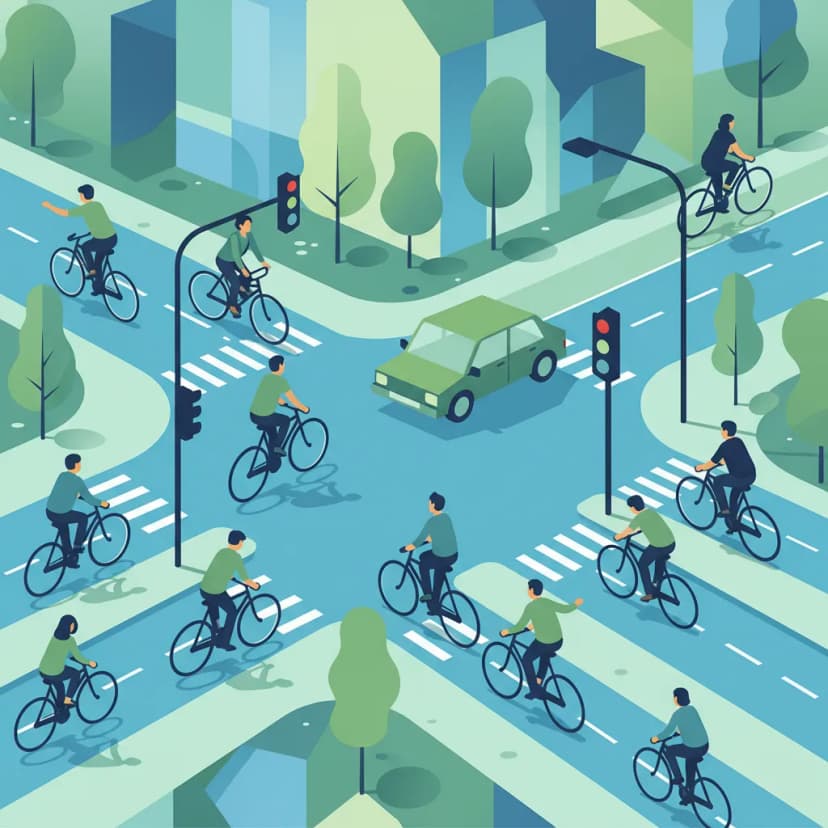
This lesson focuses on safe interaction with cyclists. You will learn to differentiate between a 'bicycle crossing' (cykelöverfart), where you have a duty to yield, and a 'bicycle passage' (cykelpassage), where specific priority rules apply. The content stresses the importance of leaving adequate space when overtaking cyclists and the critical danger of the 'right-hook' accident, emphasizing the need to check mirrors and blind spots carefully before turning right.
This lesson teaches you how to analyze and assess risk when sharing the road with a variety of users, from large trucks to cyclists and pedestrians. You will learn to recognize common patterns of behavior and potential conflict points, allowing you to anticipate the actions of others before they create a dangerous situation. Developing this predictive mindset is a cornerstone of defensive riding and is key to staying safe in busy, complex traffic environments.
This lesson focuses on the specific techniques required for riding in busy city and town environments. You will learn how to maintain correct lane positioning amidst dense traffic, navigate complex intersections with multiple signals, and manage the motorcycle at low speeds in stop-and-go conditions. Emphasis is placed on heightened awareness of pedestrians, cyclists, and vehicles making sudden maneuvers, which are common hazards in urban settings.
This lesson teaches the crucial skill of adapting your speed to the dynamic and often congested conditions of urban riding. You will learn to modulate your speed smoothly in response to traffic flow, pedestrian activity, and complex intersections to maintain safety and control. Techniques covered include using engine braking effectively, anticipating the actions of other road users, and selecting a speed that maximizes your reaction time in a high-density environment.
Find clear answers to common questions learners have about School Buses and Children. Learn how the lesson is structured, which driving theory objectives it supports, and how it fits into the overall learning path of units and curriculum progression in Sweden. These explanations help you understand key concepts, lesson flow, and exam focused study goals.
When a school bus displays its warning lights and stops, you must slow down and be prepared to stop to let passengers cross. You should always maintain a very low speed and be ready to stop immediately. Never overtake a stopped school bus with its lights flashing.
Look for the warning sign 'Skolväg' (School route) which depicts children walking. This sign indicates an area where children are likely to be present, often near schools or pedestrian paths. You must exercise extreme caution and reduce your speed in these areas.
While specific speed limits for school zones are often marked, the general rule is to adapt your speed to the circumstances. The presence of children requires a significant reduction in speed, below the general speed limit, to ensure you can react safely to unexpected movements. Always be prepared to stop.
Swedish regulations are strict. You must stop if the school bus is stopped and flashing its lights, regardless of which side of the road it is on. Children may attempt to cross the road unexpectedly, so stopping is crucial for their safety.
The Swedish theory test for Category B includes questions about interactions with vulnerable road users, including children and school buses. You will be tested on your knowledge of the relevant signs, your obligation to slow down or stop, and the general principles of protecting children on or near the road.