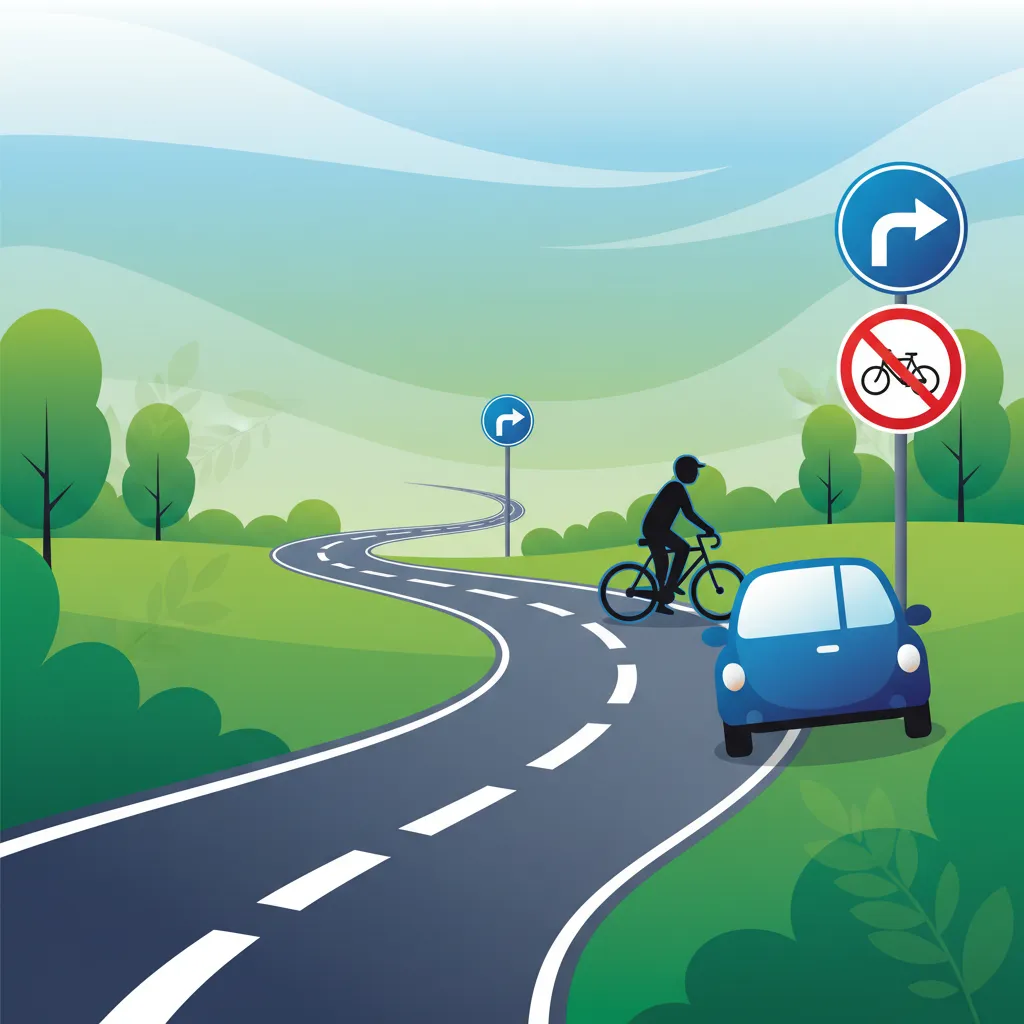
Welcome to the lesson on Swedish Regulatory Signs, covering Vägförbud (prohibitory) and Påbud (mandatory) signs. These signs dictate legally enforceable rules, forming a critical part of the Swedish driving theory test for Category B. Understanding and obeying them is essential for safe and compliant driving on Swedish roads.
Welcome to this comprehensive lesson on Swedish regulatory signs, a fundamental component of the Swedish Driving License Theory Course for Category B Cars. Understanding these signs is not merely about memorizing symbols; it's about grasping the legal framework and practical implications that govern every road user's behavior. Regulatory signs, known as vägförbud och påbud in Swedish, are legally binding commands that dictate what actions are prohibited (förbudsmärken) and what actions are mandatory (påbudsmärken). Mastering their interpretation is crucial for passing your theory test, ensuring safety on the roads, and avoiding traffic violations.
Swedish traffic signs are designed to communicate essential information quickly and unambiguously. Among these, regulatory signs hold the highest authority, directly translating legal requirements from the Trafikförordning (Traffic Ordinance) into visual commands. They are the backbone of orderly and safe traffic flow.
Regulatory signs serve as the rule-making instruments within the Swedish traffic system. They are distinct from warning signs or information signs because they enforce specific actions or restrictions that all road users must obey. Failure to comply with a regulatory sign is considered a direct violation of Swedish traffic law, carrying immediate legal consequences.
The importance of regulatory signs cannot be overstated. They are paramount for:
To fully understand and comply with regulatory signs, it's important to recognize the core principles upon which they are based:
Any regulatory sign imposes a duty or prohibition that must be obeyed under the Swedish Traffic Ordinance.
This principle ensures uniform behavior among all drivers, which is vital for traffic safety and enables effective enforcement by authorities. Drivers must adjust their speed, trajectory, or vehicle usage accordingly, as violations incur penalties.
Regulatory signs are designed with standardized shapes, colors, and symbols to be recognizable at typical approach speeds and varying environmental conditions.
This design standard reduces the time it takes for a driver to interpret a sign, minimizing the risk of misinterpretation. Ensuring timely compliance is key; failure to notice a sign due to inattention may be deemed negligent.
Regulatory signs generally outrank advisory or informational signs. When conflicting situations arise, the prohibitory or mandatory command conveyed by a regulatory sign always prevails.
This principle prevents ambiguity in complex traffic environments, directing drivers to prioritize legally binding commands over optional guidance or less critical information.
The practical effect of a regulatory sign can vary based on road type, weather conditions, time of day, or the class of vehicle.
This aligns the stringency of the rule with situational risk, meaning drivers must apply conditional logic. For example, a speed limit might differ for heavy vehicles or at specific times.
Swedish regulatory signs are primarily categorized into two main families: Förbudsmärken (prohibitory signs) and Påbudsmärken (mandatory signs).
Each category follows distinct visual conventions, simplifying learning and recognition. Förbudsmärken typically feature a red circle, while Påbudsmärken are blue and circular.
Prohibitory signs, known as förbudsmärken in Swedish, are easily recognized by their distinct design: a red circle with a white or yellow background and a black symbol, often with a diagonal line through it. These signs explicitly indicate an action that must not be performed.
When you encounter a förbudsmärke, it means the depicted action is strictly forbidden from that point forward, until another sign indicates otherwise or the road conditions change (e.g., entering an intersection where the rule is reset). Compliance is required immediately, regardless of your intention or perceived safety.
Speed limit signs are among the most common prohibitory signs and are critical for maintaining road safety.
This sign sets a legally binding maximum speed. Driving above the indicated speed is a violation.
When you see an "end of speed limit" sign, it does not mean you can accelerate indefinitely. Instead, you must adhere to the default speed limit for that specific road type (e.g., 50 km/h in urban areas, 70 km/h on most rural roads, or higher on motorways if indicated). Always be aware of the default speed limits.
These signs regulate which types of vehicles can access certain roads or areas. They are crucial for protecting vulnerable road users, maintaining infrastructure integrity, and managing traffic flow.
This means no vehicle, regardless of size or type, may pass this point in the direction of the sign.
This sign is typically seen from the side of a one-way street where entry is forbidden, often paired with a "One-way street" sign from the allowed direction.
Other signs may restrict access based on a vehicle's actual weight, height, or width, often with a numerical value inside the red circle or on a supplementary plate. For instance, a sign with "4.0 m" inside a red circle with an arrow pointing up and down indicates a maximum height. Ignoring these can lead to serious accidents and infrastructure damage.
Overtaking restrictions are vital for preventing head-on collisions, especially on roads with limited visibility or increased hazards.
This sign means you must not pull out to pass another vehicle. It applies even if you perceive the situation as safe, as the sign indicates a known hazard.
Upon seeing this sign, overtaking is generally permitted again, provided it is safe, legal, and in accordance with general overtaking rules.
These signs control where and for how long vehicles can stop or park, crucial for maintaining traffic flow and emergency access.
This sign means you cannot park your vehicle, even for a short period. However, you can stop briefly to pick up or drop off passengers or load/unload goods, as long as you do not obstruct traffic and the stop is not longer than necessary.
This is a more stringent restriction, meaning you cannot stop your vehicle for any reason, except in an emergency or when required by traffic.
Some prohibitory signs address specific local conditions or environmental concerns. Examples include signs for low-emission zones (Miljözoner) where certain vehicle types (e.g., older diesels) may be banned. Other specific prohibitions include "no U-turn" or "no horns at night."
Mandatory signs, known as påbudsmärken in Swedish, are characterized by their blue circular shape with white symbols. These signs indicate an action that drivers must perform or a specific instruction they must follow.
When you see a påbudsmärke, it means you are legally required to perform the action depicted. This obligation takes effect immediately upon reaching the sign and continues until another sign or intersection alters the instruction.
These signs are critical for guiding traffic through intersections, roundabouts, and multi-lane roads, ensuring smooth and safe maneuvers.
These direction signs are common before intersections or at turns, obliging all traffic in the lane to follow the arrow.
This sign mandates circulating clockwise around the central island of a roundabout.
Lane-use signs often combine an arrow with a specific lane. For example, a blue circle with a left-pointing arrow over a lane symbol might mean "use the left lane only" for an upcoming turn. These are frequently reinforced by road markings.
While most signs regulate maximum speed, some roads, particularly motorways or tunnels, may have a minimum speed requirement.
This sign mandates that you must not drive below the indicated speed. The purpose is to maintain traffic flow and prevent slow-moving vehicles from creating hazards, especially on high-speed roads like motorways.
Some mandatory signs specify paths or areas reserved for certain users, often to protect vulnerable road users.
Drivers must respect these lanes and not enter them, even to pass or stop.
Effective sign interpretation involves systematically decoding all visual cues to make accurate and timely driving decisions.
The primary symbol within a sign's center conveys its core meaning (e.g., a number for speed, a vehicle silhouette for restrictions, an arrow for direction).
Supplementary plates, or tilläggstavlor, are small signs placed below a main sign. They provide crucial additional information that modifies or clarifies the main sign's meaning.
Common information on supplementary plates includes:
Misreading a supplementary plate can lead directly to an illegal action, such as parking during prohibited hours or violating a vehicle-specific restriction.
The placement of a sign (e.g., before an intersection, at the beginning of a street) and accompanying road markings often reinforce or clarify the sign's meaning. For instance, a "no parking" sign might be accompanied by a yellow solid line on the curb. Drivers should always integrate these contextual clues into their decision-making.
Ignoring regulatory signs in Sweden has direct and serious legal consequences, reflecting their binding nature. These penalties are designed to deter violations and uphold road safety.
In cases of very severe violations, such as driving a grossly overweight vehicle across a restricted bridge, causing significant damage, or repeated serious infractions, additional measures may be taken. These can include vehicle impoundment (the vehicle being seized by authorities) or even court prosecution, especially if the incident causes injury or significant danger.
Regulatory signs operate within a dynamic environment. Drivers must apply conditional logic, meaning the practical implications of a sign can change based on various external factors.
Many regulatory signs include supplementary plates that specifically target heavy vehicles (e.g., trucks over 3.5 tonnes total weight) or vehicles with trailers. These can include:
Mandatory signs often protect vulnerable road users such as pedestrians and cyclists.
Understanding the cause-and-effect relationships tied to regulatory signs reinforces why compliance is crucial for safety and legal adherence.
| Situation | Correct Application | Effect | Violation | Consequence |
|---|---|---|---|---|
| Speed limit obeyed | Vehicle travels at or below the signed limit. | Adequate stopping distance, lower kinetic energy → reduced crash severity. | Speed exceeds limit | Increased stopping distance, higher crash risk, legal fine + penalty points. |
| Mandatory lane use | Vehicle stays in the designated lane. | Predictable traffic flow, reduced erratic lane changes. | Deviates from lane | Unexpected lane changes, higher collision probability, possible fine. |
| No overtaking respected | Driver remains in lane behind slower traffic. | Prevents head-on crashes on blind curves or restricted zones. | Overtakes in prohibited zone | Immediate head-on collision risk, legal sanction (fine, penalty points). |
| No parking area obeyed | Vehicle parks elsewhere. | Keeps traffic lanes clear, prevents obstruction. | Parks illegally | Traffic disruption, possible towing, fine. |
| Minimum speed maintained | Keeps pace with traffic on the motorway. | Avoids "slow vehicle" hazards, ensures smoother traffic flow. | Drops below minimum without valid cause | Causes rear-end collisions, potential fine. |
Let's explore some scenarios to solidify your understanding of regulatory signs in practice.
Setting: A residential street in an urban area during school hours, daylight, clear weather. Relevant Sign:
with a supplementary plate:
Correct Behavior: You are driving between 8:00 AM and 3:00 PM on a Tuesday. You must reduce your speed to a maximum of 30 km/h, even if the road feels clear and traffic is light. Incorrect Behavior: Maintaining 50 km/h (the default urban speed limit) because you see no children or other cars. Explanation: The sign legally imposes a lower speed limit during specific hours on weekdays to protect schoolchildren. Failure to comply endangers vulnerable users and will result in a fine and penalty points.
Setting: A multi-lane motorway, clear night, light traffic. Relevant Sign:
Correct Behavior: You must maintain a speed of at least 30 km/h. If traffic flow allows, you should drive at a speed appropriate for the maximum limit, but not below 30 km/h. Incorrect Behavior: Dropping your speed to 20 km/h because you are feeling tired or want to drive slowly to save fuel. Explanation: The minimum speed sign is a legal requirement to ensure consistent traffic flow and prevent slow vehicles from becoming hazards on a high-speed road. Driving below it without being impeded by traffic is a violation.
Setting: A two-lane country road with a sharp, blind right curve ahead, in foggy conditions. Relevant Sign:
Correct Behavior: You stay behind the slower vehicle in front of you and maintain a safe following distance, patiently waiting for the restriction to end and safe conditions to resume. Incorrect Behavior: Overtaking the slower vehicle on the inside of the curve, believing you can complete the maneuver quickly despite the fog. Explanation: The sign is placed precisely where sight distance is limited and overtaking is inherently dangerous. Ignoring it significantly increases the risk of a head-on collision, especially in adverse weather.
Setting: Approaching an old bridge over a river, marked with a height restriction. Relevant Sign:
Correct Behavior: If driving a van, you know its exact height is 2.4 meters. Since this is less than 2.5 meters, you proceed cautiously. If your vehicle were 2.6 meters high, you would take an alternative route. Incorrect Behavior: Attempting to drive a 2.6-meter-tall van under the bridge, assuming it might fit or not checking the exact dimensions. Explanation: Violating height restrictions can cause severe damage to infrastructure, render the bridge unsafe, and lead to heavy penalties for the driver, including repair costs.
Setting: A multi-lane motorway approaching a complex interchange, with specific lanes designated for different directions. Relevant Sign:
This sign is often placed above a specific lane.
Correct Behavior: You are in the rightmost lane and intend to take the exit to the right. You obey the sign by staying in this lane, which is designated for straight-ahead traffic or the right turn, and prepare for your maneuver. Incorrect Behavior: You want to go straight but are in a lane marked "Turn left only". You suddenly try to switch lanes at the last minute because you realize your mistake. Explanation: Mandatory lane-use signs organize traffic for complex maneuvers, reducing weaving and collision risk. Non-compliance creates dangerous situations and disrupts traffic flow.
The design and placement of regulatory signs are not arbitrary; they are based on extensive research in human factors, traffic engineering, and safety statistics.
The average human reaction time is about 1.5 seconds. At 80 km/h, a vehicle travels approximately 33 meters before a driver can even begin to respond to a perceived hazard or command. This understanding dictates that signs are placed with sufficient stopping sight distance as per the Swedish Road Design Manual, ensuring drivers have enough time to see, comprehend, and react safely.
Risk compensation is a phenomenon where drivers may subconsciously adjust their behavior based on perceived risk. For example, some drivers might feel safer on a road with a "no overtaking" sign and then take other risks, like accelerating too much. Education emphasizes continuous situational awareness – never assuming a sign makes the road completely safe, but rather that it defines specific legal and safe behaviors within that context.
Studies by Trafikverket (the Swedish Transport Administration) consistently show that well-placed and respected regulatory signs lead to a measurable reduction in collision rates. For instance, enforced speed limits can significantly lower the severity of crashes. Furthermore, the strategic placement of signs (e.g., placing an "80 km/h" sign before a "50 km/h" zone) creates a psychological anchor, helping drivers anticipate and adapt their speed, rather than being surprised by sudden changes.
This lesson has provided a thorough foundation in Swedish regulatory signs. To deepen your understanding and prepare for your Category B driving theory test, we recommend exploring related topics and practicing interpreting these signs in various contexts.
Lesson content overview
Explore all units and lessons included in this driving theory course.
Explore search topics learners often look for when studying Regulatory Signs (Vägförbud & Påbud). These topics reflect common questions about road rules, driving situations, safety guidance, and lesson level theory preparation for learners in Sweden.
Browse additional driving theory lessons that cover connected traffic rules, road signs, and common driving situations related to this topic. Improve your understanding of how different rules interact across everyday traffic scenarios.
Deepen your understanding of Swedish regulatory signs (Vägförbud & Påbud). Learn the specific meanings of prohibitory signs like speed limits and no-entry, alongside mandatory signs dictating direction and lane use, crucial for legal driving.
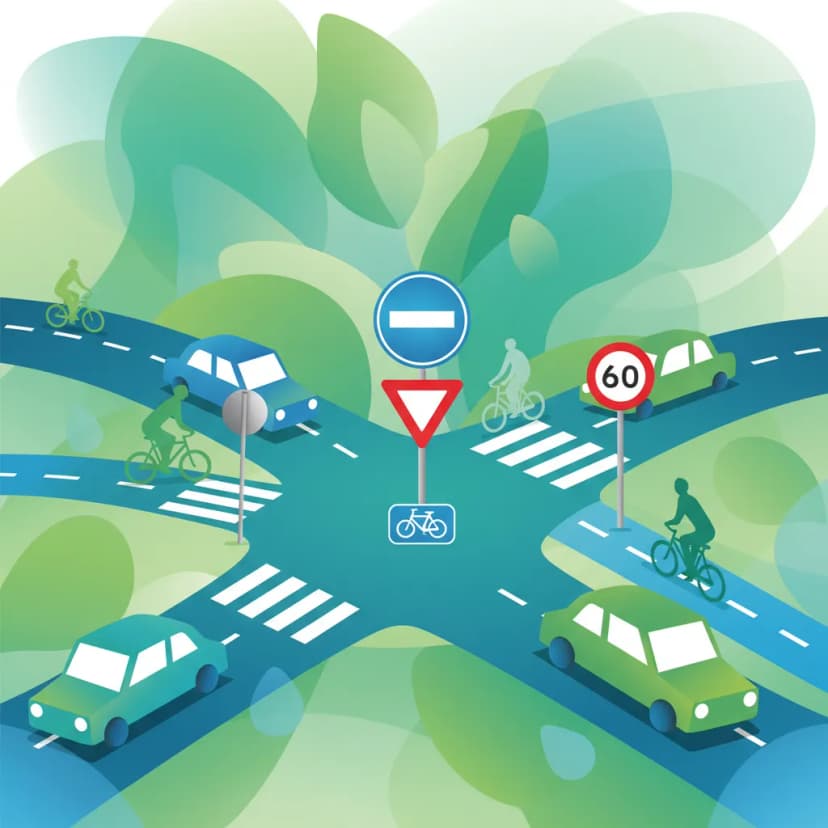
This lesson details the full range of Swedish regulatory signs, which dictate mandatory actions and prohibitions for all road users. You will learn to identify signs that establish speed limits, restrict access, prohibit overtaking, and define parking rules. Understanding these signs is critical for legal compliance and safe interaction with other traffic, as they form the basis of enforceable road law under the Trafikförordning regulations.
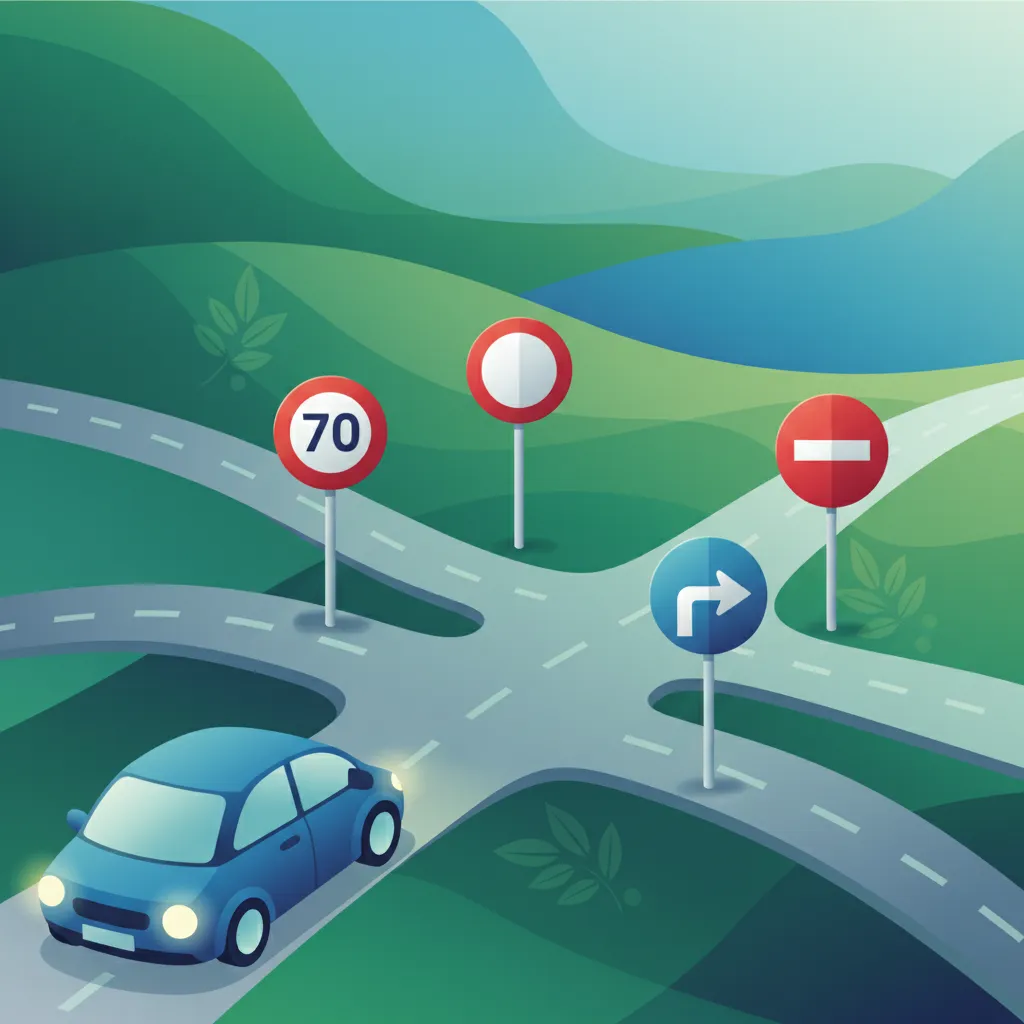
This lesson focuses on regulatory signs (Regulationsskyltar), which issue mandatory instructions and prohibitions that all road users must follow. It details common signs such as speed limits, stop and give way signs, and mandatory direction arrows. Special attention is given to signs directly affecting mopeds, like 'no moped' signs and those indicating designated moped lanes, ensuring riders can navigate legally and safely.
This lesson explains the function and legal significance of various road markings (vägmarkeringar) in Sweden. You will learn the difference between broken lines that permit overtaking and solid lines that forbid it, as well as the meaning of stop lines, pedestrian crossings, and lane direction arrows. These markings work in conjunction with signs to organize traffic flow, separate lanes, and provide critical information directly on the road surface.
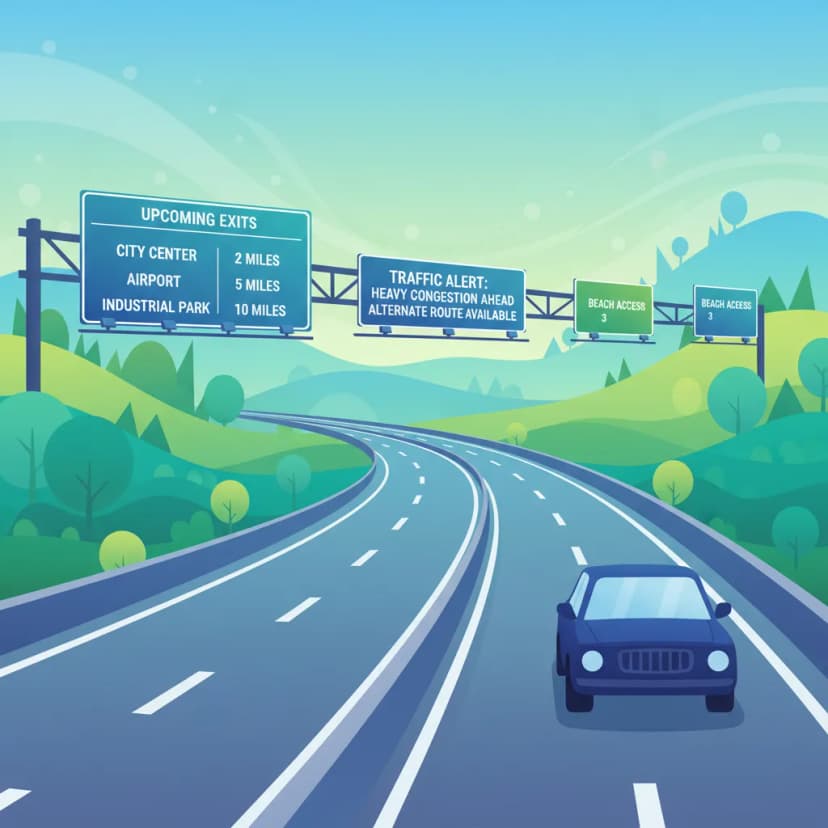
This lesson covers the extensive category of informational and directional signs that aid navigation throughout Sweden. You will learn to interpret signs for motorways, national roads, and local destinations, as well as symbols indicating services like gas stations, parking, and rest areas. Proper understanding of these signs allows for efficient route planning, reduces driver uncertainty, and contributes to smoother, safer traffic flow on all types of roads.

This lesson explains how to read and use Swedish informational and directional signs for effective route planning and navigation. You will learn to follow signs for specific destinations, identify road numbers, and recognize indicators for services such as fuel stations and rest areas. For motorcyclists on long journeys, this knowledge is crucial for making timely decisions about lane changes, exits, and stops without causing disruption to traffic flow.
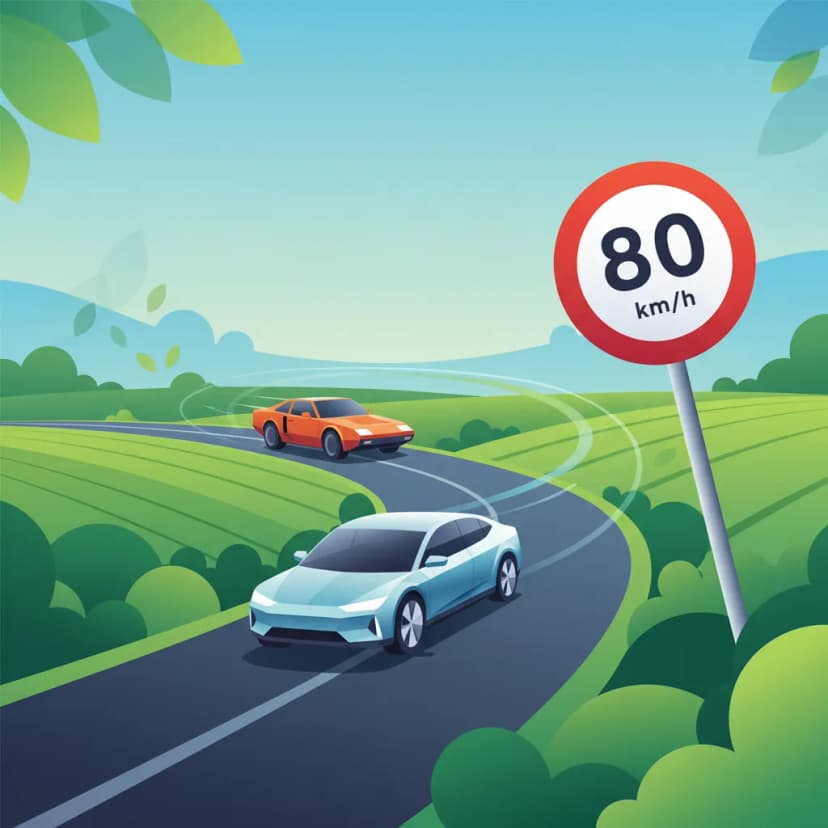
This lesson explains the hierarchical structure of speed limits in Sweden as defined by the Trafikförordning. It covers the default 'base speeds', including 50 km/h in built-up areas and 70 km/h outside them, and how these are modified by specific road signs. You will learn to identify speed limit signs for different road types, such as motorways and residential zones, and understand the legal framework that governs maximum permissible speeds.
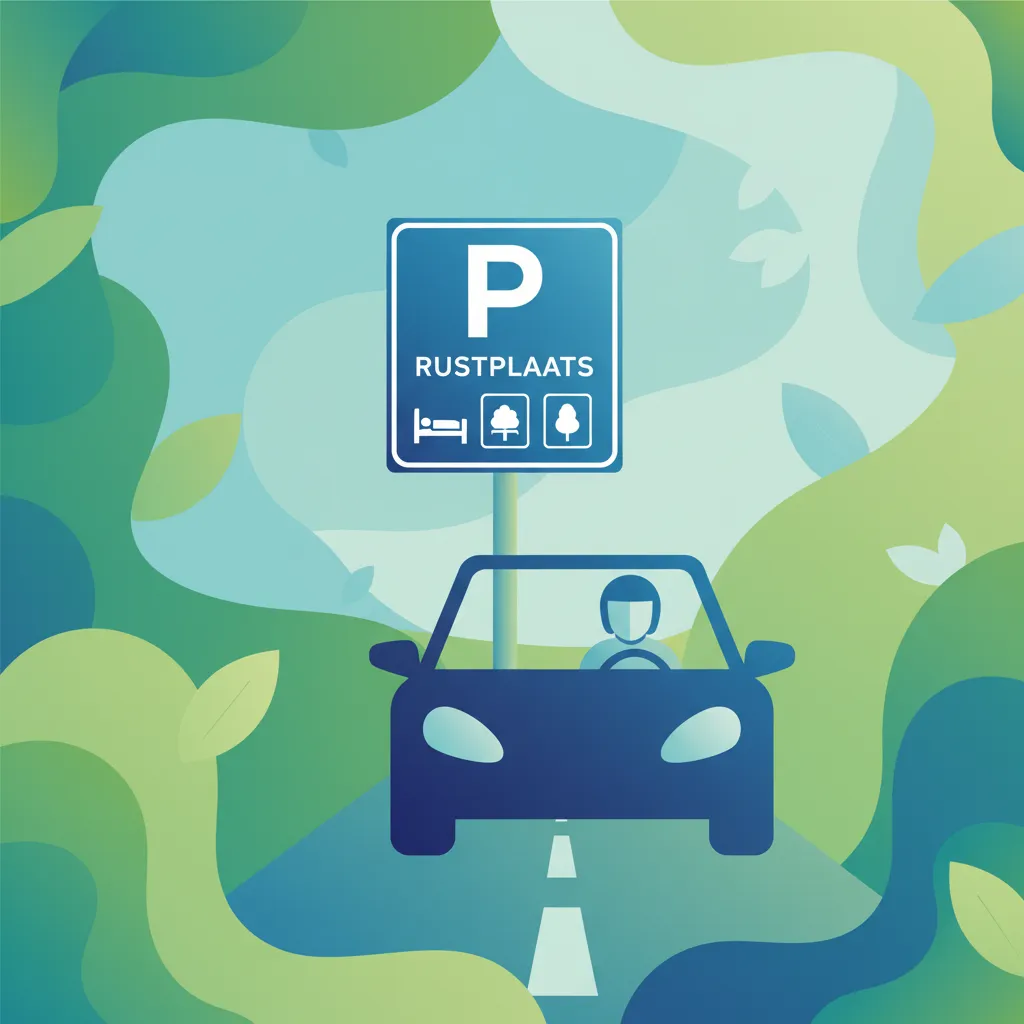
This lesson explains the function of informational signs (Informationsskyltar), which provide guidance for navigation and access to services. It covers signs indicating distances to destinations, route numbers, and locations of fuel stations or parking areas. For moped riders, this includes identifying signs for designated moped or cycle lanes, helping them to plan and follow routes efficiently and legally.
This lesson focuses on Swedish warning signs designed to alert drivers to potential dangers. You will study signs indicating sharp bends, slippery surfaces, animal crossings, and temporary hazards like road construction. Correctly interpreting these signs allows a motorcyclist to proactively adjust speed, lane position, and readiness to react, which is essential for maintaining control and safety, especially in adverse weather or on unfamiliar roads.
This lesson prepares riders for encountering roadworks, which can introduce temporary and often confusing changes to the road layout. It explains how to interpret the specific orange-colored signs used in these zones, including new speed limits, lane diversions, and warnings about surface hazards. The key takeaway is to reduce speed and increase vigilance when navigating through construction areas.

This lesson covers the essential topic of communication in traffic using the vehicle's built-in signaling devices. You will learn the rules for using your turn indicators (körriktningsvisare) in good time before turning or changing lanes. The content also explains the proper use of hazard lights (varningsblinkers) in emergency situations and the very limited, specific circumstances in which using the horn (ljudsignal) is permitted to avert immediate danger.
Explore how regulatory signs function within diverse Swedish traffic environments. Understand how prohibitory and mandatory signs directly influence driving behaviour in urban areas, on motorways, and at intersections, ensuring safe and lawful navigation.
This lesson details the full range of Swedish regulatory signs, which dictate mandatory actions and prohibitions for all road users. You will learn to identify signs that establish speed limits, restrict access, prohibit overtaking, and define parking rules. Understanding these signs is critical for legal compliance and safe interaction with other traffic, as they form the basis of enforceable road law under the Trafikförordning regulations.
This lesson covers the essential topic of communication in traffic using the vehicle's built-in signaling devices. You will learn the rules for using your turn indicators (körriktningsvisare) in good time before turning or changing lanes. The content also explains the proper use of hazard lights (varningsblinkers) in emergency situations and the very limited, specific circumstances in which using the horn (ljudsignal) is permitted to avert immediate danger.
This lesson focuses on regulatory signs (Regulationsskyltar), which issue mandatory instructions and prohibitions that all road users must follow. It details common signs such as speed limits, stop and give way signs, and mandatory direction arrows. Special attention is given to signs directly affecting mopeds, like 'no moped' signs and those indicating designated moped lanes, ensuring riders can navigate legally and safely.
This lesson focuses on Swedish warning signs (varningsmärken), designed to alert drivers to potential dangers ahead. You will study the meaning of triangular signs indicating hazards such as sharp bends, pedestrian crossings, risk of animals on the road, or temporary road work. The objective is to develop proactive driving habits by understanding how to anticipate risks and adapt speed and positioning appropriately when a warning sign is present.
This lesson focuses on the high level of caution required when driving in residential areas. You will learn about the rules for special zones like 'gångfartsområde' (walking speed area) and the need to navigate around speed calming measures like speed bumps. The central theme is anticipating unpredictable behavior from residents, especially children, and managing the risks posed by parked cars that severely limit visibility.
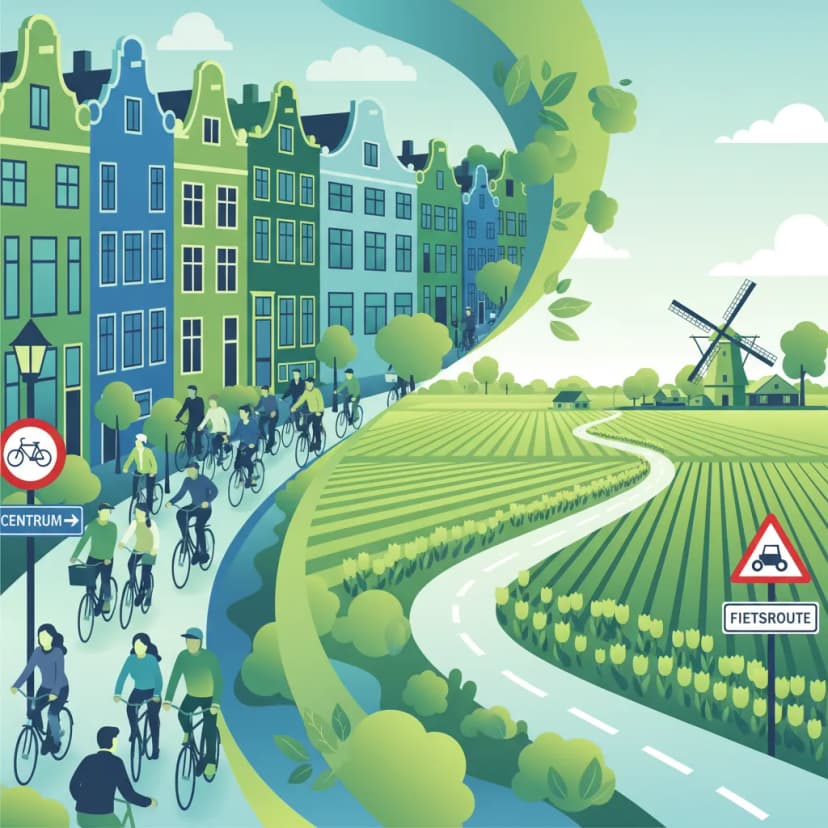
This lesson explores how the environment affects sign interpretation, contrasting the high density and visual complexity of urban settings with the sparser signage of rural areas. It teaches riders to manage visual clutter in cities and maintain focus over long distances on country roads. By understanding these contextual differences, riders can better anticipate rules and hazards regardless of their location.
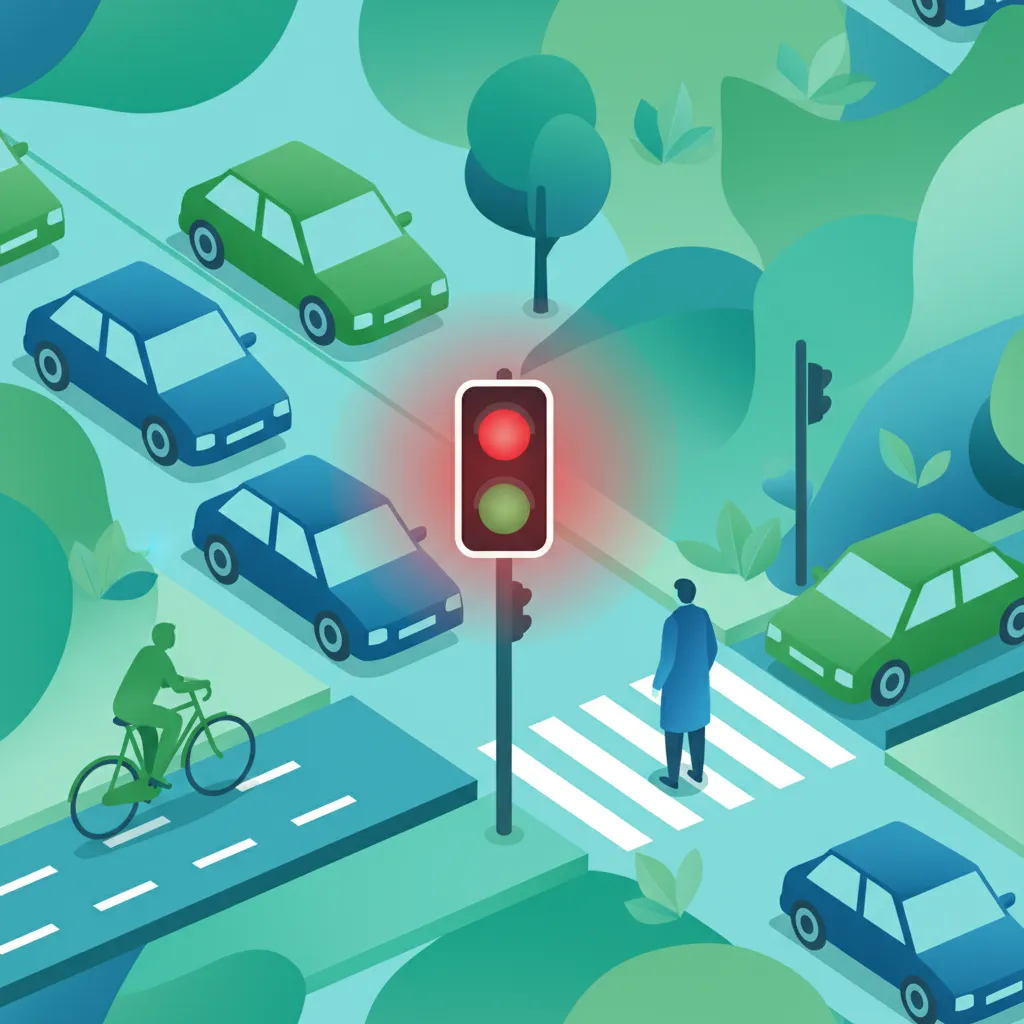
This lesson provides a detailed explanation of the Swedish traffic signal system. You will learn the precise legal meaning of solid red, yellow, and green lights, as well as green arrows which permit turning when oncoming traffic is stopped. It also covers procedures for flashing yellow signals and what to do when traffic lights are out of order, emphasizing that standard priority rules like the right-hand rule then apply.
This lesson covers the extensive category of informational and directional signs that aid navigation throughout Sweden. You will learn to interpret signs for motorways, national roads, and local destinations, as well as symbols indicating services like gas stations, parking, and rest areas. Proper understanding of these signs allows for efficient route planning, reduces driver uncertainty, and contributes to smoother, safer traffic flow on all types of roads.
This lesson focuses on Swedish warning signs designed to alert drivers to potential dangers. You will study signs indicating sharp bends, slippery surfaces, animal crossings, and temporary hazards like road construction. Correctly interpreting these signs allows a motorcyclist to proactively adjust speed, lane position, and readiness to react, which is essential for maintaining control and safety, especially in adverse weather or on unfamiliar roads.

This lesson focuses on the unique challenges of driving in urban environments. You will learn techniques for anticipating the actions of vulnerable road users like pedestrians and cyclists, especially near crossings and bus stops. The content covers how to navigate narrow streets, one-way systems, and areas with heavy traffic, emphasizing the need for lower speeds, heightened awareness, and a defensive mindset.
Find clear answers to common questions learners have about Regulatory Signs (Vägförbud & Påbud). Learn how the lesson is structured, which driving theory objectives it supports, and how it fits into the overall learning path of units and curriculum progression in Sweden. These explanations help you understand key concepts, lesson flow, and exam focused study goals.
Vägförbud signs restrict or forbid certain actions (e.g., no entry, speed limits, no overtaking). Påbud signs, on the other hand, require a specific action (e.g., turn left, pass on the right, follow the direction indicated). Both are legally binding and essential for safe driving in Sweden.
Swedish speed limit signs are regulatory signs (förbudsmärken). They are typically circular with a red border and a black number indicating the maximum permitted speed. You must adhere to this speed limit unless other signs indicate otherwise or conditions necessitate a lower speed.
Generally, mandatory direction signs must be followed. For example, if a sign indicates 'turn left only', you must turn left. Exceptions might arise in specific emergency situations or if directed by a police officer, but for everyday driving, these signs are absolute.
Ignoring a 'No Entry' sign is a serious traffic violation in Sweden. It usually indicates a one-way street where traffic is flowing in the opposite direction or an area closed to general traffic. Violating this can lead to fines, penalty points, and potentially dangerous situations.
The theory exam includes questions that require you to identify specific regulatory signs and understand their meaning in various traffic scenarios. You might be shown a sign and asked what it means, or presented with a situation where you need to decide how to act based on the regulatory signs present.