
Understanding how speed is monitored and the consequences of exceeding limits is crucial for safe motorcycle riding and passing your Swedish Category A theory exam. This lesson details the various enforcement technologies used in Sweden, such as speed cameras and police radar, and explains the legal framework and penalties, including fines (böter) and potential license suspensions. Master this topic to ensure you always ride legally and safely.
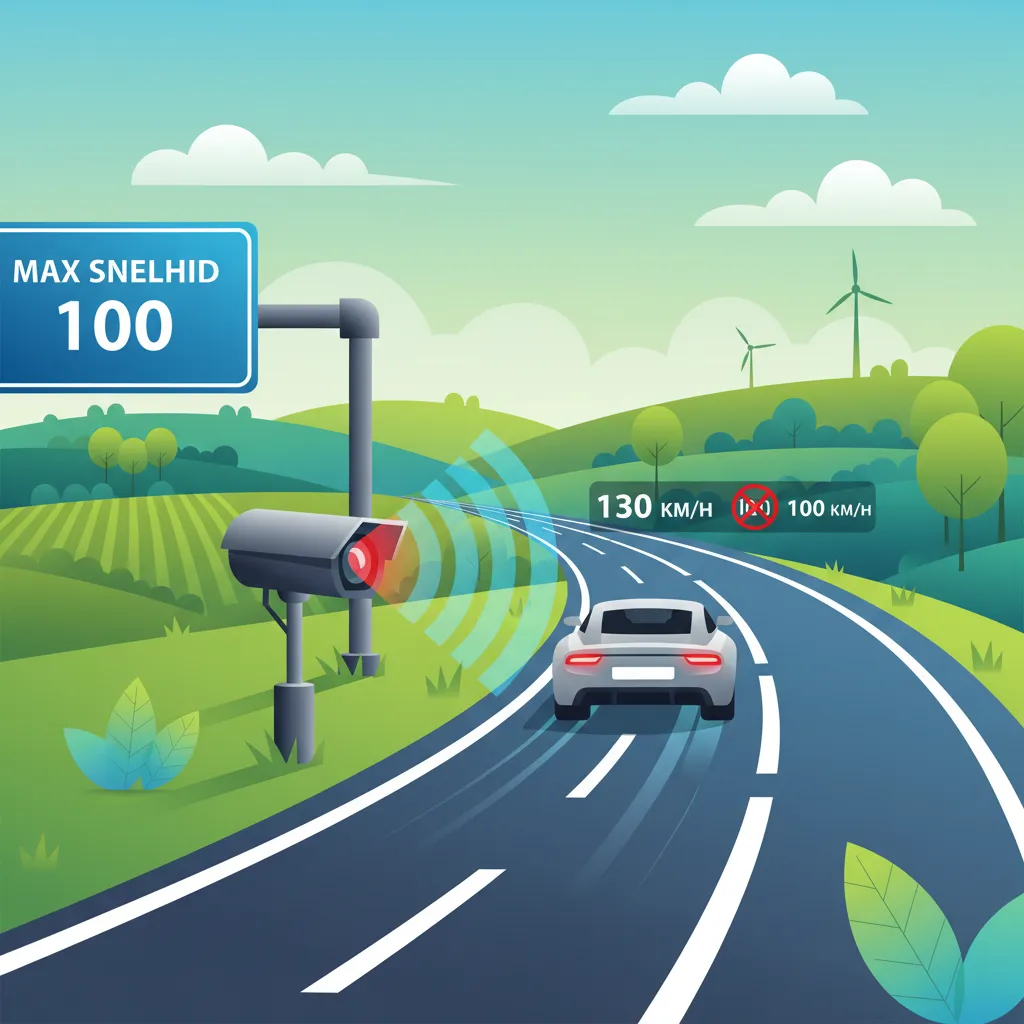
Navigating the roads safely and legally is paramount for every driver, and especially for motorcyclists. In Sweden, strict speed management and enforcement are cornerstone elements of road safety policy. This lesson, designed for the Swedish Category A motorcycle theory course, delves into the detailed mechanisms by which speed is monitored, the technologies employed for enforcement, and the comprehensive penalty system for violations. Understanding these aspects is crucial not only for passing your theory exam but also for ensuring your safety and legal compliance on every ride.
The core objective of speed monitoring and enforcement is to reduce accidents and mitigate their severity. Excessive speed dramatically reduces a driver's reaction time, significantly increases stopping distances, and amplifies the destructive forces in a collision. By creating a credible deterrent through visible monitoring and proportionate penalties, Swedish authorities aim to foster a culture of constant speed awareness and adherence to posted limits. This lesson will equip you with the knowledge to understand the legal and technical landscape of speed enforcement, helping you make informed decisions on the road.
Speed limits are fundamental to Swedish traffic law, serving as the legal ceiling for vehicle speeds on any given road segment. They are defined primarily by the Swedish Traffic Ordinance (Trafikförordningen) and are expressed in kilometres per hour (km/h). For motorcyclists, understanding and respecting these limits is non-negotiable.
A speed limit represents the maximum permissible speed – it is never a target speed. This means that while you must not exceed the limit, you are often expected to drive below it if conditions such as weather, traffic, or road layout demand a slower, safer speed.
Speed limits in Sweden fall into several categories:
For a detailed review of specific speed limits across different road types and zones in Sweden, please refer to Lesson 3.1: National Speed Limits and Zone-Specific Rules.
As a motorcyclist, your exposure to the environment means you must be particularly vigilant about speed limits. Your ability to react quickly and adapt to changing conditions is directly tied to your speed. Misunderstandings, such as assuming a "standard" speed applies everywhere or overlooking temporary reductions, can lead to dangerous situations and legal repercussions. Always prioritize reading road signage and interpreting any dynamic changes to ensure your speed remains appropriate and legal.
Speed monitoring in Sweden employs a combination of advanced technologies and traditional police methods to ensure compliance across the road network. These tools are designed to provide accurate, reliable evidence for enforcement, fostering a safer driving environment for all road users, including motorcyclists.
Fixed speed cameras, known as fasta hastighetsmätare, are permanently installed automated devices designed to detect and record vehicle speeds at specific locations. These cameras play a crucial role in consistent speed enforcement, particularly in areas identified as accident blackspots or locations where consistent speeding is common.
These systems typically utilize one of several technologies:
Operation and Legal Requirements: Fixed cameras operate automatically, recording vehicle speed and capturing images of the registration plate. If a vehicle's speed exceeds the limit plus the legally defined tolerance margin, the system automatically processes the data, leading to a fine. In Sweden, fixed speed cameras are legally required to be signposted in advance, typically with a specific road sign.
It is a common misunderstanding that fixed cameras only target cars or that motorcycles are less detectable. These advanced systems are designed to capture all vehicle types, and motorcyclists are equally liable for speeding violations detected by fixed cameras. Data retention for enforcement purposes is limited, typically to three months.
Unlike fixed cameras, mobila hastighetsmätare are portable devices deployed temporarily at high-risk locations or in response to specific speeding concerns. This unpredictable enforcement method encourages continuous compliance, as drivers cannot rely on the absence of a visible camera sign.
Mobile units can take various forms:
Deployment and Rules: Mobile speed cameras are a flexible tool for police. While they must be operated by certified personnel and comply with privacy guidelines, advance signage for mobile units is generally not required in Sweden. This means that motorcyclists should assume any road could be monitored at any time. Violations detected by mobile cameras lead to immediate citations or warnings issued by the operating officer.
Genomsnittshastighet, or section speed control, is a sophisticated system that measures a vehicle's average speed over a defined road segment rather than its speed at a single point. This method is particularly effective at deterring prolonged speeding and encouraging consistent speed compliance throughout a monitored stretch of road.
How it Works: The system uses at least two detection points: one at the entrance to the monitored section and one at the exit. As a vehicle passes the entrance point, its registration plate is recorded, along with the exact time. When the vehicle passes the exit point, its registration and time are again recorded. The system then calculates the average speed by dividing the known distance between the two points by the time taken to travel that distance.
Practical Meaning and Signage: The key implication for motorcyclists is that even if you momentarily exceed the speed limit within the section, if your overall average speed for that entire stretch is above the legal limit (plus tolerance), you will be penalised. This means slowing down just before the exit camera will not save you if you have been speeding for the majority of the section.
The start and end of a section speed control zone must be clearly signed, indicating that average speed measurement is in effect, along with the applicable speed limit.
Beyond automated systems, the Swedish police actively use handheld and vehicle-mounted radar and LIDAR devices for direct speed measurement. This method allows officers to visually identify vehicles and, if a violation occurs, stop the driver immediately.
Enforcement Procedure:
When an officer detects a speeding violation using these devices, they can issue an on-the-spot verbal warning, a written citation (böter), or even initiate a process for licence suspension depending on the severity of the offence. Officers are required to calibrate their devices regularly and follow strict procedural guidelines to ensure the accuracy and legality of their measurements. For motorcyclists, being directly stopped by police means immediate consequences for speeding.
A critical aspect of speed enforcement in Sweden is the tolerance margin (tolerans), a legally defined allowance applied to measured speeds before a violation is officially recorded. This margin accounts for potential minor measurement errors in speed detection equipment and offers a small buffer for drivers.
The standard tolerance margin applied in Sweden is 3% + 3 km/h. This means that a driver is only considered to have committed a speeding violation if their measured speed exceeds the posted limit by more than this calculated margin.
Example Calculation:
For motorcyclists, the practical meaning of the tolerance margin is that you cannot rely on it as a "right" to exceed the speed limit. Its purpose is to account for potential inaccuracies in measurement, not to provide a legal window for speeding. The tolerance is applied automatically by the enforcement system; drivers cannot claim it as a defence if their recorded speed is above the tolerance threshold. The safest and legally compliant approach is to always drive at or below the posted speed limit.
Never assume the tolerance margin grants you permission to exceed the speed limit. Always aim to stay at or below the posted limit to ensure safety and avoid penalties.
Violating speed limits in Sweden carries a range of penalties, designed to be proportionate to the severity of the offence. These can escalate from monetary fines to penalty points, driver's licence suspension, and in extreme cases, even imprisonment. Motorcyclists are subject to the same penalty system as all other road users.
For most speeding offences, the primary penalty is a monetary fine, known as böter. The calculation of this fine depends on the degree to which the speed limit was exceeded.
day-fine system. This system calculates the total fine as a number of "day points" (antal dagpenningar) multiplied by an individual "day rate" (dagpenning).
Fines must typically be paid within 21 days. Non-payment can lead to additional enforcement fees and potential legal action.
Beyond monetary fines, specific traffic violations, including speeding, can result in penalty points (prövningspoäng) being added to your driving record maintained by the Swedish Transport Agency (Transportstyrelsen). The accumulation of these points can have serious consequences for your driving privileges.
It is a common misunderstanding that penalty points only apply to cars or are insignificant for minor speeding. Every point contributes to your total, and consistent non-compliance can quickly lead to licence suspension.
A driver's licence suspension (körkortstillfälligt indragande) is a temporary revocation of your right to drive and is one of the most severe consequences of speeding. This can occur for significant or repeated violations.
Being aware of the 30 km/h threshold for automatic suspension is crucial. Even a single, significant speeding offence can lead to immediate loss of driving privileges for your motorcycle.
While rare, imprisonment (fängelsestraff) is a possible criminal penalty for the most extreme speed offences in Sweden. This applies to situations where speeding is so severe (e.g., more than 50 km/h over the limit) that it causes imminent danger to life or results in a serious accident.
This penalty is defined in the Swedish Penal Code (Brottsbalken) and is reserved for egregious behaviour that demonstrates a profound disregard for road safety and the lives of others. It serves as the ultimate deterrent for truly reckless conduct, with potential sentences up to six months. It is important to understand that while not a common outcome for everyday speeding, this legal provision underscores the seriousness with which extreme speed violations are treated in Sweden.
The framework for speed monitoring and enforcement in Sweden is robust, governed by specific laws and ordinances. Understanding these regulations is vital for motorcyclists to ensure full compliance.
Trafikförordningen (Chapter 3, Section 1).Trafikförordningen). This is a system safeguard, not a driver's right to speed.Vägmärkesförordningen (Road Sign Ordinance, Chapter 2, Section 11).Trafikförordningen).Vägmärkesförordningen).Körkortslagen (Driving Licence Act, Chapter 4, Section 8).
Rättegångsbalken - Code of Judicial Procedure, Chapter 15, Section 3), aligning financial penalties with the offender's income.Trafikförordningen).
Brottsbalken).
Even experienced riders can sometimes fall into common traps regarding speed enforcement. Being aware of these typical violations helps in maintaining a compliant and safe riding style.
Average speed control signs and adjust your speed to maintain a legal average throughout the section.+30 km/h threshold and consistently maintain speeds well below this margin.While speed limits are absolute, various contextual factors influence safe riding speeds and how enforcement is applied. Motorcyclists must constantly adapt their speed to these changing conditions.
The relationship between speed and its consequences is a clear cause-and-effect chain that every motorcyclist must understand.
| Action | Direct Effect | Indirect / Long-Term Effect |
|---|---|---|
| Maintain speed ≤ limit | No legal violation; safe stopping distance preserved. | Lower crash risk; lower insurance premiums; positive driving record; enhanced road safety for self and others. |
| Exceed limit by ≤ tolerance | No immediate fine, but still risk of increased crash severity. | Potential for habit formation of pushing limits; may still be recorded for statistical purposes; reduced safety margin. |
| Exceed limit > tolerance | Fine + penalty points (if applicable). | Accumulated points → licence suspension; financial cost; possible higher insurance premiums; negative driving record. |
| Exceed limit ≥ 30 km/h | Automatic licence suspension + fine + points. | Loss of mobility; required remedial courses; increased scrutiny on future licence renewals; significant personal inconvenience. |
| Extreme excess (≥ 50 km/h) with endangerment | Possible criminal prosecution → imprisonment. | Record of criminal conviction; long-term impact on driving privileges and employment; severe societal consequences. |
| Deliberate avoidance of detection (e.g., sudden braking before camera) | May avoid immediate fine but increases crash risk for surrounding traffic. | Development of unsafe driving habits; potential secondary offences (e.g., dangerous driving, rear-end collision). |
Safety and Reasoning Insights:
Transportstyrelsen) consistently shows that speeding is a significant contributing factor to fatal and serious injury crashes. Studies have demonstrated that sections with average-speed control have seen a substantial reduction in speed-related crashes.Understanding the theory is one thing; applying it in real-world scenarios is another. Here are practical examples of how speed monitoring and penalties might affect a motorcyclist in Sweden.
Setting: You are riding your motorcycle on a 50 km/h residential street in a Swedish town on a clear day. There's a clear sign indicating a fixed speed camera ahead. Your Action: You maintain a steady speed of 48 km/h, well below the posted limit. Outcome: The camera records your speed as 48 km/h. Since this is below the 50 km/h limit and also below the tolerance threshold (approx. 55 km/h), no violation is registered. Your journey continues without incident. Contrast: If you had accelerated to 60 km/h just before the camera, and it measured 61 km/h, this would exceed the 50 km/h limit plus tolerance. You would receive a fine and likely 2 penalty points.
Setting: You are on a 90 km/h rural highway, and it's lightly raining. You see a police officer by the roadside with a handheld radar device. No advance warning signs were present. Your Action: You were maintaining 85 km/h, slightly below the limit but within a safe margin for the conditions. Outcome: The officer's radar measures your speed at 85 km/h. This is within the 90 km/h limit and below the tolerance threshold (approx. 95.7 km/h for a 90 km/h zone). No citation is issued, and you proceed. Contrast: If the radar measured you at 101 km/h, this would be a violation of more than 10 km/h over the limit. The officer would issue an immediate day-fine and 2 penalty points.
Setting: You are riding on a 120 km/h motorway, and you see signs indicating the start of a 10 km section speed control zone. Your Action: You consciously adjust your speed to maintain an average of 115 km/h throughout the 10-kilometre stretch. Outcome: The system calculates your average speed over the section. Since it is below 120 km/h and also below the tolerance threshold (approx. 129.6 km/h for 120 km/h), no violation is recorded. Contrast: If you accelerated to 140 km/h for the first 5 km and then slowed to 110 km/h for the remaining 5 km, your average speed would be (140 * 5 + 110 * 5) / 10 = 125 km/h. While this is less than the immediate suspension threshold, it exceeds the 120 km/h limit and tolerance, leading to a fine and penalty points.
Setting: You approach a school zone during school hours where a temporary 30 km/h speed limit is clearly posted. Your Action: You immediately reduce your speed to 28 km/h, carefully observing the children and parents nearby. Outcome: A mobile camera unit deployed for the school zone records your speed. No violation is registered, and you contribute to the safety of vulnerable road users. Contrast: If you, unaware of the temporary sign, continued at 45 km/h, the mobile camera would record this as a significant violation. You would face a fine (potentially higher due to the school zone) and 2 penalty points.
Setting: On a 70 km/h urban road with moderate traffic, you are riding your motorcycle at an estimated 130 km/h. Due to this excessive speed, you fail to react in time to a sudden hazard and cause a collision with a pedestrian.
Your Action: Driving recklessly at 130 km/h in a 70 km/h zone.
Outcome: Your speed excess of 60 km/h over the limit (well over the 50 km/h endangerment threshold) combined with causing a collision results in severe legal repercussions. This would likely lead to criminal prosecution, a significant day-fine, an extended or even permanent revocation of your driver's licence, and potentially a custodial sentence (fängelsestraff) of up to 6 months.
Understanding speed monitoring, enforcement technologies, and penalties is not merely about avoiding fines; it is fundamental to responsible motorcycling and contributing to a safer road environment. In Sweden, the comprehensive system of fixed cameras, mobile units, section controls, and police intervention, coupled with a proportionate penalty system of fines, penalty points, licence suspension, and even imprisonment for extreme cases, underscores the serious commitment to road safety. By consistently adhering to speed limits and adapting to conditions, motorcyclists can ensure their safety, protect other road users, and maintain a clean driving record within the Swedish legal framework.
Lesson content overview
Explore all units and lessons included in this driving theory course.
Explore search topics learners often look for when studying Speed Monitoring, Enforcement Technologies, and Penalties. These topics reflect common questions about road rules, driving situations, safety guidance, and lesson level theory preparation for learners in Sweden.
Browse additional driving theory lessons that cover connected traffic rules, road signs, and common driving situations related to this topic. Improve your understanding of how different rules interact across everyday traffic scenarios.
Understand how speed is monitored on Swedish roads, including speed cameras and police checks. This lesson details the legal framework and consequences of speeding violations, covering fines (böter) and potential license suspension for motorcycle riders.
This lesson provides factual information about speed limit enforcement and the penalties for violations in Sweden. You will learn about the different methods used, including automatic traffic safety cameras (ATK), mobile police patrols, and laser measurements. The content details the system of fines (penningböter) and the conditions under which a speeding offense can lead to a warning or the revocation of your driving license.
This lesson outlines the enforcement measures and penalties for speeding violations in Sweden. It explains the system of fines, how they escalate based on the severity of the offense, and the potential for receiving demerit points on a license. The content serves as a serious reminder of the legal and financial consequences of speeding, reinforcing the importance of adhering to all speed regulations.
This lesson provides an overview of traffic law enforcement in Sweden, explaining the roles of the police and other authorities. You will learn about the system of penalties for common traffic violations, including the scale of fines (böter) and the conditions under which your license may be suspended. Understanding the legal consequences of unsafe or unlawful riding provides a powerful incentive to always adhere to the rules of the road.
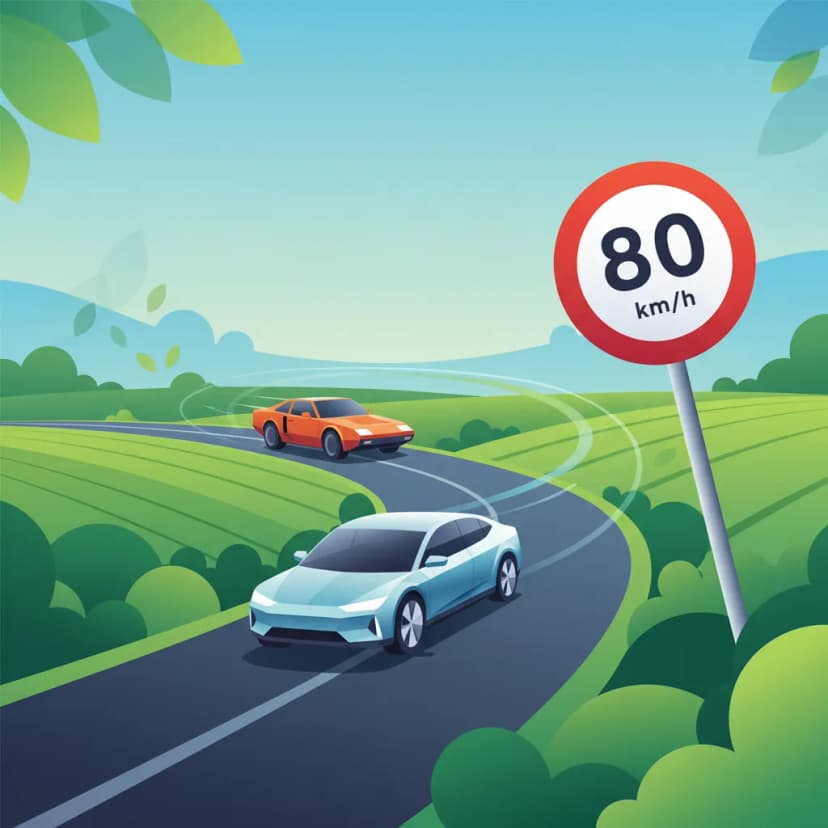
This lesson explains the hierarchical structure of speed limits in Sweden as defined by the Trafikförordning. It covers the default 'base speeds', including 50 km/h in built-up areas and 70 km/h outside them, and how these are modified by specific road signs. You will learn to identify speed limit signs for different road types, such as motorways and residential zones, and understand the legal framework that governs maximum permissible speeds.
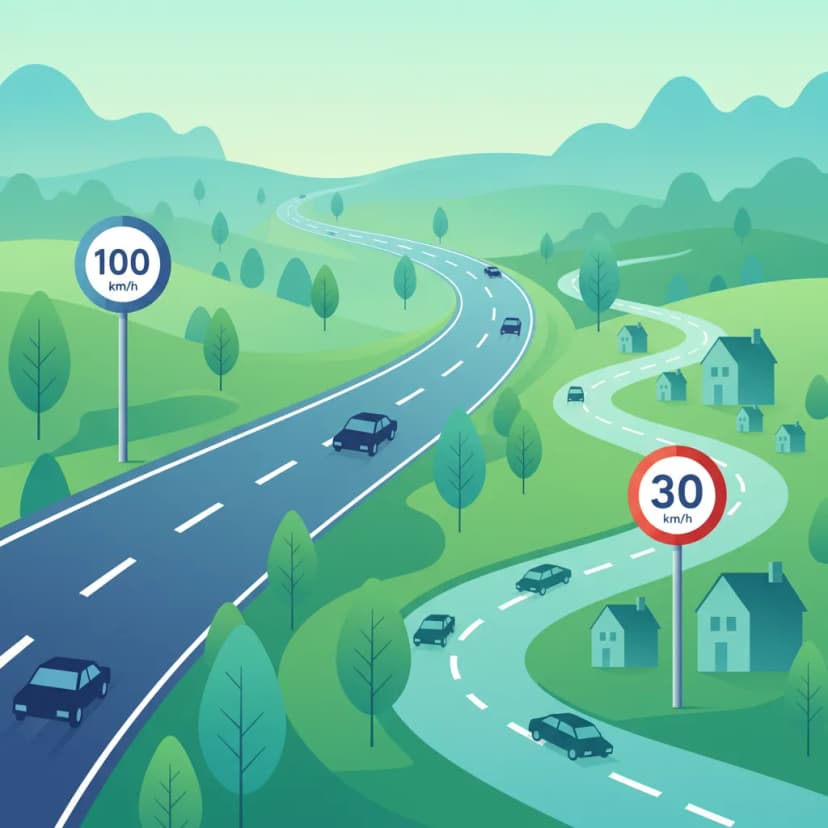
This lesson provides a comprehensive overview of the Swedish national speed limit system. You will learn the default speed limits applicable to different classes of roads, such as 50 km/h in built-up areas and 110 km/h on motorways. It also covers how to identify and comply with special zones, like residential areas (gångfartsområde), school zones, and temporary limits in construction areas, ensuring you always ride at a legal and appropriate speed.

This lesson explains the system of consequences for breaking traffic laws in Sweden. It details common violations and their associated fines and describes the demerit points system that can lead to a license suspension for repeat offenders. Understanding these consequences is a powerful incentive for riders to adhere to the rules of the road.
This lesson emphasizes that the posted speed limit is a maximum, not a target. You will learn the principles of situational speed adaptation, which involves adjusting your speed based on factors like visibility, road geometry (curves and hills), traffic density, and potential hazards. The lesson covers specific strategies for managing speed in urban environments with pedestrians, on rural roads with hidden entrances, and on motorways to match the flow of traffic.
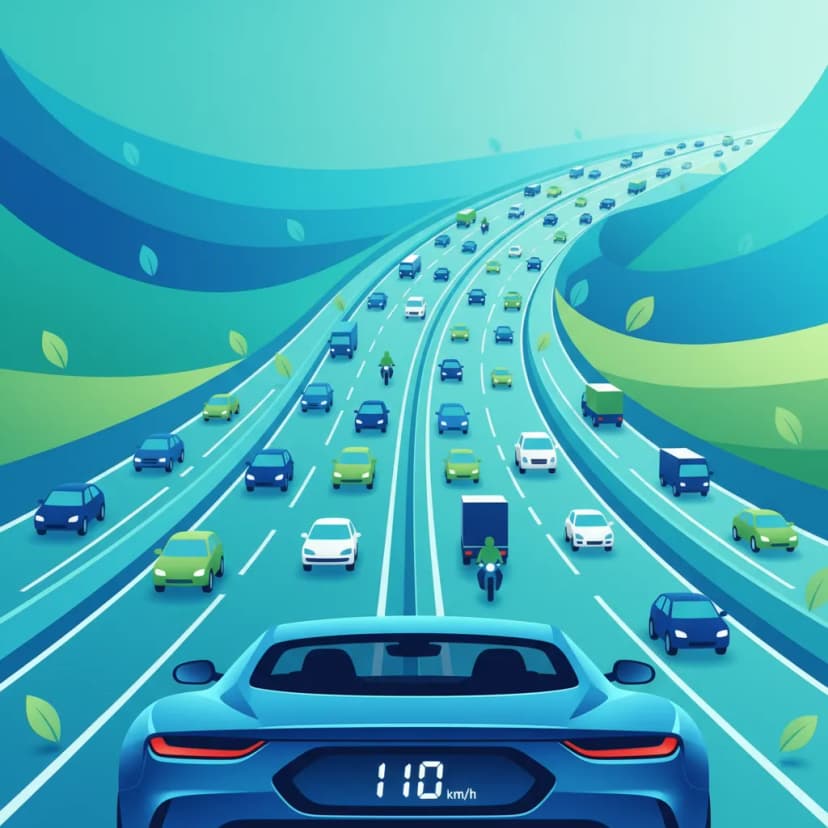
This lesson focuses on the unique demands of managing speed in high-speed environments like motorways. You will learn techniques for maintaining a steady, appropriate speed that matches the flow of traffic, how to perform smooth overtakes, and the importance of increasing your following distance. It also covers physical factors such as managing wind blast and maintaining stability when riding near large trucks, ensuring a safe and controlled high-speed riding experience.
This lesson explains the general speed limit system in Sweden, including the default limits that apply in the absence of specific signs. It covers the standard speeds for built-up areas, roads outside built-up areas, and motorways, clarifying which are relevant to moped riders. Understanding this structure enables riders to determine the correct legal speed even when signs are not immediately visible.
This lesson focuses on the high level of caution required when driving in residential areas. You will learn about the rules for special zones like 'gångfartsområde' (walking speed area) and the need to navigate around speed calming measures like speed bumps. The central theme is anticipating unpredictable behavior from residents, especially children, and managing the risks posed by parked cars that severely limit visibility.
Explore how to effectively manage speed in various Swedish traffic settings, from urban areas to motorways. This content covers adapting to different conditions and understanding the speed limits and their enforcement context, crucial for safe riding.
This lesson emphasizes that the posted speed limit is a maximum, not a target. You will learn the principles of situational speed adaptation, which involves adjusting your speed based on factors like visibility, road geometry (curves and hills), traffic density, and potential hazards. The lesson covers specific strategies for managing speed in urban environments with pedestrians, on rural roads with hidden entrances, and on motorways to match the flow of traffic.

This lesson teaches the crucial skill of adapting speed to prevailing conditions, emphasizing that the posted speed limit is a maximum, not a target. It covers various scenarios such as rain, fog, heavy traffic, and poor road surfaces, explaining why reducing speed is essential for maintaining vehicle control and safety. The goal is to cultivate a proactive mindset where the rider constantly assesses risk and adjusts their speed accordingly.

This lesson reinforces the core safety principle of adapting your driving to the prevailing weather conditions. You will learn why you must significantly reduce speed in heavy rain to avoid aquaplaning, how strong crosswinds can affect vehicle stability, and why reduced visibility in fog necessitates slower speeds and greater following distances. The goal is to instill a proactive approach to risk management whenever the weather is less than ideal.

This lesson teaches the crucial skill of adapting your speed to the dynamic and often congested conditions of urban riding. You will learn to modulate your speed smoothly in response to traffic flow, pedestrian activity, and complex intersections to maintain safety and control. Techniques covered include using engine braking effectively, anticipating the actions of other road users, and selecting a speed that maximizes your reaction time in a high-density environment.
This lesson focuses on the unique demands of managing speed in high-speed environments like motorways. You will learn techniques for maintaining a steady, appropriate speed that matches the flow of traffic, how to perform smooth overtakes, and the importance of increasing your following distance. It also covers physical factors such as managing wind blast and maintaining stability when riding near large trucks, ensuring a safe and controlled high-speed riding experience.
This lesson provides a comprehensive overview of the Swedish national speed limit system. You will learn the default speed limits applicable to different classes of roads, such as 50 km/h in built-up areas and 110 km/h on motorways. It also covers how to identify and comply with special zones, like residential areas (gångfartsområde), school zones, and temporary limits in construction areas, ensuring you always ride at a legal and appropriate speed.
This lesson focuses on the high level of caution required when driving in residential areas. You will learn about the rules for special zones like 'gångfartsområde' (walking speed area) and the need to navigate around speed calming measures like speed bumps. The central theme is anticipating unpredictable behavior from residents, especially children, and managing the risks posed by parked cars that severely limit visibility.

This lesson prepares you for the specific challenges of riding on rural roads in Sweden. You will learn how to read the road ahead for changes in surface quality, approach blind corners safely, and adjust your speed for narrow lanes with no shoulder. The content also covers how to anticipate and safely interact with slow-moving agricultural vehicles and the potential for wild animals on the road, ensuring you are prepared for the unpredictable nature of country riding.
This lesson explains the hierarchical structure of speed limits in Sweden as defined by the Trafikförordning. It covers the default 'base speeds', including 50 km/h in built-up areas and 70 km/h outside them, and how these are modified by specific road signs. You will learn to identify speed limit signs for different road types, such as motorways and residential zones, and understand the legal framework that governs maximum permissible speeds.

This lesson introduces the foundational legal concept of 'duty of care,' which requires all road users to act in a way that does not endanger others. It explains that this duty often requires driving at a 'reasonable speed' that may be lower than the posted limit, depending on conditions. This principle encourages a proactive and considerate approach to sharing the road.
Find clear answers to common questions learners have about Speed Monitoring, Enforcement Technologies, and Penalties. Learn how the lesson is structured, which driving theory objectives it supports, and how it fits into the overall learning path of units and curriculum progression in Sweden. These explanations help you understand key concepts, lesson flow, and exam focused study goals.
In Sweden, you'll commonly encounter fixed speed cameras (fartkameror) at known risk locations, mobile speed cameras operated by the police, and radar guns used by police officers. Some systems also use average speed checks over longer distances.
Speed cameras are designed to capture vehicle registration plates. For motorcycles, the camera captures the rear plate, which is generally more visible. The system measures your speed as you pass the camera and, if it exceeds the limit by a defined margin, an infringement notice with a fine (böter) will be sent to the registered owner.
Penalties vary based on how much you exceed the speed limit. They typically include a fine (böter), which increases with the severity of the violation. For significant speeding offences, points may be added to your driving record, and in extreme cases, your driving licence can be suspended (återkallande av körkort).
Yes, the Swedish driving theory exam for Category A includes questions related to speed limits, speed adaptation, and the consequences of speeding, including enforcement methods and penalties. Understanding these aspects is vital for demonstrating safe riding knowledge.
Generally, the posted speed limits apply equally to motorcycles and cars on most roads. However, a motorcyclist's ability to safely maintain a particular speed, especially in adverse conditions or on complex roads, is paramount and often requires greater adaptation than for car drivers.