
Logo
Swedish Driving Theory Courses

Lesson 2 of the Speed Limits and Distance Management unit

Swedish Driving Theory B: Reaction Time and Braking Distance (Reaktionstid)

Welcome to the lesson on Reaction Time and Braking Distance, a key part of our Swedish Driving License Theory Course for Category B cars. Understanding how quickly you can react and how long it takes your vehicle to stop is fundamental for safe driving and crucial for passing your theory exam. This lesson builds on basic speed concepts and prepares you for understanding safe following distances and speed adaptation.
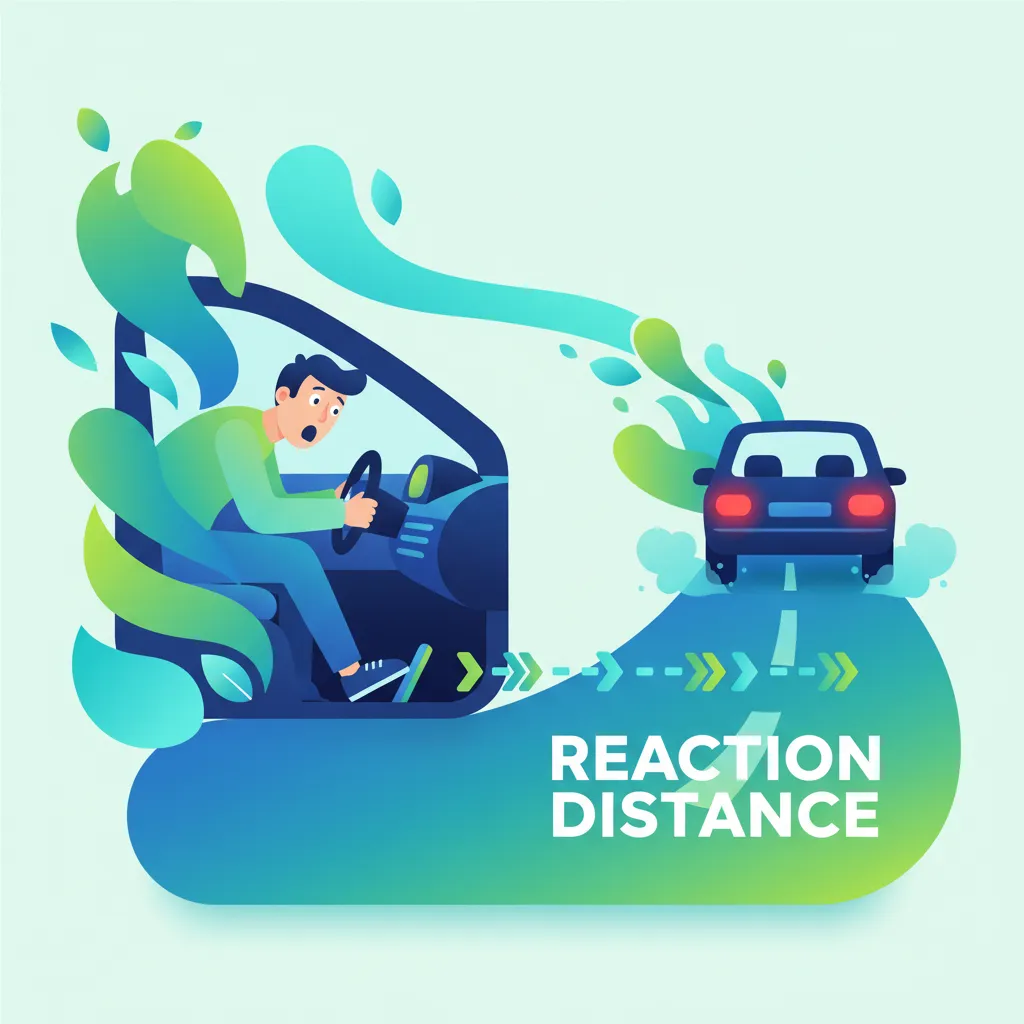
stopping distancereaction timebraking distancespeedroad conditions
Swedish Driving Theory B: Reaction Time and Braking Distance (Reaktionstid)
Swedish Driving Theory B

Reaction Time and Braking Distance: Understanding Your Vehicle's Stopping Power in Swedish Traffic

Understanding how long it takes to bring a vehicle to a complete stop is paramount for safe driving, especially on Swedish roads where conditions can vary dramatically. The total distance a vehicle travels from the moment a driver perceives a hazard to the point it finally stops is known as the Total Stopping Distance (TSD). This critical distance is composed of two main parts: Reaction Distance (RD) and Braking Distance (BD). Mastering these concepts is fundamental for any driver seeking a Swedish Category B driving license, as it directly influences safe speed selection, appropriate following distances, and ultimately, collision prevention.

This lesson will thoroughly break down the components of total stopping distance, explore the factors that influence each, and explain how these principles are applied within the framework of Swedish traffic law.

The Total Stopping Distance (TSD): A Critical Safety Metric

The Total Stopping Distance (TSD) represents the entire length your vehicle needs to come to a halt after you identify a potential danger. It is the sum of two distinct phases:

  1. Reaction Distance (RD): The distance your vehicle travels while you, the driver, perceive the hazard, decide to act, and initiate the braking process.
  2. Braking Distance (BD): The distance your vehicle travels from the moment the brakes are effectively applied until it completely stops.

Recognising that TSD is not static, but a dynamic value influenced by numerous factors, is key to safe driving. Misjudging this distance is a leading cause of rear-end collisions and impacts with stationary obstacles, which are unfortunately common incidents.

Unpacking Reaction Time and Reaction Distance (Reaktionstid)

Before your vehicle even begins to slow down, there's an unavoidable human element at play: your Reaction Time (RT). This is the elapsed time from when a hazard becomes visible to the driver until the driver's foot first makes contact with the brake pedal.

Components of Reaction Time

Reaction time is not a single, instantaneous event, but rather a sequence of cognitive and motor processes:

  • Perception Time: The time it takes for your eyes to see the hazard and your brain to register it. For a clear, expected hazard, this might be around 0.7 seconds. However, in low visibility (night, fog) or with obscured hazards, this can be significantly longer.
  • Decision Time: Once perceived, your brain needs time to process the information and decide on the appropriate action (e.g., brake, steer, or both). This typically adds another 0.3 seconds.
  • Motor Response Time: Finally, the time it takes for your brain to send signals to your muscles and for your foot to physically move from the accelerator to the brake pedal. This is usually about 0.2 seconds.

For an alert driver under normal conditions, the total Reaction Time (RT) typically ranges from 1.0 to 1.5 seconds. This might seem short, but even a single second can mean a substantial distance traveled at speed.

Calculating Reaction Distance

The Reaction Distance (RD) is simply the distance your vehicle covers during your reaction time. It is directly proportional to your speed:

RD (metres) = Speed (m/s) × Reaction Time (s)

Since speed limits in Sweden are given in km/h, it's often helpful to remember a simple conversion: speed in km/h is roughly half the speed in m/s (e.g., 90 km/h is 25 m/s).

Tip

Quick mental calculation for Reaction Distance: A common rule of thumb in Sweden is to take the first digit of your speed in km/h and multiply it by 3 for an approximate reaction distance in metres for 1 second of reaction time. For example, at 90 km/h, the first digit is 9. 9 x 3 = 27 metres. If your reaction time is longer, you need to adjust this upwards.

Example: If you are driving at 90 km/h (which is 25 metres per second) and your reaction time is 1.2 seconds, your reaction distance will be: RD = 25 m/s × 1.2 s = 30 metres.

This means your car will travel the length of approximately seven standard car lengths before you even begin to apply the brakes.

Factors Affecting Reaction Time

Several factors can significantly increase a driver's reaction time, thereby extending the reaction distance and overall stopping distance:

  • Fatigue: Tiredness severely impairs concentration and slows down all cognitive processes. Even mild fatigue can add 0.3–0.5 seconds to your RT.
  • Alcohol and Drugs: These substances are particularly dangerous because they impair judgment, perception, and motor skills, often increasing RT by 0.4 seconds or more, even at low concentrations.
  • Distraction: Anything that takes your attention away from the road, such as using a mobile phone, adjusting the radio, or talking to passengers, will dramatically increase RT. In extreme cases, RT can double or more.
  • Age: While experience can compensate to some extent, reaction times generally slow slightly with age.
  • Stress and Emotional State: High stress, anxiety, or anger can interfere with clear thinking and quick responses.
  • Low Visibility: Fog, heavy rain, snow, or night driving reduce the time you have to perceive a hazard, effectively increasing your overall reaction time to the unexpected.

Warning

Swedish law (Trafikförordning 5 kap., 2 §) explicitly states that drivers must be fit to drive and not be under the influence of substances or fatigue. Failing to acknowledge and compensate for impaired reaction time is a serious offense.

Understanding Braking Distance: The Physics of Stopping

Once you've reacted and firmly pressed the brake pedal, the vehicle enters the Braking Distance (BD) phase. This is the distance it travels while decelerating to a complete stop. Unlike reaction distance, which is primarily a human factor, braking distance is governed by the laws of physics and the interaction between your vehicle and the road.

The Quadratic Relationship with Speed

One of the most crucial concepts to grasp is that braking distance does not increase linearly with speed; it increases quadratically. This means:

  • If you double your speed, your braking distance will quadruple (2² = 4).
  • If you triple your speed, your braking distance will increase ninefold (3² = 9).

This quadratic relationship is explained by the fundamental physics formula for braking distance:

BD (metres) = v² / (2 × a) Where:

  • v is the initial speed in metres per second (m/s).
  • a is the deceleration rate in metres per second squared (m/s²).

This principle is why even a small increase in speed can have a profound impact on your ability to stop safely, especially at higher speeds.

The Role of the Coefficient of Friction (µ)

The deceleration rate (a), and therefore the braking distance, is primarily limited by the Coefficient of Friction (µ) between your tyres and the road surface. The coefficient of friction is a dimensionless number that describes the grip available. A higher µ means more grip and thus greater potential for rapid deceleration.

  • Dry Asphalt (µ ≈ 0.8–0.9): Optimal grip, allowing for strong deceleration (typically 8-9 m/s²).
  • Wet Asphalt (µ ≈ 0.5–0.6): Water acts as a lubricant, significantly reducing grip (deceleration around 5-6 m/s²).
  • Snow-covered Road (µ ≈ 0.2–0.25): Very low grip, with deceleration dropping to 2-2.5 m/s².
  • Ice-covered Road (µ ≈ 0.1–0.15): Extremely low grip, making effective braking very difficult (deceleration often 1-1.5 m/s²).

Note

Gravitational Acceleration (g): In the formula for deceleration (a = µ·g), 'g' represents the acceleration due to gravity, which is approximately 9.81 m/s². So, a coefficient of friction of 0.8 means a maximum theoretical deceleration of 0.8 × 9.81 ≈ 7.85 m/s².

Other Factors Influencing Braking Distance

Beyond speed and surface friction, other elements play a role:

  • Tire Condition: Worn tires (low tread depth) or incorrectly inflated tires reduce the contact patch and grip, especially on wet roads, leading to longer braking distances. Swedish law requires a minimum tread depth of 1.6 mm, but for winter conditions, 3 mm is recommended.
  • Vehicle Load: A heavier vehicle has greater inertia, meaning it requires more force and thus a longer distance to stop, assuming the same braking system and deceleration rate. This is particularly relevant when towing a trailer or carrying heavy cargo.
  • Brake System Condition: Worn brake pads, faulty calipers, or low brake fluid can compromise the effectiveness of your braking system, extending BD. Regular vehicle inspections (kontrollbesiktning) check brake performance.
  • Road Gradient:
    • Uphill: Gravity assists deceleration, slightly shortening braking distance.
    • Downhill: Gravity works against deceleration, significantly increasing braking distance. A driver must compensate by reducing speed.

The Role of Braking Assist Systems (ABS, EBD, ESP)

Modern vehicles are equipped with advanced safety systems that enhance braking performance and control:

  • Anti-lock Braking System (ABS): Prevents the wheels from locking up during hard braking, especially on slippery surfaces. This allows the driver to maintain steering control, but it does not inherently shorten the braking distance on all surfaces. On very loose gravel or deep snow, locked wheels might actually stop the car faster. However, ABS generally optimizes braking on most surfaces by preventing skidding and maximizing the usable grip.
  • Electronic Brake-force Distribution (EBD): Works with ABS to distribute braking force optimally between the front and rear wheels, preventing premature wheel lock-up and maximizing deceleration.
  • Electronic Stability Control (ESP/ESC): Helps the driver maintain control of the vehicle during extreme steering maneuvers or skids by selectively applying brakes to individual wheels and/or reducing engine power. While primarily for stability, it can indirectly aid in stopping by maintaining vehicle control during emergency braking on slippery roads.

Tip

While these systems are invaluable, remember they are limited by the available friction. They cannot defy the laws of physics and create grip where none exists (e.g., black ice).

Total Stopping Distance: Putting It All Together

The Total Stopping Distance (TSD) is the true measure of how much room you need to avoid an obstacle. It is the sum of your reaction distance and your braking distance:

TSD = Reaction Distance (RD) + Braking Distance (BD)

Understanding this combined distance is critical for every driving decision. For example:

  • At 50 km/h (13.9 m/s) on a dry road with an RT of 1.0 s and a strong deceleration of 8 m/s²:

    • RD = 13.9 m/s × 1.0 s ≈ 13.9 m
    • BD = (13.9 m/s)² / (2 × 8 m/s²) ≈ 12.1 m
    • TSD = 13.9 m + 12.1 m = 26 m
  • Now consider the same speed (50 km/h) but on an icy road (µ ≈ 0.12, so deceleration ≈ 1.2 m/s²) and a slightly increased RT of 1.5 s due to the challenging conditions:

    • RD = 13.9 m/s × 1.5 s ≈ 20.8 m
    • BD = (13.9 m/s)² / (2 × 1.2 m/s²) ≈ 80.6 m
    • TSD = 20.8 m + 80.6 m = 101.4 m

This stark comparison highlights why conditions like ice demand extreme caution and significant speed reduction. The TSD increases by nearly four times, primarily due to the drastically longer braking distance.

Speed Adaptation and Safe Following Distance in Swedish Law

Swedish traffic law places a strong emphasis on speed adaptation and maintaining sufficient distance to ensure safety. These legal requirements are directly underpinned by the principles of reaction and braking distance.

Trafikförordning (Traffic Ordinance)

  • 3 kap., 4 § (Maintaining Sufficient Distance): "A driver shall keep such a distance to the vehicle that has passed in front, that the driver has sufficient time and distance to bring the vehicle to a stop if the vehicle in front stops suddenly."

    • This regulation directly mandates that your Total Stopping Distance must always be less than the gap you maintain to the vehicle ahead. It prevents rear-end collisions.
  • 3 kap., 5 § (Adapting Speed to Conditions): "The driver shall adapt speed to road, traffic, and environmental conditions so that the vehicle can be stopped safely."

    • This is a broad but critical rule. It means you are legally obliged to reduce your speed when factors like reduced friction (wet, snow, ice), poor visibility (fog, heavy rain), or heavy traffic increase your TSD or reduce your ability to perceive hazards.
  • 3 kap., 6 § (Special Cases, e.g., Towing): This section implies that drivers must increase following distance when towing a trailer or driving a heavier vehicle, acknowledging the increased braking distance associated with greater mass.

Safe Following Distance: The 2-Second Rule

To simplify the complex calculation of TSD into a practical, everyday guideline, the 2-second rule is widely taught and recommended in Sweden:

Applying the 2-Second Rule

  1. Choose a fixed point ahead on the road (e.g., a sign, a tree, a bridge).

  2. When the vehicle in front of you passes that point, start counting "one thousand and one, one thousand and two."

  3. If your vehicle passes the same point before you finish counting, you are following too closely. Increase your distance.

The 2-second rule is a time-based gap, meaning it automatically adjusts for your speed. For example:

  • At 50 km/h, a 2-second gap is roughly 28 metres.
  • At 90 km/h, a 2-second gap is roughly 50 metres.
  • At 110 km/h, a 2-second gap is roughly 61 metres.

However, this rule is a minimum for ideal conditions (dry road, alert driver). You must increase your following distance (e.g., to 3 or 4 seconds) when:

  • The road is wet, snowy, or icy.
  • Visibility is poor (fog, heavy rain, darkness).
  • You are feeling fatigued or distracted.
  • You are towing a trailer or driving a heavily loaded vehicle.
  • You are driving a vehicle with less effective brakes.

Factors Influencing Stopping Distances: A Deeper Dive

Let's summarize and expand on how various conditions and factors affect reaction and braking distances:

Driver Factors (Primarily Affect RD)

  • Fatigue: Significantly increases RT, leading to longer RD.
  • Distraction (e.g., mobile phone): Can dramatically increase RT, as perception and decision-making are delayed.
  • Alcohol/Drugs: Impair judgment and motor skills, lengthening RT.
  • Age: May slightly increase RT in older drivers.
  • Stress/Emotions: Can cause delayed or inappropriate reactions.

Vehicle Factors (Primarily Affect BD)

  • Tire Condition: Worn tires reduce grip (lower µ), especially in wet conditions, leading to longer BD. Correct tire pressure is also vital.
  • Brake System Performance: Poorly maintained brakes increase BD. Current Swedish vehicle inspection regulations generally require passenger car braking systems to achieve a deceleration of at least 4 m/s² on a dry surface.
  • Vehicle Load: Heavier vehicles have greater inertia, requiring a longer BD for the same deceleration rate.
  • ABS/EBD/ESP: While they improve control and can optimize braking, they are limited by the available road friction. They do not increase the coefficient of friction itself.

Environmental Factors (Primarily Affect BD, but also RT)

  • Road Surface (µ):
    • Dry asphalt: Highest grip, shortest BD.
    • Wet asphalt: Reduced grip, longer BD.
    • Snow: Significantly reduced grip, much longer BD.
    • Ice: Minimal grip, extremely long BD. Black ice is particularly dangerous as it's hard to see.
  • Visibility: Fog, heavy rain, or darkness can increase perception time, thereby lengthening RT.
  • Road Gradient:
    • Uphill: Gravity aids braking, slightly shortening BD.
    • Downhill: Gravity opposes braking, significantly lengthening BD. Requires greater speed reduction.

Common Misunderstandings and Dangerous Practices

To avoid critical mistakes on the road, it is crucial to clarify common misconceptions:

  1. "Braking distance is linear with speed."
    • False: Braking distance is quadratic (proportional to speed squared). Doubling speed quadruples braking distance. This is a fundamental concept for safe speed adaptation.
  2. "ABS means I won't skid and will stop faster on any surface."
    • False: ABS prevents wheel lock-up, preserving steering control. It optimizes braking by preventing skidding but does not increase the available grip (µ). On very slippery surfaces like ice, your braking distance will still be very long.
  3. "My reaction time is always 1 second."
    • False: 1 second is a baseline for an alert driver in normal conditions. Fatigue, distraction, alcohol, and poor visibility can easily extend your reaction time to 1.5, 2, or even more seconds, dramatically increasing your reaction distance.
  4. "A heavy vehicle stops faster because it has more traction."
    • False: While weight increases normal force, it also increases inertia. For the same braking force and coefficient of friction, a heavier vehicle will generally have a longer braking distance.
  5. "I'm keeping a safe distance because I'm X meters behind the car in front."
    • False: Following distance should be time-based (e.g., 2-second rule), not a fixed distance. 30 meters is a safe gap at 50 km/h, but dangerously short at 100 km/h.

Practical Scenarios: Applying Stopping Distance Knowledge

Let's look at how these principles translate into real-world driving decisions:

Scenario 1: Urban Driving on a Wet Road

  • Setting: Driving at 50 km/h (13.9 m/s) in a city on a wet day. Visibility is reduced.
  • Analysis: Wet roads reduce the coefficient of friction (µ ≈ 0.55), increasing braking distance. Reduced visibility may also slightly extend your reaction time (e.g., to 1.2-1.5 s).
  • Safe Action: Reduce your speed significantly (e.g., to 40 km/h or lower). Increase your following distance to at least a 3-second gap. Anticipate hazards earlier.

Scenario 2: Motorway Driving on a Frosty Morning

  • Setting: Driving at 110 km/h (30.6 m/s) on a motorway. The sun has not fully risen, and there are signs of frost on bridges or shaded areas.
  • Analysis: High speed combined with potential black ice (µ ≈ 0.1) creates an extremely dangerous situation. Even a slightly increased reaction time at high speed leads to a very long reaction distance, and braking distance on ice is immense.
  • Safe Action: Drastically reduce speed to well below the limit (e.g., 70-80 km/h or even lower if conditions worsen). Maintain a very large following distance (4 seconds or more). Be smooth with all controls.

Scenario 3: Towing a Caravan on a Rural Road

  • Setting: Driving at 80 km/h (22.2 m/s) on a rural road, towing a heavy caravan.
  • Analysis: The increased mass of the caravan significantly extends the vehicle's braking distance. Your car's braking system has to work harder to stop the combined weight.
  • Safe Action: Increase your following distance to at least a 3-second gap, or even 4 seconds, to account for the increased TSD. Maintain a conservative speed, especially when approaching turns or intersections.

Scenario 4: Driver Fatigue

  • Setting: Driving home after a long day at work, feeling tired. Speed 70 km/h (19.4 m/s).
  • Analysis: Fatigue will increase your reaction time (e.g., to 1.5-2.0 s), dramatically extending your reaction distance. You might also struggle to maintain a consistent speed or focus.
  • Safe Action: Pull over as soon as safely possible to rest or take a break. If a break is not feasible, increase your following distance to at least a 3-4 second gap to compensate for your delayed reaction. Understand that driving fatigued is dangerous and illegal.

By consistently applying these principles and adapting your driving to current conditions, you significantly reduce the risk of collisions and contribute to safer Swedish roads.

Total Stopping Distance (TSD)
The total distance a vehicle travels from the moment a driver perceives a hazard to the point it finally stops, encompassing reaction and braking distances.
Reaction Distance (RD)
The distance a vehicle travels during the driver's reaction time, from hazard perception to initial brake application.
Braking Distance (BD)
The distance a vehicle travels from the moment the brakes are effectively applied until it comes to a complete stop.
Reaction Time (RT)
The elapsed time from a driver perceiving a hazard to their first physical action of applying the brakes, typically 1.0-1.5 seconds for an alert driver.
Coefficient of Friction (µ)
A dimensionless number that describes the amount of grip or friction between a vehicle's tires and the road surface. Higher values indicate more grip.
Deceleration Rate (a)
The negative acceleration achieved during braking, measured in metres per second squared (m/s²), limited by the coefficient of friction and brake system capabilities.
2-Second Rule
A time-based method for maintaining a safe following distance, recommending at least a two-second gap between vehicles under ideal conditions.
Trafikförordning
The Swedish Traffic Ordinance, containing key regulations regarding road safety, speed adaptation, and driver conduct.
Anti-lock Braking System (ABS)
An electronic safety system that prevents wheels from locking up during hard braking, allowing the driver to maintain steering control.
Electronic Brake-force Distribution (EBD)
A system that automatically varies the amount of force applied to each of a vehicle's brakes, based on road conditions, speed, loading, and dynamic forces.
Electronic Stability Control (ESC/ESP)
A computerized technology that improves a vehicle's stability by detecting and reducing skids, working by applying brakes to individual wheels.
Road Gradient
The slope or inclination of a road, which can affect braking distance by either assisting (uphill) or hindering (downhill) deceleration due to gravity.

Learn more with these articles

Check out these practice sets


Search topics related to Reaction Time and Braking Distance (Reaktionstid)

Explore search topics learners often look for when studying Reaction Time and Braking Distance (Reaktionstid). These topics reflect common questions about road rules, driving situations, safety guidance, and lesson level theory preparation for learners in Sweden.

reaction distance driving theory swedenbraking distance formula swedenhow to calculate stopping distance theory testfactors affecting braking distance swedish drivingreaction time driving test questionssafe following distance calculator swedenunderstanding reaction distance category Bdriving theory sweden speed and stopping

Related driving theory lessons for Reaction Time and Braking Distance (Reaktionstid)

Browse additional driving theory lessons that cover connected traffic rules, road signs, and common driving situations related to this topic. Improve your understanding of how different rules interact across everyday traffic scenarios.

Physics of Stopping Distance in Swedish Driving Theory

Understand the physical principles governing reaction distance and braking distance. Learn how speed, road conditions, and driver state impact the total distance needed to stop a vehicle safely on Swedish roads. Essential theory for safe driving decisions.
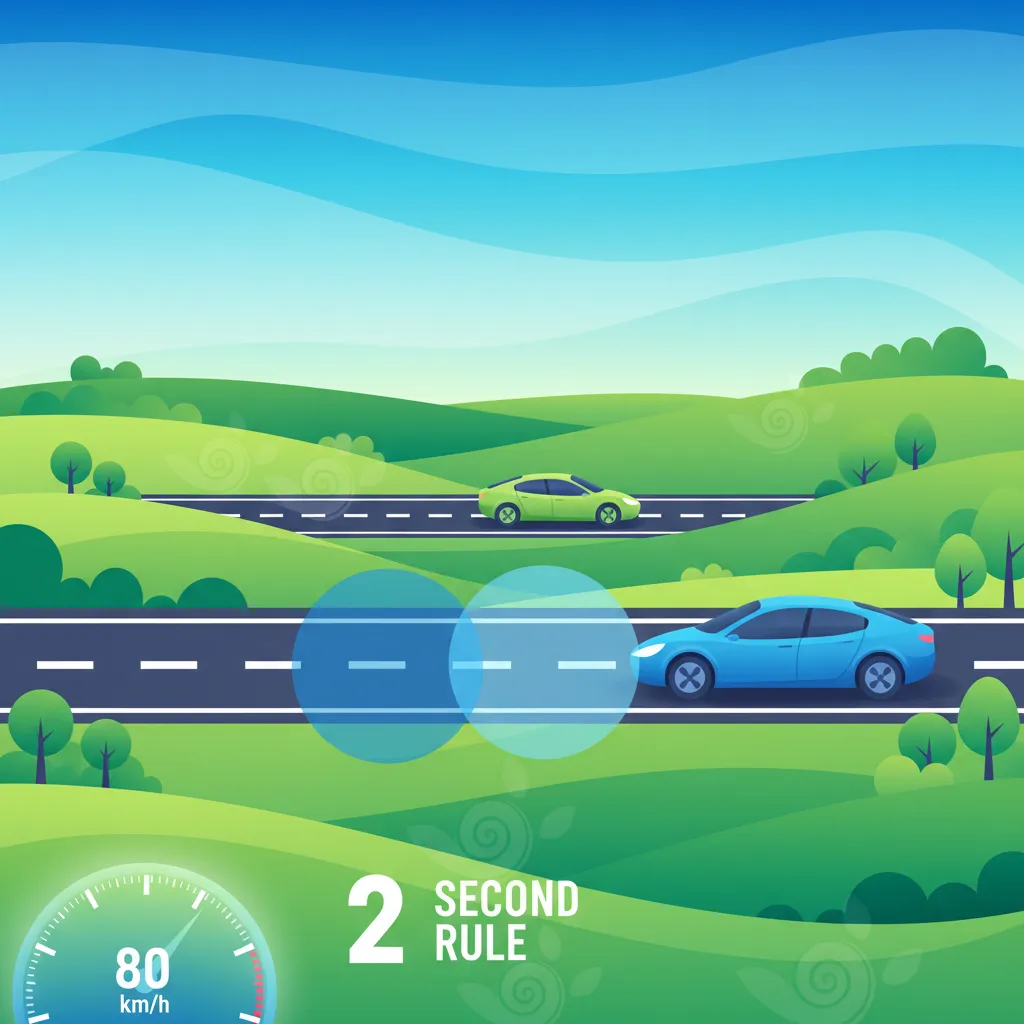
stopping distancebraking distancereaction timephysics of drivingroad conditionsspeeddriving theory sweden
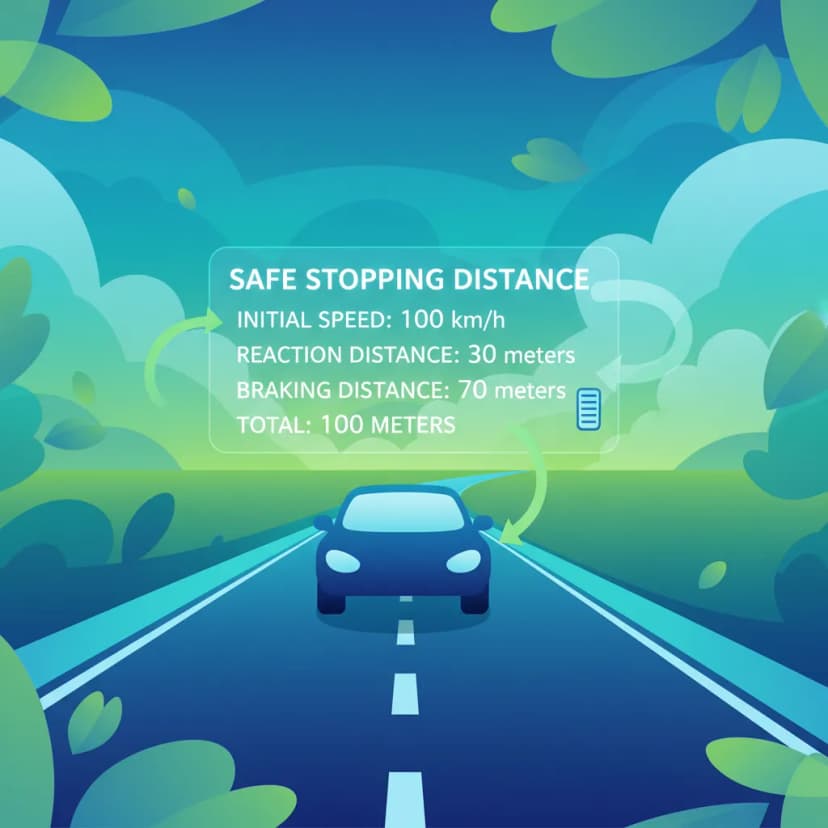
Safe Following Distance (Avstånd) lesson image

Safe Following Distance (Avstånd)

This lesson teaches practical methods for maintaining a safe buffer to the vehicle ahead, with a primary focus on the universally recommended 'three-second rule'. You will learn how to apply this rule by picking a fixed point and counting the seconds until you pass it. The content also explains why this distance must be increased significantly in adverse conditions such as rain, snow, or when following large vehicles that obstruct your view.
Swedish Driving Theory BSpeed Limits and Distance Management
View lesson
Calculating Safe Stopping Distances lesson image

Calculating Safe Stopping Distances

This lesson provides a practical understanding of the physics behind stopping a moped. It breaks down the total stopping distance into two key components: reaction distance (the distance traveled before applying the brakes) and braking distance (the distance covered while braking). Learners will explore how factors like speed, road conditions, and rider alertness dramatically affect these distances.
Swedish Moped Theory AMSpeed Limits and Safe Following Distances
View lesson
Safe Following Distances and Stopping Sight Distance lesson image

Safe Following Distances and Stopping Sight Distance

This lesson delves into the physics of stopping a motorcycle, explaining the components of total stopping distance: perception time, reaction time, and braking distance. You will learn practical methods like the 'two-second rule' to maintain a safe following distance and how to adjust this buffer for adverse weather and high speeds. Understanding these concepts is fundamental to avoiding rear-end collisions and having enough space to react to any hazard.
Swedish Motorcycle Theory ASpeed Management and Distance Keeping
View lesson
Weather-Related Speed Adjustment lesson image

Weather-Related Speed Adjustment

This lesson reinforces the core safety principle of adapting your driving to the prevailing weather conditions. You will learn why you must significantly reduce speed in heavy rain to avoid aquaplaning, how strong crosswinds can affect vehicle stability, and why reduced visibility in fog necessitates slower speeds and greater following distances. The goal is to instill a proactive approach to risk management whenever the weather is less than ideal.
Swedish Driving Theory BWinter and Adverse Weather Driving
View lesson
Legal Parking Rules lesson image

Legal Parking Rules

This lesson covers the general, nationwide rules that govern where you may and may not park or stop, even without specific signs. You will learn about the prohibitions on stopping near intersections, on pedestrian crossings, and at bus stops. The content clarifies the legal definitions and provides clear guidelines on maintaining safe distances and ensuring that your parked vehicle does not obstruct traffic or create a hazard.
Swedish Driving Theory BParking, Stopping, and Loading Zones
View lesson
Residential Areas and Speed Calming lesson image

Residential Areas and Speed Calming

This lesson focuses on the high level of caution required when driving in residential areas. You will learn about the rules for special zones like 'gångfartsområde' (walking speed area) and the need to navigate around speed calming measures like speed bumps. The central theme is anticipating unpredictable behavior from residents, especially children, and managing the risks posed by parked cars that severely limit visibility.

Swedish Driving Theory BDriving in Different Environments
View lesson
Stopping for Passengers and Loading lesson image

Stopping for Passengers and Loading

This lesson focuses on the specific activity of stopping for the purpose of passenger embarkation/disembarkation or loading/unloading goods. You will learn that this is often permissible in areas marked with a 'no parking' sign, as long as the stop is brief and continuous. The lesson distinguishes this from a 'no stopping' zone, where any voluntary stop is prohibited, ensuring you understand the nuanced difference.

Swedish Driving Theory BParking, Stopping, and Loading Zones
View lesson
Stopping and Waiting at Designated Areas lesson image

Stopping and Waiting at Designated Areas

This lesson clarifies the legal distinction between stopping temporarily and parking. It identifies areas where stopping is prohibited, such as near intersections or on pedestrian crossings, to maintain traffic flow and safety. The content also discusses designated waiting areas at traffic lights, often marked for cyclists and mopeds, which can offer a safer position.
Swedish Moped Theory AMRoad Markings and Shared Spaces
View lesson
Use of Emergency Triangle and Warning Lights lesson image

Use of Emergency Triangle and Warning Lights

This lesson focuses on the correct use of warning devices to protect an accident or breakdown scene. You will learn to immediately activate your hazard lights (varningsblinkers). The main focus is on the proper placement of the warning triangle, explaining how the distance from the vehicle must be adapted based on the road's speed limit and visibility to give oncoming drivers adequate time to react.
Swedish Driving Theory BEmergency Situations and Accident Procedures
View lesson
Reduced Visibility and Headlight Use lesson image

Reduced Visibility and Headlight Use

This lesson covers strategies for driving safely when visibility is compromised. You will learn the correct use of different lighting systems: when to use low beams, high beams (helljus), and how to avoid dazzling other drivers. The lesson also explains the specific regulations for using front and rear fog lights and provides techniques for navigating safely in dense fog or heavy precipitation by reducing speed and using the road edge as a guide.

Swedish Driving Theory BWinter and Adverse Weather Driving
View lesson

Frequently asked questions about Reaction Time and Braking Distance (Reaktionstid)

Find clear answers to common questions learners have about Reaction Time and Braking Distance (Reaktionstid). Learn how the lesson is structured, which driving theory objectives it supports, and how it fits into the overall learning path of units and curriculum progression in Sweden. These explanations help you understand key concepts, lesson flow, and exam focused study goals.

What is the difference between reaction distance and braking distance?

Reaction distance is the distance your vehicle travels from the moment you perceive a hazard until you physically apply the brakes. Braking distance is the distance your vehicle travels from the moment the brakes are applied until it comes to a complete stop. Total stopping distance is the sum of these two.

How does speed affect reaction distance and braking distance?

Reaction distance increases proportionally with speed – if you double your speed, your reaction distance also doubles. Braking distance increases much more significantly with speed; doubling your speed quadruples your braking distance. Therefore, higher speeds drastically increase total stopping distance.

Can road surface conditions really change braking distance that much?

Absolutely. A dry, clean road offers the best grip for braking. Wet roads can double braking distance, while icy or snowy conditions can increase it by five to ten times or even more. Always adapt your speed and increase following distance significantly in adverse conditions.

What is the typical reaction time for a driver?

A typical reaction time is often estimated at 2 seconds, but this can vary greatly. Factors like fatigue, distraction (e.g., using a phone), alcohol, or medication can significantly increase your reaction time, making it much longer and therefore more dangerous.

How is stopping distance tested in the Swedish theory exam?

The theory exam will present scenarios where you need to judge safe distances. Questions might ask about the impact of speed on stopping distance, what to do on slippery roads, or how to calculate a safe gap in traffic. Understanding these principles is vital for correct answers.

Does vehicle condition affect braking distance?

Yes, vehicle condition is critical. Worn tires reduce grip and increase braking distance, especially on wet or slippery surfaces. Poorly maintained brakes will also significantly lengthen the distance required to stop. Regular checks are essential.

Continue your Swedish driving theory learning journey

Swedish road signsSwedish article topicsSearch Swedish road signsSwedish driving theory homeSwedish road sign categoriesSwedish Moped Theory AM courseSearch Swedish theory articlesSwedish driving theory coursesSwedish Driving Theory B courseSwedish driving theory articlesSwedish driving theory practiceSwedish practice set categoriesSwedish Motorcycle Theory A courseSearch Swedish driving theory practiceRoad Signs and Signals unit in Swedish Driving Theory BVehicle Control and Maneuvering unit in Swedish Driving Theory BPriority Rules and Intersections unit in Swedish Driving Theory BSpeed Limits and Distance Management unit in Swedish Driving Theory BAccident Response & Roadside Safety unit in Swedish Motorcycle Theory AAdverse Weather & Low-Grip Conditions unit in Swedish Motorcycle Theory ASpeed Limits and Safe Following Distances unit in Swedish Moped Theory AMEmergency Maneuvers & Obstacle Avoidance unit in Swedish Motorcycle Theory AEmergency Situations and Accident Procedures unit in Swedish Driving Theory BSafe Following Distance (Avstånd) lesson in Speed Limits and Distance ManagementEnforcement and Penalties (Fartkontroll) lesson in Speed Limits and Distance ManagementLegal Responsibilities, Documentation & Protective Equipment unit in Swedish Motorcycle Theory AReaction Time and Braking Distance (Reaktionstid) lesson in Speed Limits and Distance ManagementSwedish Speed Limit Structure (Vägens hastighetsgränser) lesson in Speed Limits and Distance ManagementSpeed Adaptation in Different Zones (Stads-, landsväg, motorväg) lesson in Speed Limits and Distance Management