
This unit is vital for safe driving in Sweden. We'll explore the national speed limit structure, how to calculate stopping distances, and the essential 'three-second rule' for maintaining safe following distances. Understanding these principles is key to preventing accidents and passing your theory test.
Browse all lessons that make up Speed Limits and Distance Management. Each lesson focuses on specific topics, learning objectives, and core concepts, helping you build essential knowledge and follow a clear, structured progression toward your study goals in Sweden.
This lesson explains the hierarchical structure of speed limits in Sweden as defined by the Trafikförordning. It covers the default 'base speeds', including 50 km/h in built-up areas and 70 km/h outside them, and how these are modified by specific road signs. You will learn to identify speed limit signs for different road types, such as motorways and residential zones, and understand the legal framework that governs maximum permissible speeds.
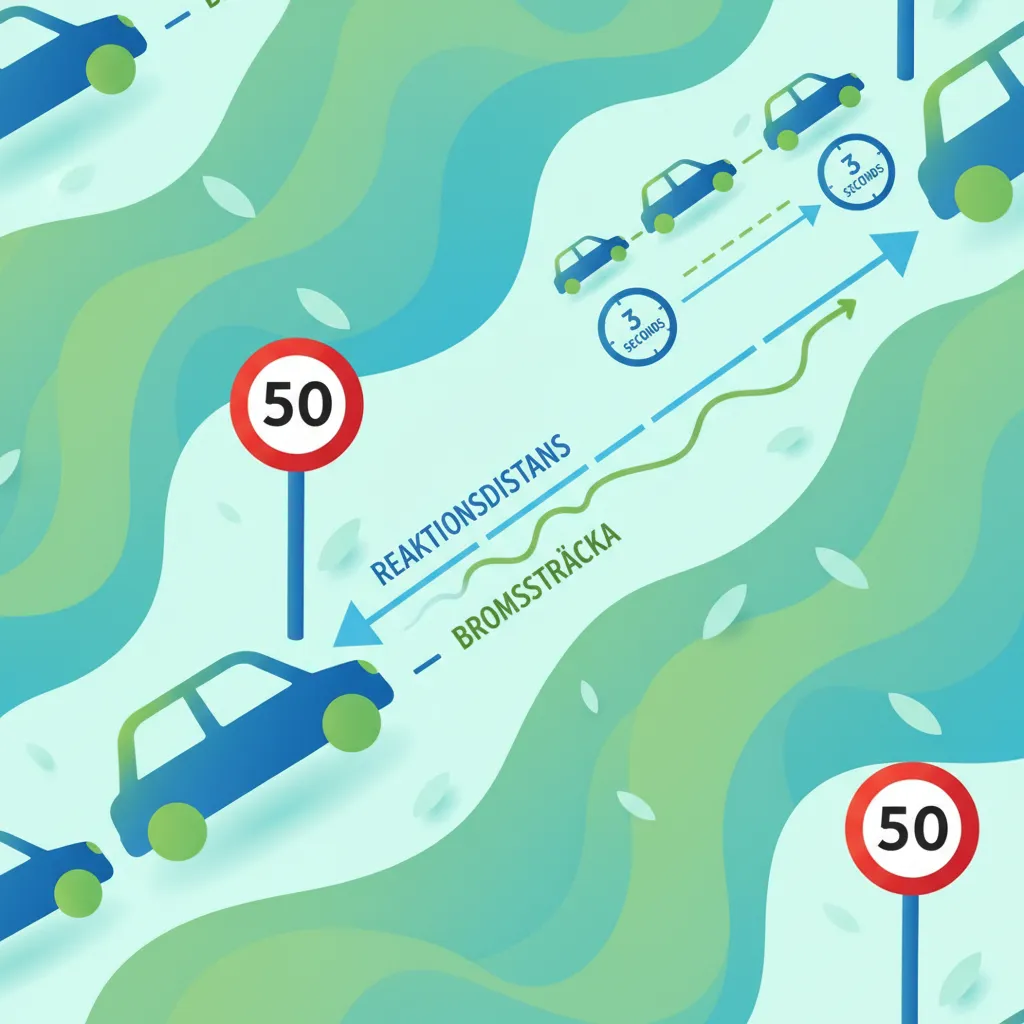
This lesson breaks down the components of the total stopping distance: reaction distance and braking distance. You will learn how your physical and mental state affects reaction time, and how speed, tire condition, and road surface (e.g., ice, rain) influence the distance required to brake to a complete stop. Understanding these physical principles is essential for making safe decisions about speed and following distance in all conditions.
This lesson teaches practical methods for maintaining a safe buffer to the vehicle ahead, with a primary focus on the universally recommended 'three-second rule'. You will learn how to apply this rule by picking a fixed point and counting the seconds until you pass it. The content also explains why this distance must be increased significantly in adverse conditions such as rain, snow, or when following large vehicles that obstruct your view.
This lesson emphasizes that the posted speed limit is a maximum, not a target. You will learn the principles of situational speed adaptation, which involves adjusting your speed based on factors like visibility, road geometry (curves and hills), traffic density, and potential hazards. The lesson covers specific strategies for managing speed in urban environments with pedestrians, on rural roads with hidden entrances, and on motorways to match the flow of traffic.
This lesson provides factual information about speed limit enforcement and the penalties for violations in Sweden. You will learn about the different methods used, including automatic traffic safety cameras (ATK), mobile police patrols, and laser measurements. The content details the system of fines (penningböter) and the conditions under which a speeding offense can lead to a warning or the revocation of your driving license.
Explore high-intent keywords and long-tail search topics learners use when researching Speed Limits and Distance Management. These terms reflect how people search for reliable study materials, structured explanations, and unit-level theory preparation support in Sweden.
Find clear answers to the most common questions learners ask about Speed Limits and Distance Management. Understand how the unit is organized, what learning goals it supports, and how it contributes to your study progression with structured explanations and practical guidance tailored for learners in Sweden.
Sweden has a structured speed limit system. In built-up areas (tätbebyggt område), the general limit is 50 km/h, unless otherwise indicated by signs. On rural roads (landsväg), the general limit is typically 70 km/h, and on motorways (motorväg), it's usually 110 km/h or 120 km/h. Always pay close attention to road signs as they override general limits.
Stopping distance is the sum of reaction distance and braking distance. Reaction distance is the distance your vehicle travels during your reaction time (average 2 seconds). Braking distance is the distance your vehicle travels once the brakes are applied. Both are heavily influenced by your speed. A common formula for calculating braking distance involves speed squared divided by a constant related to road friction and brake efficiency.
The three-second rule is a simple method to maintain a safe following distance. While driving, pick a fixed point (like a signpost) that the vehicle in front of you passes. Start counting 'one thousand one, one thousand two, one thousand three'. If you pass the same point before finishing your count, you are too close. Ideally, you should pass it after you finish counting 'one thousand three'.
Yes, while official speed limits are set by signs, you are legally required to drive at a speed appropriate for prevailing conditions. This means reducing your speed significantly in rain, fog, snow, or icy conditions, even if the posted limit is higher. Driving too fast for the conditions is a common cause of accidents and is specifically tested on the theory exam.
Exceeding the speed limit in Sweden can result in fines (dagsböter), penalty points on your license, or even suspension depending on the severity. The theory test includes questions about speed limits and the consequences of violations. Safe driving requires adherence to both posted limits and conditions.
The average reaction time for a driver is often estimated at 2 seconds, but this can vary greatly. Factors like fatigue, distraction, alcohol, or medication can significantly increase your reaction time. It's crucial to be alert and minimize distractions to keep your reaction time as short as possible.
All included lessons
Lessons in Speed Limits and Distance Management
See who benefits most from studying Speed Limits and Distance Management. This overview explains how the unit supports different learning needs, what level of knowledge is helpful before starting, and how it fits into the overall study path in Sweden.
This unit is essential for all learners preparing for the Swedish Category B driving theory test. It is particularly beneficial for those who find calculations challenging or need to understand how speed and distance critically impact road safety in Sweden.

See how Swedish Driving Theory B is structured, with key topics, learning objectives, and a step-by-step path for theory preparation in Sweden.
Explore all units and lessons included in this driving theory course.