
This lesson focuses on safely navigating common and unavoidable road surface hazards like potholes, debris, and road work zones. Understanding how to approach and manage these obstacles is crucial for maintaining motorcycle stability and control, building confidence for your Swedish Category A motorcycle theory test.
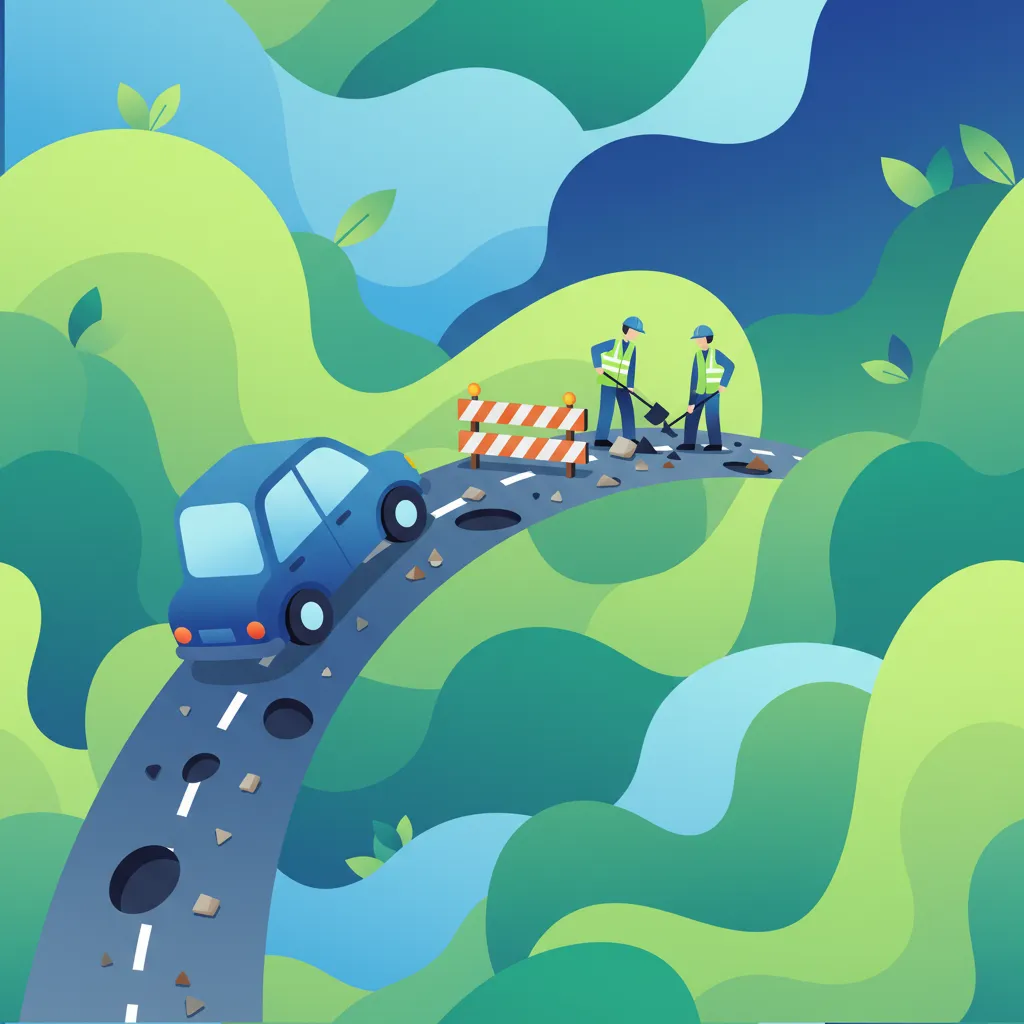
Motorcycle riding on public roads inevitably means encountering imperfections. From minor surface cracks to significant potholes, unexpected debris, and temporary road work zones, these obstacles pose unique challenges to a motorcycle's stability and a rider's safety. This lesson provides essential techniques and legal guidance for safely negotiating unavoidable surface hazards, ensuring you maintain control and comply with Swedish traffic regulations.
The dynamic interaction between a motorcycle's tires and the road surface is crucial for stability and control. Any sudden disruption to this interaction, such as hitting a pothole or encountering loose gravel, can lead to a loss of traction, wheel lift, or even a fall. Mastering obstacle negotiation is not just about personal safety; it's also a legal obligation under Swedish traffic law, which requires all drivers to maintain control of their vehicle and avoid causing damage to the road network.
Surface hazards are a significant contributing factor to motorcycle accidents, often leading to loss of traction, sudden changes in direction, or wheel damage that compromises control. Even a seemingly minor obstacle, if approached incorrectly, can unbalance a motorcycle, especially at speed or when leaning into a turn. Developing precise techniques for managing these situations reduces your risk of a crash, protects your motorcycle from damage, and enhances your overall riding confidence. It builds upon foundational knowledge from Motorcycle Dynamics & Control and Hazard Perception & Risk Management by applying those principles to specific road irregularities.
In Sweden, the Trafikförordningen (Swedish Traffic Ordinance) and Körkortslagen (Driving Licence Act) underpin a driver's duty of care. This includes the obligation to operate a vehicle in a manner that does not endanger oneself, others, or public property. This translates into a responsibility to handle foreseeable obstacles properly, adjusting speed and driving line as necessary. Ignoring clear road work signage or recklessly driving over hazardous obstructions could be considered a violation of these general duties, potentially leading to legal consequences. Moreover, maintaining your motorcycle in a road-worthy condition, including functional suspension and tires, is a legal requirement set by Transportstyrelsen.
Successfully navigating road obstacles relies on a consistent application of several key principles. These principles guide your decision-making and actions when encountering unexpected or unavoidable hazards.
Maintaining control means keeping your motorcycle on its intended path without unintended wheel lift, slides, or deviations. This is your primary objective. When approaching an obstacle, every decision—from speed adjustment to line selection and body positioning—must be made with the goal of preserving the motorcycle's stability and traction. Losing control, even momentarily, can have serious consequences.
Abrupt braking or acceleration just before or on an obstacle can destabilize your motorcycle. Instead, reduce your speed gradually and smoothly well in advance of the hazard. This allows your suspension and tires to prepare for and absorb the impact effectively. Reducing kinetic energy before impact significantly lessens the forces transmitted to the bike and rider. Engine braking is often the smoothest way to reduce speed without upsetting the motorcycle's balance.
Choosing the right path, or "line," across an obstacle minimizes the angle of attack and reduces adverse forces on your tires and wheels. For most surface hazards, the goal is to hit the obstacle squarely or at the shallowest possible angle that allows the tires to roll over it rather than be caught by an edge. When possible, the "neutral line" – often the center of the lane – can sometimes offer the smoothest path, especially when dealing with crowned roads or potholes near the road edge.
Motorcycles have limited suspension travel compared to cars. As a rider, your body can act as a "secondary suspension" to absorb vertical impacts. By adjusting your posture—relaxing your grip on the handlebars, slightly lifting your weight off the seat, and using your knees and elbows to absorb shock—you can significantly dampen the forces transmitted through the bike, maintaining tire contact and control. This technique is critical for comfort and safety over uneven surfaces.
Road work zones (vägarbeten or arbetsplats) are temporary environments with altered rules designed to protect both workers and road users. Compliance with all temporary signage, including speed limits, lane closures, and directional arrows, is mandatory under Swedish law. These regulations ensure an orderly and safe flow of traffic through a potentially hazardous area. Failure to comply is a traffic offence and poses a significant risk.
When faced with multiple hazards or conflicting demands, always prioritize safety. The hierarchy is:
This hierarchy guides decision-making, ensuring that evasive actions or speed adjustments are always focused on minimizing risk.
Understanding the characteristics of different obstacles is key to responding appropriately and safely.
Potholes are depressions in the road surface formed by water infiltration, freeze-thaw cycles, and repeated traffic loads. They can range from shallow, wide indentations to deep, narrow holes with sharp edges.
How to Handle Potholes:
Hitting a pothole filled with water is particularly dangerous as you cannot judge its depth. Treat it as a deep pothole and reduce speed significantly. Water also increases the risk of hydroplaning or reduced tire grip on slippery edges.
Manhole covers and utility lids are metal or concrete plates covering underground access points. They can be flush with the road, slightly raised, or even offset from the surrounding pavement, creating an abrupt edge. They are often made of metal, which can be slippery, especially when wet or worn smooth.
How to Handle Manhole Covers:
Loose debris includes anything not fixed to the road surface, such as gravel, sand, fallen leaves, oil spills, broken glass, or even larger objects like vehicle parts. Debris can cause a loss of traction or mechanical damage.
How to Handle Loose Debris:
Road work zones (vägarbeten or arbetsplats) are areas where construction, maintenance, or utility work is taking place. These zones are characterized by temporary signage, altered lane configurations, reduced speed limits, and potentially uneven or unfinished road surfaces (e.g., loose asphalt, temporary ramps, metal plates).
Key Elements and Handling:
When navigating a road work zone, assume the worst: anticipate slippery surfaces, sudden stops by other vehicles, and unexpected obstacles. Your heightened awareness is your best defense.
Beyond basic principles, two techniques are particularly valuable for effectively dealing with road obstacles: refined body absorption and proper suspension management.
The body-absorption technique is a dynamic process that requires timing and practice. It involves using your legs, arms, and core to dampen the vertical forces of an impact.
Relax Your Grip: Loosen your hands on the handlebars. This allows the handlebars and front wheel to move freely within the suspension's travel, rather than transmitting the shock directly to your arms and shoulders.
Lift Off the Seat: Just before impact, slightly lift your weight off the seat, transferring it to your footpegs. This allows the motorcycle's rear suspension to work independently and prevents the impact from launching you upwards.
Bend Knees and Elbows: Keep your knees and elbows bent and flexible. They act like shock absorbers, compressing and extending to soak up the vertical movement of the bike.
Keep Your Eyes Up: Maintain your gaze beyond the obstacle, focusing on your exit path. This helps maintain balance and prepares you for the next section of road.
"Kneeling" for Deep Obstacles: For very deep potholes or significant bumps, some experienced riders might briefly extend one leg outwards, almost touching the road surface (the "knee-on-ground" technique). This is not for lean angle, but to lower the center of gravity and provide an immediate balance correction point if the bike becomes unsettled. It's an advanced technique requiring careful practice.
Your motorcycle's suspension is designed to absorb impacts and keep the tires in contact with the road. Proper setup is crucial.
While many street bikes have fixed suspension, those with adjustable components should be tuned according to the manufacturer's recommendations for varying loads and anticipated road conditions. Regularly inspect your suspension components for leaks or damage.
Understanding specific Swedish traffic regulations is vital for safe and lawful riding, especially concerning temporary road conditions.
Swedish law, particularly Körkortslagen §§ 2-4, imposes a general duty of care on all drivers. This means:
Avoiding common pitfalls is as important as mastering correct techniques.
Wrong: Approaching a noticeable pothole at highway speeds without reducing speed. Right: Identifying the pothole well in advance, progressively reducing speed using engine braking and light front brake application, and then smoothly traversing the obstacle. Consequence: High-speed impacts can cause tire punctures, rim damage, wheel hop leading to loss of control, or even a crash.
Wrong: Slamming on the brakes inside a road work zone with uneven surfaces or loose gravel. Ignoring temporary lane arrows. Right: Decelerating gently before entering the work zone, using engine braking where possible, and strictly adhering to all temporary lane markings and directional arrows. Consequence: Late braking on uneven surfaces can cause skidding or loss of traction. Disregarding lane markings can lead to head-on collisions or traffic disruption.
Wrong: Not reporting a large, dangerous pile of broken glass or a significant pothole that you could not avoid, assuming someone else will. Right: After safely negotiating an unavoidable hazard, pulling over when safe to do so, and contacting the appropriate road authority (e.g., Trafikverket for national roads, municipality for local roads) to report the hazard. If you are involved in an incident or cause damage due to an unaddressed hazard, ensure you fulfill your reporting duties. Consequence: The hazard remains, potentially causing accidents for other road users. Failure to report damage you caused can have legal repercussions.
The ideal approach to obstacles can vary significantly depending on the prevailing conditions.
Effective obstacle negotiation on a motorcycle is a skill built on a combination of observation, anticipation, precise control, and legal compliance. By consistently applying these principles, you can significantly enhance your safety and confidence on Swedish roads.
Lesson content overview
Explore all units and lessons included in this driving theory course.
Explore search topics learners often look for when studying Obstacle Negotiation: Potholes, Debris, and Road Work Zones. These topics reflect common questions about road rules, driving situations, safety guidance, and lesson level theory preparation for learners in Sweden.
Browse additional driving theory lessons that cover connected traffic rules, road signs, and common driving situations related to this topic. Improve your understanding of how different rules interact across everyday traffic scenarios.
Explore how various road surface conditions, beyond just obstacles, affect motorcycle handling and safety. This lesson delves into the theory behind riding on gravel, wet roads, and other challenging surfaces, expanding on obstacle negotiation for Swedish road safety.

This lesson provides essential information for any motorcyclist considering riding in cold Swedish weather. You will learn how cold temperatures affect tire performance and the extreme caution required on surfaces with potential ice or snow. The content focuses on recognizing hazardous spots like black ice, the need for exceptionally smooth and gentle control inputs, and why in many cases, the safest decision is not to ride at all in such conditions.

This lesson prepares you for the specific challenges of riding on rural roads in Sweden. You will learn how to read the road ahead for changes in surface quality, approach blind corners safely, and adjust your speed for narrow lanes with no shoulder. The content also covers how to anticipate and safely interact with slow-moving agricultural vehicles and the potential for wild animals on the road, ensuring you are prepared for the unpredictable nature of country riding.

This lesson provides a complete guide to riding in wet conditions. You will learn how rain affects traction and braking distances, and the techniques needed to ride smoothly and safely, including gentle throttle and brake application. The content explains the phenomenon of hydroplaning, how to recognize conditions where it might occur, and what to do to avoid it, as well as tips on rain gear and maintaining clear vision.

This lesson focuses on the variety of road markings used on Swedish roads and their meaning for motorcyclists. You will learn the difference between solid and broken lines regarding overtaking, how to position yourself correctly at intersections based on markings, and how to interpret symbols painted on the road surface. Adhering to these markings is essential for maintaining correct lane discipline and ensuring predictability for other road users.

This lesson provides practical advice on selecting the appropriate riding gear for the diverse Swedish seasons. You will learn about the importance of layering for warmth in the cold, ventilated gear for summer heat, and effective waterproofs for rain. The content emphasizes how the right equipment not only keeps you comfortable and focused but also provides crucial protection and enhances your visibility to other road users, making it a critical component of overall motorcycle safety.

This lesson focuses on Swedish warning signs designed to alert drivers to potential dangers. You will study signs indicating sharp bends, slippery surfaces, animal crossings, and temporary hazards like road construction. Correctly interpreting these signs allows a motorcyclist to proactively adjust speed, lane position, and readiness to react, which is essential for maintaining control and safety, especially in adverse weather or on unfamiliar roads.

This lesson details the specific hazards associated with riding on wet roads, including significantly increased stopping distances and the risk of aquaplaning. It explains how to recognize conditions where aquaplaning is likely and the importance of reducing speed. Riders will learn to use smoother throttle, braking, and steering inputs to maintain traction and control.
This lesson provides critical strategies for dealing with one of the biggest dangers in traffic: blind spots. You will learn the importance of the shoulder check and how to position yourself on the road to be more visible to other drivers. The lesson also trains you to scan the road surface ahead for hidden hazards like potholes, gravel, or oil spills that can pose a significant threat to a motorcycle's stability, teaching you to see and avoid them in time.

This lesson addresses the specific challenges of riding at night or in low-light conditions. You will learn how to use your headlights most effectively, how to cope with the glare from oncoming traffic, and how darkness affects your depth perception and ability to judge distances. Strategies for spotting nocturnal animals and the increased importance of wearing reflective gear to be seen by others are also key components of this essential safety lesson.

This lesson encourages a mindset of adapting riding style to the specific challenges of each season. It covers seasonal hazards such as wet leaves in the fall, loose gravel after winter, and sun glare in the summer. By being aware of these predictable changes, riders can proactively adjust their technique and maintain safety throughout the year.
Build upon obstacle negotiation skills by learning advanced risk assessment and hazard perception techniques. This lesson focuses on identifying potential threats, planning escape routes, and making critical decisions to avoid accidents in complex traffic scenarios relevant to Swedish roads.

This lesson teaches you how to analyze and assess risk when sharing the road with a variety of users, from large trucks to cyclists and pedestrians. You will learn to recognize common patterns of behavior and potential conflict points, allowing you to anticipate the actions of others before they create a dangerous situation. Developing this predictive mindset is a cornerstone of defensive riding and is key to staying safe in busy, complex traffic environments.
This lesson provides critical strategies for dealing with one of the biggest dangers in traffic: blind spots. You will learn the importance of the shoulder check and how to position yourself on the road to be more visible to other drivers. The lesson also trains you to scan the road surface ahead for hidden hazards like potholes, gravel, or oil spills that can pose a significant threat to a motorcycle's stability, teaching you to see and avoid them in time.

This lesson teaches you how to make an accident scene as safe as possible for yourself, any other involved parties, and approaching traffic. You will learn the correct use of hazard lights, the placement of warning triangles, and the importance of wearing a high-visibility vest. The content also covers how to identify and manage immediate post-crash hazards, such as spilled fuel or unstable vehicles, to prevent the situation from worsening.
This lesson focuses on Swedish warning signs designed to alert drivers to potential dangers. You will study signs indicating sharp bends, slippery surfaces, animal crossings, and temporary hazards like road construction. Correctly interpreting these signs allows a motorcyclist to proactively adjust speed, lane position, and readiness to react, which is essential for maintaining control and safety, especially in adverse weather or on unfamiliar roads.
This lesson prepares you for the specific challenges of riding on rural roads in Sweden. You will learn how to read the road ahead for changes in surface quality, approach blind corners safely, and adjust your speed for narrow lanes with no shoulder. The content also covers how to anticipate and safely interact with slow-moving agricultural vehicles and the potential for wild animals on the road, ensuring you are prepared for the unpredictable nature of country riding.

This lesson introduces the core concepts of defensive riding, which involves anticipating potential dangers and actively managing the space around your motorcycle. You will learn the technique of continuously identifying and maintaining an 'escape path'—an open space to move into if a threat suddenly appears. This proactive, forward-thinking approach dramatically reduces the chances of being trapped in a dangerous situation and is a key skill of advanced, safe riders.

This lesson focuses on strategies to make yourself more visible to other road users, a critical factor in motorcycle safety. You will learn how to use lane positioning strategically to stay out of other drivers' blind spots and to maximize your own line of sight through corners and intersections. The content also covers the effectiveness of high-visibility and reflective clothing, as well as the correct use of lights to ensure you are seen in all conditions.

This lesson focuses on the cognitive side of handling emergencies: seeing the threat early and making the right decision instantly. You will learn to analyze a developing hazard and quickly determine the best course of action, whether it's maximum braking, an evasive swerve, or a combination of both. This mental training is just as important as the physical skill, as the correct initial decision is the key to a successful outcome.

This lesson teaches the crucial skill of adapting your speed to the dynamic and often congested conditions of urban riding. You will learn to modulate your speed smoothly in response to traffic flow, pedestrian activity, and complex intersections to maintain safety and control. Techniques covered include using engine braking effectively, anticipating the actions of other road users, and selecting a speed that maximizes your reaction time in a high-density environment.

This lesson provides in-depth analysis of how to safely interact with the full spectrum of road users. You will learn about the specific characteristics of each, such as the large blind spots of trucks, the potential for sudden movements from cyclists, and the unpredictability of pedestrians. The content teaches strategies for communication, anticipation, and defensive positioning to ensure safe and respectful coexistence on the road for everyone.
Find clear answers to common questions learners have about Obstacle Negotiation: Potholes, Debris, and Road Work Zones. Learn how the lesson is structured, which driving theory objectives it supports, and how it fits into the overall learning path of units and curriculum progression in Sweden. These explanations help you understand key concepts, lesson flow, and exam focused study goals.
The safest approach is to assess the pothole from a distance. If possible and safe to do so, alter your line to go around it. If you must ride through, try to approach it at a slight angle (not directly head-on if possible), maintain a steady throttle or slight acceleration, and prepare to absorb the impact by slightly standing on the pegs or using your knees and elbows to cushion the jolt. Avoid braking abruptly while entering the pothole.
Loose debris like gravel, sand, or wet leaves significantly reduces traction. Avoid sudden braking, acceleration, or sharp turns. If you must ride through it, maintain a steady, upright position, keep a gentle, consistent throttle, and choose a path with the least amount of debris. Look far ahead to anticipate areas with less debris.
Road work zones often have unexpected changes in road surface, lane configurations, and traffic. Slow down, increase your following distance, and scan for workers, equipment, and temporary signage. Be prepared for uneven surfaces, sudden stops, and narrowed lanes. Always expect the unexpected and maintain a high level of awareness.
It is generally not recommended to brake hard while directly hitting a pothole or patch of debris, as this can upset the motorcycle's balance and increase the risk of a skid or loss of control. If you encounter one unexpectedly, try to maintain your speed and line, absorb the impact, and then make any necessary adjustments or braking once you are clear.
By slightly standing on your footpegs, bending your knees and elbows, you create a 'body suspension' system. This allows your legs and arms to absorb the shock of hitting an obstacle, rather than transferring the full impact directly to the motorcycle frame. It also helps maintain tyre contact with the road and keeps you balanced.