
Driving under the influence of alcohol or drugs is a serious offense with significant repercussions. This lesson, part of the 'Alcohol, Drugs, Fatigue, and Driver Fitness' unit for your Swedish Category B driving license, details the severe legal, financial, and personal consequences you face if convicted of impaired driving. Understanding these risks is crucial for safe and responsible driving.
Driving a vehicle is a privilege that comes with significant responsibility, particularly concerning road safety. In Sweden, driving under the influence of alcohol, drugs, or even severe fatigue is not only dangerous but carries a broad spectrum of severe legal and non-legal consequences. This lesson provides a comprehensive overview of what awaits drivers convicted of impaired driving offenses within the framework of the Swedish Driving License Theory Course for Category B Cars. Understanding these repercussions is crucial for making responsible choices and ensuring public safety.
The Swedish legal system views impaired driving as a serious breach of statutory duties designed to protect all road users. This offense triggers a multi-layered response, encompassing criminal liability, administrative sanctions, civil responsibility, and significant social and financial repercussions. The underlying logic is clear: alcohol and drugs demonstrably degrade a driver's perception, decision-making, and motor coordination, exponentially increasing the risk of accidents. Penalties are designed to deter such behavior and hold drivers accountable for all consequences, regardless of intent.
Impaired driving refers to operating a motor vehicle while a driver's abilities are compromised by substances like alcohol or drugs, or by conditions such as severe fatigue. In Sweden, this is not merely a personal safety issue; it's a criminal offense with far-reaching implications. The legal framework aims to prevent accidents, punish dangerous behavior, and ensure accountability.
The penalties for impaired driving are graduated, meaning they increase in severity based on factors such as the level of impairment, whether it's a repeat offense, and if injury or property damage occurred. This proportionality ensures that the punishment fits the risk and harm caused. Drivers must be aware that the legal system holds them liable for all consequences of their impairment.
This lesson connects directly with previous modules on legal blood-alcohol limits, the influence of medication and drugs, and fatigue management. It provides the essential legal context for understanding risk management and accident procedures.
Blood Alcohol Concentration (BAC) is a critical measure in Swedish law, indicating the amount of ethanol per 1,000 grams of blood, expressed in promille (‰). Exceeding these limits, even slightly, constitutes a legal offense with significant penalties.
The legal BAC limits in Sweden are stringent and vary depending on the driver's age and professional status:
Even at the lowest legal limit of 0.2‰, a driver's reaction time is reduced, and judgment can be impaired. Common misunderstandings include believing that 0.2‰ is negligible or that one can safely drive after a single drink. The truth is that individual metabolism, body weight, and food intake vary greatly, making it impossible to predict one's BAC without a reliable test. The only safe approach is to consume no alcohol if you plan to drive.
Swedish law also prohibits driving under the influence of drugs or medications that impair driving ability, regardless of BAC. This includes both illegal narcotics and prescription drugs that may cause drowsiness, dizziness, or affect motor skills. If a driver's abilities are impaired, they can face charges even if no alcohol is detected. This falls under the general principle of driver fitness.
Driving under the influence (DUI) is a criminal offense in Sweden, categorized based on the severity of impairment and consequences. Police have the authority to conduct roadside breath and urine tests, and a conviction leads to criminal penalties imposed by the district court.
The Swedish Penal Code (Brottsbalken) outlines the penalties for various levels of impaired driving:
A monetary penalty system used in Sweden where the total fine amount is calculated based on the number of "day-fines" awarded by the court, with each day-fine unit reflecting a portion of the offender's daily disposable income. This makes fines proportional to an individual's financial capacity.
A common misunderstanding is that fines are flat fees; in Sweden, they vary significantly with the offender's income. Another misconception is that one is safe if not stopped by the police. Random checks, targeted enforcement, and even automated speed-camera-linked checks are part of Sweden's strategy to detect impaired drivers.
Even if you are acquitted of criminal charges, civil liability for damages caused by an accident can still apply independently.
Beyond criminal penalties, a conviction for impaired driving almost always leads to the administrative sanction of driver's licence revocation or prohibition. This is enforced by the Swedish Transport Agency (Transportstyrelsen) and signifies a temporary removal of the right to hold a valid driver's licence.
The duration of the prohibition period varies significantly based on the severity of the offense, BAC level, and whether it's a repeat violation:
After a prohibition period ends, drivers generally do not automatically regain their licence. They often need to reapply for a driver's permit (körkortstillstånd) and may need to undergo mandatory retraining, educational programs, or even re-take the theory and practical driving tests.
Beyond criminal charges and licence revocation, impaired drivers face civil liability, which is the legal obligation to compensate victims for any damages caused. This is a separate legal process from criminal proceedings and focuses on making the victims whole again.
Under the Swedish Tort Liability Act (Skadeståndslag), an impaired driver found at fault for an accident may be liable for:
Civil claims can be substantial, especially in cases involving severe personal injury or death. This financial burden is independent of any criminal sentence or fine.
While vehicle insurance policies are designed to cover damages in accidents, a DUI conviction can significantly complicate matters. Insurance companies may refuse to cover all costs, leaving the impaired driver personally liable for substantial amounts. Even if the insurer initially pays out to the victims, they often have the right to claim back (subrogate) some or all of these costs from the convicted driver.
A conviction for impaired driving sends a clear signal to insurance companies that the driver represents a significantly higher risk. This inevitably leads to severe financial repercussions related to vehicle insurance.
Insurance providers will almost certainly impose a premium surcharge, commonly known as a risk premium. This can result in a 20-40% increase in insurance costs for several years following a conviction, potentially lasting for three to five years. The increase reflects the insurer's heightened exposure to future claims.
In more severe cases, or for repeat offenders, insurance companies may choose to cancel the existing policy or refuse to renew it at the end of its term. This forces the driver to seek coverage from specialized "high-risk" insurers, which typically come with significantly higher premiums and more restrictive terms.
Most insurance policies reward safe driving with a "no-claim bonus" or "bonus-malus discount," which reduces premiums over time. A DUI conviction almost always results in the loss of this discount, effectively increasing the cost of insurance even further.
Swedish insurance law generally requires policyholders to disclose material facts to their insurer. A DUI conviction is a material fact, and failure to disclose it could lead to policy invalidation if an accident occurs. Insurance companies also receive data from the Swedish Transport Agency, making it difficult to conceal a conviction.
For certain impaired driving convictions, particularly those involving higher BAC levels, repeat offenses, or causing injury, the Swedish legal system mandates participation in specific rehabilitation programs or the installation of an ignition interlock device before a driver's licence can be reinstated. These measures aim to reduce recidivism by addressing underlying substance use issues.
An ignition interlock device (alkolås) is a breath-alcohol sensor installed in a vehicle. It prevents the engine from starting if it detects alcohol on the driver's breath. Courts or the Transport Agency may order the use of such a device for a specific period, typically 12 months or longer, as a condition for regaining driving privileges. The driver bears the cost of installation, maintenance, and monitoring of the device.
Convicted drivers may be required to complete approved alcohol and drug education programs or substance-abuse counseling courses. These courses, which can range from a few hours to several days, aim to educate drivers about the dangers of impairment, help them understand their relationship with alcohol or drugs, and equip them with strategies to avoid future impaired driving. Failure to complete these mandatory programs will result in the denial of licence reinstatement.
Serve the full licence revocation period as mandated by the Transport Agency.
Complete all court-ordered or Transport Agency-mandated rehabilitation programs, such as alcohol education courses or ignition interlock installation. Obtain official proof of completion.
Reapply for a driver's permit (körkortstillstånd) through the Swedish Transport Agency, submitting all required documentation and certifications.
Pass any required re-examinations (theory test and/or practical driving test) if stipulated by the Transport Agency based on the severity and nature of the offense.
Receive a new driver's licence, often with special conditions (e.g., continued use of an ignition interlock) for an initial period.
The consequences of impaired driving extend far beyond legal and financial penalties, deeply affecting a driver's social standing, employment prospects, and personal well-being. These non-legal repercussions can be some of the most enduring.
For many individuals, a driver's licence is essential for their livelihood. A DUI conviction can lead to:
A DUI conviction carries a considerable social stigma. It can damage a driver's reputation within their community, among friends, and with family. Public records and, in some cases, media coverage can lead to lasting reputational harm.
The personal toll of a DUI conviction can be immense. Drivers may experience:
The psychological impact of causing an accident while impaired can be a heavier burden than any legal penalty, affecting mental health for years.
The severity of penalties for impaired driving in Sweden is not fixed; it can be significantly influenced by the circumstances surrounding the offense. Various contextual factors can escalate charges and lead to harsher sentences.
Driving while impaired in challenging weather conditions compounds the danger and can lead to more severe penalties.
The type of road where the offense occurs also plays a role in determining consequences.
The condition or type of vehicle being driven can also influence the severity of the offense.
Impaired driving offenses that involve vulnerable road users carry particularly severe consequences.
As discussed earlier, specific driver categories face stricter rules.
These contextual variations underscore that the legal consequences of impaired driving are not static but are highly adaptive to the specific dangers posed by the impaired driver's actions.
Understanding the specific legal acts and ordinances that govern impaired driving in Sweden is crucial. These regulations form the backbone of the penalties and enforcement measures discussed in this lesson.
These laws collectively create a comprehensive legal framework designed to deter impaired driving, punish offenders, protect victims, and ensure public safety on Swedish roads.
Always verify the exact wording and current paragraph numbers for specific laws and ordinances against the latest official publications, as legal texts can be updated.
Lesson content overview
Explore all units and lessons included in this driving theory course.
Explore search topics learners often look for when studying Legal Consequences of Impairment. These topics reflect common questions about road rules, driving situations, safety guidance, and lesson level theory preparation for learners in Sweden.
Browse additional driving theory lessons that cover connected traffic rules, road signs, and common driving situations related to this topic. Improve your understanding of how different rules interact across everyday traffic scenarios.
Explore the full spectrum of legal ramifications for impaired driving offenses in Sweden. Understand the breakdown of fines, license revocation periods, and potential jail sentences as mandated by Swedish law.

This lesson explains the stringent Swedish laws concerning alcohol and driving. You will learn the legal blood alcohol content (BAC) limit, which is 0.2 per mille, and the higher limit of 1.0 per mille that constitutes the more serious crime of 'grovt rattfylleri'. The content details how alcohol impairs judgment, coordination, and reaction time, and outlines the severe legal penalties, including fines, imprisonment, and license revocation.
This lesson covers Sweden's stringent 'Nolltolerans' (zero tolerance) laws regarding driving under the influence of alcohol and drugs. It explains the very low legal blood alcohol limits and the severe penalties for violations, which can include heavy fines, license suspension, and even imprisonment. The message is unequivocal: riding and impairment do not mix.

This lesson extends the topic of impaired driving to include medications and illegal drugs. You will learn that there is a zero-tolerance policy for illegal narcotics in traffic. The lesson also highlights the importance of being aware of the side effects of prescribed or over-the-counter medications, particularly those marked with a red warning triangle, and stresses the driver's responsibility to consult a doctor or pharmacist about their fitness to drive.
This lesson explains the system of consequences for breaking traffic laws in Sweden. It details common violations and their associated fines and describes the demerit points system that can lead to a license suspension for repeat offenders. Understanding these consequences is a powerful incentive for riders to adhere to the rules of the road.
This lesson provides an overview of traffic law enforcement in Sweden, explaining the roles of the police and other authorities. You will learn about the system of penalties for common traffic violations, including the scale of fines (böter) and the conditions under which your license may be suspended. Understanding the legal consequences of unsafe or unlawful riding provides a powerful incentive to always adhere to the rules of the road.
This lesson outlines the enforcement measures and penalties for speeding violations in Sweden. It explains the system of fines, how they escalate based on the severity of the offense, and the potential for receiving demerit points on a license. The content serves as a serious reminder of the legal and financial consequences of speeding, reinforcing the importance of adhering to all speed regulations.
This lesson provides factual information about speed limit enforcement and the penalties for violations in Sweden. You will learn about the different methods used, including automatic traffic safety cameras (ATK), mobile police patrols, and laser measurements. The content details the system of fines (penningböter) and the conditions under which a speeding offense can lead to a warning or the revocation of your driving license.
This lesson covers the legal medical requirements for drivers, which are designed to ensure public safety. You will learn about the specific standards for visual acuity and field of vision, and the requirement to wear corrective lenses if needed. The lesson also explains that drivers have a legal obligation to report certain medical conditions (like epilepsy or severe diabetes) to the Swedish Transport Agency, as they may impact their ability to drive safely.
This lesson covers the administrative and legal obligations following a collision. You will learn under which circumstances you are legally required to notify the police, such as when there are injuries or significant property damage. The content details the essential information that must be exchanged between all involved parties—names, contact details, vehicle registration, and insurance information—and the importance of documenting the scene and gathering witness details for insurance claims.
This lesson covers the general, nationwide rules that govern where you may and may not park or stop, even without specific signs. You will learn about the prohibitions on stopping near intersections, on pedestrian crossings, and at bus stops. The content clarifies the legal definitions and provides clear guidelines on maintaining safe distances and ensuring that your parked vehicle does not obstruct traffic or create a hazard.
Understand how alcohol, drugs, and fatigue impair driver fitness and lead to severe legal consequences. This covers effects on reaction time, decision making, and the mandatory requirements for safe driving in Sweden.
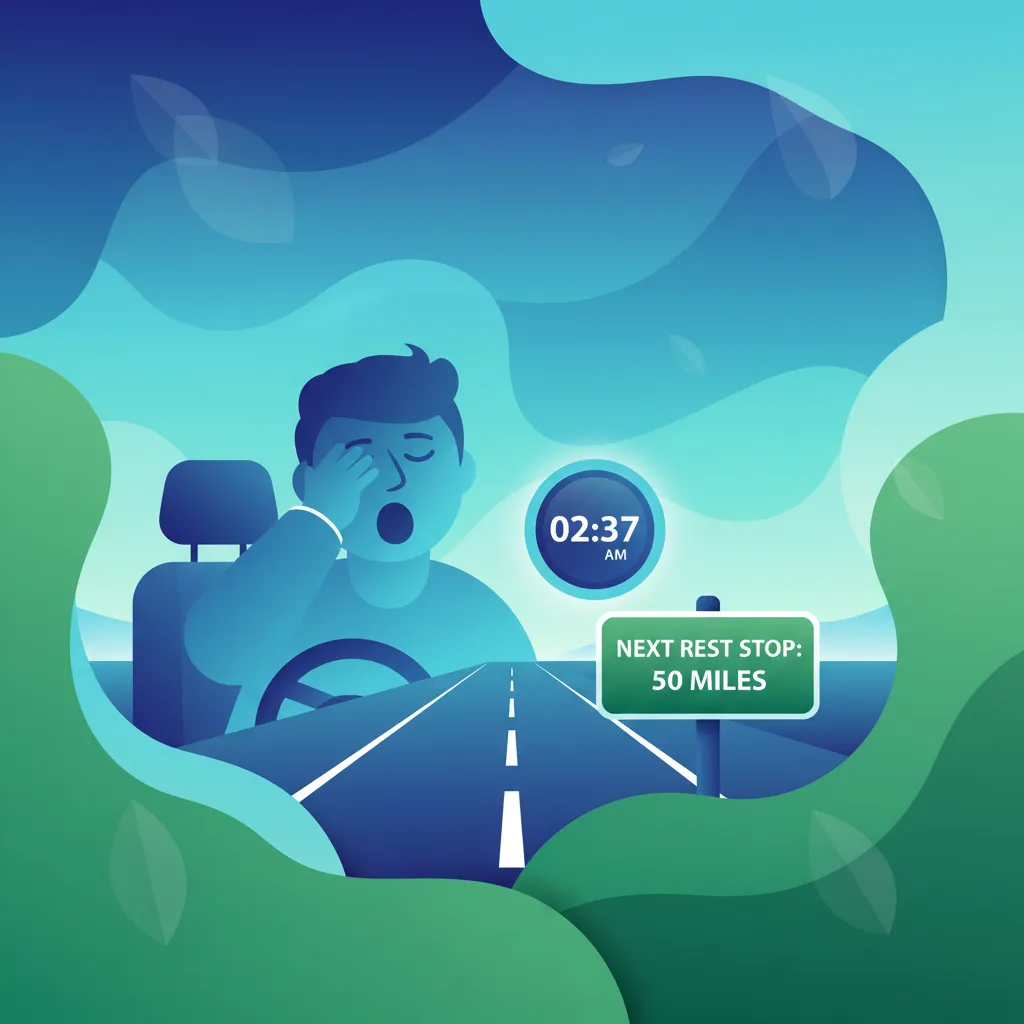
This lesson addresses the significant danger of driving while tired. You will learn to recognize the warning signs of fatigue, such as frequent yawning, difficulty focusing, and heavy eyelids. The content explains that fatigue severely impairs reaction time and decision-making, and discusses the concept of 'microsleep'. The only effective countermeasure is rest, and the lesson emphasizes the importance of planning long trips to include regular breaks.
Find clear answers to common questions learners have about Legal Consequences of Impairment. Learn how the lesson is structured, which driving theory objectives it supports, and how it fits into the overall learning path of units and curriculum progression in Sweden. These explanations help you understand key concepts, lesson flow, and exam focused study goals.
In Sweden, impaired driving, or 'rattfylleri', refers to driving a vehicle while under the influence of alcohol or drugs. Legally, this is defined by exceeding the blood-alcohol limit (0.2 per mille) or being demonstrably impaired by narcotics or certain medications to the extent that your driving ability is affected. The Swedish Transport Agency (Transportstyrelsen) defines these limits and conditions.
Fines for a first-time DUI conviction in Sweden are typically based on the offender's income, often calculated as a number of 'dagsböter' (day-fines). This means the amount can vary significantly, but they are generally substantial. For instance, a common range could be 30-50 day-fines, where each day-fine might be several hundred SEK depending on your financial situation. A basic penalty for driving with alcohol levels just above the limit can be around 50,000 SEK.
The duration of driving license revocation (indragning av körkort) for impaired driving in Sweden depends on the severity of the offense and the blood-alcohol level. For a first offense with a blood-alcohol content between 0.2 and 0.5 per mille, it might be a period of 2 months. However, for higher alcohol levels or repeat offenses, the revocation period can extend to 1 year, 2 years, or even permanently in severe cases.
Yes, absolutely. A conviction for impaired driving will significantly increase your car insurance premiums. Insurance companies view drivers with DUI convictions as high-risk. You may even find it difficult to get coverage from some providers, or you might need to pay a much higher premium for comprehensive coverage.
While a first offense with a relatively low blood-alcohol level might primarily result in fines and license revocation, serious cases of impaired driving can lead to imprisonment. This includes driving with extremely high alcohol levels, causing an accident while impaired, or being convicted of aggravated drunk driving ('grov rattfylleri'). The court assesses each case individually based on the circumstances and the degree of impairment.