
Welcome to the lesson on Vehicle Load Management and Aerodynamics, part of Unit 7: Eco-Driving and Environmental Impact. Understanding how the weight you carry and the air resistance your vehicle encounters affect its performance is key to driving more economically and safely. This lesson will equip you with the knowledge to minimize fuel consumption and reduce your environmental footprint by optimizing your vehicle's load and aerodynamic profile, crucial aspects for the Category B driving theory exam.

Optimizing how you load your vehicle and understanding its aerodynamics are crucial aspects of safe, economical, and environmentally friendly driving. In Sweden, as part of your Category B driving license theory, comprehending these principles is essential not only for passing your test but also for becoming a responsible driver. Every decision, from what you pack in your boot to whether you leave your roof box on, impacts your car's performance, fuel consumption, handling, and ultimately, road safety. This lesson delves into the fundamental physics behind vehicle load and air resistance, providing practical advice and outlining the relevant Swedish traffic regulations.
The total mass of your vehicle significantly affects almost every aspect of its operation. This includes its ability to accelerate, its braking distance, how it handles turns, and perhaps most noticeably, its fuel efficiency. Every extra kilogram requires additional energy to move, translating directly into higher fuel consumption and increased wear on various vehicle components.
The relationship between a vehicle's mass and the energy required to move it is direct. To accelerate a heavier vehicle, more kinetic energy is needed. Once moving, more energy is constantly consumed to overcome rolling resistance and aerodynamic drag, both of which are influenced by mass.
Drivers should regularly clear out unnecessary items from their car. Removing just 100 kilograms of accumulated clutter can reduce fuel consumption by approximately 0.5–1% in city driving and up to 2% on motorways. This seemingly small effort adds up to significant savings over time and reduces your carbon footprint.
Every vehicle has a Maximum Permitted Mass (MPM), also known as the Gross Vehicle Weight Rating (GVWR), specified by the manufacturer. This is the absolute maximum total weight (vehicle itself + passengers + cargo + fuel) that the vehicle is legally allowed to carry. This limit is critical for safety and is typically found on a sticker or plate inside the driver's door frame or in the owner's manual. Exceeding the MPM can lead to:
The Swedish Traffic Ordinance (Trafikförordningen) § 12 explicitly states that a vehicle must not be overloaded beyond the manufacturer's stated maximum permissible mass. Violating this rule is not only dangerous but also illegal.
In addition to the overall MPM, vehicles also have axle load limits. These specify the maximum weight that can be placed on each individual axle (front and rear). Even if the total vehicle weight is below the MPM, exceeding an axle load limit is illegal and unsafe. This is particularly relevant for vans or when transporting heavy items, where improper distribution can easily overload one axle.
Trafikförordningen § 23 mandates that axle load limits must not be exceeded, and the load must be distributed to keep each axle within its rated limit.
Rolling resistance (RR) is a force that opposes the motion of a vehicle when a round object (like a tyre) rolls on a flat surface. It's primarily caused by the deformation of the tyres as they flatten slightly at the point of contact with the road, as well as the minor deformation of the road surface itself. While often less noticeable than aerodynamic drag, rolling resistance is a significant contributor to overall energy consumption, especially at lower speeds.
Tyre pressure is the most crucial factor a driver can control to minimize rolling resistance. Under-inflated tyres deform more, increasing the contact patch with the road and creating more friction and heat. This increased deformation requires more energy from the engine to keep the vehicle moving.
Under-inflated tyres can increase rolling resistance by 10–20%, directly leading to higher fuel consumption and reduced tyre lifespan. They also negatively impact steering response and braking performance, compromising safety.
Trafikförordningen § 27 stipulates that tyres must be inflated to the pressure specified by the vehicle manufacturer. This pressure is typically provided as a "cold inflation pressure," meaning you should check it when the tyres are cold (after the vehicle has been parked for at least three hours or driven for less than a few kilometers).
Checking tyre pressure regularly (at least monthly and before long trips) is a simple yet effective way to save fuel and enhance safety. Modern vehicles often come equipped with a Tyre Pressure Monitoring System (TPMS), which alerts the driver if pressure drops significantly. While helpful, TPMS should not replace manual checks with a reliable gauge.
While under-inflation is detrimental, over-inflation is not the solution for better fuel economy. Over-inflated tyres reduce the contact patch, leading to decreased grip, uneven tyre wear, and a harsher ride. This can compromise safety, particularly in wet conditions or during emergency braking. Always adhere to the manufacturer's recommended pressure.
Aerodynamic drag (AD) is the resistance a vehicle experiences as it moves through the air. This force becomes increasingly dominant at higher speeds, requiring a substantial amount of engine power to overcome. The formula for aerodynamic drag is (F_d = \frac12 \rho C_d A v^2), where:
Even a modest increase in speed, for example, from 80 km/h to 100 km/h, can dramatically increase fuel consumption due to the exponential rise in aerodynamic drag. Driving at lower, steady speeds is one of the most effective eco-driving techniques for highway travel.
External attachments like roof boxes, bike racks, and even open roof racks significantly alter a vehicle's aerodynamics and centre of gravity, leading to increased fuel consumption and changes in handling.
When you add a roof box or a bike rack, you are effectively increasing both the vehicle's frontal area (A) and often its drag coefficient ((C_d)) due to less streamlined shapes and turbulent airflow. This directly translates into higher aerodynamic drag, which the engine must work harder to overcome.
For example, a roof box can increase a car's drag coefficient by 0.05–0.15, leading to a 5–12% increase in fuel consumption, particularly at motorway speeds. Bike racks, whether roof-mounted or rear-mounted, have similar effects.
While there's no direct Swedish regulation prohibiting roof boxes or bike racks, Trafikförordningen sets general rules for external devices:
Trafikförordningen § 16 states that external attachments must be securely fixed and must not increase the vehicle's width beyond 2 metres or cause hazardous handling. Unsecured loads are strictly prohibited, as they can become dangerous projectiles in the event of sudden braking or a collision.
Also, be mindful of the vehicle's total height with a roof box installed. This can affect clearance under bridges, in tunnels, and in parking garages. The increased height also raises the vehicle's centre of gravity, making it more susceptible to crosswinds and affecting stability during cornering.
The way you distribute weight inside your vehicle is just as important as the total weight itself. Proper load distribution ensures that the vehicle's centre of gravity (CoG) remains within safe limits, maintaining stability, proper steering response, and even tyre wear.
The CoG is the point where the entire weight of the vehicle and its load is effectively concentrated. A lower, more centrally located CoG generally leads to better stability and handling. When you load a vehicle, you shift this CoG.
Place heavy items low and centrally: Whenever possible, put the heaviest items in the boot, directly over or slightly in front of the rear axle, and as low as possible.
Distribute weight evenly: Aim for a balanced load, avoiding placing all heavy items on one side.
Secure all cargo: Use tie-down straps, nets, or partitions to prevent items from shifting during acceleration, braking, or cornering. Even small, unsecured items can become dangerous projectiles in a collision.
Utilize available space wisely: Fill gaps with softer items to prevent heavier objects from moving.
Swedish traffic law, specifically under Trafikförordningen, generally prohibits unsecured loads. All cargo must be fastened so that it cannot shift, fall, or become a projectile. Failure to do so can result in fines and, more importantly, severe accidents.
Understanding and adhering to the following sections of the Trafikförordningen (Swedish Traffic Ordinance) is crucial for all drivers in Sweden.
| Regulation | Rule Statement | Applicability | Legal Status | Rationale |
|---|---|---|---|---|
| Trafikförordningen § 12 | The vehicle must not be overloaded beyond the manufacturer’s specified Maximum Permitted Mass (MPM). | All road vehicles, when carrying passengers, fuel, and cargo. | Mandatory | Prevents structural damage, brake overload, and unsafe handling. |
| Trafikförordningen § 16 | Attachments (roof boxes, bike racks) must not increase vehicle width beyond 2 m and must be securely fixed so they cannot become projectiles. | Any external cargo-carrying device. | Mandatory | Maintains lane discipline and ensures the safety of other road users. |
| Trafikförordningen § 23 | Axle load limits must not be exceeded; load must be distributed to keep each axle within its rated limit. | All vehicles, especially heavy vans and trucks. | Mandatory | Guarantees tyre and suspension integrity, and avoids axle failure. |
| Trafikförordningen § 27 | Tyres must be inflated to the pressure specified by the manufacturer (cold pressure). | All vehicles, at all times. | Mandatory | Reduces rolling resistance, ensures handling, and minimizes tread wear. |
| Transportstyrelsen (general) | Unsecured loads are prohibited; all cargo must be restrained. | All vehicles on public roads. | Mandatory | Prevents cargo from shifting or becoming hazardous projectiles in traffic. |
Even experienced drivers can make mistakes when it comes to vehicle loading and aerodynamics. Being aware of these common pitfalls can help you drive more safely and efficiently.
The principles of load management and aerodynamics need to be adapted to various driving conditions to maintain safety and efficiency.
Proper vehicle load management and an awareness of aerodynamics offer benefits far beyond just passing your driving test.
Understanding these interconnected principles empowers you to make informed decisions that contribute to a safer, more sustainable, and more economical driving experience on Swedish roads.
Applying these concepts to real-world driving situations is key to safe and efficient vehicle operation.
Setting: A driver is using their car for a 25 km urban commute with a roof box that still contains some luggage from a previous trip. The luggage is not strapped down inside the box, and the box itself is only loosely fastened to the roof bars. Traffic is light, and the weather is clear.
Rule/Decision Point: Trafikförordningen § 16 (secure attachments) and the general requirement for securing all cargo.
Correct Behavior: Before departure, the driver ensures that all luggage inside the roof box is secured using straps or nets. They then verify that the roof box is firmly attached to the roof bars according to the manufacturer's instructions, tightening all mounting points. For daily commutes without need for the box, they would remove it entirely.
Incorrect Behavior: The driver starts the commute without checking the roof box or its contents. While driving at 50 km/h, they have to brake suddenly to avoid a pedestrian. The unsecured luggage inside the box shifts violently, causing a loud bang and slight instability. If the roof box had been more loosely attached, it could have partially lifted or detached, potentially striking another vehicle or pedestrian.
Explanation: Unsecured loads, whether inside a roof box or in the main cabin, pose a significant safety risk. They can shift, impact vehicle handling, and become dangerous projectiles during sudden maneuvers or collisions. Proper fastening is mandatory and prevents secondary accidents and legal consequences.
Setting: A family car is regularly used for a 100 km highway commute at 110 km/h. For convenience, the driver has left a medium-sized, empty roof box mounted on the car year-round, despite only using it for vacations twice a year.
Rule/Decision Point: No direct legal regulation against leaving an empty roof box, but it is a critical eco-driving and economical decision point related to aerodynamic drag and fuel consumption.
Correct Behavior: The driver understands that even an empty roof box significantly increases aerodynamic drag at highway speeds. They remove the roof box for daily commuting and only install it for specific long trips where the extra cargo space is essential. They are aware this leads to an estimated 5-10% fuel saving on their commute.
Incorrect Behavior: The driver continues to drive with the roof box permanently installed, believing its impact on an empty vehicle is negligible. Over the course of a year, this results in hundreds of extra liters of fuel consumed and higher CO₂ emissions, unnecessarily increasing their operating costs.
Explanation: Aerodynamic drag increases with the square of speed. At highway speeds, aerodynamic resistance accounts for a large portion of the engine's work. A roof box, even when empty, increases the frontal area and drag coefficient, leading to a substantial "fuel consumption penalty" that quickly adds up financially and environmentally.
Setting: It's a cold winter morning (-8 °C) with fresh snow on suburban streets. A driver is heading to work. They checked their tyre pressure a month ago in warmer weather and haven't re-checked it since. The recommended cold pressure is 2.2 bar, but due to the cold, the actual pressure is now 1.9 bar.
Rule/Decision Point: Trafikförordningen § 27 (tyre pressure) and general winter driving safety principles.
Correct Behavior: The driver checks their tyre pressure using an accurate gauge before starting the journey, after the car has been parked for several hours. Recognizing the lower pressure due to cold, they inflate the tyres to the recommended 2.2 bar cold pressure. This ensures optimal grip and reduced rolling resistance on the snowy roads.
Incorrect Behavior: The driver proceeds with the under-inflated tyres. While turning a corner at low speed, the car experiences reduced grip due to the softer tyre sidewalls and slightly altered contact patch, resulting in a minor skid that is difficult to correct. The longer stopping distance due to under-inflation also makes an emergency stop riskier.
Explanation: Cold temperatures cause the air in tyres to contract, leading to a drop in pressure. Under-inflated tyres reduce stability, increase rolling resistance, and can dangerously compromise grip, particularly on slippery winter surfaces. Maintaining correct cold tyre pressure is vital for safety, especially in adverse weather.
Setting: A driver is using a light commercial van with a Gross Vehicle Weight Rating (GVWR) of 3,500 kg, a front axle limit of 1,600 kg, and a rear axle limit of 2,000 kg. They need to transport 1,200 kg of furniture. The van itself weighs 2,100 kg. The driver loads a heavy refrigerator and washing machine directly behind the driver's cabin, and lighter boxes towards the rear.
Rule/Decision Point: Trafikförordningen §§ 12 (MPM) and 23 (axle load limits), and the general requirement for proper load distribution.
Correct Behavior: The driver calculates: Van (2,100 kg) + Cargo (1,200 kg) + Driver (80 kg) = 3,380 kg total weight, which is below the 3,500 kg GVWR. They load the heaviest items (refrigerator, washing machine) centrally and low in the cargo area, close to the middle of the wheelbase, distributing the weight over both axles. Lighter items are packed around them and towards the rear, all securely strapped. They estimate axle loads to be around 1,500 kg front and 1,880 kg rear, both within limits.
Incorrect Behavior: The driver, wanting easy access to lighter boxes at the front, loads all the heavy furniture (refrigerator, washing machine, sofa) at the very back of the van. While the total weight remains under 3,500 kg, this might result in the rear axle exceeding its 2,000 kg limit (e.g., 2,200 kg on the rear axle and 1,180 kg on the front axle). This causes the front wheels to lift slightly, reducing steering control and increasing the risk of oversteer.
Explanation: Exceeding an axle load limit is illegal and compromises vehicle stability and safety, even if the total vehicle weight is within the overall MPM. Heavy items must be positioned to distribute weight appropriately over both axles, ensuring each axle operates within its specified limit and the vehicle's CoG is balanced.
Setting: A family is heading on a long summer holiday with their SUV, towing a caravan (750 kg) and also carrying a roof box full of camping gear (50 kg) on the roof. They are driving on a highway at 90 km/h.
Rule/Decision Point: No explicit law against this combination, but it is a critical decision point regarding cumulative aerodynamic drag, engine strain, and fuel consumption.
Correct Behavior: The driver, understanding the combined impact of towing and a roof box, decides to either pack more efficiently within the SUV and caravan to avoid needing the roof box, or, if the roof box is absolutely necessary, they reduce their speed significantly. Ideally, they would remove the roof box to minimize drag. This improves fuel efficiency, reduces engine strain, and makes the vehicle-trailer combination more stable.
Incorrect Behavior: The driver leaves both the caravan and the roof box attached, attempting to maintain 90 km/h. The SUV's engine has to work significantly harder, leading to much higher fuel consumption (potentially 20-30% higher than without the roof box), reduced acceleration, and increased engine temperature, especially on uphill sections. The increased height and drag from the roof box also make the entire setup more susceptible to crosswinds and less stable.
Explanation: When towing, the vehicle already faces substantial additional mass and aerodynamic drag from the trailer. Adding a roof box compounds this effect dramatically, pushing the engine beyond its optimal operating range, increasing fuel consumption, and negatively impacting overall vehicle performance, stability, and safety. Prioritizing efficiency often means minimizing external attachments when towing.
Lesson content overview
Explore all units and lessons included in this driving theory course.
Explore search topics learners often look for when studying Vehicle Load Management and Aerodynamics. These topics reflect common questions about road rules, driving situations, safety guidance, and lesson level theory preparation for learners in Sweden.
Browse additional driving theory lessons that cover connected traffic rules, road signs, and common driving situations related to this topic. Improve your understanding of how different rules interact across everyday traffic scenarios.
Explore the physics behind fuel efficiency, focusing on how increased vehicle weight and aerodynamic drag from external attachments like roof racks impact fuel consumption in Swedish driving conditions. Understand the connection between load management and eco-driving principles.

This lesson focuses on the two most significant actions affecting fuel consumption: acceleration and braking. You will learn that aggressive driving with rapid acceleration and hard braking wastes significant amounts of fuel. The content teaches the technique of gentle, steady acceleration and a forward-planning approach to driving, where you look far ahead to anticipate traffic light changes and slowdowns, allowing you to decelerate by simply releasing the accelerator (motor braking).
This lesson explains the relationship between engine speed (RPM) and fuel consumption. You will learn the eco-driving principle of shifting to a higher gear as early as possible without straining the engine, keeping the RPMs in the most efficient range. The content covers how modern engines are designed to operate effectively at low revs and how this technique significantly reduces fuel use, noise, and engine wear.

This lesson addresses the wasteful practice of engine idling (tomgångskörning). You will learn about the common local regulations in Sweden that typically prohibit idling for more than one minute. The content explains that a modern engine consumes more fuel idling than it does to restart, and discusses the benefits of automatic start-stop systems found in many newer cars, which help reduce emissions and fuel use in city traffic.

This lesson reinforces the core safety principle of adapting your driving to the prevailing weather conditions. You will learn why you must significantly reduce speed in heavy rain to avoid aquaplaning, how strong crosswinds can affect vehicle stability, and why reduced visibility in fog necessitates slower speeds and greater following distances. The goal is to instill a proactive approach to risk management whenever the weather is less than ideal.
This lesson breaks down the components of the total stopping distance: reaction distance and braking distance. You will learn how your physical and mental state affects reaction time, and how speed, tire condition, and road surface (e.g., ice, rain) influence the distance required to brake to a complete stop. Understanding these physical principles is essential for making safe decisions about speed and following distance in all conditions.

This lesson covers strategies for driving safely when visibility is compromised. You will learn the correct use of different lighting systems: when to use low beams, high beams (helljus), and how to avoid dazzling other drivers. The lesson also explains the specific regulations for using front and rear fog lights and provides techniques for navigating safely in dense fog or heavy precipitation by reducing speed and using the road edge as a guide.
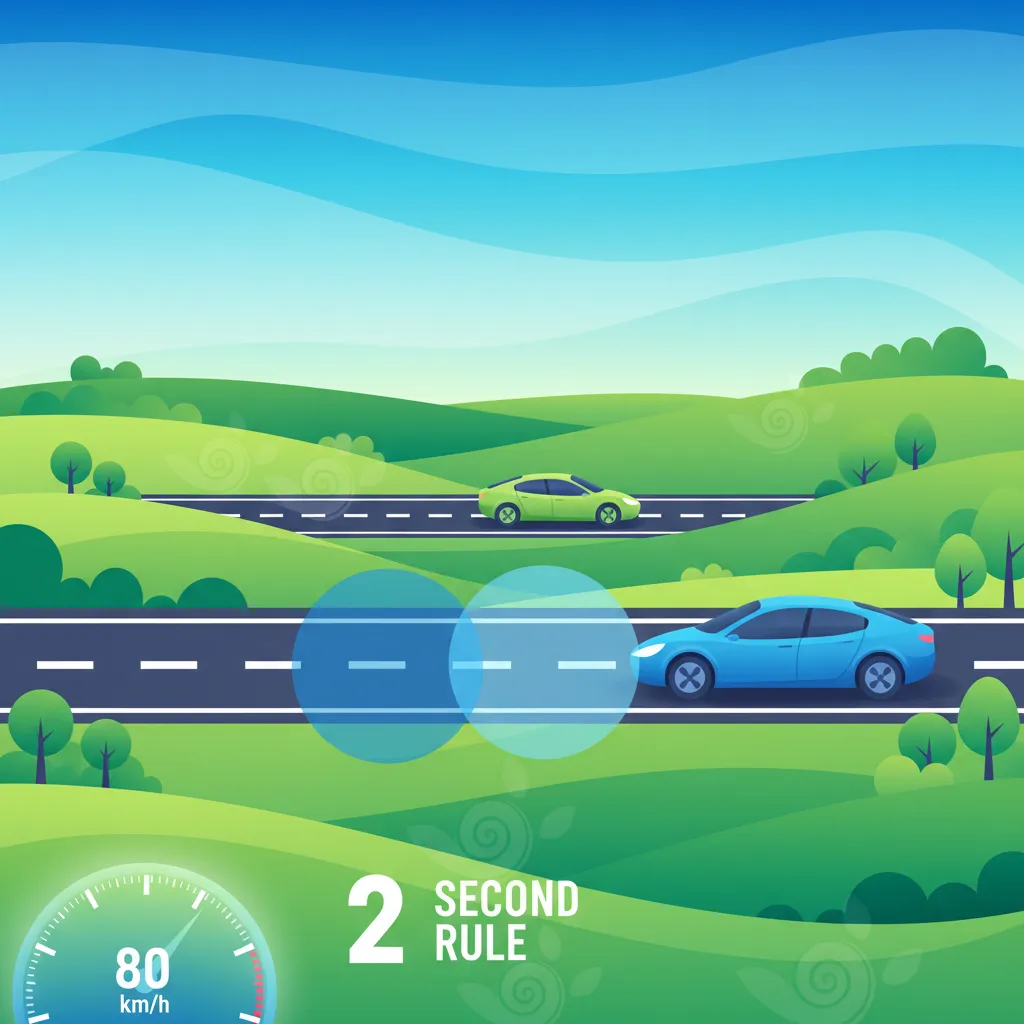
This lesson teaches practical methods for maintaining a safe buffer to the vehicle ahead, with a primary focus on the universally recommended 'three-second rule'. You will learn how to apply this rule by picking a fixed point and counting the seconds until you pass it. The content also explains why this distance must be increased significantly in adverse conditions such as rain, snow, or when following large vehicles that obstruct your view.

This lesson explains how to identify and interact with various types of mopeds and other low-speed vehicles common on Swedish roads. You will learn the difference between Class I and Class II mopeds and their place on the road, as well as how to recognize A-tractors by their LGF (långsamtgående fordon) sign. The key focus is on managing the large speed differential and making safe judgments when deciding to overtake.

This lesson focuses on the three fundamental inputs for controlling a car: steering, acceleration, and braking. You will learn the correct hand positioning on the steering wheel for maximum control and techniques for smooth, progressive application of the gas and brake pedals. The content explains how these inputs affect the vehicle's balance and stability, forming the basis for all advanced driving and maneuvering techniques.
This lesson focuses on the high level of caution required when driving in residential areas. You will learn about the rules for special zones like 'gångfartsområde' (walking speed area) and the need to navigate around speed calming measures like speed bumps. The central theme is anticipating unpredictable behavior from residents, especially children, and managing the risks posed by parked cars that severely limit visibility.
Learn practical strategies for improving fuel economy by understanding the role of proper vehicle loading and maintaining correct tire pressure. This lesson covers how these factors influence rolling resistance and overall efficiency for the Swedish Category B theory test.
This lesson focuses on the two most significant actions affecting fuel consumption: acceleration and braking. You will learn that aggressive driving with rapid acceleration and hard braking wastes significant amounts of fuel. The content teaches the technique of gentle, steady acceleration and a forward-planning approach to driving, where you look far ahead to anticipate traffic light changes and slowdowns, allowing you to decelerate by simply releasing the accelerator (motor braking).
This lesson explains the relationship between engine speed (RPM) and fuel consumption. You will learn the eco-driving principle of shifting to a higher gear as early as possible without straining the engine, keeping the RPMs in the most efficient range. The content covers how modern engines are designed to operate effectively at low revs and how this technique significantly reduces fuel use, noise, and engine wear.

This lesson covers the simple yet vital pre-drive checks that are the driver's responsibility. You will learn the step-by-step process for a 'safety control' (säkerhetskontroll), which includes checking tire pressure and tread depth, verifying that all lights are working, and checking the levels of critical fluids like engine oil, coolant, brake fluid, and windshield washer fluid. Performing these checks regularly helps ensure your vehicle is in a safe condition to drive.
This lesson covers strategies for driving safely when visibility is compromised. You will learn the correct use of different lighting systems: when to use low beams, high beams (helljus), and how to avoid dazzling other drivers. The lesson also explains the specific regulations for using front and rear fog lights and provides techniques for navigating safely in dense fog or heavy precipitation by reducing speed and using the road edge as a guide.
This lesson reinforces the core safety principle of adapting your driving to the prevailing weather conditions. You will learn why you must significantly reduce speed in heavy rain to avoid aquaplaning, how strong crosswinds can affect vehicle stability, and why reduced visibility in fog necessitates slower speeds and greater following distances. The goal is to instill a proactive approach to risk management whenever the weather is less than ideal.
This lesson addresses the wasteful practice of engine idling (tomgångskörning). You will learn about the common local regulations in Sweden that typically prohibit idling for more than one minute. The content explains that a modern engine consumes more fuel idling than it does to restart, and discusses the benefits of automatic start-stop systems found in many newer cars, which help reduce emissions and fuel use in city traffic.
This lesson focuses on the high level of caution required when driving in residential areas. You will learn about the rules for special zones like 'gångfartsområde' (walking speed area) and the need to navigate around speed calming measures like speed bumps. The central theme is anticipating unpredictable behavior from residents, especially children, and managing the risks posed by parked cars that severely limit visibility.
This lesson teaches practical methods for maintaining a safe buffer to the vehicle ahead, with a primary focus on the universally recommended 'three-second rule'. You will learn how to apply this rule by picking a fixed point and counting the seconds until you pass it. The content also explains why this distance must be increased significantly in adverse conditions such as rain, snow, or when following large vehicles that obstruct your view.
This lesson focuses on the three fundamental inputs for controlling a car: steering, acceleration, and braking. You will learn the correct hand positioning on the steering wheel for maximum control and techniques for smooth, progressive application of the gas and brake pedals. The content explains how these inputs affect the vehicle's balance and stability, forming the basis for all advanced driving and maneuvering techniques.
This lesson addresses the significant danger of driving while tired. You will learn to recognize the warning signs of fatigue, such as frequent yawning, difficulty focusing, and heavy eyelids. The content explains that fatigue severely impairs reaction time and decision-making, and discusses the concept of 'microsleep'. The only effective countermeasure is rest, and the lesson emphasizes the importance of planning long trips to include regular breaks.
Find clear answers to common questions learners have about Vehicle Load Management and Aerodynamics. Learn how the lesson is structured, which driving theory objectives it supports, and how it fits into the overall learning path of units and curriculum progression in Sweden. These explanations help you understand key concepts, lesson flow, and exam focused study goals.
In Sweden, as everywhere, extra weight increases fuel consumption. For every 50 kg of extra weight, fuel consumption can increase by approximately 1-2%. This is because the engine needs more energy to accelerate and maintain speed. The Swedish theory exam often tests awareness of this fact, particularly in relation to eco-driving principles.
A roof box significantly increases aerodynamic drag, acting like a sail. This can reduce fuel efficiency by as much as 10-20%, especially at higher speeds on motorways. It's crucial to remember to remove roof racks or boxes when not in use to save fuel and reduce wear, a common point in Swedish driving theory questions about 'sparsam körning' (economical driving).
While not directly related to aerodynamics in the same way a roof box is, maintaining the correct tire pressure is vital for reducing rolling resistance. Underinflated tires deform more, requiring more energy to roll, thus increasing fuel consumption and wear. Correct pressure, as recommended by the vehicle manufacturer, helps optimize efficiency and is a key eco-driving practice tested in the Swedish theory exam.
Swedish traffic regulations (Trafikförordning) emphasize that the vehicle's load must not obstruct visibility, affect steering, or be a safety hazard. While specific weight limits depend on the vehicle, overloading is illegal. Regarding external carriers, they must be securely attached and not unduly increase drag or create noise pollution. Eco-driving principles, which include managing load and aerodynamics for efficiency, are important for the theory test.
Yes, for optimal fuel efficiency and to reduce unnecessary drag, it's best practice to remove roof racks or boxes when they are not in use, regardless of distance. Even an empty rack creates some aerodynamic resistance. This habit aligns with the eco-driving principles you'll encounter in the Swedish Category B theory test.