
Mastering corners is crucial for safe and enjoyable motorcycle riding. This lesson delves into the physics of cornering, teaching you how to select the optimal line through a bend and use your body weight effectively. It builds upon basic motorcycle control principles, preparing you for more complex riding scenarios and specific exam questions on cornering techniques.

Navigating corners safely and efficiently is a fundamental skill for every motorcyclist. This lesson delves into the science and art of cornering, exploring the physical forces at play, the optimal path through a bend, and how your body positioning can enhance stability and control. Mastering these principles is crucial for advanced riding skills, ensuring your safety on Swedish roads, and achieving a successful outcome in your Swedish Category A motorcycle theory exam.
Motorcycles defy gravity to turn, relying on a delicate balance of forces. Understanding these core physical principles is essential for predicting how your bike will react and for maintaining control in a variety of situations.
Centripetal force is the invisible hand that pulls your motorcycle towards the center of a curve, keeping it from flying off in a straight line. This force is directly proportional to your motorcycle's mass and the square of its velocity, and inversely proportional to the radius of the curve. This means that a faster speed or a tighter curve demands significantly more centripetal force. If the required centripetal force exceeds the available grip, your motorcycle will slide outwards.
The inward force required to keep a moving object, such as a motorcycle, on a curved path. It is calculated as mass × velocity² / radius.
In practical terms, this concept dictates how fast you can safely enter and exit a corner. Excessive speed into a tight bend is the most common reason for a loss of control, as the tires simply cannot generate enough lateral grip to maintain the required centripetal force.
Every motorcycle tire has a finite amount of grip, which can be thought of as a "friction circle" or "grip envelope." This represents the maximum combined longitudinal (braking and acceleration) and lateral (cornering) forces the tire can generate before it begins to slip. Imagine a circle: any point within the circle represents a safe combination of forces, but pushing beyond its perimeter will result in a loss of traction.
When you are braking heavily, a large portion of the friction circle is used for longitudinal grip, leaving less for lateral grip to turn. Similarly, accelerating hard during a turn consumes lateral grip, which can cause the rear wheel to slide. Effective cornering requires you to manage your speed and apply forces smoothly, ensuring you stay within the tire's available grip at all times. This circle shrinks significantly on wet or low-grip surfaces, demanding even more careful management.
To generate the necessary centripetal force and counterbalance the motorcycle's tendency to fall, you must lean the bike into the turn. The lean angle is the angle between the motorcycle’s vertical axis and the road surface. This angle is directly related to your speed and the radius of the turn. A faster speed or a tighter turn requires a greater lean angle.
The angle between the motorcycle's plane and the vertical axis, necessary to balance centripetal force with gravitational force during a turn.
However, there are limits to how much a motorcycle can lean. Exceeding the tire's maximum slip angle or the motorcycle's physical clearance (e.g., scraping hard parts) will lead to a loss of control. Proper lean angle management is crucial for maintaining stability and staying within your lane. Rider body positioning plays a significant role in reducing the required geometric lean angle of the bike itself, enhancing safety.
Load transfer is the redistribution of weight (or normal force) between your motorcycle's front and rear tires, and from side to side. This occurs naturally during acceleration, braking, and cornering.
Understanding load transfer allows you to strategically manage grip. For instance, braking before a turn maximizes front grip for precise steering, while smooth throttle application on exit helps settle the rear without overwhelming the front tire.
The "line" you choose through a corner is your motorcycle's trajectory on the road. An optimal line minimizes the required steering angle and lean, maximizes cornering speed, and most importantly, enhances safety by maintaining lane discipline and providing a clear view of the road ahead. The ideal line is generally described by three points: the entry, the apex, and the exit.
The entry point is where you begin to commit to the turn. This involves positioning your motorcycle on the road, adjusting your speed, and preparing your body. For most corners, especially those without obstructions or unique hazards, you will typically approach from the outer edge of your lane. This broadens your view through the turn and allows for a larger turning radius initially.
Before entering the corner, all significant braking should be completed while the motorcycle is upright and travelling in a straight line. This maximises available grip for the front tire, crucial for steering, and prevents instability that can arise from braking while leaned over.
Swedish Traffic Regulation § 31 (Speed adaptation): You must adapt your speed to road, traffic, and weather conditions. This means reducing speed before entering a corner, especially on wet or slippery surfaces.
The apex is the innermost point of your trajectory through the corner. Depending on the type of corner and your riding goals, the apex can be "early," "mid," or "late."
For road riding, a late apex is almost always preferred due to its inherent safety benefits, providing a better view and a greater margin for error. Your chosen apex should always allow you to stay well within your lane.
Swedish Traffic Regulation § 6 (Lane discipline): You must always drive your vehicle within the lane you occupy. Cutting corners across the centre line or into an oncoming lane is illegal and extremely dangerous.
The exit point is where your motorcycle straightens up and begins to accelerate out of the turn. An optimal line will allow you to gradually increase throttle as you un-lean the bike, using the available grip to drive smoothly out of the corner. By this point, your line should be naturally heading towards the outer edge of your lane, preparing you for the next straight or subsequent turn. Smooth, controlled acceleration helps to stabilize the motorcycle.
The ideal line is not static; it requires continuous adjustment based on conditions:
Your body is an integral part of the motorcycle's overall mass and control system. Strategic body positioning allows you to influence the combined center of mass (CoM) of the bike and rider, reducing the lean angle required of the motorcycle itself and improving tire grip.
For most street riding, a subtle shift in your body position is sufficient. By shifting your hips and torso slightly to the inside of the turn, you effectively move the combined CoM further into the corner. This allows the motorcycle to maintain the same turning radius with less lean from the bike itself. This reduced bike lean angle provides a greater safety margin, keeping more of the tire's contact patch available for grip and reducing the risk of scraping hard parts.
Key elements of effective body positioning include:
Remember to keep both feet firmly on the foot-rests while riding. Swedish Traffic Regulation § 5 states that both feet must be placed on the foot-rests while the motorcycle is in motion, unless needed for balance (e.g., stopping).
Counter-steering is the primary method by which motorcycles are steered at speeds above approximately 30 km/h. It often feels counter-intuitive to new riders, but it is an essential technique for precise and rapid directional changes.
A brief, opposite-direction steering input (pushing the handlebar on the side of the desired turn) that causes the motorcycle to lean into the intended direction, thereby initiating the turn.
Here's how it works:
Counter-steering allows for quick and controlled changes in lean angle, making it indispensable for navigating corners efficiently and for emergency maneuvers. Without conscious counter-steering, a motorcycle will respond slowly or not at all to attempts to "steer" into a turn at speed.
Even experienced riders can fall into common cornering traps. Recognizing and correcting these habits is vital for improving safety.
The principles of cornering remain the same, but their application must be adapted to different scenarios.
The friction circle dramatically shrinks on wet or slippery roads.
Limited visibility reduces your ability to perceive the road ahead and react to hazards.
Tight corners in urban areas demand precision and awareness.
These corners require smooth, sustained commitment.
Adding weight changes the motorcycle's dynamics.
The Swedish Road Traffic Regulations (RVK) are designed to promote safety, and cornering techniques are directly linked to these legal mandates:
Statistics consistently show that a significant percentage of motorcycle accidents in corners are due to excessive speed for the conditions or incorrect braking. By internalizing the physics of cornering, practicing optimal line selection, and utilizing effective body positioning, you dramatically reduce your risk of a crash. Confidence in these techniques also reduces cognitive load, allowing you to react faster and more effectively to unforeseen hazards.
Lesson content overview
Explore all units and lessons included in this driving theory course.
Explore search topics learners often look for when studying Cornering Physics, Line Selection, and Body Positioning. These topics reflect common questions about road rules, driving situations, safety guidance, and lesson level theory preparation for learners in Sweden.
Browse additional driving theory lessons that cover connected traffic rules, road signs, and common driving situations related to this topic. Improve your understanding of how different rules interact across everyday traffic scenarios.
Explore advanced physics principles behind motorcycle cornering, including detailed explanations of lean angle, traction limits, and how these forces affect stability. Understand the dynamics that enable precise control through various types of turns for safer riding.
This lesson breaks down the three pillars of motorcycle control: balance, throttle, and steering. You will learn how the motorcycle maintains stability at speed and how to control it at low speeds, the art of smooth and precise throttle application, and the essential technique of counter-steering to initiate turns. Understanding how these three inputs work together is the first step toward becoming a smooth, confident, and safe rider who is truly in control of their machine.
This lesson provides a deeper understanding of the factors that affect a motorcycle's stability and grip. You will learn how acceleration and braking cause load transfer between the front and rear wheels, affecting the size of the tire contact patch and available traction. This knowledge is crucial for managing grip on various surfaces, especially in wet or loose conditions, and for understanding how carrying a passenger or luggage impacts the bike's handling.

This lesson delves into the dynamics of cornering on a two-wheeled vehicle, introducing the essential technique of counter-steering to initiate turns efficiently. It explains the importance of choosing a proper line, managing speed before the turn, and looking through the corner to the exit. The content also provides guidance on how to recognize and correct for a loss of traction or a skid.

This lesson teaches the physical skill of applying maximum braking force while maintaining control of the motorcycle. You will learn the technique of progressive braking to avoid locking the wheels and how to react if a skid does occur. Understanding how to manage both front and rear wheel skids and how an ABS system assists in these situations gives you the best possible chance of stopping safely and quickly in an emergency.

This lesson details the technique for performing a quick, decisive swerve to avoid an obstacle in your path. You will learn the correct positive counter-steering inputs required to make the motorcycle change direction rapidly while remaining stable. The lesson also addresses the dangerous phenomenon of 'target fixation' and teaches you to look where you want to go, a critical mental skill for successful evasive maneuvers.

This lesson explores the critical relationship between the rider's body and the moped's stability. It explains how to maintain balance using correct posture and weight distribution for different maneuvers. The content covers basic steering inputs and how body positioning, such as leaning into turns, directly influences the vehicle's handling and responsiveness.
This lesson provides a detailed guide to motorcycle braking, explaining the roles of the front and rear brakes and how to use them effectively in combination. You will learn about the physics of weight transfer during deceleration, how to apply brakes progressively to avoid locking a wheel, and techniques for emergency stops. The content also covers the function of ABS and how to adapt your braking strategy for different road surfaces and conditions, a vital skill for every rider.

This lesson teaches the correct methodology for negotiating curves and turns of varying sharpness. You will learn the principle of 'slow in, fast out,' involving braking before the curve and gently accelerating through it to maintain stability and grip. The lesson also covers how to choose the correct line (placering) through a bend and how to use your vision effectively to look far ahead for a safe and controlled passage.

This lesson introduces the core concepts of defensive riding, which involves anticipating potential dangers and actively managing the space around your motorcycle. You will learn the technique of continuously identifying and maintaining an 'escape path'—an open space to move into if a threat suddenly appears. This proactive, forward-thinking approach dramatically reduces the chances of being trapped in a dangerous situation and is a key skill of advanced, safe riders.

This lesson explains the significant effect wind can have on a motorcycle and rider. You will learn how to anticipate and react to crosswinds and sudden gusts using subtle counter-steering inputs and adjustments in body position to maintain your line. The content also covers how to deal with the turbulence created by large vehicles, a common and unsettling experience, ensuring you can remain stable and in control even on the windiest days.
Learn how to adapt your cornering line selection and body positioning for different Swedish road environments including urban areas, rural roads, and motorways. Understand how road conditions and traffic density influence the optimal approach to safe and efficient cornering.

This lesson prepares you for the specific challenges of riding on rural roads in Sweden. You will learn how to read the road ahead for changes in surface quality, approach blind corners safely, and adjust your speed for narrow lanes with no shoulder. The content also covers how to anticipate and safely interact with slow-moving agricultural vehicles and the potential for wild animals on the road, ensuring you are prepared for the unpredictable nature of country riding.
This lesson focuses on the specific techniques required for riding in busy city and town environments. You will learn how to maintain correct lane positioning amidst dense traffic, navigate complex intersections with multiple signals, and manage the motorcycle at low speeds in stop-and-go conditions. Emphasis is placed on heightened awareness of pedestrians, cyclists, and vehicles making sudden maneuvers, which are common hazards in urban settings.

This lesson focuses on the variety of road markings used on Swedish roads and their meaning for motorcyclists. You will learn the difference between solid and broken lines regarding overtaking, how to position yourself correctly at intersections based on markings, and how to interpret symbols painted on the road surface. Adhering to these markings is essential for maintaining correct lane discipline and ensuring predictability for other road users.

This lesson teaches the crucial skill of adapting your speed to the dynamic and often congested conditions of urban riding. You will learn to modulate your speed smoothly in response to traffic flow, pedestrian activity, and complex intersections to maintain safety and control. Techniques covered include using engine braking effectively, anticipating the actions of other road users, and selecting a speed that maximizes your reaction time in a high-density environment.

This lesson provides practical techniques for dealing with unavoidable road surface hazards. You will learn how to approach and cross obstacles like potholes, manhole covers, and patches of debris with minimal disruption to the motorcycle's stability. The content covers adjusting your speed, choosing the best line, and using your body to absorb impacts, helping you navigate the imperfections of real-world roads safely.
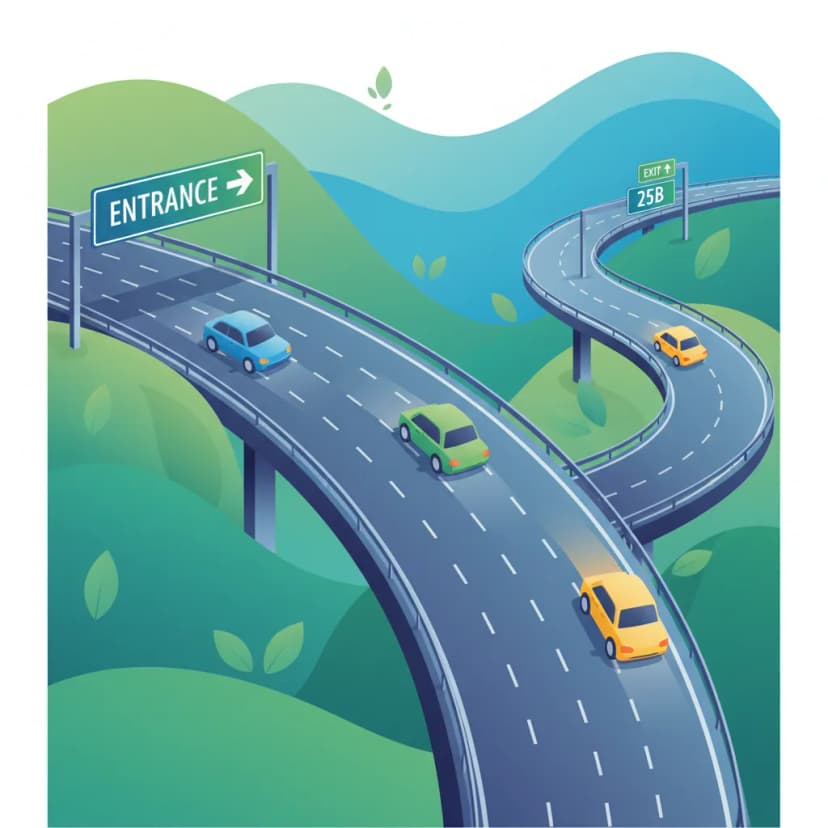
This lesson provides a step-by-step guide to motorway riding. You will learn the correct technique for accelerating on an on-ramp and merging smoothly into high-speed traffic. The content also covers maintaining proper lane discipline, executing safe overtakes, keeping a safe following distance at speed, and planning for your exit well in advance to ensure a smooth and stress-free experience on Sweden's fastest roads.
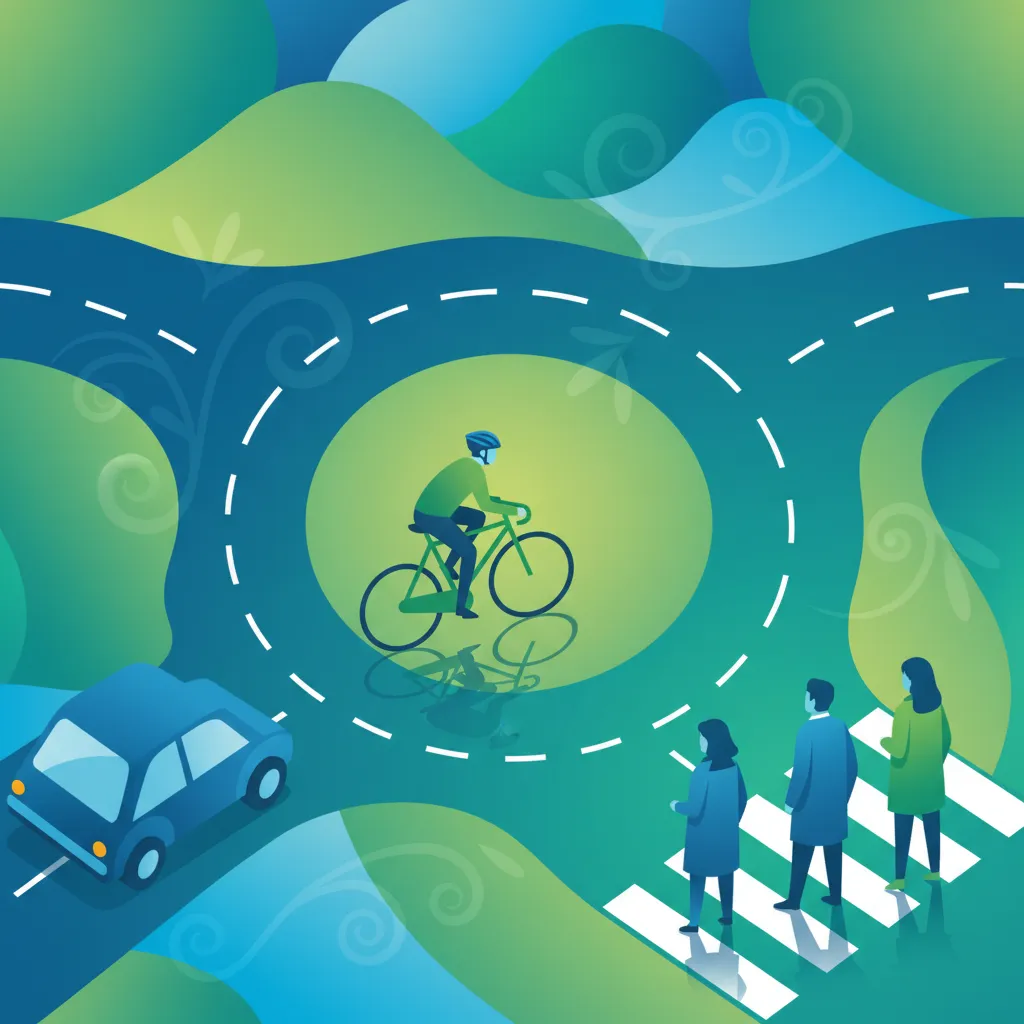
This lesson provides detailed guidance on navigating complex traffic points such as signalized intersections, multi-lane roundabouts, and pedestrian crossings. You will learn the correct procedures for entering and exiting roundabouts, the specific rules for yielding to pedestrians and cyclists at designated crossings, and how to interpret complex traffic light signals. These skills are vital for safe urban and suburban riding, where interaction with vulnerable road users is frequent.
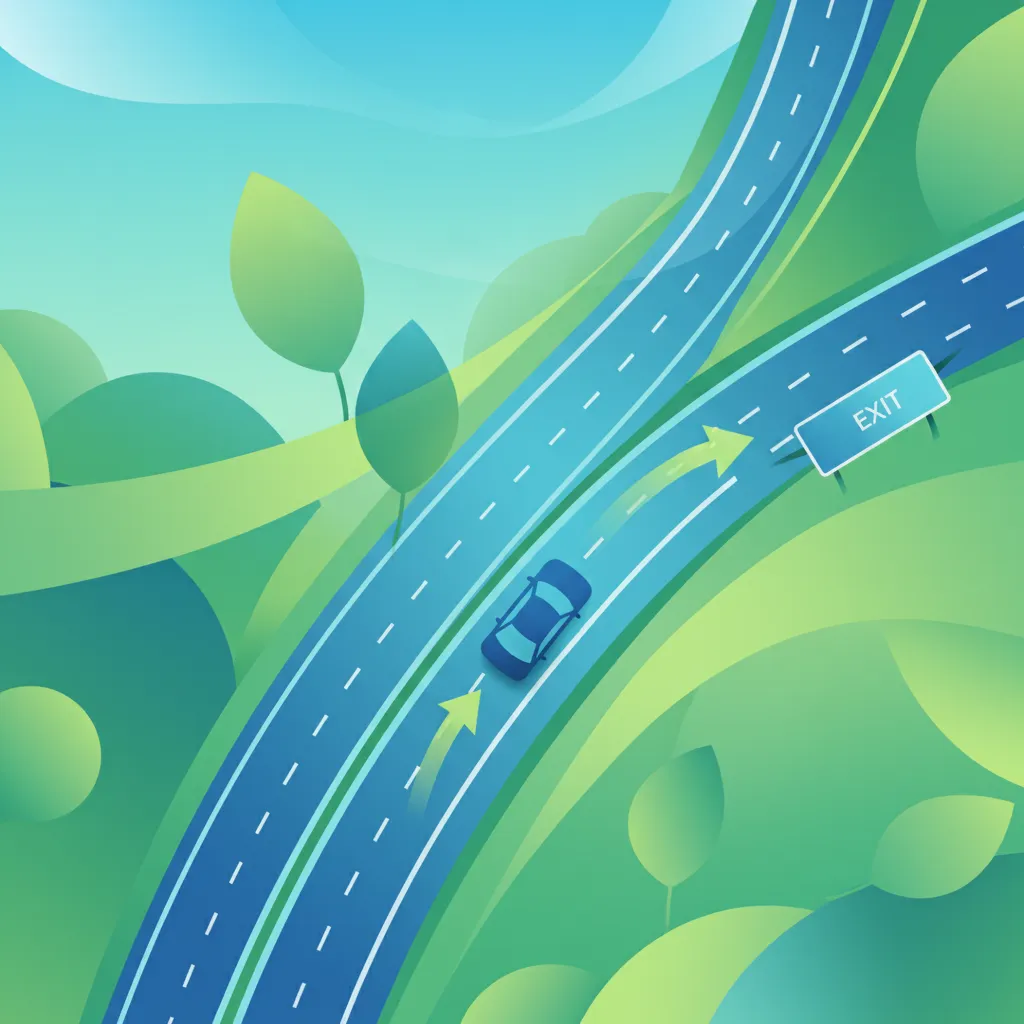
This lesson provides clear guidance on selecting the appropriate lane on multi-lane roads to match your intended direction of travel. It covers the rules and best practices for moving into turning lanes, positioning for overtakes, and maintaining a steady course. The focus is on making early, predictable decisions to ensure smooth integration with surrounding traffic.
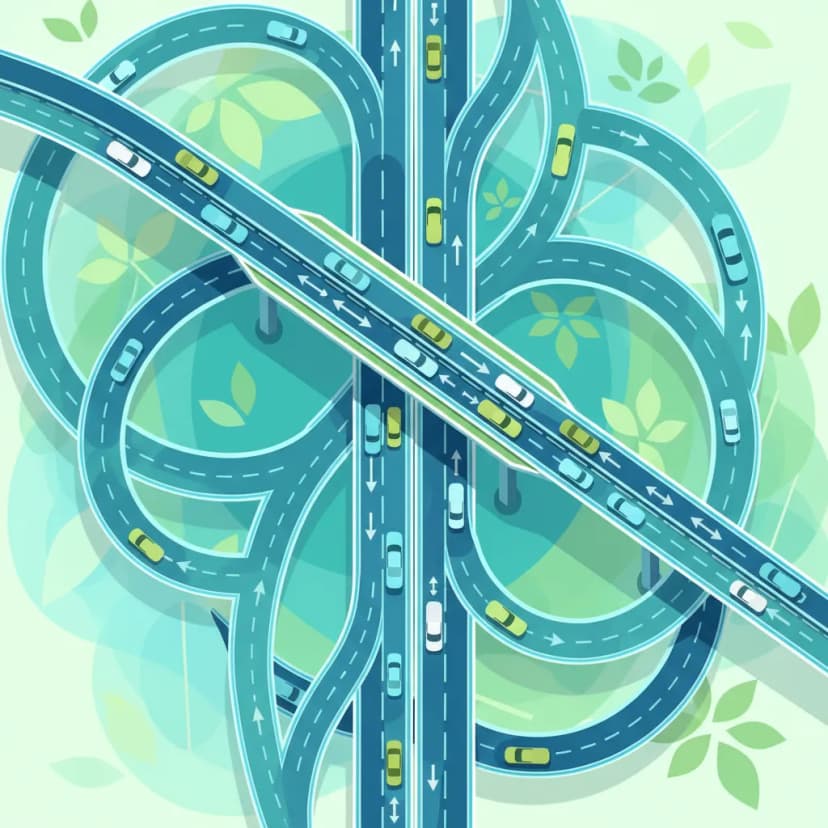
This lesson tackles the challenge of navigating some of the most complex road features, such as large multi-lane roundabouts and grade-separated interchanges. You will learn the importance of advance planning, choosing the correct lane on approach, clear signaling, and comprehensive observation to safely move through these busy areas. Mastering these junctions is a key indicator of an advanced and competent rider who can handle any road layout.

This lesson focuses on strategies to make yourself more visible to other road users, a critical factor in motorcycle safety. You will learn how to use lane positioning strategically to stay out of other drivers' blind spots and to maximize your own line of sight through corners and intersections. The content also covers the effectiveness of high-visibility and reflective clothing, as well as the correct use of lights to ensure you are seen in all conditions.
Find clear answers to common questions learners have about Cornering Physics, Line Selection, and Body Positioning. Learn how the lesson is structured, which driving theory objectives it supports, and how it fits into the overall learning path of units and curriculum progression in Sweden. These explanations help you understand key concepts, lesson flow, and exam focused study goals.
Selecting the correct line—entry, apex, and exit—is vital for maintaining a safe speed, ensuring stability, and maximizing your visibility through the corner. An optimal line allows for a smoother transition, reduces the need for excessive leaning, and provides a larger margin of safety. Incorrect line selection can lead to reduced visibility, insufficient lean angle, or even entering the oncoming lane, posing significant risks.
Your body weight acts as a control input. By shifting your weight, you assist the motorcycle in leaning and turning. For a standard lean, you'll typically move your upper body slightly inside the corner while keeping your hips over the bike. This movement helps counteract the centrifugal force, keeps the bike more upright for better traction, and enhances overall stability and control.
The primary forces are centrifugal force (pushing the motorcycle outwards) and the centripetal force provided by tire friction, which keeps the motorcycle turning. The lean angle of the motorcycle balances these forces. Traction is the key; exceeding the tire's available grip will result in a skid or fall. Managing speed is therefore essential to manage these forces.
The entry is where you prepare to turn, adjusting speed and positioning. The apex is the innermost point of the turn. The exit is where you straighten the motorcycle and accelerate out of the corner. A common safe technique is to approach wide, turn in towards the apex, and then accelerate out towards the opposite side of the road.
Yes, but it needs to be done correctly. Hanging off the inside of the bike, with your torso and head looking through the turn, helps to keep the motorcycle more upright for a given lean angle. This improves tyre grip and stability. It’s a coordinated effort between your body position and the bike's lean.
Focus on understanding the principles covered in this lesson. The test will present scenarios requiring you to identify the safest line, understand speed adjustments, and know how rider positioning affects control. Practice questions related to cornering, looking for explanations that emphasize safety, visibility, and adherence to road rules.