
This lesson dives into managing your motorcycle's power through effective acceleration and gear shifting. Understanding these techniques is crucial for smooth riding, efficient fuel consumption, and confident control, especially when preparing for the Swedish Category A theory exam.

Effective management of your motorcycle's power through acceleration and gear shifting is fundamental to safe and proficient riding. This lesson delves into the critical techniques for coordinating the throttle, clutch, and gear shift lever to ensure optimal performance, control, and adherence to Swedish traffic regulations. Understanding these dynamics allows you to maintain stability, prevent wear on components, and react effectively to diverse road conditions.
This knowledge builds upon foundational concepts like throttle control, braking techniques, and cornering physics, providing the practical skills necessary for advanced riding and hazard management.
At the heart of motorcycle power delivery lies the concept of the "powerband." This crucial range of engine speeds, or revolutions per minute (RPM), is where your engine produces its most effective combination of torque and horsepower. Operating within this optimal RPM range is key to achieving responsive acceleration, efficient fuel consumption, and maximum control.
The powerband represents the RPM range where your motorcycle engine is most efficient and powerful. It is not a single point but a continuous band on the engine's performance curve, typically located in the mid-to-high RPM range, though this varies significantly between different engine types. Staying within this zone ensures that adequate power is readily available for acceleration, maintaining speed on inclines, or executing maneuvers.
For instance, an engine might produce its peak torque at 5,000 RPM and peak horsepower at 9,000 RPM. Its usable powerband would likely fall somewhere between these points, allowing for strong acceleration when needed.
Motorcycle engines often exhibit different characteristics across their RPM range, leading to varying powerband profiles:
Choosing the optimal RPM range depends on your riding objective. For spirited riding and quick responses, keeping the engine in its mid-to-high powerband is ideal. For fuel-efficient cruising, you'll generally select a gear that keeps the RPM slightly above the lowest point of the usable powerband, where the engine is running smoothly without lugging.
Operating too far below the powerband (lugging the engine) means insufficient torque, sluggish response, and potential engine strain. Operating above the red-line (over-revving) provides no additional usable power, risks engine damage, and is legally prohibited.
Familiarize yourself with your motorcycle's tachometer and learn to recognize the feel and sound of your engine operating within its optimal powerband. This intuition is invaluable for smooth and controlled riding.
Gear ratios are fundamental to how your motorcycle converts engine power into motive force at the rear wheel. A clear understanding of these ratios, combined with strategic gear selection, allows you to effectively manage torque and speed for any riding situation.
Each gear in your motorcycle's transmission represents a different numerical relationship between the engine's crankshaft rotations and the rear wheel's rotations.
The gear lever, operated by your left foot, allows you to select these ratios. Most motorcycles use a "one down, four or five up" shift pattern, with neutral typically found between first and second gear.
Selecting the appropriate gear is a continuous process that depends on speed, road conditions, and your immediate intentions.
Swedish traffic law emphasizes the driver's responsibility to maintain full control of their vehicle at all times. This directly impacts gear selection.
The primary Swedish legal framework governing traffic rules and vehicle operation.
According to the Swedish Traffic Ordinance (Trafikförordning 3 kap., § 4), you must at all times maintain a gear appropriate for your speed and the prevailing conditions to ensure safe operation. This means avoiding both excessively high gears that cause engine lugging and dangerously low gears that lead to over-revving or uncontrolled engine braking.
Furthermore, Trafikförordning 3 kap., § 6 explicitly prohibits coasting in neutral on inclines. This rule ensures that the rider always has immediate access to engine power for acceleration or engine braking, maintaining full control of the vehicle's speed and direction.
The seamless interaction between the clutch and throttle is the hallmark of a skilled motorcyclist. Mastering this coordination is essential for smooth starts, effortless gear changes, and maintaining stability in all riding conditions.
The clutch, operated by your left hand, acts as the intermediary between the engine and the transmission. It allows you to:
Proper clutch use prevents sudden torque spikes that can destabilize the motorcycle, especially during starts or shifts on low-traction surfaces.
Throttle control, managed by your right hand, dictates the amount of power your engine produces. Smooth, precise throttle inputs are vital for maintaining traction and stability.
In congested traffic or near vulnerable road users, sudden throttle spikes are considered reckless and can be hazardous. Swedish law (Trafikförordning 3 kap., § 5) requires drivers to operate their vehicles in a manner that does not endanger others.
The synchrony between clutch and throttle is most evident during gear changes:
Roll off the throttle slightly.
Simultaneously pull the clutch lever in completely and flick the gear lever up.
As the new gear engages, immediately and smoothly release the clutch lever while simultaneously rolling back onto the throttle. The goal is to match engine RPM to the new gear's speed.
The key is to minimize the time the clutch is disengaged and to ensure a smooth transition of power. Any abruptness in clutch release or throttle input will result in a jerky shift, reducing stability and increasing wear on the drivetrain.
Beyond basic up- and down-shifting, advanced techniques like rev-matching and effective engine braking elevate your control, safety, and riding smoothness. These skills are particularly crucial in dynamic situations like cornering or descending steep grades.
Rev-matching, often referred to as "blipping the throttle," is the act of briefly increasing engine RPM with a quick twist of the throttle (a "blip") while the clutch is disengaged during a down-shift. The purpose is to match the engine speed to the higher RPM it will be at in the lower gear before the clutch is re-engaged.
Briefly increasing engine RPM with the throttle during a down-shift while the clutch is disengaged, to synchronize engine speed with the wheel speed in the lower gear.
Why is rev-matching crucial?
Some modern motorcycles are equipped with electronic quick-shifters or auto-blippers that can perform this function automatically, allowing for clutch-less down-shifts. Even with these aids, understanding the principle remains vital.
Engine braking refers to the deceleration force created by the engine's resistance when the throttle is closed or when a lower gear is selected. It acts as a powerful supplementary braking system.
Engine braking is particularly useful for:
While highly effective, engine braking must be used judiciously. Excessive engine braking, especially without rev-matching or on low-traction surfaces, can cause the rear wheel to lock up, leading to a slide. Always balance engine braking with gentle application of the front and rear brakes, prioritizing smooth deceleration and maintaining traction. On extremely slippery surfaces like ice, minimize engine braking to avoid upsetting the bike.
Optimal gear selection is rarely static; it's a dynamic process that adapts to the specific demands of your environment. Understanding how to choose gears for different scenarios is a hallmark of an experienced rider.
Approaching a corner requires careful preparation, and gear selection plays a crucial role in maintaining stability and providing power for a smooth exit.
Hills present unique challenges that necessitate specific gear strategies.
Safe overtaking requires decisive acceleration, and proper gear selection is paramount.
While the focus is often on performance, gear selection also impacts fuel efficiency.
Adhering to specific regulations concerning acceleration and gear usage is not just about legal compliance; it's about ensuring your safety and the safety of other road users. The Swedish Traffic Ordinance (Trafikförordning) outlines key principles for responsible vehicle operation.
As previously mentioned, Trafikförordning 3 kap., § 4 mandates that drivers must operate their vehicle in a manner that allows for control at all times, including maintaining an appropriate gear for the prevailing speed and conditions.
A crucial safety regulation is found in Trafikförordning 3 kap., § 6, which prohibits coasting in neutral when the vehicle is moving, particularly on inclines.
Trafikförordning 3 kap., § 5 implies a general duty to avoid driving in a manner that poses a risk. Sudden or aggressive throttle applications, especially in urban environments, can fall under this.
Exceeding the engine's red-line—the maximum permissible RPM indicated on your tachometer—is not only damaging to the engine but is also covered by vehicle type approval regulations (Swedish vehicle type approval regulation 68/69). Over-revving indicates a lack of vehicle control.
Understanding common mistakes in acceleration and gear shifting can significantly improve your riding safety and technique. Many errors stem from a lack of coordination or awareness of the motorcycle's dynamics.
Applying the theoretical concepts of acceleration and gear shifting to practical riding scenarios is essential for developing safe and confident motorcycle control.
Setting: You're stopped at a traffic light in an urban area. It's raining, and the asphalt looks slick. You need to pull away smoothly and safely.
Correct Behavior:
Incorrect Behavior: Releasing the clutch too quickly or aggressively rolling on the throttle. This will likely cause the rear wheel to spin violently, leading to a loss of traction and potential fall, or a dangerous surge forward.
Reasoning: On slippery surfaces, the available traction (friction) is greatly reduced. Gentle and coordinated clutch-throttle inputs ensure that the torque delivered to the rear wheel never exceeds the available grip, maintaining stability and control.
Setting: You are on a rural road with a 5% uphill gradient, following a slow-moving vehicle at 45 km/h in 2nd gear. The road ahead is clear for an overtake.
Correct Behavior:
Incorrect Behavior: Attempting to overtake in 2nd gear by simply opening the throttle fully. While it will accelerate, the engine will be lugging under load, making the acceleration sluggish and extending the time spent in the opposing lane, thereby increasing risk.
Reasoning: Overtaking, especially uphill, requires immediate and strong acceleration. Downshifting to a lower gear maximizes the torque multiplication, ensuring the engine is operating in its optimal powerband for maximum thrust, allowing for a swift and safe maneuver.
Setting: You are approaching a sharp 90-degree right turn on a dry, curvy mountain road. Your current speed is 60 km/h in 3rd gear, and you anticipate needing to slow to 40 km/h for the turn.
Correct Behavior:
Incorrect Behavior: Remaining in 3rd gear and sharply rolling off the throttle, or downshifting without rev-matching. The sudden engine braking will cause an abrupt weight transfer to the front, potentially upsetting the bike's balance and risking rear-wheel lock-up, making the bike unstable through the corner.
Reasoning: Choosing the right gear for corner entry provides multiple benefits: it helps control speed through engine braking, positions the engine in a responsive part of the powerband for a strong exit, and with rev-matching, ensures smooth deceleration, preserving traction and stability.
Setting: You are descending a long, 10% grade on a motorway, cruising at 80 km/h in 5th gear. You want to maintain a safe speed without overheating your brakes.
Correct Behavior:
Incorrect Behavior: Remaining in 5th gear and relying solely on constant mechanical braking. This will quickly overheat your brake pads and fluid, leading to "brake fade" (loss of braking power), which can be extremely dangerous. Also, coasting in neutral is illegal and eliminates engine braking entirely.
Reasoning: Engine braking is a highly effective way to manage speed on descents. By shifting to a lower gear, you leverage the engine's internal resistance to slow the bike, significantly reducing the load on your conventional brakes and preventing dangerous overheating and fade.
Mastering acceleration and gear shifting is a core competency for any motorcyclist. It's about more than just speed; it's about control, safety, efficiency, and compliance with the law.
By diligently applying these principles, you will enhance your riding skill, significantly reduce risk, and contribute to safer roads for everyone.
Lesson content overview
Explore all units and lessons included in this driving theory course.
Explore search topics learners often look for when studying Acceleration, Gear Shifting, and Power Delivery. These topics reflect common questions about road rules, driving situations, safety guidance, and lesson level theory preparation for learners in Sweden.
Browse additional driving theory lessons that cover connected traffic rules, road signs, and common driving situations related to this topic. Improve your understanding of how different rules interact across everyday traffic scenarios.
Learn the theory behind smooth acceleration and efficient gear changes. This lesson explains clutch control, throttle coordination, and selecting the right gear to keep the engine in its optimal powerband for control and efficiency in Swedish traffic.
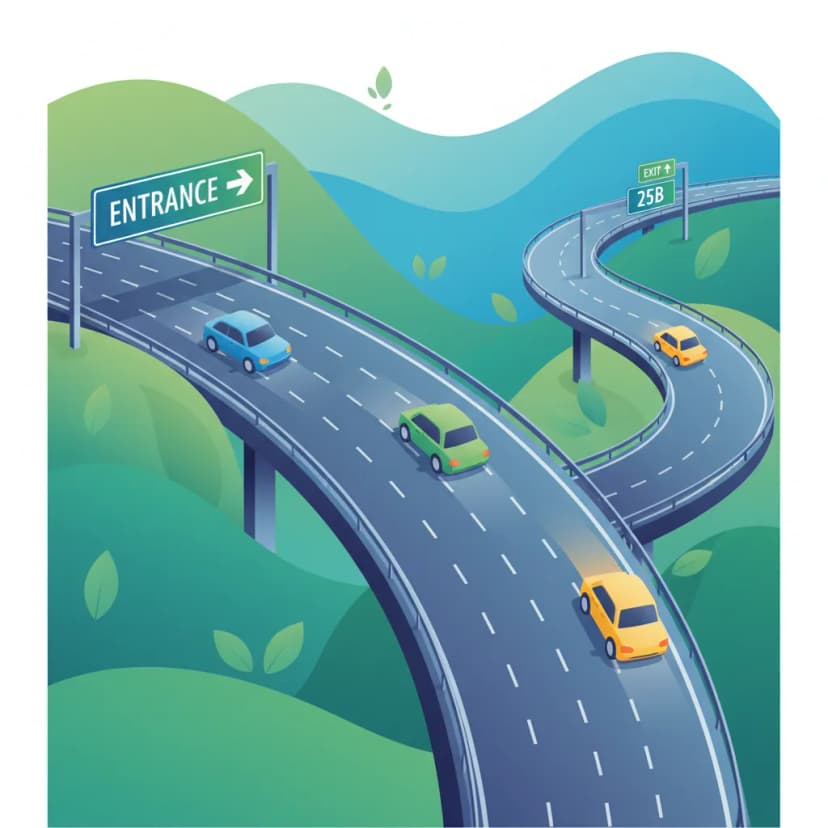
This lesson provides a step-by-step guide to motorway riding. You will learn the correct technique for accelerating on an on-ramp and merging smoothly into high-speed traffic. The content also covers maintaining proper lane discipline, executing safe overtakes, keeping a safe following distance at speed, and planning for your exit well in advance to ensure a smooth and stress-free experience on Sweden's fastest roads.
This lesson teaches the art of smooth throttle control, which is essential for predictable and safe riding. It explains how to apply gradual acceleration to seamlessly merge with traffic and maintain traction, especially on loose or wet surfaces. The goal is to develop a refined feel for the engine's response, allowing for precise speed adjustments in any situation.
This lesson provides a deeper understanding of the factors that affect a motorcycle's stability and grip. You will learn how acceleration and braking cause load transfer between the front and rear wheels, affecting the size of the tire contact patch and available traction. This knowledge is crucial for managing grip on various surfaces, especially in wet or loose conditions, and for understanding how carrying a passenger or luggage impacts the bike's handling.
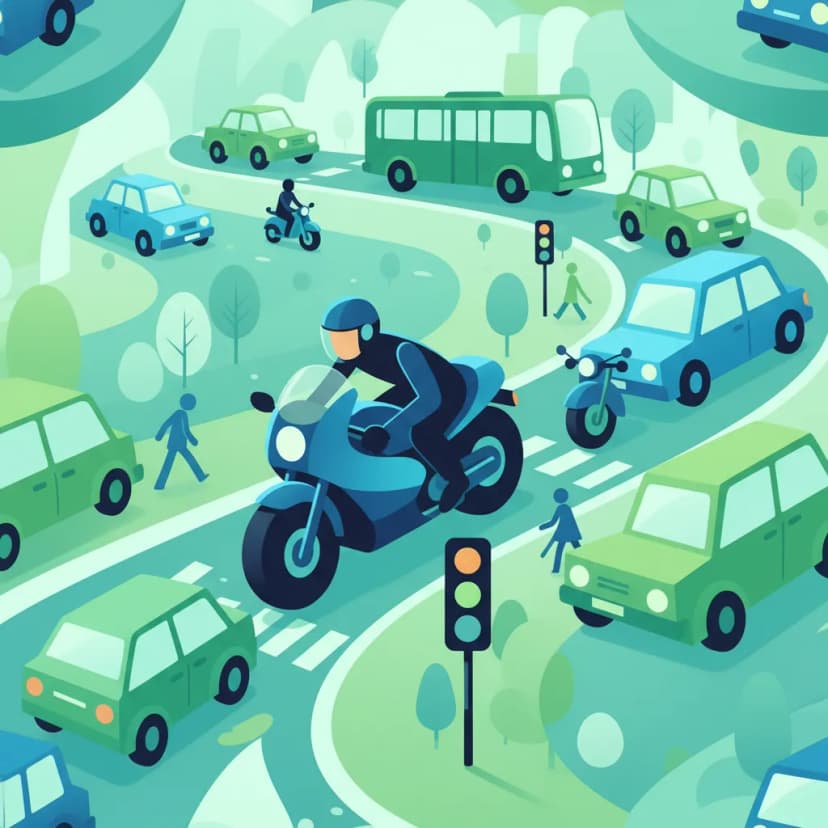
This lesson teaches the crucial skill of adapting your speed to the dynamic and often congested conditions of urban riding. You will learn to modulate your speed smoothly in response to traffic flow, pedestrian activity, and complex intersections to maintain safety and control. Techniques covered include using engine braking effectively, anticipating the actions of other road users, and selecting a speed that maximizes your reaction time in a high-density environment.
This lesson focuses on the unique demands of managing speed in high-speed environments like motorways. You will learn techniques for maintaining a steady, appropriate speed that matches the flow of traffic, how to perform smooth overtakes, and the importance of increasing your following distance. It also covers physical factors such as managing wind blast and maintaining stability when riding near large trucks, ensuring a safe and controlled high-speed riding experience.
This lesson breaks down the three pillars of motorcycle control: balance, throttle, and steering. You will learn how the motorcycle maintains stability at speed and how to control it at low speeds, the art of smooth and precise throttle application, and the essential technique of counter-steering to initiate turns. Understanding how these three inputs work together is the first step toward becoming a smooth, confident, and safe rider who is truly in control of their machine.
This lesson focuses on the two most significant actions affecting fuel consumption: acceleration and braking. You will learn that aggressive driving with rapid acceleration and hard braking wastes significant amounts of fuel. The content teaches the technique of gentle, steady acceleration and a forward-planning approach to driving, where you look far ahead to anticipate traffic light changes and slowdowns, allowing you to decelerate by simply releasing the accelerator (motor braking).
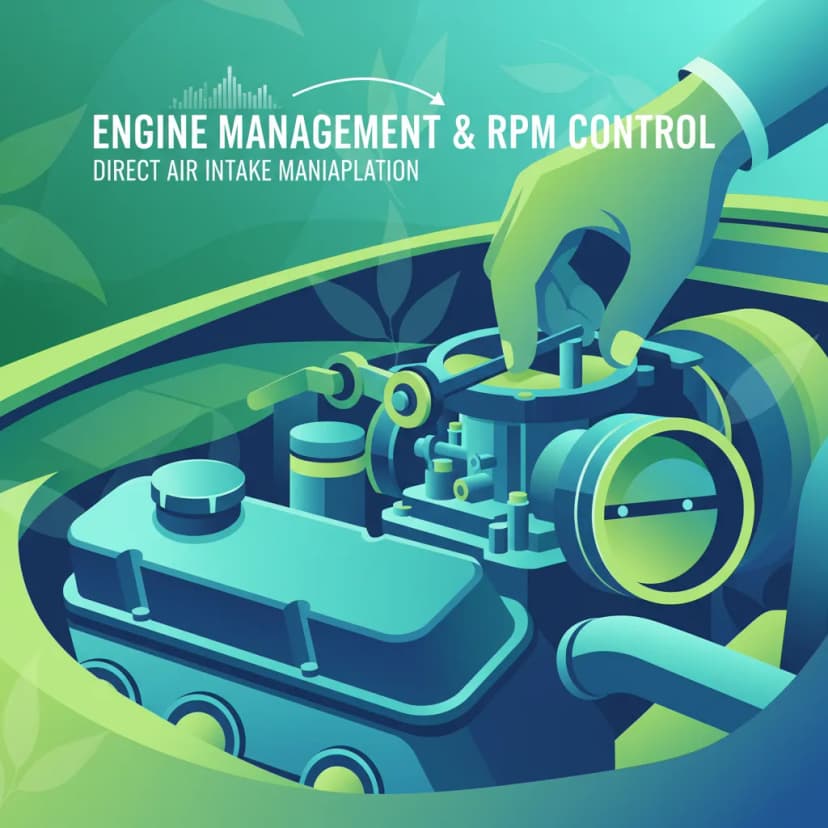
This lesson explains the relationship between engine speed (RPM) and fuel consumption. You will learn the eco-driving principle of shifting to a higher gear as early as possible without straining the engine, keeping the RPMs in the most efficient range. The content covers how modern engines are designed to operate effectively at low revs and how this technique significantly reduces fuel use, noise, and engine wear.

This lesson teaches the physical skill of applying maximum braking force while maintaining control of the motorcycle. You will learn the technique of progressive braking to avoid locking the wheels and how to react if a skid does occur. Understanding how to manage both front and rear wheel skids and how an ABS system assists in these situations gives you the best possible chance of stopping safely and quickly in an emergency.
This lesson focuses on the specific techniques required for riding in busy city and town environments. You will learn how to maintain correct lane positioning amidst dense traffic, navigate complex intersections with multiple signals, and manage the motorcycle at low speeds in stop-and-go conditions. Emphasis is placed on heightened awareness of pedestrians, cyclists, and vehicles making sudden maneuvers, which are common hazards in urban settings.
Explore how fundamental motorcycle dynamics influence acceleration and gear shifting. This lesson connects engine power delivery, gear selection, and rider control techniques to navigating various Swedish traffic situations safely and efficiently.
This lesson provides a deeper understanding of the factors that affect a motorcycle's stability and grip. You will learn how acceleration and braking cause load transfer between the front and rear wheels, affecting the size of the tire contact patch and available traction. This knowledge is crucial for managing grip on various surfaces, especially in wet or loose conditions, and for understanding how carrying a passenger or luggage impacts the bike's handling.
This lesson teaches the crucial skill of adapting your speed to the dynamic and often congested conditions of urban riding. You will learn to modulate your speed smoothly in response to traffic flow, pedestrian activity, and complex intersections to maintain safety and control. Techniques covered include using engine braking effectively, anticipating the actions of other road users, and selecting a speed that maximizes your reaction time in a high-density environment.
This lesson provides a step-by-step guide to motorway riding. You will learn the correct technique for accelerating on an on-ramp and merging smoothly into high-speed traffic. The content also covers maintaining proper lane discipline, executing safe overtakes, keeping a safe following distance at speed, and planning for your exit well in advance to ensure a smooth and stress-free experience on Sweden's fastest roads.
This lesson teaches the art of smooth throttle control, which is essential for predictable and safe riding. It explains how to apply gradual acceleration to seamlessly merge with traffic and maintain traction, especially on loose or wet surfaces. The goal is to develop a refined feel for the engine's response, allowing for precise speed adjustments in any situation.
This lesson focuses on the unique demands of managing speed in high-speed environments like motorways. You will learn techniques for maintaining a steady, appropriate speed that matches the flow of traffic, how to perform smooth overtakes, and the importance of increasing your following distance. It also covers physical factors such as managing wind blast and maintaining stability when riding near large trucks, ensuring a safe and controlled high-speed riding experience.

This lesson provides in-depth analysis of how to safely interact with the full spectrum of road users. You will learn about the specific characteristics of each, such as the large blind spots of trucks, the potential for sudden movements from cyclists, and the unpredictability of pedestrians. The content teaches strategies for communication, anticipation, and defensive positioning to ensure safe and respectful coexistence on the road for everyone.

This lesson provides practical advice on selecting the appropriate riding gear for the diverse Swedish seasons. You will learn about the importance of layering for warmth in the cold, ventilated gear for summer heat, and effective waterproofs for rain. The content emphasizes how the right equipment not only keeps you comfortable and focused but also provides crucial protection and enhances your visibility to other road users, making it a critical component of overall motorcycle safety.
This lesson breaks down the three pillars of motorcycle control: balance, throttle, and steering. You will learn how the motorcycle maintains stability at speed and how to control it at low speeds, the art of smooth and precise throttle application, and the essential technique of counter-steering to initiate turns. Understanding how these three inputs work together is the first step toward becoming a smooth, confident, and safe rider who is truly in control of their machine.
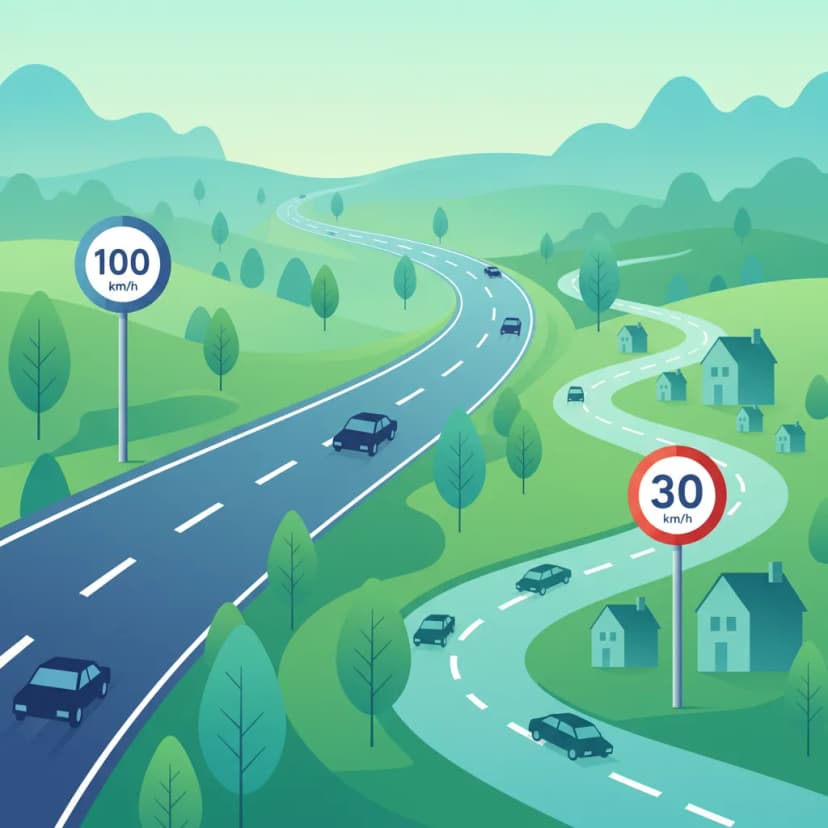
This lesson provides a comprehensive overview of the Swedish national speed limit system. You will learn the default speed limits applicable to different classes of roads, such as 50 km/h in built-up areas and 110 km/h on motorways. It also covers how to identify and comply with special zones, like residential areas (gångfartsområde), school zones, and temporary limits in construction areas, ensuring you always ride at a legal and appropriate speed.
This lesson teaches the physical skill of applying maximum braking force while maintaining control of the motorcycle. You will learn the technique of progressive braking to avoid locking the wheels and how to react if a skid does occur. Understanding how to manage both front and rear wheel skids and how an ABS system assists in these situations gives you the best possible chance of stopping safely and quickly in an emergency.
Find clear answers to common questions learners have about Acceleration, Gear Shifting, and Power Delivery. Learn how the lesson is structured, which driving theory objectives it supports, and how it fits into the overall learning path of units and curriculum progression in Sweden. These explanations help you understand key concepts, lesson flow, and exam focused study goals.
To accelerate smoothly, gradually release the clutch while simultaneously and smoothly increasing the throttle. The goal is to match engine speed to wheel speed as the clutch engages, avoiding jerky movements. Practice is key to finding the perfect balance.
For upshifts, briefly close the throttle, apply pressure to the gear lever, and smoothly release the clutch. For downshifts, briefly close the throttle, use the clutch, blip the throttle slightly to match engine speed for the lower gear, then release the clutch. This blipping technique is essential for preventing rear-wheel lock-up and ensuring a smooth transition.
You should select a lower gear when you need more power for acceleration, such as when overtaking, climbing a steep hill, or exiting a corner. A lower gear keeps the engine in its higher RPM range, where it produces more horsepower.
Failing to blip the throttle during a downshift means the engine speed will be lower than the road speed when the clutch is re-engaged. This causes the drivetrain to slow the rear wheel abruptly, potentially leading to instability, a jerky feeling, or even a rear-wheel skid, especially on slippery surfaces.
Riding in a higher gear at lower RPMs generally leads to better fuel efficiency, as the engine is working less. However, lugging the engine (running at too low an RPM) can be inefficient and cause strain. Choosing the appropriate gear for your speed and load ensures the engine operates within its most efficient range.